

A lot of professional services firms are stuck in the same position. They do excellent work, clients rate them highly, referrals come in, and yet outside their immediate network they're barely visible. The problem usually isn't quality. It's translation.
A managing partner knows the firm's advice is sharper. A founder knows the team has solved harder problems than bigger competitors. But if that expertise only lives in pitch decks, private conversations, or jargon-heavy website copy, the market can't recognise it. Buyers don't choose the best firm on secret merit. They choose the one they understand, trust, and remember.
That's where PR for professional services becomes commercially useful. Not as a vanity exercise. As a disciplined way to turn expertise into authority, authority into trust, and trust into enquiries, referrals, mandates, and resilience when scrutiny arrives.
Beyond Visibility The Real Role of PR in Professional Services
The wrong way to think about PR is “getting us in the press”.
The right way to think about it is building a public version of your credibility. In professional services, buyers can't inspect the work in the same way they can inspect a product. They use signals instead. Media coverage, consistent messaging, strong commentary, visible experts, polished spokespeople, and a reputation for clarity all help reduce perceived risk.
That matters in a mature market. As of March 2021, the UK public relations industry comprised 66,908 practitioners, with the vast majority based in England and Wales, which shows how central PR has become to helping firms convert expertise into media-ready content and manage reputation in competitive markets, according to the CIPR PR population report.pdf).
What trust looks like in practice
A legal practice, accountancy firm, consultancy, planning adviser, or specialist finance business doesn't need empty noise. It needs a reputation that does three jobs:
- Explains expertise clearly: Buyers need to understand what you do without needing an interpreter.
- Signals judgement: Good PR shows how you think, not just what you sell.
- Reduces buyer anxiety: If your name appears in the right places, with the right message, you look safer to instruct.
Strong PR doesn't just help people notice your firm. It helps them feel comfortable choosing it.
This is also why procurement and growth teams increasingly treat communications as part of commercial infrastructure. If you're reviewing routes to market, sector frameworks, or public relations contract bidding, it's worth seeing PR as a strategic buying category rather than an optional add-on.
Why generic PR advice usually falls flat
Professional services firms often get poor advice because the advice isn't built for specialist, regulated, reputation-sensitive businesses. A consumer campaign mindset won't help a tax adviser explain a complex planning issue. A generic social media calendar won't help a law firm partner handle a hostile broadcast question.
The firms that make PR work usually do one thing differently. They apply editorial judgement. They decide what's interesting, what's too technical, what a journalist would cut, what a buyer would remember, and what a regulator or investor might read between the lines.
That's why specialist nature and expertise matter. Carlos Alba Media is run by Carlos Alba, a multi award-winning former national newspaper editor with 20 years in national newspaper journalism, most recently as Editor of Sunday Times Scotland, according to ResilienceWeb's profile of Carlos Alba Media. Everyone who works for Carlos Alba Media is a former national news journalist or has agency experience of working with international brands. That mix matters because professional services PR works best when newsroom judgement meets modern digital execution.
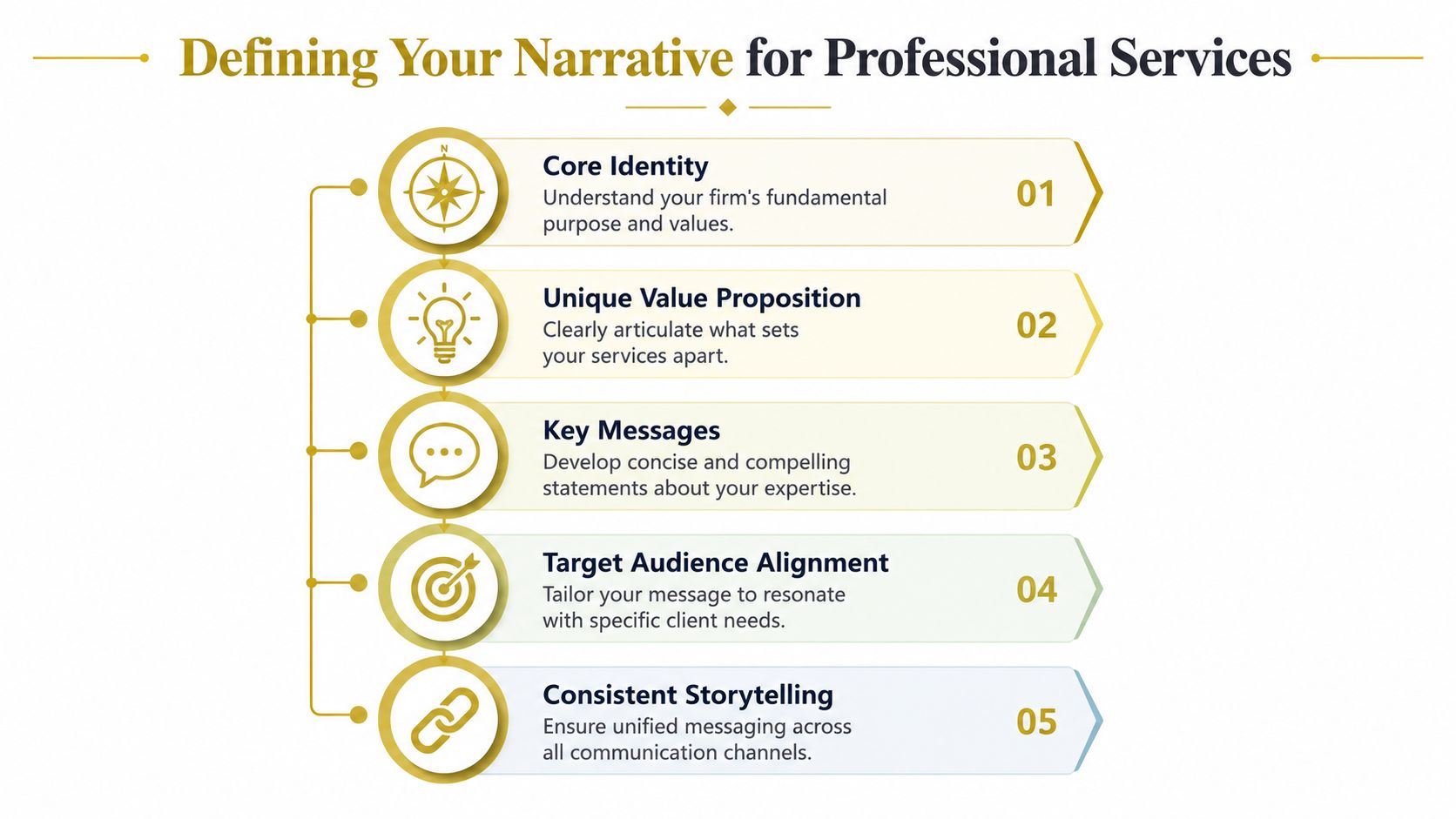
Define Your Narrative Before Someone Else Does
Most firms don't have a visibility problem first. They have a narrative problem first.
The market already says something about your business. Prospects fill in gaps. Competitors frame categories. Search results shape first impressions. Referral partners describe you in their own words. If you haven't defined your position clearly, someone else will do it for you, and they won't do it with much care.
While 78% of UK professional services firms cite differentiation as their main challenge, only 22% successfully convert their technical expertise into narrative-driven stories that resonate with non-expert audiences, as noted in Greentarget's professional services PR analysis. That gap is where good firms disappear.
Start with the problem you solve
Most firms begin with credentials. That's understandable, but it's usually backwards.
Journalists, buyers, and referral partners respond more quickly when you frame your expertise around a recognisable problem. “We advise on regulatory compliance” is accurate but forgettable. “We help owner-led firms avoid expensive regulatory mistakes when they scale” is clearer, more human, and easier to repeat.
Use this test at leadership level:
- What changes for the client because you exist?
- Which pain point keeps showing up in mandates or enquiries?
- What do clients misunderstand before they hire you?
- Where does your judgement beat process-driven competitors?
If your partners give four different answers, your narrative isn't settled.
Turn technical depth into plain-English messaging
A strong narrative doesn't dumb down expertise. It removes friction. That means cutting phrases that sound clever internally but land badly externally.
A useful messaging framework usually includes:
- Core proposition: One plain-English statement of what the firm is known for.
- Supporting proof points: The specific types of work, sectors, or outcomes that support the proposition.
- Audience variants: Slight shifts in wording for clients, referrers, media, recruits, and investors.
- Red-line language: Terms you won't use because they're vague, inflated, or full of jargon.
Practical rule: If a good journalist can't turn your message into a clean intro, your audience won't repeat it either.
Voice matters here as much as message. If you need a practical way to sharpen tone and personality, this guide on how to define your voice with archetypes is a useful starting point. Then pressure-test it against real-world messaging, such as these tone of voice guidelines from Carlos Alba Media.
Find the human angle inside specialist work
The firms that stand out usually know how to answer one hard question. Why should anyone outside your sector care?
That answer rarely sits inside a technical descriptor. It sits inside consequence. Delayed funding. Boardroom pressure. Family business succession. Regulatory exposure. Brand damage. Community impact. Expansion risk. The work may be technical, but the story is usually human.
Here's a simple comparison:
| Weak positioning | Stronger positioning |
|---|---|
| Specialist employment law advice | Helping employers handle workplace disputes before they become reputational problems |
| Tax advisory for growth companies | Helping founders scale without avoidable tax friction |
| Corporate communications consultancy | Helping leadership teams say difficult things clearly when scrutiny rises |
That's the difference between information and narrative. Information describes. Narrative gives the expertise a shape people can understand.
Create Your Thought Leadership Content Engine
Once the narrative is set, you need proof in public. Not more claims. Proof.
Thought leadership content is where many firms either build authority properly or waste months producing bland material nobody reads, shares, or cites. The fix is straightforward. Stop writing what you want to say and start publishing what your market needs help understanding.

Build around real intellectual capital
Good professional services content usually comes from one of four places:
- Client patterns: Repeated issues your team keeps solving.
- Market movement: Regulatory changes, sector shifts, funding trends, labour pressure, or deal activity.
- Operational insight: What goes wrong in practice, not just in theory.
- Leadership perspective: A point of view that a credible senior voice can defend in interview.
The mistake is treating thought leadership like a blog quota. If the content could sit on any competitor's site with a logo swap, it isn't leadership. It's filler.
A stronger model is to create a small library of assets with different jobs.
| Content asset | What it does |
|---|---|
| Opinion article | Shows judgement and a clear point of view |
| White paper | Organises complex information into something buyers can use |
| Commentary note | Responds quickly to breaking developments |
| Case study | Demonstrates method, not just results |
| FAQ page | Answers common buyer questions in searchable language |
For a useful grounding in what qualifies as quality thought leadership, this explainer on what thought leadership content is is worth keeping handy.
Think like a desk editor
An editor doesn't ask, “What do you want to publish this month?” An editor asks, “What's the story, why now, and who cares?”
Use those questions before you commission or draft anything.
- What's the story: Identify the tension, change, problem, or argument.
- Why now: Tie the piece to timing, relevance, or a current debate.
- Who cares: Name the audience precisely. Founder. Managing director. HR lead. Finance director. Investor. Regulator. Referral partner.
If you can't answer all three in one sentence each, pause.
Most weak content fails before the first word is written. The angle wasn't strong enough.
A newsroom approach also improves speed. Instead of waiting for the perfect annual report, firms can produce sharper, smaller pieces anchored in expertise they already have. A partner's client note can become a trade press comment. A webinar can become three article angles. A white paper can become a press briefing, a LinkedIn series, website copy, and a speaking abstract.
Here's a useful example of the mindset in action:
Run an engine, not a random acts calendar
The firms that get traction usually work to an editorial rhythm, not a pile of disconnected tasks.
A practical monthly cycle looks like this:
- Choose one anchor theme linked to your strategic positioning.
- Create one substantial asset such as a guide, paper, or opinion piece.
- Break it into derivatives for social, email, media comments, and sales follow-up.
- Brief spokespeople early so they can talk about the issue consistently.
- Review response from clients, journalists, and referral sources, then sharpen the next angle.
That system does more than fill a website. It creates material your team can pitch, reuse, quote, and build upon.
Master the Art of Media Outreach
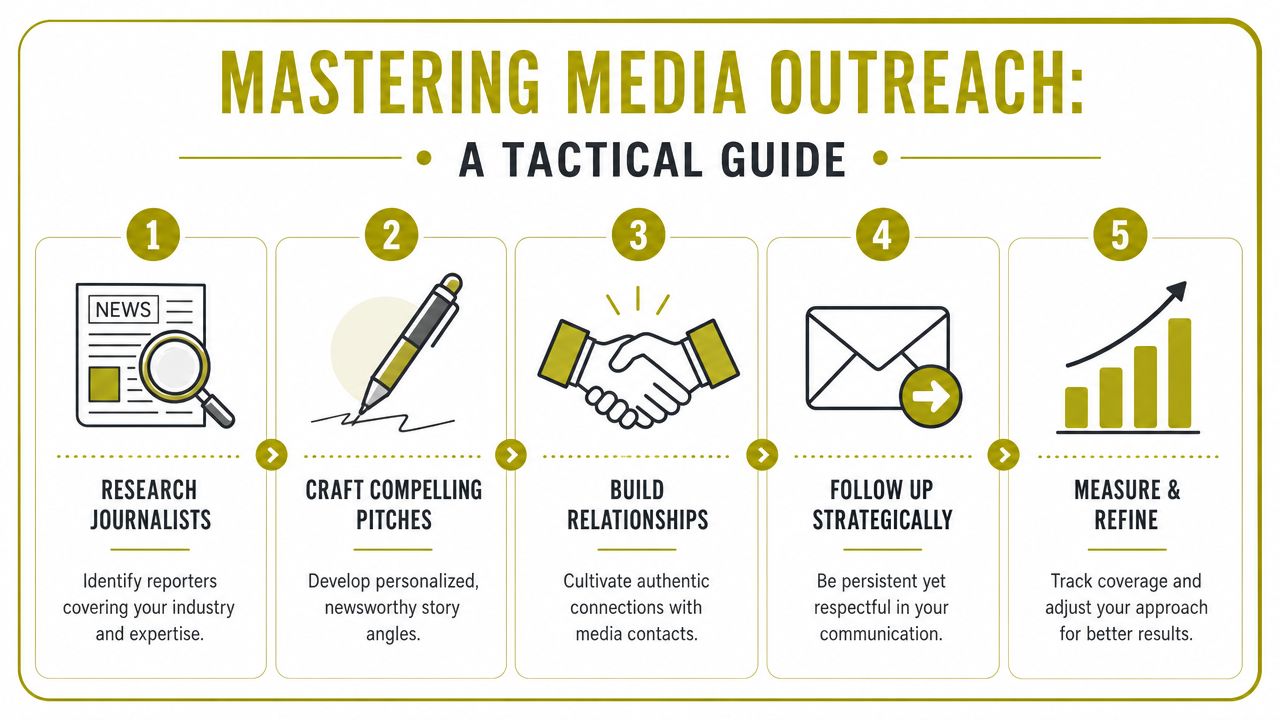
Most media outreach fails for one reason. The pitch is written from the sender's point of view, not the journalist's.
Journalists don't wake up hoping to receive another “just checking in” email about a company that has confused promotion with news. They want relevance, speed, clarity, and access to someone who can say something useful without wasting time. If your outreach ignores that, it goes straight into the bin.
That's why a targeted approach matters. PR pitch success rates in the UK often fall below 5%, and the cost per placement ranges from £830 to £2,500, according to Sapience Communications' professional services PR guidance. Broad, lazy pitching is expensive even before you count the opportunity cost.
Build a list with intent
A media list isn't a spreadsheet of names. It's a judgement call.
For professional services, a useful list normally combines:
- Core trade titles: The places your buyers and peers read.
- National outlets: Used selectively when the issue has broader relevance.
- Broadcast producers: Important when the story has urgency, public interest, or strong spokesperson value.
- Specialist newsletters and sector commentators: Often overlooked, often influential.
The key is fit. A tax restructuring comment won't belong everywhere. A founder dispute, cyber issue, housing trend, tourism development, or regulatory row might travel much further if framed properly.
Write pitches that respect the newsroom
A solid pitch has three jobs. It gets opened, understood, and acted on.
This is the anatomy of a workable email:
| Element | What good looks like |
|---|---|
| Subject line | Specific and timely, not clever |
| Opening line | Why you're contacting this journalist specifically |
| Core angle | One clear story, not three |
| Proof | Data, experience, or informed commentary |
| Ask | Interview, quote, background, or contributed article |
What doesn't work:
- Mass mailing: It signals you haven't done the reading.
- Long introductions: Nobody needs your company history.
- Corporate adjectives: “Leading”, and “award-winning” rarely help a pitch.
- No news value: A service launch isn't news unless tied to a wider issue people care about.
Send fewer pitches. Make each one smarter.
Follow up like a professional
A follow-up should add value, not pressure.
If the first email was sound, a short follow-up can work when you offer a sharper angle, a new timing peg, a stronger spokesperson line, or relevant availability. Re-sending the same generic note with “bumping this up your inbox” is a quick way to annoy people.
Professional services firms often improve outreach when they stop acting like marketers and start acting like useful contributors. That means:
- Be available quickly: Journalists work to deadlines, not your diary.
- Offer commentary, not a lecture: Brevity wins.
- Know your lane: Comment where your expertise is real and defensible.
- Keep relationships warm: Don't only call when you want coverage.
A former editor can spot, within seconds, whether the sender understands how a newsroom works. The best outreach sounds informed, calm, and relevant. It never sounds desperate.
Maximise Your Wins From Interview to SEO
Securing coverage is not the finish line. It's raw material.
Too many firms celebrate a piece of coverage, post it once on LinkedIn, and move on. That wastes the hardest part of the process. Full value appears when you turn one media win into a wider credibility asset across search, sales, social, speaking, and business development.
The market is already moving towards integrated communications. The UK's Public Relations & Communication Activities industry is projected to reach £4.3 billion in 2026, with growth fuelled by integrated services such as digital PR and SEO, according to IBISWorld's UK industry outlook.
Prepare for the interview properly
A good interview starts long before the call, studio booking, or camera light.
Spokespeople need three things ready:
- Message discipline: What are the two or three points that must survive the edit?
- Evidence and examples: What can you say that is useful, clear, and specific?
- Bridging control: How will you handle questions that are too broad, hostile, or beside the point?
The biggest mistake is over-answering. Senior experts often know far too much and try to prove it all at once. Media performance improves when the spokesperson gives a clean answer first, then adds context only where it helps.
Coverage can raise your profile. A disciplined interview can shape your reputation.
Turn one mention into a distribution system
Once coverage lands, use it.
A practical post-coverage checklist looks like this:
- Add the coverage to your website with context about why the issue matters.
- Share it through email to clients, prospects, and referrers who'd find it relevant.
- Repurpose the angle on LinkedIn in the voice of the spokesperson, not just the company page.
- Feed it into sales conversations as third-party validation.
- Use it to strengthen related owned content so your site becomes more useful on the same topic.
Digital PR proves commercially sharper than old-school clipping culture. The value isn't only the mention. It's the chain reaction after it.
If you're building that link between earned media and search performance, this practical overview of B2B SEO Marketing gives a useful framework for how authority content and discoverability reinforce each other.
Make earned media work harder in search
High-quality media mentions can support search visibility, brand credibility, and content authority when they connect back to strong owned pages. That means your website can't be an afterthought.
If a journalist quotes your partner on a specialist issue, your site should already have a credible related page, article, guide, or insight hub. That gives search engines and human readers somewhere to go next. It also makes the PR win last longer than the news cycle.
The strongest firms build an ecosystem. Press coverage supports search. Searchable content supports media pitching. Social proof supports both. That's how PR for professional services moves from reputation support into revenue support.
Build an Armour of Crisis Readiness
Most firms think about crisis communications too late. They start planning when the issue is already live, journalists are asking questions, staff are forwarding screenshots internally, and leadership is trying to approve statements on the hop.
That approach isn't just stressful. It's avoidable.
Despite 91% of UK professional services firms identifying reputation risk as their top strategic threat, 76% lack a crisis communication protocol tested within the last year, and only 14% have provided formal media training for their spokespeople, according to Altitude PR's professional services sector guidance. For regulated firms, that gap is dangerous.
What readiness actually involves
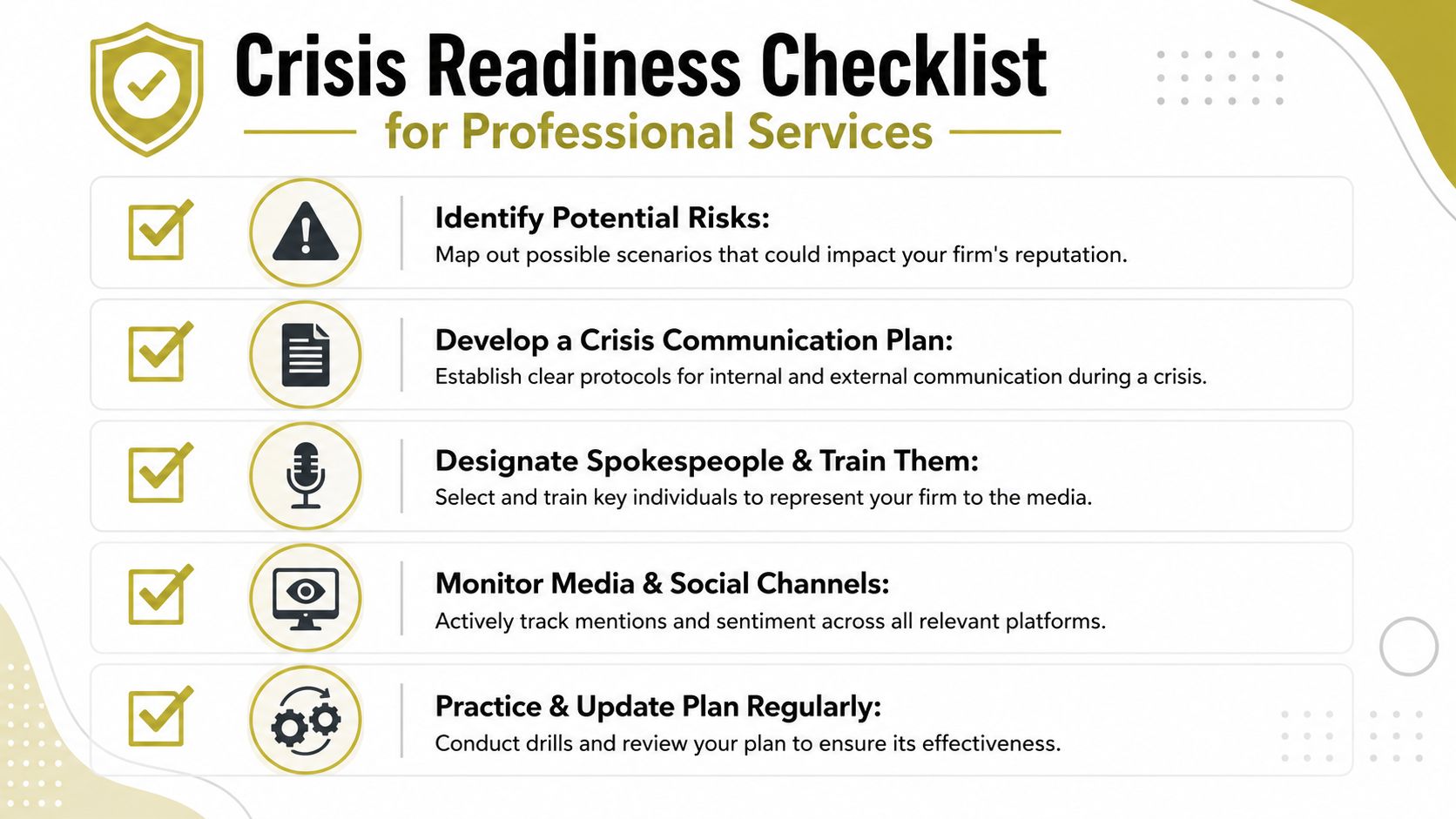
Crisis readiness doesn't mean drafting a dramatic doomsday binder. It means doing sensible professional groundwork before you need it.
A credible plan usually includes:
- Risk mapping: Identify the issues most likely to trigger scrutiny.
- Decision roles: Know who approves, who speaks, and who handles internal communication.
- Holding statements: Prepare short, accurate language for the first response.
- Media handling process: Decide how enquiries are logged, escalated, and answered.
- Training and rehearsal: Test the plan with realistic scenarios.
This is especially important for firms where legal, regulatory, client confidentiality, or reputational exposure can collide in a matter of hours.
Why spokespeople need training before pressure hits
In a difficult moment, knowledge alone isn't enough. Delivery matters.
A technically brilliant partner can still make a weak spokesperson if they ramble, speculate, become defensive, or answer the question they wish they'd been asked. That's why media training belongs inside risk management, not just marketing.
The first response sets the tone. Silence creates a vacuum, and panic fills it badly.
Professional services leaders don't need performance coaching in the theatrical sense. They need disciplined preparation. What can be said. What can't. How to acknowledge concern. How to avoid escalating the story. How to sound steady on camera, on radio, and in writing.
If you want a practical framework to start from, these steps on how to develop a crisis communications plan are a useful reference point.
The firms that cope best don't improvise
When scrutiny arrives, the calmest organisations usually aren't calmer by nature. They're calmer because they've prepared.
That preparation protects more than headlines. It protects staff confidence, client trust, referral relationships, regulator perception, and leadership time. In professional services, your reputation is part of the product. You can't treat it as an afterthought.
Carlos Alba Media brings a rare mix of editorial judgement and modern digital execution to PR for professional services. Founded and run by Carlos Alba Media, the agency is led by a multi award-winning former national newspaper editor, and everyone who works for Carlos Alba Media is a former national news journalist or has agency experience of working with international brands. For SMEs, founders, spokespeople, and established firms that need senior-level counsel without big-agency overheads, that means practical support on media strategy, thought leadership, digital PR, interview training, and crisis communications from people who know exactly how newsrooms and reputations work.