
A lot of founders start in the same place. They have a clear point of view, strong industry knowledge, and a decent microphone sitting in a shopping basket. Then the practical questions arrive all at once.
Who will shape the format? Who will brief guests? Who will fix poor audio from a remote interview? Who will write the episode copy, publish it properly, and make sure the show supports sales, recruitment, partnerships, or PR instead of becoming another abandoned marketing idea?
That is usually the moment a podcast stops looking like a side project and starts looking like a production job.
Beyond the Microphone An Introduction for Founders
A founder in this position does not usually need more enthusiasm. They need a system.
The common mistake is assuming a podcast is mainly about recording. It is not. Recording is the visible part. The harder part sits around it. Editorial planning, guest management, host preparation, audio quality, publishing discipline, and turning each episode into something useful for the wider business all matter more than buying expensive kit.
For SMEs, that gap is where a specialist podcast production agency earns its keep. The agency takes the load that would otherwise land on a founder, an overstretched marketing manager, or whoever happens to be “good with content” in the business.
That matters because podcasting works best when it is tied to business intent. You might want to sharpen market positioning, build credibility in a regulated sector, create stronger founder visibility, or open doors with difficult-to-reach prospects. A podcast can do all of that. It can also fail if nobody owns the process.
A useful primer on podcasting for small business is worth reading if you are still weighing whether the format fits your commercial goals. The key issue is not whether audio is fashionable. It is whether your business can produce a show with consistency and purpose.
Strong podcasts also depend on narrative clarity. If your business cannot explain what it stands for, the show will drift. That is why brand foundations matter before the first episode goes live. This piece on https://carlosalbamedia.co.uk/what-is-brand-storytelling/ is a useful reminder that audiences respond to a coherent story, not a random sequence of interviews.
Tip: If your first thought is “we should start a podcast”, the next question should be “what strategic job will this show do for the business?”
The right partner makes that answer sharper. They do not just help you sound better. They help you sound more relevant.
What a Podcast Production Agency Does
A good podcast production agency is closer to a film crew than a freelance editor. One person rarely does everything well.
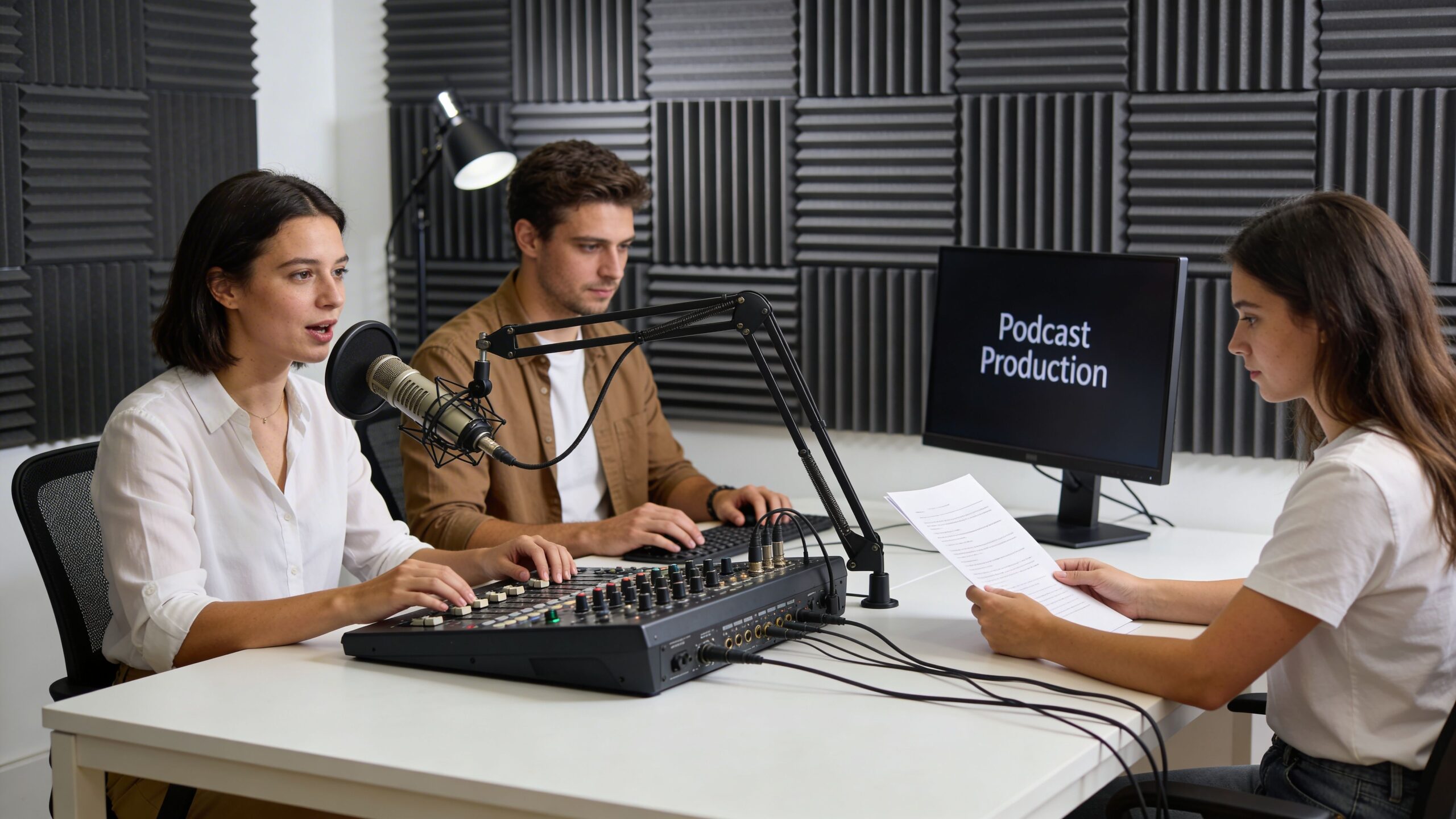
Consider building a house. You need an architect, a builder, wiring, finishes, and inspection. Podcasts work the same way. Strategy comes first. Recording follows. Audio engineering cleans and shapes the material. Editorial assets make it usable. Distribution puts it where audiences can find it.
Strategy before software
Businesses often ask first about microphones, cameras, or studio setup. Those matter, but they are not the foundation.
An agency should help define:
- Show purpose: Is the podcast there to build authority, support lead generation, strengthen employer brand, or create a platform for partnerships?
- Audience fit: A podcast for procurement buyers sounds different from one aimed at founders, investors, visitors, or trade bodies.
- Format choice: Interview show, narrative series, founder commentary, panel discussion, or limited-run branded series.
- Editorial rhythm: Weekly, fortnightly, seasonal, or campaign-led.
Without this layer, the show often becomes a diary of whatever the team could record that week.
Production support during recording
Experienced agencies remove avoidable problems before they become expensive.
They guide hosts on pacing, questioning, and interview control. They prep guests so answers are shorter, clearer, and more useful. They recommend recording workflows for remote and in-person sessions. If the agency has newsroom instincts, they also know how to pull stronger quotes out of a guest instead of accepting vague answers.
Some agencies stop there and pass the raw files into editing. Better ones run the session with editorial intent, so post-production is about improvement rather than rescue.
A practical overview of what buyers should expect from a Podcast Production Service can help if you are comparing offer structures and wondering what belongs inside the scope.
Audio engineering that protects your brand
Many non-specialists underestimate this part.
Professional podcast production agencies use multitrack editing, which means each speaker is cleaned and balanced independently. That matters for interview shows, especially when one person is on a laptop mic and the other is in a treated room.
Professional agencies also work to -16 LUFS, the loudness specification used for platforms such as Spotify and Apple Podcasts, as noted by Rise25. Hitting that standard involves more than turning the volume up. Engineers use tools such as iZotope RX, noise reduction, EQ, compression, limiting, noise gates, and spectral repair to remove distractions and keep audio consistent.
Poor audio does not just sound amateur. It signals weak attention to detail.
The assets around the episode
A finished WAV or MP3 file is not the whole product. Most agencies also handle supporting assets such as:
- Show notes: Clear summaries, key themes, and guest context
- Transcripts: Useful for accessibility, internal repurposing, and search visibility
- Episode titles and descriptions: Important for discoverability and click-through
- Platform publishing: Uploading and formatting for hosting platforms and directories
- Quality control: Reviewing tone, pacing, naming, and consistency before release
Key takeaway: A podcast production agency is not selling edits. It is selling reliability, polish, and a repeatable process that protects your reputation.
When founders understand that, pricing discussions become much easier. They stop comparing an agency to a cheap editing service and start comparing it to a specialist team.
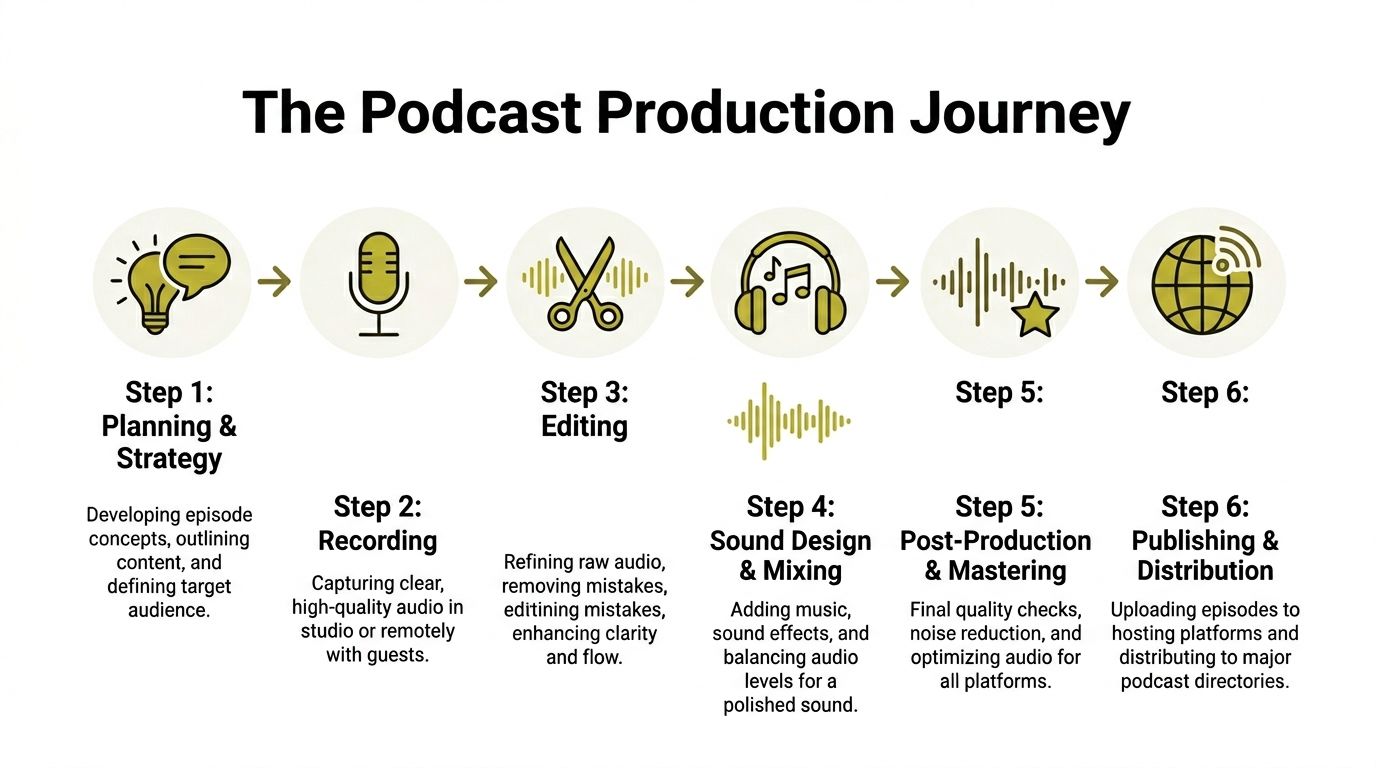
The Typical Podcast Production Workflow
The easiest way to judge a podcast production agency is to look at its workflow. Chaotic agencies create chaotic shows.
The work should move in a clean sequence from idea to release, with clear handoffs and checks. That structure matters even more when hosts, producers, editors, designers, and account leads work remotely.
Pre-production
Pre-production is where expensive mistakes are prevented.
The team agrees the episode objective, angle, guest, and call to action. For interview-led shows, this usually includes research, a guest briefing, host notes, and a recording checklist. A serious agency also confirms practical details such as file naming, permissions, artwork requirements, and turnaround expectations.
This stage sounds administrative. It is not. It is editorial control.
A host who turns up with three generic questions usually gets generic answers. A host with a sharp brief gets moments worth publishing.
Recording
Recording should feel calm because the hard thinking happened earlier.
The producer’s role during the session is partly technical and partly editorial. They watch for clipping, latency, room noise, and dropped connections. They also listen for thin answers, interruptions, and sections that need to be redone while the guest is still present.
Remote recording is now standard for many business shows. The best agencies support it with disciplined setups and contingency planning rather than pretending it is the same as everyone sitting in one studio.
Post-production
Post-production is where the raw material becomes listenable.
Editors remove false starts, repetition, distracting filler, and technical noise. They tighten structure. They smooth awkward transitions. If the show uses music, sonic branding, or section markers, these elements are applied with restraint.
The strongest agencies do not treat post as one pass. They check pacing, consistency, naming, and brand tone. They review the episode again before sign-off.
According to Pro Podcast Solutions, leading agencies use cloud-based digital audio workstations that let multiple team members collaborate on the same project with version control and backup redundancy. That matters in practice. An editor can clean dialogue, a producer can review structure, and another team member can prepare publishing assets without tripping over each other or losing files.
Publishing and distribution
Publishing is where many in-house efforts lose momentum.
The file needs uploading to the host. Metadata needs checking. Episode titles and descriptions need to work for real listeners, not internal stakeholders. Transcripts, artwork, clips, and accompanying copy need to be organised and approved.
A disciplined release process usually includes:
- Final master approval: Audio, naming, guest credits, and links checked.
- Platform upload: Hosting platform settings, scheduling, and distribution confirmed.
- Asset packaging: Show notes, transcript, episode webpage, and social cutdowns prepared.
- Internal circulation: Sales, PR, leadership, and social teams get the assets early enough to use them.
Tip: Ask any agency to show you its workflow in order. If they cannot explain it clearly, they probably cannot run it consistently.
Why this workflow matters commercially
A founder often sees one episode. The agency sees a pipeline.
That difference is important. A good workflow allows the business to batch record, maintain quality across multiple episodes, and avoid the feast-or-famine pattern that kills most branded podcasts. It also gives marketing and PR teams a predictable stream of material they can use.
The best podcast production agency is not the one with the most dramatic sales pitch. It is the one with a process that makes consistent publishing feel boring in the best possible way.
Understanding Pricing Models and What to Expect
Podcast pricing feels confusing when quotes bundle together very different jobs. One proposal may cover editing only. Another may include strategy, recording support, publishing, clips, guest coordination, and reporting.
That is why the model matters as much as the price.
Podcast Production Pricing Models Compared
| Model | Best For | Pros | Cons |
|---|---|---|---|
| Per-episode | Businesses testing a format or publishing irregularly | Flexible, easier to start, useful for pilot runs | Costs can become unpredictable, often narrower in scope, less incentive for long-term planning |
| Monthly retainer | Brands publishing consistently and wanting an external team embedded in workflow | Better continuity, smoother scheduling, easier asset planning, stronger editorial rhythm | Requires commitment, can feel wasteful if internal delays slow output |
| Full-season package | Businesses launching a defined campaign or branded series | Clear scope, strong upfront planning, easier to align with a campaign or product story | Less flexible if the format changes mid-season, can front-load decision pressure |
What changes the quote
A short founder monologue recorded cleanly in one take is cheaper to produce than a multi-guest interview with remote contributors, custom music, transcripts, publishing support, and promotional cutdowns.
Common cost drivers include:
- Format complexity: Solo shows are simpler than panel episodes or narrative series.
- Recording conditions: Clean studio audio takes less repair than mixed remote sources.
- Editorial support: Research, scripting, guest outreach, and host coaching all add value and time.
- Asset volume: Show notes, transcripts, social clips, video edits, and web copy increase the workload.
- Approval layers: The more stakeholders reviewing each episode, the slower and more labour-intensive the process becomes.
How buyers should evaluate value
Founders often ask the wrong budget question. They ask, “What does it cost per episode?” The better question is, “What business function am I outsourcing?”
A quote may be justified if it removes operational drag from your team, protects your brand, and gives your commercial or PR teams useful material to work with. A cheaper option can become expensive if it creates delays, weak episodes, or extra internal work.
There is also a trade-off between flexibility and discipline. Per-episode pricing gives room to experiment. Retainers and season packages tend to produce better consistency because both sides commit to a workflow.
Key takeaway: Cheap editing and full production are not the same purchase. If two quotes look far apart, check the scope before you compare the fee.
What to ask when a quote lands
Before signing anything, ask for clarity on four points:
- Scope boundaries: What is included, and what triggers extra charges?
- Turnaround terms: What happens if recordings run late or approvals stall?
- Asset ownership: Who owns the final masters, raw files, transcripts, and artwork?
- Revision process: How many rounds are included, and who signs off?
A sound pricing model should fit your publishing rhythm, your internal capacity, and the role the podcast plays in the wider business.
The Carlos Alba Media Difference Newsroom Discipline and PR
Many agencies can edit audio. Fewer understand how to turn a podcast into a reputational asset.
That difference matters most for SMEs, founders, and organisations that do not have spare budget for content that sits in isolation. If a show is going to exist, it should support visibility, authority, and media relevance, not just fill a feed.
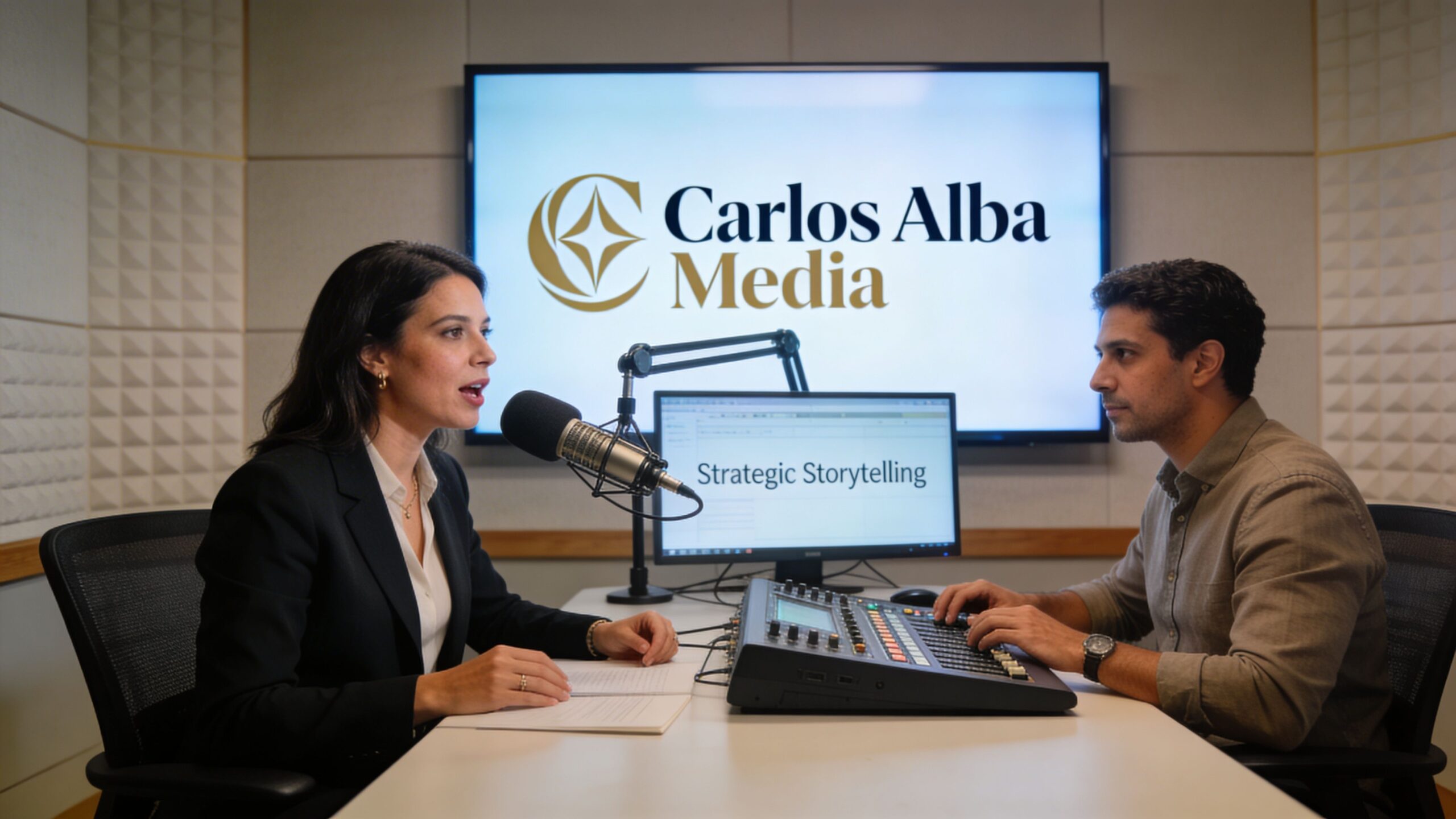
A production house thinks in episodes
A newsroom-trained team thinks in angles.
That sounds subtle, but it changes everything. Former national news journalists and agency professionals approach a podcast with editorial judgement. They ask what is interesting, what is timely, what has a clear point, and what can travel beyond the audio itself into coverage, clips, commentary, and interviews.
This is especially useful for businesses in crowded or technical sectors. It is easy to produce a competent show full of polite conversations. It is harder to produce a show that sharpens positioning and gives the market a reason to pay attention.
PR integration changes the return
For many SMEs, the strongest podcast is not the one with the largest audience. It is the one that creates business opportunities.
A good episode can support media outreach, inform thought-leadership articles, supply talking points for keynote appearances, strengthen executive visibility, and create a bank of owned content the team can reuse. That is where PR and production stop being separate disciplines.
The strategic case is strong. Pacific Content notes that branded podcasts can deliver a 4x ROI for SMEs, while only 15% of Scottish SMEs use podcasts because they often see production as too expensive. The same source also notes that 62% seek integrated media exposure. That gap is important for founders in Scotland and across the UK who want one programme of work to do more than one job.
Why newsroom discipline improves the show itself
Journalists are trained to find the line of the story quickly.
They know how to interview for substance, not just warmth. They know when a guest is dodging the question. They know how to tighten a rambling answer into a useful excerpt. They know how to spot what might make a headline, a quote, or a follow-up media opportunity.
That discipline improves podcast quality long before PR enters the picture.
It also reduces a common problem in branded podcasts. Businesses often talk in approved messaging instead of saying anything memorable. A newsroom mindset pushes past that. It looks for specificity, stakes, and real human texture.
Why this matters in the UK SME market
Large global agencies often pitch podcast production as a premium content product for major brands. Many SMEs need something different.
They need senior people on the work. They need practical delivery. They need a team that understands UK media habits, founder-led businesses, and the reputational pressures that come with operating in visible or regulated categories. They also need a partner that understands how to connect audio with broader media relations.
A useful way to think about that wider discipline is through https://carlosalbamedia.co.uk/what-is-media-relations/. The mechanics of coverage still depend on relevance, timing, clarity, and credibility. A podcast can feed all four when it is planned properly.
Tip: If your agency talks only about downloads, ask what they will do with the ideas inside each episode. The answer will tell you whether they understand PR or just production.
The practical effect for founders
This integrated model changes the founder’s role.
Instead of carrying the whole show alone, the founder becomes the informed voice while the agency acts as editorial producer, technical team, and strategic translator. That is far more sustainable for busy leadership teams.
It also creates advantage. One recording session can produce a polished episode, usable quotes, media angles, internal sales material, social content, and stronger message discipline for future interviews.
That is the kind of output SMEs usually need. Not more content. More value from the content they already have.
How to Choose Your Agency A Buyer’s Checklist
Most agency websites sound capable. The useful differences appear when you ask awkward questions.
Buy like an editor commissioning a series, not like a shopper comparing gadgets. You are choosing a partner that will shape your voice, your reputation, and a recurring part of your public output.

The shortlist test
Before you get on a call, review the basics.
- Relevant portfolio: Have they produced work that resembles your sector, audience, or level of seriousness?
- Clear process: Can you see how they move from briefing to release, or is the offer vague?
- Editorial standard: Do their own podcasts sound well judged, not just technically polished?
- Commercial understanding: Do they talk about outcomes such as authority, sales support, guest strategy, and PR value?
- Senior involvement: Will experienced people do the work, or only appear in the pitch?
If the website is all mood and no method, be careful.
Questions worth asking on the call
Use direct questions that force concrete answers.
- How do you shape the editorial angle of an episode before recording?
- What happens if a guest records with poor sound or drops off mid-session?
- Who edits the audio, and what quality control steps happen before publication?
- How do you handle host coaching for founders who are not natural presenters?
- What supporting assets do you create around each episode?
- How do you measure whether the podcast is helping the wider business?
- What sits outside scope and tends to create extra cost?
- Who owns the raw recordings and final published assets?
A serious agency should answer these without hesitation.
Red flags that usually appear early
Some warning signs are obvious once you know what to look for.
- No strategic questions: If they do not ask about your audience, goals, or commercial context, they are probably selling production in a vacuum.
- Over-focus on gear: Equipment matters, but agencies that lead with kit often underplay editorial craft.
- Unclear approvals: Confusion around sign-off creates delays and weak accountability.
- No guest process: Interview shows fail when guests are not briefed or prepared.
- Thin examples: If they cannot point to work with substance, they may still be learning on your budget.
For businesses that need wider brand visibility, it is also worth comparing podcast capability with broader communications experience. A firm that also understands digital PR, media exposure, and reputation work will often think more strategically about the role of the show. That broader context is reflected in services such as https://carlosalbamedia.co.uk/pr-agency-uk/.
Ask for a sample workflow
Do not just ask what they do. Ask how a single episode moves.
A strong answer should include briefing, prep, recording support, editing, review, publishing, and asset delivery. If the workflow is loose, your publishing schedule will be loose too.
Later in the buying process, this video is useful for framing what a more disciplined decision looks like:
A simple buyer’s checklist
Use this as a final filter before deciding.
- Can they explain your audience back to you clearly?
- Can they improve your thinking, not just execute your instructions?
- Do they have a process for consistency?
- Do their examples sound credible and well edited?
- Will the account be handled by people you trust to represent your brand?
- Do they understand the link between content, reputation, and business growth?
Key takeaway: The best podcast production agency is rarely the cheapest or the flashiest. It is the one that combines technical discipline, editorial judgement, and a process your team can live with.
Conclusion Your Podcast as a Strategic Business Asset
A podcast can look deceptively simple from the outside. Someone speaks into a microphone, an episode appears, and the brand seems active. However, the work is more demanding. Shows that help businesses grow are built on editorial judgement, production discipline, and a clear reason for existing. They are planned properly, recorded cleanly, edited with care, and published with intent. Their impact extends beyond the audio file itself.
That is why a podcast production agency should not be seen as a technical supplier alone. The right partner gives structure to your ideas, protects your brand in the details, and turns each episode into an asset the wider business can use. For founders, that can mean stronger authority, better conversations with prospects, more useful content for marketing, and a clearer public voice.
The bigger point is this. A podcast is not just content. It is a repeatable way to show how your business thinks.
When that thinking is presented well, audiences notice. Prospects notice. Journalists notice. Partners notice. Over time, the show becomes part of how the market understands your brand.
That makes the decision more strategic than many businesses first realise. You are not only choosing how to produce a podcast. You are choosing how your expertise sounds in public.
Frequently Asked Questions
How long does one episode usually take to produce
It depends on complexity, guest setup, and how many approval stages sit inside your business. A straightforward episode usually moves faster than a multi-guest or heavily branded production. The best way to get a realistic timeline is to ask the agency to map the process from recording to release.
Do I own the finished podcast
You should. A reputable agreement should make ownership of final published assets clear. Check whether that also includes raw recordings, transcripts, artwork, and project files.
Can a podcast production agency help with guests
Some can. Some only edit and publish. Agencies with PR and media relations expertise are usually stronger on guest strategy because they understand outreach, positioning, and what makes a guest credible or newsworthy.
Do I need a studio to start
No. Many strong business podcasts begin with a sensible remote setup and tight production discipline. The deciding factor is less about having a studio and more about having a repeatable process that produces clear, reliable audio and strong conversations.
If you want a podcast that does more than fill a content calendar, Carlos Alba Media brings together production, PR thinking, and newsroom discipline in one senior-led offer. The team includes former national news journalists and agency professionals who know how to shape stories that work on air, online, and in front of the media that matters.