
The launch looked modest on paper. A small footprint, a tight run time, a simple audience interaction, and one sharp visual that made people stop, film, and ask what was going on.
That's usually where effective experiential work starts. Not with spectacle for its own sake, but with a clear story, disciplined production, and a built-in reason for people to talk about it after they've walked away.
What Experiential Marketing Really Means in 2026
Experiential marketing in 2026 isn't a dressed-up word for “put on an event”. It's brand storytelling in lived form. The audience doesn't just see the message. They enter it, test it, react to it, and, if you've done the job properly, carry it into their own channels and conversations.
That distinction matters because plenty of brands still confuse activity with impact. They book a venue, build a set, hire a few ambassadors, then wonder why nothing meaningful happens beyond a flurry of photos. Presence alone doesn't create recall. Participation does.

It's not a party. It's a narrative mechanism
The cleanest way to define experiential marketing is this: it turns a brand promise into something people can feel, do, and retell.
A static ad says, “Here's who we are.”
A strong activation says, “Come and experience what that means.”
That's why the best experiential marketing campaigns tend to share a few traits:
- They have a clear point of view. You can explain the idea in one sentence.
- They create useful tension. Surprise, delight, challenge, exclusivity, discovery, or competition.
- They reward participation. The audience gets more than a free tote bag. They get a moment worth sharing.
- They leave evidence behind. Captured content, press angles, data, and follow-up actions.
If you want a practical primer on the broader discipline, this guide on experiential marketing explained is a useful reference point. It helps separate immersive engagement from ordinary event attendance.
The post-pandemic shift changed the discipline
The UK market learned this the hard way. Before the pandemic, the UK events industry was reported to be worth around £70 billion annually, and the Events Industry Forum said in 2020 that 95% of event businesses had experienced a negative impact from the crisis, with 66% reporting losses of 75% or more in turnover, as noted in these UK experiential marketing statistics.
Those figures matter because live activations, pop-ups, exhibitions, and event-led brand work sit inside that wider events economy. When the sector contracted, brands had to rethink what an activation looked like. Hybrid formats, digital extensions, remote participation, and content-first planning stopped being optional extras and became part of the brief.
The most resilient campaigns now work in two places at once: on the ground and in the feed.
At Carlos Alba Media, that shift fits how we already think. Everyone in the team is either a former national news journalist or has agency experience working with international brands. That changes the planning. We don't treat an activation as a one-off production day. We look for the story thread that can travel beyond the site itself, because an experience with no wider narrative usually dies where it happened.
Why this is more accessible than many SMEs assume
Smaller brands often rule themselves out too early. They assume experiential means big city takeovers, giant fabrication budgets, celebrity drop-ins, and long lead times.
It doesn't.
A compact activation with a precise audience fit often outperforms an expensive one with a vague purpose. If the concept is tight, the setup is frictionless, and the story is easy to grasp, you can create disproportionate impact without trying to impersonate a global drinks brand at a festival.
That's the standard in 2026. Not bigger. Sharper.
Building Your Campaign's Strategic Foundation
Creative teams like to start with the fun bit. That's a mistake. If the brief is muddy, the idea usually turns into an expensive compromise that tries to satisfy everyone and persuades no one.
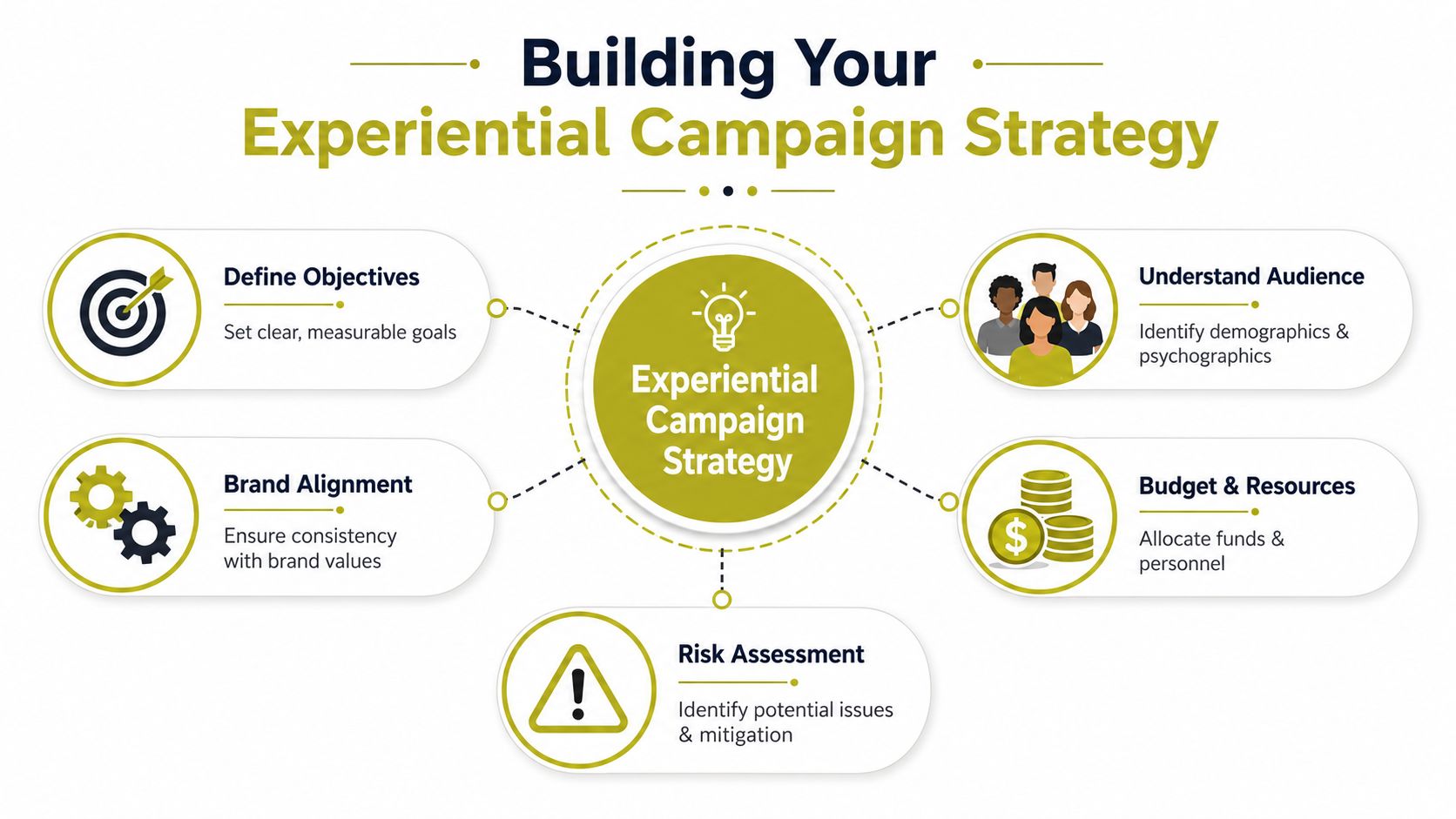
The strategic foundation comes down to two decisions. What must this campaign achieve, and who must it matter to? Everything else sits underneath those answers.
Set objectives that can survive scrutiny
A lot of briefs use soft language because it sounds safe. “Raise awareness.” “Create buzz.” “Drive engagement.” None of that is useless, but none of it is sufficient either.
For experiential marketing campaigns, SMART thinking works well if you adapt it to physical reality. The goal shouldn't just describe a feeling. It should describe an observable outcome. If your team can't tell whether the activation worked without arguing about it afterwards, the objective wasn't set properly.
A useful way to pressure-test objectives is to ask:
| Question | What a strong answer sounds like |
|---|---|
| What action matters most? | Trial, sign-up, demo interaction, media pickup, retailer conversation, lead capture |
| Who must take it? | A named audience segment, not “everyone in London” |
| Where will it happen? | Specific venue type, city, route, or community setting |
| How will you know? | On-site scans, forms, surveys, post-event conversion signals |
| What would failure look like? | Wrong audience, weak throughput, poor dwell, no follow-up path |
That's also where a proper communications strategy becomes useful. Experiential work shouldn't sit in isolation from your wider PR, digital, social, and sales messaging. If the campaign says one thing but your press line, website copy, and follow-up emails say another, people feel the disconnect immediately.
Audience research needs more than demographics
Demographics tell you who someone is on paper. They rarely tell you why they'll stop, interact, share, or buy.
The operational questions are more revealing:
- What interrupts them? A challenge, a personalised result, a practical reward, a social proof moment?
- What do they mistrust? Sales scripts, over-designed brand theatre, forced UGC prompts?
- What context are they in? Commuting, browsing, networking, shopping, waiting, celebrating?
- What would feel useful rather than intrusive? Sampling, advice, entertainment, participation, exclusivity?
A B2B founder at an industry expo behaves differently from a family in a shopping centre or a student at a campus pop-up. The same core brand can't speak to all of them in the same way.
Practical rule: If your audience insight could describe half the market, it isn't insight yet.
Align the activation with the brand you actually are
Some campaigns fail because the idea isn't bad. It's just from the wrong brand.
A cautious financial services firm doesn't need to imitate a streetwear launch. A heritage hospitality brand doesn't need a gimmicky tech layer to look modern. The strongest activations feel inevitable once you see them. They express the brand's character in a physical setting.
Use this quick test before approving a concept:
- Would this still make sense if the logo were covered?
- Does the experience prove the message, not just repeat it?
- Will the people attending recognise themselves in it?
- Can sales, PR, and social teams all use the same central idea afterwards?
If the answer is no to two or more, the foundation needs more work. Better to catch that in planning than on install day.
Developing a Memorable Creative Concept
Bad experiential ideas usually fail in one of two ways. They're either overbuilt and under-thought, or they're technically neat but emotionally flat. In both cases, the audience walks through them without feeling much, and that's fatal.
A memorable concept starts with one thing. The hook. Newsrooms live on hooks. Why this story, today, for these people? The same test applies to experiential marketing campaigns. Why would anyone stop? Why would they tell someone else? Why would a camera turn up?
Start with the brand tension, not the prop list
Teams often brainstorm backwards. They start with “Could we build a tunnel?”, “Should we use AR?”, or “What if we gave away samples from a branded van?” Those are production choices, not concepts.
Start with the tension inside the brand instead:
- A product people don't yet understand
- A category that feels dull or overfamiliar
- A brand claim that needs proof
- A customer frustration you can dramatise
- A cultural moment you can enter without forcing it
That tension gives you the central idea. The execution comes later.
A useful exercise is to write three short lines before any creative workshop:
- What do people currently think?
- What do we need them to feel?
- What can they physically do that closes the gap?
That sequence produces stronger work than beginning with mood boards.
Judge ideas like an editor would
At Carlos Alba Media, our team's former journalism background changes how we score creative routes. We don't just ask whether something looks good in a render. We ask whether it has a compelling angle, whether the human reaction is visible, and whether the story can be understood at a glance. That's the same instinct behind effective brand storytelling.
Here's a sharper way to evaluate options:
| Test | Weak concept | Strong concept |
|---|---|---|
| Clarity | Needs a paragraph to explain | Makes sense in seconds |
| Participation | People watch | People do something |
| Emotional pull | Nice visual | Genuine reaction |
| Shareability | Generic photo wall | Built-in retell value |
| Media potential | No obvious angle | Clear image, tension, or local relevance |
Simple often beats elaborate
A compact idea with disciplined execution usually lands harder than a sprawling one with too many moving parts. Audiences don't award points for operational complexity. They respond to clarity.
For example, one straightforward interaction can do serious work if it:
- demonstrates the product
- gives people a personalised outcome
- creates a visible reaction
- leaves behind a useful content asset
- fits naturally with the setting
That's enough. You don't need a carnival of touchpoints if one decisive experience does the job.
If people can't explain the activation to a friend in one breath, the concept is carrying too much weight.
Build for participation, not admiration
There's a difference between an activation that people admire and one they enter. Admiration produces a glance. Participation produces memory.
When shaping the final concept, stress-test these points:
- Entry friction. How quickly can someone understand what to do?
- Social permission. Will they feel comfortable taking part in public?
- Pacing. Does the interaction move cleanly, or does it bottleneck?
- Narrative arc. Is there a beginning, reveal, and payoff?
- Afterlife. What leaves the event with them, digitally or physically?
The best creative concept is rarely the most decorative. It's the one that gives the audience a role and gives the campaign a story worth repeating.
Managing Logistics Legal and Staffing
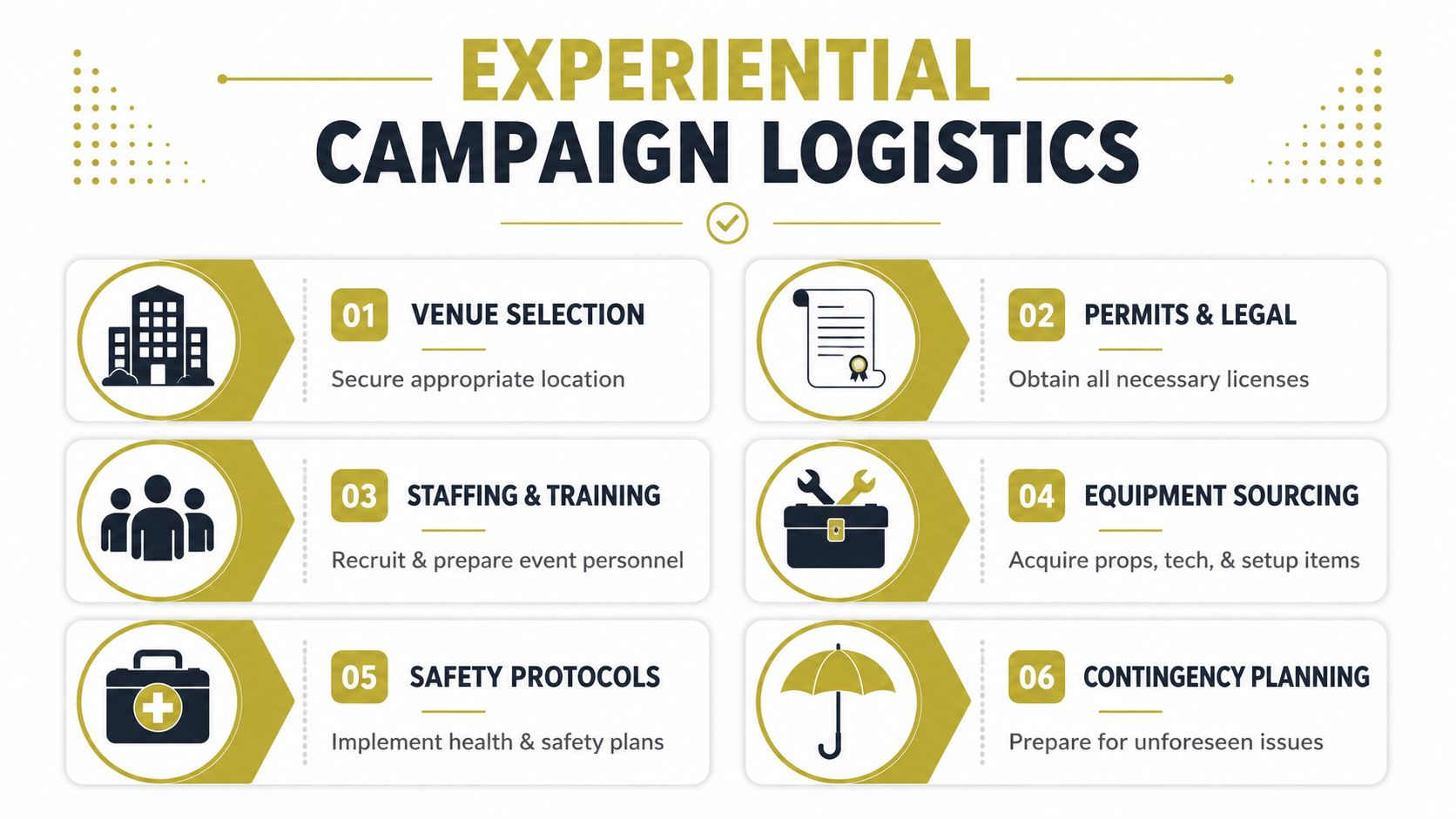
Execution is where a lot of promising ideas come unstuck. Not because the concept was wrong, but because someone underestimated the boring parts. Venue constraints, permits, insurance, load-in windows, power access, queue management, staffing gaps, wet weather, poor briefings. How these elements are managed determines whether campaigns become professional or become fragile.
The practical workflow matters. A UK-oriented approach outlined by Exhibitus recommends starting with audience research, defining SMART goals and KPIs, pre-testing the activation with a representative subset, instrumenting the event for measurement using sign-ups, surveys, or QR codes, then reviewing the data afterwards. The same guidance flags unclear goals and poor compliance or safety planning as common failure points in experiential work, as set out in this piece on avoiding experiential marketing pitfalls.
Production planning that holds up on the day
You don't need a bloated process. You do need a disciplined one.
These are the operational checkpoints that deserve attention early:
- Venue suitability. Footfall matters, but so do access, power, storage, sound restrictions, and weather exposure.
- Permissions. Public spaces, shopping centres, transport hubs, and private estates all work differently. Ask early, not late.
- Insurance position. Public liability, supplier cover, and contractor documentation need checking before anyone arrives on site.
- Technical dependencies. Wi-Fi, mobile signal, charging, screen brightness, lighting, and backup power can all break an otherwise sound idea.
- Data capture setup. If the campaign needs sign-ups or scans, test the devices and flow under live conditions.
A venue can look perfect in a deck and still fail in reality. I've seen activations compromised by loading routes nobody checked, acoustic bleed from neighbouring spaces, and simple queue pinch points that made the whole experience feel chaotic.
Legal and safety decisions aren't admin
Brands often treat legal and compliance work as if it's there to slow down creativity. It isn't. It protects the campaign from becoming a reputational problem.
You need clear ownership over:
- permits and licences
- risk assessments
- public liability requirements
- safeguarding where relevant
- accessibility
- emergency procedures
- contractor responsibilities
For teams handling public activations, this guide to event safety and crowd control is a sensible reference for thinking through movement, entry points, bottlenecks, and incident planning.
The audience never thanks you for flawless compliance. They definitely notice when it's missing.
Budget where the campaign actually lives or dies
The most common budgeting error isn't spending too much on fabrication. It's underfunding the invisible parts that make the experience work.
A practical budget should account for:
- Pre-production such as site visits, permissions, testing, and rehearsals
- On-site delivery including crew, transport, install, derig, and staff cover
- Measurement tools like QR assets, forms, tablets, and CRM workflow
- Contingency for weather, replacement equipment, timing shifts, or access issues
If budget pressure hits, protect the audience experience first. Cut decorative extras before you cut staffing, safety, or the data capture mechanism.
Staff are part of the experience
Brand ambassadors shouldn't just recite a script and point at a display. They are the live interface between the idea and the audience.
Train them on four things:
- The story. What the campaign is really about in plain language.
- The behaviour. How to approach, when to hold back, how to read hesitation.
- The mechanics. Devices, queue flow, troubleshooting, escalation.
- The press posture. Who handles media questions, who doesn't, and what to do if cameras arrive.
That last point matters more than many brands realise. A staff member can either preserve the campaign narrative or derail it in ten seconds. Rehearse awkward questions. Rehearse handovers. Rehearse the first line they use when someone asks, “So what's this all for?”
When logistics, legal checks, and staffing are handled properly, the activation feels effortless. That's the standard. Not perfection in theory. Control in reality.
Amplifying Your Campaign with PR and Media
A live activation that only reaches the people who physically attended is leaving value on the table. That's the hard truth.
The strongest experiential marketing campaigns are designed to produce two outcomes at once. They create a worthwhile in-person experience, and they generate a story that can travel through press coverage, social clips, creator content, stakeholder updates, and post-event assets. If you ignore the second part, you cap the campaign too early.
Think like an editor before you think like a promoter
Editors don't care that your brand has spent time and money on a build. They care whether there's a story.
That usually means at least one of these angles is present:
- a strong visual
- a local relevance hook
- a timely cultural connection
- a surprising public reaction
- a clear first, biggest, or only-in-this-context proposition
- an issue-led narrative that gives the activation a wider meaning
Former newsroom experience provides an advantage. A journalist doesn't ask, “How do we get coverage for the event?” They ask, “What's the actual story, and why would anyone run it today?” That discipline strips away weak ideas quickly.
If your campaign has no angle beyond “brand does pop-up”, it won't travel far.
Build pre-event momentum properly
PR shouldn't begin when the doors open. Good campaigns create anticipation before anyone arrives.
That can include:
- targeted media outreach to relevant desks and regional titles
- advance photography or concept visuals
- short spokesperson lines that frame the story crisply
- embargoed previews where appropriate
- social teasers that reveal enough to create curiosity, not confusion
A broader public relations campaign often works best when experiential sits inside it, rather than beside it. The activation becomes one proof point in a wider communications push, not a disconnected stunt.
Create a media moment on site
Photographers and camera crews need more than access. They need a reason to point the lens.
That usually comes from one of three things:
- A visual reveal that happens at a set time
- A human interaction with visible emotion or surprise
- A public participation element that shows scale, movement, or contrast
A practical mistake brands make is allowing media opportunities to emerge by chance. Don't. Script them. If there's a reveal, time it. If there's a spokesperson, brief them. If there's a participation beat, make sure the setting is camera-friendly and uncluttered.
Coverage rarely comes from the general atmosphere. It comes from one usable moment.
Give the story an afterlife
The campaign isn't finished when the structure comes down. That's when the second half begins.
You should leave the event with:
- edited photography for press and owned channels
- short-form video clips with captions ready for distribution
- attendee reactions and testimonials, where appropriate
- follow-up comments from the brand
- a clear internal summary for sales, leadership, and partners
This is also where user-generated content can do real work, if the campaign gave people something worth posting. Forced hashtags and clumsy “share now” prompts don't create momentum. Distinctive experiences do.
From a practitioner's point of view, this is often the biggest gap between average and effective experiential work. Average campaigns focus on attendance. Strong campaigns focus on narrative multiplication. They understand that the event is the source material, not the finish line.
Tracking KPIs and Proving Your Campaign's ROI
If a campaign can't be measured, it becomes vulnerable in the next budget meeting. That's the practical reality for SMEs and larger brands alike.
Experiential marketing campaigns often get judged unfairly because teams either track too little or present the results badly. They report footfall without context, social mentions without quality, or warm anecdote without commercial follow-through. None of that is enough. You need a measurement plan that starts before the activation and ends after the sales and PR signals have had time to show themselves.
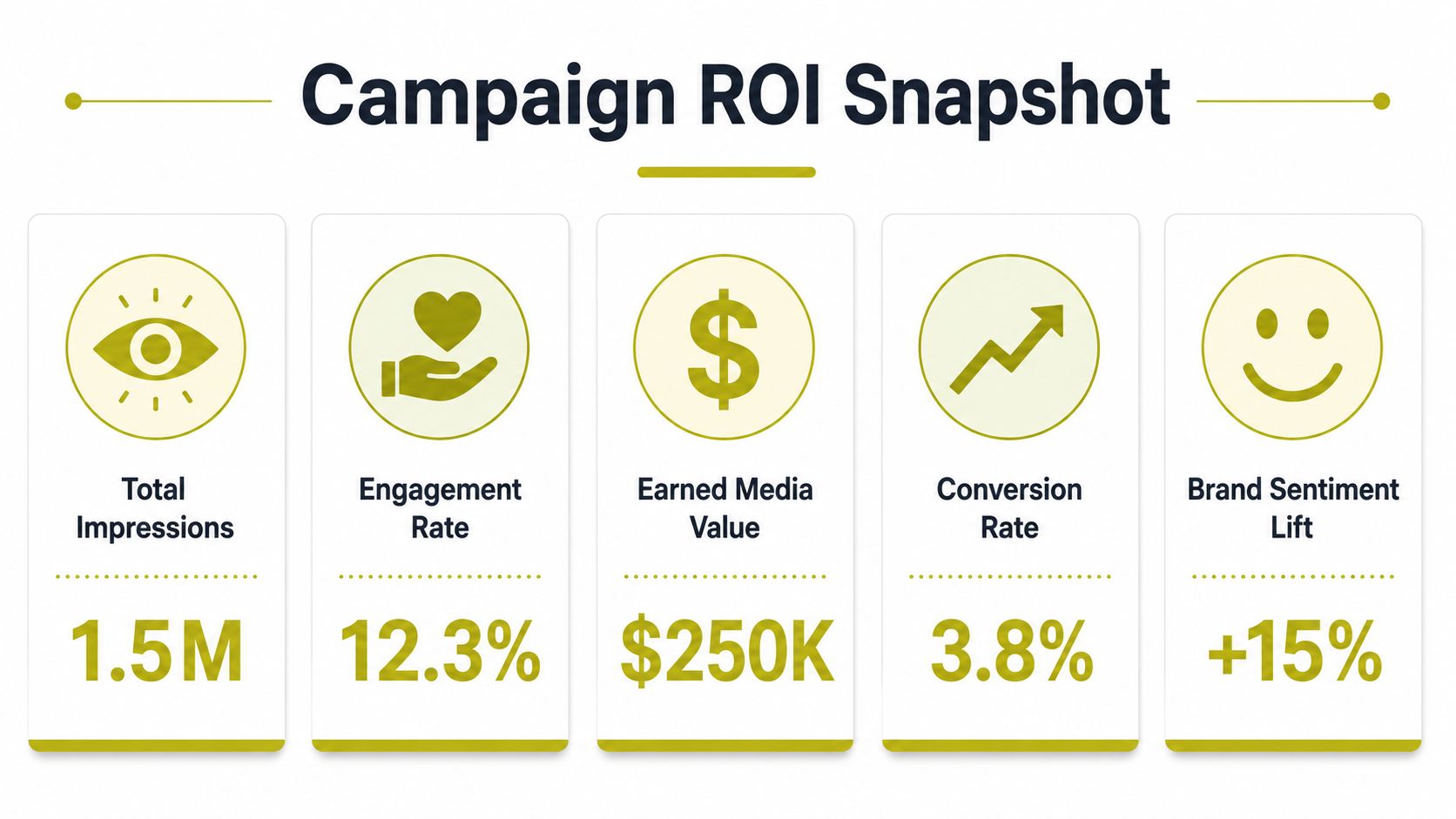
Start with the benchmarks that are useful. A survey of more than 200 marketing professionals cited average experiential event ROI at 25–34%, while 91% of consumers reported being more likely to buy after participating in a brand activation. The same source recommends tracking foot traffic, dwell time, demo interactions, lead capture, post-event conversion, and social amplification, with multi-touch attribution via CRM and GA4 as the strongest method for proving impact, according to this guide on how experiential marketing ROI works.
Track behaviour, not just presence
Attendance is a starting point. It isn't proof of business value.
A stronger KPI stack usually includes a mix of:
- Foot traffic. How many people entered the activation area or approached the unit.
- Dwell time. Whether they stayed long enough to absorb the message.
- Interaction quality. Demo completions, participation rates, or meaningful conversations.
- Lead capture. Email sign-ups, QR scans, app actions, or form completions.
- Post-event movement. Site visits, booked calls, purchases, or retailer follow-up.
- Social amplification. Earned shares, creator posts, audience content, and sentiment.
- Media outcomes. Coverage secured, message pull-through, spokesperson visibility.
Not every campaign needs every KPI. A product trial activation and a reputation-led public installation won't share the same primary measure. What matters is matching the metric to the job.
Instrument the campaign before launch
If you wait until the event is live to think about measurement, you've already weakened it.
Use tools that are simple enough for the audience and capable enough for the reporting:
- QR codes linked to unique landing pages
- digital forms on tablets
- event-specific UTMs
- CRM tags for campaign-origin leads
- on-site surveys with a short completion path
- a clear process for staff to log interaction types
This short explainer is also useful for anyone wrestling with understanding marketing ROI challenges, especially where multiple touchpoints affect conversion and no single channel deserves all the credit.
Here's a practical split between weak and strong measurement:
| Weak setup | Strong setup |
|---|---|
| Counts people vaguely | Distinguishes passers-by from participants |
| Tracks likes only | Tracks actions tied to business outcomes |
| Leaves data in separate tools | Connects event data to CRM and analytics |
| Reports immediately and shallowly | Reviews immediate, short-term, and follow-up signals |
| Uses vanity screenshots | Uses stakeholder-ready summaries with context |
The video below gives a useful visual perspective on measurement and campaign thinking in this area.
Present the results like a decision-maker would
Senior teams want a clear answer to three questions:
- What happened?
- What did it mean?
- What should we do next?
That means your reporting should separate output from outcome. Output is what the campaign produced. Outcome is what changed because of it.
A crowded activation can still be a weak campaign if it attracted the wrong audience and produced no next step.
A clean post-campaign summary should include:
- the original objective
- the KPIs attached to that objective
- what the audience did
- PR and content results
- lead and conversion signals
- operational lessons for the next activation
If you need external support, Carlos Alba Media is one option for brands that want PR, content, and measurement thinking connected rather than handled in separate silos.
The final discipline is honesty. Don't inflate, don't blur, and don't hide the misses. If dwell time was strong but sign-up flow was weak, say that. If the media angle landed better than the sales mechanism, say that too. Useful reporting doesn't just defend spend. It improves the next round.
If you're planning experiential marketing campaigns and want the live experience to generate press interest, stronger storytelling, and measurable follow-through, Carlos Alba Media can help shape the concept, media angle, and campaign structure from the start.