
You’ve probably felt this already. The business is solid, the service is strong, clients are happy, but online you still look quieter than competitors with half your substance and twice your noise.
That’s common in Edinburgh. A firm can have a real reputation in its sector, strong referrals and a decent website, then still lose attention in search, social and media because the marketing is fragmented. One supplier handles paid ads. Another posts on LinkedIn. Someone else “does SEO”. Nobody owns the full picture.
That’s where choosing the right edinburgh digital marketing agency matters. The difference isn’t just technical skill. It’s whether the agency can connect visibility, credibility and conversion so your marketing supports growth.
For Scottish SMEs, that often means looking beyond agencies that only sell channels. The more useful partner is the one that understands how people discover a business, why they trust it, and what makes them act.
Beyond the Royal Mile Why Your Business Needs a Local Digital Partner
An Edinburgh business can feel invisible even when it’s doing good work.
A founder in tech might have a strong product but struggle to explain it in plain language. A hotel group may rely too heavily on seasonal demand. A legal or financial firm may need visibility but can’t afford clumsy messaging in a regulated market. In each case, the problem isn’t effort. It’s alignment.

A local partner sees the context faster. They understand the mix of Edinburgh’s business base, from tourism and hospitality to professional services, scale-ups and public-facing brands. They know that “more traffic” isn’t the brief. Better enquiries are.
Local knowledge changes the brief
A national agency might give you a polished deck and a standard channel plan. That can work for broad consumer campaigns.
It often works less well when your business needs nuance. Edinburgh firms frequently need one or more of these:
- Regional credibility: You need to speak to Scottish audiences without sounding forced.
- National reach: You want coverage or search visibility beyond the city.
- Reputation control: One weak message can create problems with customers, stakeholders or regulators.
- Senior judgement: You don’t need layers of account handling. You need clear calls on what to do next.
That’s why many owners stop seeing agency support as a marketing cost and start seeing it as commercial infrastructure.
Practical rule: If your agency can’t explain how press coverage, search visibility, landing pages and lead quality connect, you’re buying activity rather than strategy.
Value isn’t more content
Most SMEs don’t need more posts, more blogs or more jargon. They need a partner who can prioritise.
Sometimes that means fixing technical SEO before spending another pound on ads. Sometimes it means reshaping the offer on your homepage because the traffic is fine but the messaging is weak. Sometimes it means handling a sensitive issue in public before it damages trust.
That local, joined-up approach is what separates a supplier from a growth partner. If you’re weighing options, a useful starting point is to look at what a marketing agency in Edinburgh should deliver in practice, not just what it lists on a services page.
What an Edinburgh Digital Marketing Agency Does
A proper agency doesn’t sell disconnected tasks. It builds a system.
Think of your marketing as a route through a city. SEO is the signposting that gets people to the right street. PR is the trusted recommendation that makes them believe your business is worth their time. Paid media puts you in front of the right people quickly. Website UX decides whether they walk in or keep moving.
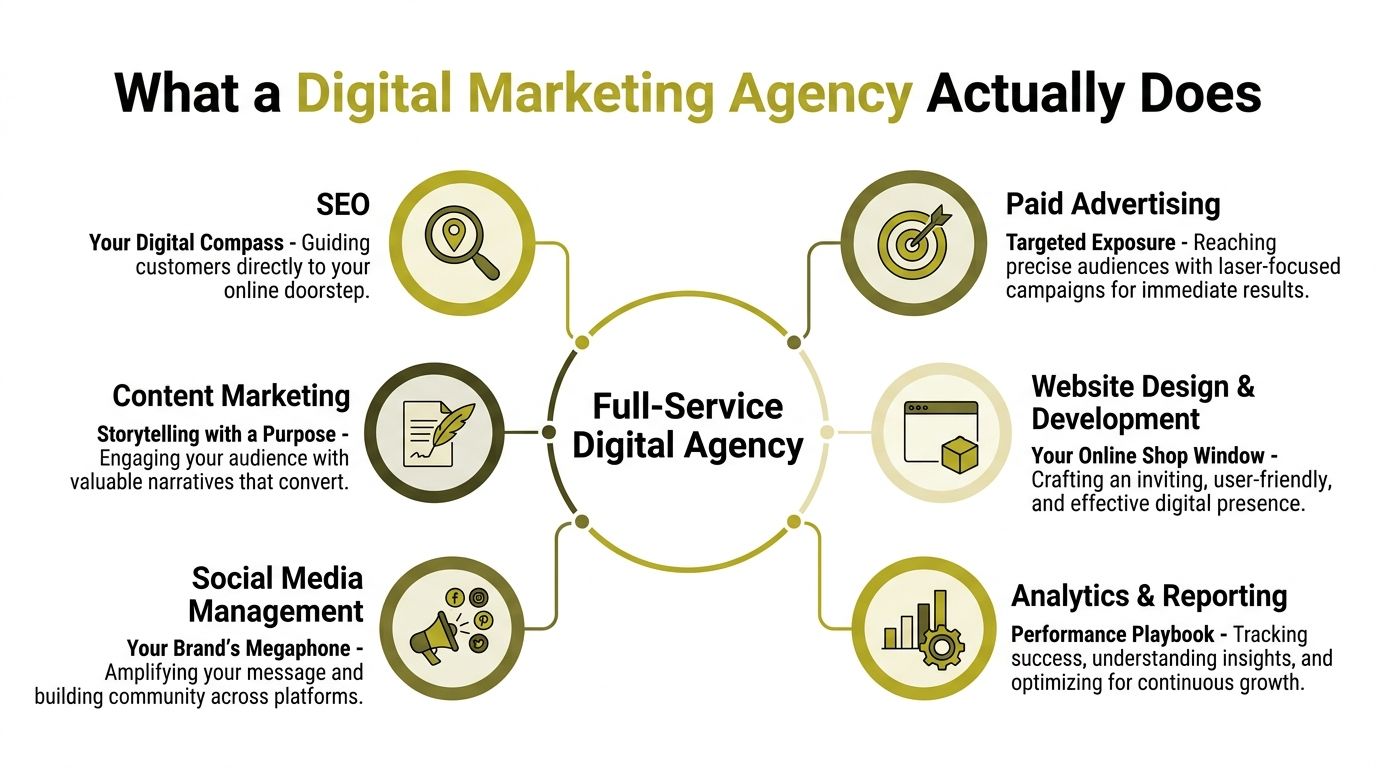
Agencies that create value don't treat these as separate departments with separate agendas. They make each part support the next.
Strategic PR and media exposure
PR still gets misunderstood. Many firms think it means press releases. It doesn’t, at least not in any useful sense.
Strong PR answers harder questions. What’s the story? Why now? Why should anyone outside your business care? Which angle belongs in trade media, which belongs on LinkedIn, and which should be turned into comment for broadcast or online news?
For an SME, PR does three jobs at once:
- Builds trust: Independent coverage carries a different weight from brand copy.
- Clarifies positioning: A business with a clear story is easier to sell.
- Supports search and content: Media coverage often strengthens branded search, authority and on-site content planning.
Technical SEO and content
SEO isn’t magic. It’s structured clarity.
Search engines need to understand what you do, who you do it for, and why your pages deserve to rank. That means the basics have to be in place. Site architecture, page intent, internal linking, metadata, crawlability, content depth and local signals all matter.
The common mistake is chasing blog volume without fixing fundamentals. If your service pages are thin, your navigation is messy, and your site loads poorly on mobile, publishing more articles won’t rescue the problem.
A practical agency will usually start by checking areas such as:
| Area | What matters |
|---|---|
| Site structure | Clear hierarchy, sensible navigation, pages built around search intent |
| Content quality | Useful service pages, relevant supporting content, consistent messaging |
| Local visibility | Edinburgh relevance where it helps, without stuffing locations everywhere |
| Measurement | Proper reporting on leads, enquiries and page performance |
If you’re reviewing workflow options or stack choices, this round-up of best digital marketing agency tools is useful because it shows how agencies handle research, reporting, content and automation in practice.
Website performance and conversion
Your website isn't a brochure. It’s a sales environment.
A good agency looks at where users hesitate, where pages leak attention and where calls to action fail. Sometimes the issue is design. Sometimes it’s copy. Often it’s both.
What works is usually less glamorous than people expect. Cleaner service pages. Sharper value proposition. Better proof. Fewer distractions. More obvious next steps.
A beautiful site that doesn’t convert is still underperforming.
Social media and paid advertising
Social media should have a job. If it’s only there to prove the business is active, it’s probably wasting effort.
For some Edinburgh SMEs, social content is best used to show expertise, reinforce credibility and support remarketing. For others, especially hospitality, events or consumer-facing brands, it can also drive direct action.
Paid advertising is different. It’s speed with a budget attached. Google Ads captures active demand. Paid social can create attention earlier in the buying cycle. Both need disciplined targeting, message testing and landing pages that match the promise of the ad.
Crisis communications
This is the service many businesses ignore until they need it.
A complaint, executive issue, supply problem or reputational flashpoint can spill from social to search results and media enquiries quickly. When that happens, “we’ll draft something tomorrow” isn’t a plan.
A serious edinburgh digital marketing agency should know how to hold a line publicly, protect trust and stop digital channels from amplifying confusion.
Choosing the Right Agency Beyond a Pretty Website
A polished homepage tells you almost nothing.
Most agencies can present well. The harder question is whether they can think clearly under pressure, understand your market, and connect communications to commercial goals. That’s where many buying decisions go wrong.
Start with how they think
Ask an agency how they’d approach your business in the first month. Don’t ask for ideas you can take away for free. Ask how they diagnose problems.
Useful answers usually include questions about your customer journey, current lead sources, brand perception, search performance, conversion path and internal capacity. Weak answers jump straight to outputs.
Watch for these signs:
- They lead with channels: “You need SEO, PPC and socials.” Maybe. But why, in that order?
- They avoid trade-offs: Every decision in marketing has one. Budget spent on rapid lead generation isn’t being spent on longer-term authority.
- They talk only about reach: Visibility matters, but relevance matters more.
Generalist or specialist
Some firms need a broad agency. Others need a sharper edge.
If you’re a founder-led business, a regulated company, or a brand that may face media scrutiny, specialist judgement matters more than breadth. You need people who can write under pressure, understand reputational consequences and shape messaging that survives public attention.
That matters in Scotland because many SMEs still haven’t solved the gap between visibility and credibility. A 2025 UK SME Digital Marketing Report by the Federation of Small Businesses says 62% of Scottish SMEs struggle with integrated PR-digital strategies, and only 28% achieve national media exposure via digital channels, compared with 45% in London (redskydigital.co.uk). That isn’t just a stat. It points to a structural weakness in how many agencies package their services.
Why integration matters
A business can rank well and still look unconvincing. It can earn media coverage and still fail to convert visitors. It can run paid ads efficiently and still send traffic to a weak page.
That’s why PR and digital execution should sit together. One shapes authority. The other captures and converts demand.
Here’s a simple way to assess fit:
| Question | Strong answer | Weak answer |
|---|---|---|
| Do they understand your sector? | They grasp your audience, buying cycle and reputational risks | They speak in generic categories |
| Can they join PR and digital? | They explain how messaging, media, SEO and conversion work together | They split everything into separate workstreams |
| Who does the work? | Senior practitioners stay involved | The pitch team disappears after signing |
| How do they report? | They focus on outcomes and decision-making | They drown you in vanity metrics |
Lean teams often make better decisions
Large agencies have their place. They also have handovers, internal politics and billing pressure.
Many SMEs are better served by lean, senior-led teams. The communication is tighter. Strategy doesn’t get diluted across layers. Feedback moves faster. If your business changes direction, the agency can adapt without waiting for three meetings and a revised scope document.
If you need mature judgement more than manpower, choose the team that puts experienced people on the work, not just on the pitch.
That’s especially true when your marketing includes public narrative, not just campaign mechanics.
The Journalist's Edge The Power of Newsroom Thinking in Marketing
The strongest marketing often starts with an editorial instinct.
Former journalists are trained to find the angle fast, test whether it stands up, and cut away anything that doesn’t matter. In a crowded market, that skill is valuable because most brand messaging is still too slow, too padded and too safe.

News judgement sharpens marketing
A newsroom teaches people to answer difficult questions quickly.
Why should anyone care? What’s new? What evidence supports the claim? What line will survive scrutiny if a client, investor, journalist or regulator pushes back? Those habits improve far more than media relations. They improve landing pages, ad hooks, executive profiles, thought leadership and crisis response.
That’s one reason specialist firms built by former national news journalists tend to work differently. They don’t just ask what you want to say. They ask what the audience will believe.
Attention is earned in the first few seconds
Digital marketing and journalism share one brutal reality. If the opening is weak, the rest often doesn’t get read.
That affects almost every asset a business publishes:
- Website copy: Your homepage has to establish relevance immediately.
- Paid campaigns: The message has to be clear before the scroll continues.
- Executive content: A strong point of view beats corporate filler.
- Media handling: Short, accurate, defensible lines matter when pressure rises.
This is also where crisis work becomes part of marketing, not separate from it. The same discipline that helps secure useful coverage also helps businesses respond when the attention is unwanted. For organisations exposed to scrutiny, public complaints or sensitive stakeholder issues, a clear crisis communication management process is part of brand protection.
A quick example helps. This video touches the wider media and communication mindset that businesses now need from advisers, not just suppliers.
The editorial habit that most agencies miss
Journalists cut aggressively. Many marketing teams don’t.
They keep the weak headline, the vague claim, the quote that says nothing and the page section nobody needs. That creates clutter. Clutter lowers trust because it makes businesses sound less certain than they are.
Former newsroom professionals usually bring a different standard. They look for the strongest line, the cleanest evidence and the most defensible message. That doesn’t make the work flashy. It makes it usable.
Seeing is Believing Real Results and Case Studies
Results are where agency promises meet reality.
Edinburgh’s market offers a good benchmark because there are firms with documented outcomes, not just nice design and broad claims. The lesson for SME owners is simple. Ask what changed, how it was measured, and whether the result ties back to a commercial objective.
What good looks like in the Edinburgh market
Clutch’s April 2026 Edinburgh rankings point to agencies with clear performance evidence. In that market, local firms have documented an 82% reduction in cost per lead, a 126% increase in site visits, a 2814% increase in return on ad spend, a 20.46% reduction in cost per click, and a #1 ranking for a main keyword in client work, depending on agency and campaign (Clutch Edinburgh digital marketing rankings).
Those numbers matter because they represent different commercial wins.
- Lower cost per lead means the same budget can work harder.
- More site visits matters when the traffic is relevant and the site can convert.
- Higher return on ad spend shows campaign efficiency, especially in e-commerce.
- Lower cost per click creates room for scale or stronger margins.
- Top keyword rankings matter when the term reflects real buying intent.
Read case studies with a commercial eye
A case study isn’t useful because it sounds impressive. It’s useful when it shows cause and effect.
If an agency tells you traffic rose, ask what happened to enquiry quality. If they show press coverage, ask what page those visitors landed on and whether the message held together. If they talk about PPC efficiency, ask what changed in the account structure, targeting or landing page experience.
That same discipline applies when reviewing campaign examples from specialist consultancies. Work involving brands such as The Johnnie Walker Experience and VisitScotland can show range, but the more helpful question is what strategic role the campaign played. Was it awareness, trust-building, conversion support, stakeholder positioning, or a mix of all four? Looking at an example of a public relations campaign is useful when you want to understand how narrative, media handling and commercial intent come together.
Expect evidence, not theatre
Some agencies produce reports that feel busy without telling you much.
A stronger reporting culture focuses on:
- Business impact: Enquiries, sales conversations, lead quality or reputation outcomes
- Channel role: Which activity created demand and which captured it
- What changed: Message, targeting, content, user journey or press angle
- Next decision: What the business should keep, stop or refine
The best case studies don't just prove that something happened. They show why it happened and whether it can be repeated.
Why Carlos Alba Media is Built for Scottish SMEs and Startups
Scottish SMEs often need something awkwardly specific. Senior judgement, media nous, practical digital execution, and no appetite for bloated agency process.
That’s where the specialist model matters. Carlos Alba Media is a Scottish-led PR and digital marketing agency built around former national news journalists and experienced agency professionals who’ve worked with international brands. That background changes the shape of the service.

Why that model suits SMEs
Smaller and mid-sized businesses rarely need a dozen specialists working in silos. They need a senior team that can see the whole board.
That means combining media exposure, SEO-aware content, web performance, social strategy, media training and crisis readiness in one commercial conversation. It’s a better fit for founder-led firms, growth-stage businesses and organisations in sensitive sectors because the advice stays joined up.
There’s also a practical reason this matters in Edinburgh’s tech and startup scene. 71% of Edinburgh tech SMEs report that untrained spokespeople hinder broadcast visibility, and only 19% of Scottish tech firms use AI for multi-channel PR, versus a 35% UK average, according to a 2025 Tech Nation UK survey referenced by Think Limitless (thinklimitless.co.uk). That gap creates a clear opening for agencies that can train leaders for media while also improving modern content workflows.
What that looks like in practice
A useful partner for Scottish SMEs should be able to do several things without turning each into a separate mini-project.
- Shape the message: Tighten the story so customers, journalists and partners understand it quickly.
- Prepare the spokesperson: Media training helps founders stop sounding hesitant on camera or in interviews.
- Build digital follow-through: Coverage only matters if search, landing pages and content support it.
- Manage risk: If scrutiny rises, the same team can respond quickly and consistently.
The point isn’t to bolt PR onto digital or digital onto PR. It’s to remove the gap between them.
Better for regulated and reputation-sensitive sectors
Some sectors can’t afford vague language or delayed reactions.
Property, finance, legal, health, hospitality and public-facing organisations all have moments when communication needs to be accurate, fast and defensible. A team with newsroom instincts and agency execution is often better prepared for that than a channel-only shop.
That’s also why this model suits Scottish businesses trying to grow beyond local awareness. National exposure brings opportunity, but it also brings more scrutiny. If your agency can win attention but can’t prepare you for what follows, it has only done half the job.
Your Questions Answered Before Choosing an Agency
How much should an SME in Edinburgh budget for marketing?
There isn’t one correct figure.
The better question is what the business needs marketing to do over the next year. A company that needs immediate lead generation will structure spend differently from one that needs stronger positioning, search authority and media visibility. Budget should follow the commercial objective, not a generic rule.
When owners get this wrong, they often underfund strategy and overfund activity. They buy content, ads or design work before the message and conversion path are ready.
How long does it take to see results?
It depends on the channel and the starting point.
Paid campaigns can produce signals quickly if the offer and landing page are already strong. SEO takes longer because technical fixes, content quality and authority don’t move at the same speed as ad spend. PR can create immediate visibility, but its full value often shows up over time through trust, branded search and easier conversations with prospects.
A sensible agency won’t promise instant transformation. It should tell you which outcomes can move early, which take longer, and what to watch in each phase.
What should happen in the first month?
The first month should be diagnostic, not theatrical.
Expect the agency to review your current website, messaging, visibility, search performance, content, analytics and lead flow. They should also ask sharp questions about margin, customer quality, sales process and capacity. That groundwork is what prevents random tactics later.
A weak onboarding process usually feels busy but shallow. Lots of meetings. Little clarity.
What questions should I ask before signing?
Use the conversation to test judgement.
Ask things like:
- What would you audit first, and why?
- What do you think is the main weakness in our current marketing?
- Who will work on the account day to day?
- How do you decide between PR, SEO, paid media and website changes?
- How do you report progress in a way that helps us make decisions?
Good agencies answer directly. They don’t hide behind process language.
Should I choose a specialist or a full-service agency?
Choose the team that fits the problem.
If your challenge is narrow and technical, a focused specialist may be enough. If the business needs stronger public positioning, search visibility, better conversion and executive communications at the same time, a more integrated partner is usually the smarter choice.
What if I’ve been burned by an agency before?
That’s common.
The fix is to tighten your buying criteria. Don’t buy on presentation. Buy on clarity, senior involvement, evidence of judgement and whether the agency can explain trade-offs in plain English. If they can’t do that in the pitch, they won’t do it once the work starts.
If your business needs sharper visibility, stronger media handling and digital marketing that joins the dots, Carlos Alba Media is worth a look. The agency combines former national news journalists with experienced brand and agency practitioners, which suits Scottish SMEs that need senior-level PR, digital strategy, media training and crisis support without unnecessary layers.