
You are probably looking at Spotify for one of two reasons. Either paid social has become noisier and more expensive than you like, or you want a channel that reaches people when they are not doom-scrolling past your message in half a second.
That is where advertising with spotify gets interesting for UK SMEs. It puts your brand into a listening environment that is often more focused, more habitual and, if the creative is right, far less cluttered than many visual-first platforms. For founders, marketing managers and in-house teams with limited time, the attraction is obvious. You can start relatively small, target tightly, and track outcomes with more discipline than many people assume.
At Carlos Alba Media, the practical view matters. Our team includes former national news journalists and agency operators who have worked with international brands, so we tend to look at platforms the same way editors and strategists do. Where is the attention? What message lands there? What is wasted? What creates risk? Spotify can work well, but only when the campaign is built around audience behaviour, clean creative and proper measurement.
Beyond the Playlist Why Spotify Ads Unlock UK SME Growth
A UK SME does not need mass-market budgets to benefit from Spotify. It needs a credible offer, a clear audience and a message that sounds like a real person talking to another real person.
That matters because Spotify is not just a music app in the marketing plan. It is a daily habit for many listeners. People use it while commuting, working, exercising, cooking and switching off. Those moments have commercial value because attention is often less fragmented than on channels built around endless feeds.
The UK opportunity is already established
Spotify’s UK ad business is not a fringe experiment. Spotify's ad-supported revenue in the UK reached approximately £250 million in 2024, up 15% from £217 million in 2023, while UK ad-supported MAUs hit 25 million by Q4 2024 with 12% year-on-year growth according to Electro IQ’s Spotify statistics roundup. For a smaller business, the more immediate point is commercial access. The same source says minimum budgets start from £200 via Ad Studio, which removes the old assumption that audio advertising is only for national brands.
The more useful strategic point is not the headline revenue figure. It is what it signals. UK advertisers are already putting serious money into the platform because the audience is there and the buying tools are mature enough to support serious campaigns.
For founders who are building a practical channel mix, Spotify sits well beside search, paid social, email and PR. It is especially relevant if your business sells on memory, familiarity and trust rather than instant impulse alone.
If your wider plan still needs tightening, this guide to digital marketing for small business is a sensible starting point before you add another paid channel.
Why audio can cut through
Audio does something display often fails to do. It gets into the listener’s head in a literal sense. You are not hoping they glance at a banner while juggling tabs. You are speaking while they are already in a listening mode.
Electro IQ reports a 93% brain engagement transfer from content to ads on Spotify in the UK context, which helps explain why audio can be so effective for recall when the script and voice are strong. That does not mean every ad works. Bad scripts still sound bad. Flat delivery still dies on contact. But it does mean the medium gives you a strong starting position.
A useful rule for SMEs is simple. If your offer can be explained clearly in one sentence and remembered after one listen, Spotify is worth testing.
Who tends to benefit most
In practice, Spotify often suits businesses that need to stay memorable between active buying moments.
That includes:
- Tourism and hospitality brands: Hotels, attractions, events and food-led venues often benefit from mood, place and timing.
- Tech and service SMEs: Strong for niche propositions that need explanation without writing an essay.
- Lifestyle and local brands: Particularly where postcode targeting and repeated exposure matter.
What does not work as well? Weak offers, generic copy and campaigns launched without a tracking plan. Spotify is accessible. It is not forgiving.
Choosing Your Sound A Practical Guide to Spotify Ad Formats
Spotify gives SMEs more than one route in. The mistake is assuming every format solves the same problem. It does not.
Some formats are built for memory. Some are better for attention on-screen. Some work because the host or programme context lends trust to the message. If you choose badly, the campaign can still run smoothly and underperform.
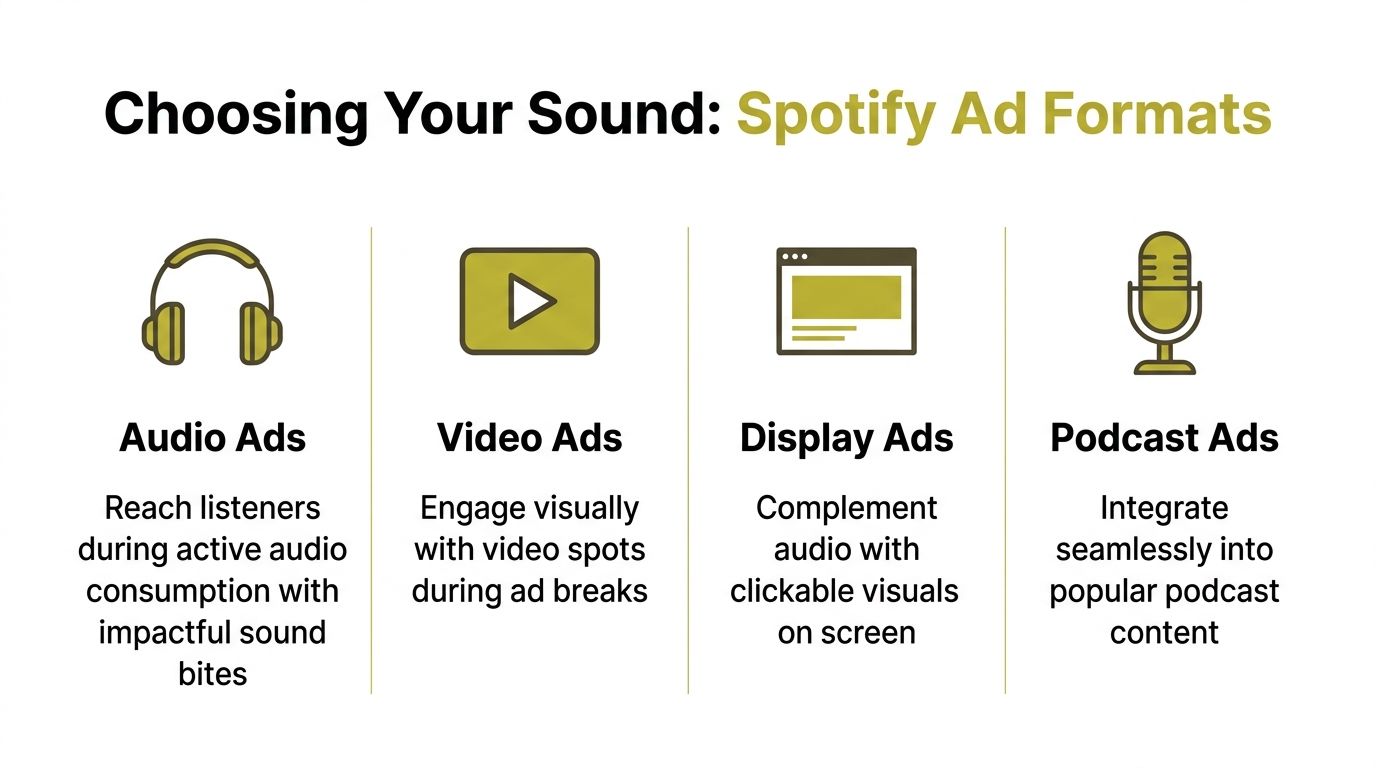
The four formats most SMEs should assess
Audio ads are the standard entry point. They run as short audio spots and are usually the best first test for SMEs that want reach, recall and manageable production demands. If your proposition is easy to communicate by voice and your landing page does the heavy lifting after the click, audio is often enough.
Video ads work when the visual matters. Product design, venue atmosphere, packaging and demonstrations all benefit. They also demand more from your creative process. Weak visuals damage credibility faster than weak static design elsewhere.
Display ads should rarely carry the campaign by themselves, but they can support recognition and clicks when paired with audio. Think of them as reinforcement rather than the star of the show.
Podcast ads can be the most persuasive format when the fit is right. A host-read or contextually aligned placement can feel far more natural than a generic interruption. The trade-off is that relevance matters more. A mismatch is obvious.
Spotify Ad Format Comparison for UK SMEs
| Ad Format | Best For | Creative Needs | Typical UK SME Budget |
|---|---|---|---|
| Audio Ads | Brand awareness, local promotions, simple offers | Strong script, clear voiceover, concise CTA | Entry point can start from £200 via Ad Studio |
| Video Ads | Visual products, hospitality ambience, launches | Good footage, branding discipline, mobile-friendly edit | Usually better for SMEs with more room for testing |
| Display Ads | Supporting clicks and visual recall | Clean design, offer clarity, landing page alignment | Best used as a supporting format |
| Podcast Ads | Trust-led messaging, niche audiences, founder stories | Strong host fit, customized message, authentic tone | Budget varies by placement and production approach |
What works for each goal
If the aim is awareness, start with audio unless your visual asset is unusually strong.
If the aim is traffic, audio plus a disciplined CTA can work, but only if the destination page is built for mobile users and the offer is obvious.
If the aim is credibility, podcast inventory deserves attention because the surrounding content can do some of the trust-building for you.
Creative trade-offs most SMEs miss
A lot of SME creative fails before media spend becomes the issue. The script sounds like a brochure. The voice sounds synthetic. The message tries to do too much.
A better approach:
- Lead with the offer: Say what you do early.
- Write for the ear: Short words, short sentences, no jargon.
- Use one CTA: Do not ask listeners to remember three actions.
- Match sound to brand: Background audio should support the message, not compete with it.
If you need a primer on selecting background tracks without licensing headaches, this guide to royalty free music for advertising is useful.
Brand consistency matters here too. A Spotify ad should sound like the same business people meet on your site, socials and in your sales deck. If your messaging still feels fragmented, it helps to tighten your what is brand storytelling approach before producing ads.
Choose the format that suits the decision you want from the listener, not the format that looks most impressive in a media deck.
Launching Your First Spotify Ad Campaign Step by Step
Most first campaigns go wrong in ordinary ways. The setup is rushed. The objective is vague. The creative is uploaded before anyone asks what success should look like.
Spotify’s self-serve tools made entry much easier in the UK. The 2021 UK launch of Spotify Ad Studio enabled self-serve campaigns from £200 and helped drive a 35% surge in UK advertiser sign-ups to over 5,000 brands by 2022, according to Stape’s review of Spotify ad costs and pros and cons. Accessibility is no longer the barrier. Discipline is.
Start with the campaign objective
Before you open Ads Manager, decide what the campaign is meant to do.
Not “grow the brand”. Not “see what happens”.
Pick one primary outcome:
- Awareness if you need recognition in-market.
- Consideration if you want listeners to visit a page or learn more.
- Conversion support if Spotify is assisting a broader sales journey rather than closing the sale alone.
This choice affects everything after it, including the script, audience and landing page.
Build the campaign in the right order
Many teams start with the ad file. Start with the audience and destination instead.
A practical order looks like this:
Define the audience
Keep it narrow enough to matter. A Scottish tourism business should not target the whole UK by default if the actual priority is reachable visitors in specific areas.Set the destination
Send traffic to a page built for the ad. Do not send paid visitors to a generic homepage unless the offer is broad.Choose the format
Pick audio, video or another format based on the commercial goal, not curiosity.Write the script
Read it aloud. Then cut it again.Prepare artwork and copy
Keep branding clean and the offer easy to understand at a glance.Set budget and schedule
Give the campaign enough time to collect useful signals. Tiny bursts often create noise, not learning.
What to upload and check before launch
Your pre-flight process should be dull and methodical. That is the point.
Use a checklist like this:
- Audio quality: No clipping, no background hiss, no rushed edit.
- Naming conventions: Label campaigns clearly so reporting stays readable later.
- Landing page match: The page headline should reflect the ad message.
- Tracking links: Every destination URL should be tagged consistently.
- Mobile experience: Most paid traffic is unforgiving if the page loads badly or hides the CTA.
- Compliance review: Especially important for offers, comparisons and regulated claims.
Common first-campaign mistakes
Some mistakes are technical. Most are strategic.
Talking too late
Many SME ads waste the first few seconds on mood-setting. State the brand and value early.
Over-explaining
Audio is not a white paper. One message wins.
Using the wrong page
A good ad can still fail if the click lands on a cluttered page with no obvious next step.
Judging too quickly
Do not switch everything off because the first readout feels underwhelming. Look for patterns, not emotional reactions.
A simple launch workflow
A small business team does not need a complex operating model. It needs one owner and a clear review rhythm.
A sensible internal workflow:
- One person owns setup.
- One person signs off the script.
- One person checks compliance and landing page alignment.
- Launch only when all three agree the campaign answers a real business need.
If nobody in the business can explain the campaign objective, audience and CTA in one breath, the ad is not ready.
That sounds strict, but it saves money.
Smarter Targeting and Budgeting for Maximum SME Impact
Spotify gives advertisers useful targeting levers, but precision only helps when the proposition is precise too. Many small businesses target tightly and still miss because the message is vague.
The strongest campaigns line up three things at once. Who should hear it, when it should reach them, and what they should do next.
Use targeting to reflect actual buying behaviour
Spotify campaigns in the UK can be targeted by postcodes in Scotland or England, which is especially helpful for businesses that trade by geography rather than broad national reach, according to Salesforce’s customer story on Spotify advertising productivity.
That means a Glasgow venue, a Highland tourism operator or a London hospitality brand can build campaigns around realistic customer footprints instead of wasting spend on listeners who will never convert.
The targeting process should move from broad to specific:
- Start with geography: Where can you sell?
- Layer in audience relevance: Match genre, mood or listening context to the offer.
- Refine by timing: Consider when the message is most useful, not merely when inventory is available.
A weekend-break offer sounds different on a Thursday than a Monday. A B2B software message may perform better during workday listening than late-night entertainment sessions.
Here is a useful explainer on the platform itself:
Budgeting for learning, not just launch
The cheapest campaign is often the one that teaches you something fast.
That does not mean spending recklessly. It means allocating budget so you can compare messages, audiences and offers instead of backing one untested idea and hoping for the best.
A practical SME budgeting model usually includes:
- A test budget: Enough to compare at least a small number of creative angles.
- A hold-back budget: Reserved for the version that proves strongest.
- A review window: Long enough to detect direction, short enough to make adjustments before waste compounds.
Creative is part of targeting
Many marketers separate targeting from creative. On Spotify, that is a mistake. The listener’s context and the ad’s tone are linked.
The same Salesforce source notes a common pitfall. Human or influencer voices can lift ad completion rates by up to 35% compared with robotic voiceovers, and UTM promo codes are essential for tracking because there is no native pixel for retargeting.
That creates two direct implications.
First, use a human read unless you have a very good reason not to. Audio is intimate. Robotic delivery sounds cheap and often gets ignored.
Second, build your tracking outside the platform assumptions many social advertisers are used to. Spotify is not a lazy retargeting machine. It rewards cleaner planning.
What usually works best for SMEs
The strongest SME scripts tend to share the same traits:
- Immediate relevance: The listener knows quickly why the ad matters.
- Natural speech: It sounds spoken, not copied from a brochure.
- Firm CTA: Visit, book, claim, listen, register. One action.
What usually fails:
- Generic slogans.
- Long lists of features.
- Forced humour.
- Trying to sound like a national brand when you are winning because you are local, specialist or personal.
Write the ad for one listener in one place at one moment. Broad messaging is usually expensive messaging.
From Plays to Profit Measuring and Optimising Your Campaigns
A Spotify campaign is not successful because it ran smoothly. It is successful because it moved a business outcome you can defend.
That distinction matters because audio platforms can tempt teams into soft reporting. Reach looks encouraging. Completion rates look tidy. The dashboard appears active. None of that matters if the campaign does not contribute to visits, leads, bookings or sales.
What to measure first
Start with platform metrics, but do not stop there.
The basic reporting stack usually includes:
- Reach: How many people had the chance to hear the ad.
- Frequency: Whether repetition is helping recall or creating fatigue.
- Completion rate: A useful indicator of creative quality and audience fit.
- Clicks or site visits: Important when the CTA expects immediate action.
- Tagged landing page behaviour: What paid visitors did after arrival.
The platform can tell you what happened inside the campaign. Your site and analytics setup tell you whether those interactions meant anything commercially.
If the landing page is underpowered, fix that before blaming the channel. This guide on how to increase website conversion rates is relevant because Spotify traffic often exposes weak pages quickly.
Why testing matters more on Spotify than many SMEs expect
There is a practical reason to treat Spotify as a testing environment, not just a placement environment. Global benchmarks show multi-format campaigns can boost purchase intent by 50%, but UK-specific SME data is sparse, so smaller advertisers need stronger testing discipline, according to Spotify’s performance insights page.
That same source warns that unoptimised SME tests can waste 20% to 30% of the initial budget, and that teams mitigate this with daily performance reviews.
For an SME, that means optimisation should not be occasional. It should be operational.
A sensible optimisation loop
You do not need a giant team to optimise properly. You need a repeatable loop.
Use this sequence:
Read the early signals
Look at delivery, completion and click patterns without panicking.Form one hypothesis
For example, the audience is right but the CTA is too soft.Change one meaningful variable
Swap the opening line, tighten geography, or test a new landing page headline.Review again
Avoid changing multiple things at once unless the campaign is clearly broken.Scale only after proof
More spend amplifies strengths, but it also amplifies bad assumptions.
What deserves an A/B test
The best variables to test are usually the least glamorous.
Opening line
The first seconds often decide whether attention holds.
Voice and delivery
A different read can change how trustworthy or local the brand feels.
Offer framing
“Book now” and “Plan your stay” may attract different kinds of intent.
Audience scope
A narrower local segment may outperform a broad one, even if volume is lower.
Landing page alignment
Sometimes the ad is fine and the destination is weak.
Mistakes that distort the results
Bad measurement often comes from bad habits, not bad tools.
Watch for these:
- Calling it too early: Some campaigns need enough delivery to show real patterns.
- Obsessing over vanity metrics: High completion is nice, but not if nobody acts.
- Testing too many things together: You cannot learn cleanly from muddled changes.
- Ignoring qualitative feedback: Sales teams and front-line staff often hear what customers remembered.
The right question is not “Did the ad perform?” It is “What did the ad teach us about the audience, the offer and the page?”
That is how paid media becomes an asset instead of a recurring expense.
DIY vs Done For You When to Engage a Specialist Agency
Spotify’s self-serve model is good enough for many first campaigns. If your offer is simple, your landing page is solid and someone in-house can write and judge audio properly, DIY is a fair place to begin.
But there is a clear point where self-serve convenience stops being enough. Usually that happens when the campaign affects reputation, compliance, cross-channel strategy or budget efficiency at a level that makes amateur mistakes expensive.

When DIY is usually fine
An in-house team can often handle Spotify themselves when:
- The offer is straightforward: A local promotion, event push or simple booking message.
- Approval chains are short: One or two decision-makers, not five.
- The risk is low: No sensitive claims, regulated wording or reputational complications.
- The team can measure properly: Tagged URLs, page tracking and disciplined review are already in place.
In those cases, self-serve can be efficient and educational.
When specialist support becomes essential
The situation changes quickly in regulated sectors and high-visibility campaigns. A key challenge for UK businesses, especially in sectors such as tech or hospitality, is making sure Spotify ads comply with Advertising Standards Authority rules, and this is often overlooked without expert support that blends PR and crisis-management judgement, as noted in Spotify’s inclusive advertising insights.
That matters because a Spotify ad is not just media inventory. It is public messaging. If the wording overpromises, if the targeting creates sensitivity, or if a campaign lands badly during a difficult news cycle, the issue is not only performance. It is reputational exposure.
Specialist support also helps when:
- You are integrating Spotify with PR and search
- You need scripts that sound editorially sharp rather than salesy
- You want podcast opportunities that feel native, not bolted on
- You need senior judgement without large agency overheads
Production quality is part of strategy
A final point many SMEs underestimate is production value. Not expensive-for-the-sake-of-it production. Appropriate production.
If you are considering podcast-led campaigns or founder-read creative, recording conditions matter. This piece on professional podcast studios is useful because it explains what businesses gain when they stop relying on improvised audio setups.
Poor sound tells the listener something about the brand before your message even lands.
Why the right agency type matters
Not every agency is built for this work. Spotify sits between media buying, creative discipline, analytics and public positioning. That is why a specialist team with newsroom judgement and major-brand agency experience can be a better fit than a generic paid media supplier.
Former journalists tend to spot weak claims, woolly messaging and reputational tripwires quickly. Agency operators with international brand experience tend to know how to structure campaigns, creative testing and cross-channel reporting without wasting time.
For SMEs, that combination is unusually useful. It gives you strategic depth without paying for layers of overhead that do not improve the work.
If you want expert help with advertising with spotify, wider digital strategy, PR integration or campaign messaging that can withstand both performance scrutiny and public scrutiny, Carlos Alba Media offers senior-level support built for UK SMEs and ambitious brands. The team combines former national news journalists with agency professionals who have worked with international names, giving clients practical strategy, sharper creative and measurable growth without big-agency drag.