
A criticism lands badly because it rarely arrives at a convenient moment. You're between meetings, checking your phone at dinner, or about to walk into an investor call when a review, email, comment or journalist's question hits a nerve. The instinct is usually the same. Correct them. Defend yourself. Explain what they've missed.
That instinct causes most of the damage.
If you want to know how to respond to criticism properly, stop treating it as a personal contest. Treat it as a reputation event. The key question isn't whether the critic is fair. It's whether your next move improves or worsens the situation in front of the people who matter.
A customer watches your reply. A reporter screens your wording. A regulator may later read the same thread with none of your emotional context. That's why the answer changes depending on who's speaking, where they're speaking, and what legal or commercial risk sits behind the complaint.
The First 60 Minutes Your Initial Response Protocol
The first reaction is physical before it's strategic. Your pulse lifts. Your jaw tightens. You start drafting the reply in your head before you've even assessed whether one is needed. That's exactly when people write the sentence they later regret.

A better approach is to treat the first hour as containment, not communication. According to a 2022 UK government-commissioned report on criticism and mental health at work, 89% of UK-based mental health professionals recommend a structured “pause-and-process” approach before responding to criticism, including allowing 24 to 48 hours for emotional regulation. That matters even more for founders and executives, because resilience affects how you show up to media, staff and investors.
What to do immediately
In the first ten minutes, do four things and nothing else:
- Capture it. Screenshot the post, email, review or message. If it changes later, you need the original wording.
- Stop drafting replies. Don't write the “honest version” to get it out of your system. Those drafts have a habit of being sent.
- Classify the issue. Is it feedback, misinformation, abuse, or an allegation?
- Check visibility. Private email and public post are different problems.
Practical rule: If you feel an urgent need to “set the record straight”, you're probably still too angry to do it well.
The triage questions that matter
Once the initial jolt settles, assess the criticism against a short set of questions:
- Is there truth in it? Even a badly delivered complaint can point to a real failure.
- Who made it? A paying customer, staff member, journalist, competitor and anonymous account each require different handling.
- How far can it travel? A one-star review on a dead profile isn't the same as a thread a reporter could lift into a story.
- What's the consequence of delay? Some issues improve with a pause. Others require immediate internal escalation.
If you're in a visible leadership role, this is also the moment to separate your ego from the business. Criticism of your service, conduct or communication is not automatically an attack on your identity. The people who handle this well are not the people who never feel stung. They're the people who refuse to let that feeling choose the response.
Build a pause into the system
Many organizations fail here because they rely on self-control rather than process. Put the pause into policy. Decide in advance who gets alerted, who signs off replies, and what gets held for review. A simple written playbook prevents impulsive mistakes, especially outside office hours. If you need a structure for that, a crisis communications plan should spell out approval lines, holding statements and escalation triggers.
For organisations exposed to elections, campaigns or public office scrutiny, the same principle applies at a higher temperature. The mechanics outlined in this guide to political reputation management are useful because they focus on response discipline, search visibility and the danger of feeding a story through careless rebuttal.
When to Respond and When to Stay Silent
Not every criticism deserves oxygen. Some criticism needs a reply because silence looks evasive. Some criticism should be left alone because the response creates the story.
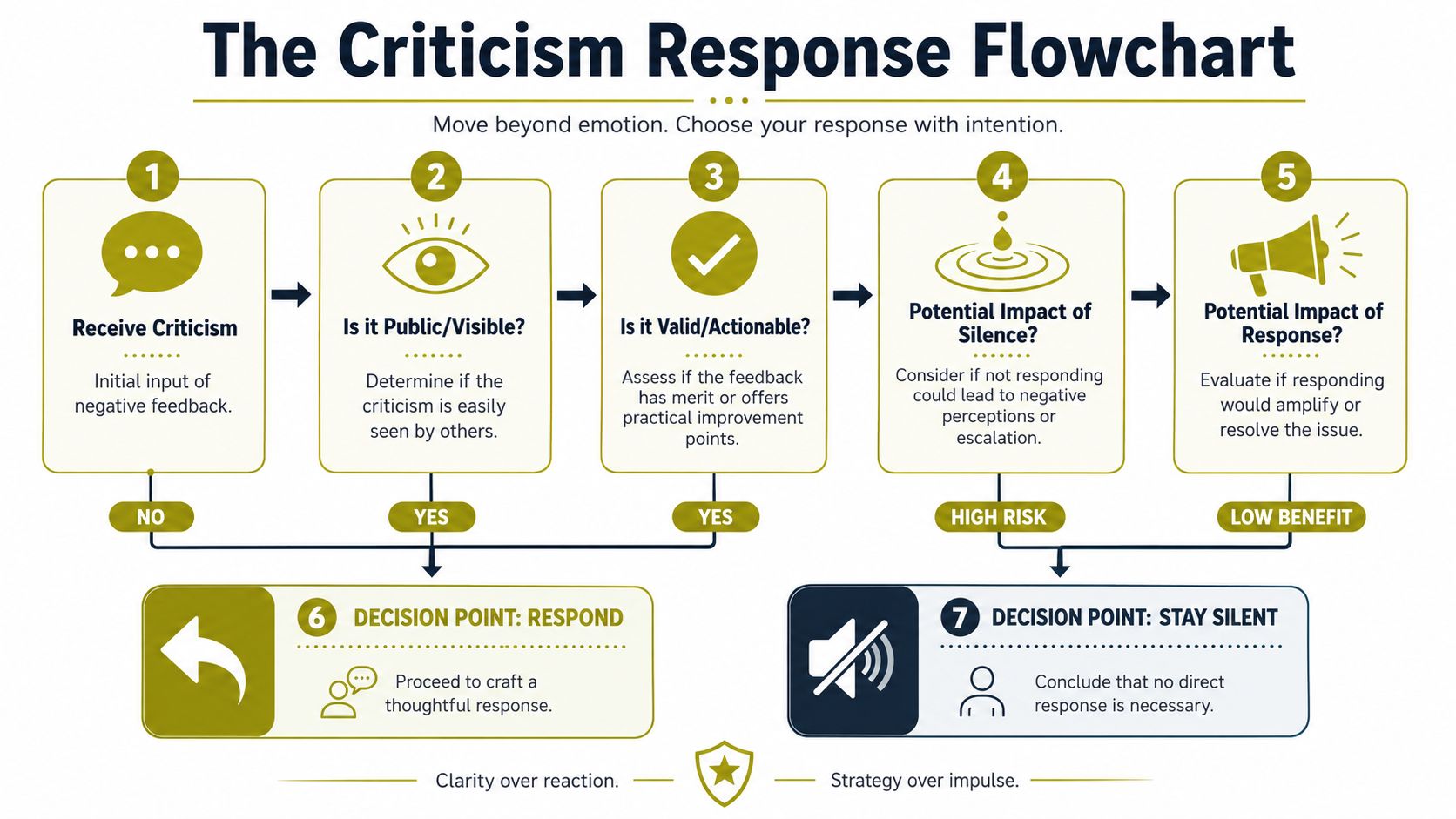
That's the judgement clients usually want outsourced because instinct is unreliable here. People tend to overreact to insults and underreact to credible complaints. A better method is to decide based on visibility, validity and likely audience interpretation.
Respond when the criticism is visible and credible
If the comment is public, easy to find, and points to a recognisable problem, a response usually helps. You're not only answering the critic. You're signalling to everyone else that the issue is being handled.
A useful discipline is to treat criticism as a perception first. A 2023 CIPD-related analysis of negative feedback found that only 32% of UK employees believe managers provide constructive feedback, and it noted that criticism is more likely to lead to progress when it's framed as a perception and the recipient asks clarifying questions instead of debating. That's a strong test for business owners too. If your first line is argument, you're usually trying to win. If your first line is clarification, you're trying to understand.
Stay silent when the response becomes the story
Silence is often the right choice when the criticism is clearly malicious, anonymous and low-reach. The mistake is believing every public jab demands a public rebuttal. It doesn't. A weak attack can die on its own. Your reply can give it shape, legitimacy and distribution.
Use this rough decision filter:
| Situation | Better move |
|---|---|
| A customer raises a specific service failure publicly | Respond |
| A journalist emails with factual allegations | Respond, but carefully |
| An anonymous troll posts abuse with no evidence | Stay silent or moderate |
| A former employee makes a broad personal attack with no new facts | Usually stay silent, monitor |
| A reviewer states something materially false that could affect sales | Correct or clarify |
Think like a newsroom, not a wounded founder
Former national news journalists are trained to ask one brutal question about every complaint, leak or row: does this have legs? In plain English, will it spread because it affects more than one unhappy person?
That depends on things like public interest, novelty, proof, contradiction and timing. A complaint that reveals a wider pattern has more traction than a one-off grumble. A post with screenshots travels further than a vague accusation. A criticism that clashes with your public brand claim can become much bigger than the original incident.
If a point is subjective, answer softly. If it's factual, verify it. If it's malicious and empty, don't platform it.
Use silence actively, not passively
Staying silent doesn't mean doing nothing. It means you monitor, document, and prepare if the issue shifts. Internally, you may still need to investigate, brief staff, gather records and decide who would speak if escalation follows.
That's the difference between strategic silence and avoidance. One protects your position. The other leaves you exposed.
Crafting the Right Reply for Any Channel
Once you've decided to reply, the channel dictates the shape of the answer. People make a mess of criticism because they recycle the same tone everywhere. A sentence that sounds thoughtful in a meeting can look evasive in an email. A legalistic social reply can make a minor complaint look serious. A breezy answer to a journalist can create a quote you didn't mean to give.

A UK guide for sellers handling online product criticism found that a 20-minute emotional detachment window reduces defensive language by 68% and increases resolution success rates to 82%. It also notes that British phrasing matters. “I am sorry that your order didn't meet our usual standards” lands far better than a non-apology such as “I am sorry you feel that way.”
In person or in an internal meeting
Live criticism is where body language and tone do as much work as words. Don't interrupt. Don't explain too early. Let the other person finish, then narrow the issue before you answer.
A useful structure is:
“Let me make sure I've understood you. You're saying the delay wasn't the only problem. The communication around it made the issue worse. Is that fair?”
That response does three jobs. It lowers temperature, tests your understanding, and shows you're listening rather than preparing a defence. Only after that should you address what you accept and what you'll change.
In email
Email needs precision. The recipient can reread every line, forward it, and strip it of vocal tone. Keep it short, calm and specific.
“Thank you for raising this. I've reviewed the points you made and I understand why you're frustrated. We fell short on the timeline we set. I'm now checking the sequence of events with the team and will come back to you by 3pm tomorrow with the next step.”
What works here is restraint. You acknowledge the issue, avoid self-justifying detail, and commit to a clear follow-up. What doesn't work is a long chronology written to prove you were technically right.
On social media and review platforms
Public channels are performance spaces. You are writing for the silent audience as much as the complainant. The goal is to acknowledge, lower heat, and move the detail into a private setting.
“I'm sorry that your order didn't meet our usual standards. Please send your order number and best contact details by direct message or email us at [address], and we'll look into this today.”
That works because it accepts the experience without making wider admissions. It offers a route to resolution. It also removes the temptation to have a point-scoring exchange in public.
If you manage high volumes of comments, the practical examples in these ProdShort engagement tips are useful for keeping replies concise and human without sounding automated. Consistency matters, but scripted blandness usually makes criticism worse.
You also need channel-specific tone rules. A founder's personal LinkedIn voice may be too casual for a formal complaint response under the company name. A proper set of tone of voice guidelines helps prevent that mismatch.
For journalists and media enquiries
Press criticism is different because anything you send may appear in print, online or on air. Never treat a journalist's critical email like a customer complaint. It isn't a conversation. It's evidence gathering.
Use a holding statement when you need time:
“We're aware of the concerns raised and are reviewing the matter urgently. It would be inappropriate to comment in detail until that review is complete. We will provide an update as soon as we're in a position to do so.”
That is not evasive if it's true. It buys time, avoids speculation and prevents loose language. What fails here is the half-defensive message that mixes denial, irritation and too much explanation.
If a business needs external help drafting those statements, Carlos Alba Media offers media skills, public relations and crisis support shaped by newsroom practice. That matters because everyone who works for Carlos Alba Media is a former national news journalist or has agency experience of working with international brands, which changes how criticism is assessed before anything is published or broadcast.
The Professional's Toolkit for Responding
There's a visible difference between a basic reply and a professional one. The basic reply answers the complaint. The professional reply also manages the audience, protects future options and reduces the chance of a second wave.
The backbone of that approach is the Listen-Question-Own-Thank model. According to UK workplace guidance reported by Metro, criticism response success rates improve from 45% to 79% when people follow that protocol. The same reporting says 73% of employees who stay calm and ask for clarification maintain healthy communication, while 61% who respond defensively experience deteriorating workplace relationships.
The techniques professionals use
The first is paraphrasing. You repeat the point back in cleaner language so both sides know what is being discussed. That alone prevents a lot of useless argument.
The second is bridging. You acknowledge the concern, then move to the point you need on record.
“I understand why that raised concern. The immediate priority now is fixing the issue for affected customers and confirming exactly what happened.”
That sentence doesn't dodge the criticism. It accepts the concern, then directs attention to action.
The habits that de-escalate fast
Professionals also know what to remove. They strip out sarcasm, over-explanation, motive-reading and legal theatre. Most defensive replies are padded with lines that feel satisfying to write and damaging to publish.
For teams handling large volumes of incoming complaints, some of the workflow thinking in these AI-powered customer support tactics can help with triage, prioritisation and consistency. The useful part isn't automation for its own sake. It's building a process so the tone stays steady under pressure.
Criticism Response Do's and Don'ts
| Do | Don't |
|---|---|
| Pause before replying so the wording reflects judgement, not adrenaline | Reply instantly to relieve tension |
| Paraphrase the criticism to confirm what you've heard | Assume intent and answer the version that annoys you most |
| Own the part that's true with plain language | Offer a non-apology or hide behind vague phrasing |
| State the next action clearly so people know what happens now | Write long explanations to prove you're not at fault |
| Thank the person for raising it when the criticism is genuine | Punish the critic for tone if the underlying point is valid |
| Document repeat hostile incidents in workplace settings | Rely on memory when a pattern may later need reporting |
The mindset shift that matters
Amateurs treat criticism as a challenge to status. Professionals treat it as incoming information with reputational consequences. That sounds dry, but it's freeing. Once you stop trying to look unbothered, you can focus on sounding credible.
Escalation When Criticism Becomes a Crisis
There is a point where criticism stops being a communications issue and becomes a legal, regulatory or existential one. Many businesses miss that line because they've been told to be open, responsive and human. Fine. But there are moments when public warmth is not the main priority. Risk control is.
The trigger is usually the subject matter, not the tone. If the criticism includes allegations of illegality, discrimination, harassment, safeguarding failures, data breaches, financial misconduct, product safety problems or professional misconduct, stop treating it like ordinary feedback.
The danger of a polite but damaging reply
In regulated sectors, even a civil response can create exposure. The BMJ's guidance on online criticism for medical professionals is clear that in UK healthcare settings, a polite defensive reply can trigger regulatory scrutiny or legal liability, and doctors are advised to avoid retaliatory posts and consult supervisors before responding. That principle extends well beyond medicine.
A founder in financial services, a care provider, a tourism operator dealing with safety complaints, or a healthcare director answering online allegations all face the same risk. The wrong sentence can look like an admission, a confidentiality breach, retaliation, or an attempt to influence witnesses.
Escalation triggers you should not handle casually
Use immediate escalation when criticism includes any of the following:
- Allegations of unlawful conduct that could attract police, regulator or tribunal attention
- Protected characteristic issues involving discrimination, harassment or victimisation
- Patient, client or customer confidentiality concerns
- Threats to safety involving products, premises, transport or operations
- Media interest combined with documentary evidence, such as screenshots, recordings or internal documents
When the facts are incomplete and the stakes are high, saying less publicly is often the most responsible thing you can do.
What to do instead
First, preserve records. Second, limit who speaks externally. Third, align legal advice with communications advice before anyone posts or replies. Public statements should be approved, version-controlled and built around what can be said safely now.
That is where a proper legal crisis management process earns its keep. The purpose isn't to sound polished. It's to make sure the response doesn't create a second crisis while you are still trying to contain the first.
Developing Your Response Reflex
Good criticism handling isn't a personality trait. It's trained behaviour.
The people who do this well have built a repeatable reflex. Pause. Assess. Decide whether the criticism deserves a reply. Match the response to the channel. Escalate early when the issue carries legal or regulatory risk. That sounds simple because the steps are simple. Doing them consistently under pressure is the hard part.
The larger shift is mental. Your aim isn't to win the exchange. It's to protect trust, reduce harm and keep control of what happens next. In business, that's a leadership skill, not a soft skill.
That's especially true for founders, spokespeople and executives. They are criticised in more places, with less context, in front of larger audiences. A careless sentence in a team meeting can damage culture. A careless sentence online can damage sales. A careless sentence to a reporter can define the entire story.
Teams trained by former journalists usually improve faster because they learn to hear criticism the way a newsroom hears it. What's the line? What's provable? What will be lifted into a headline? What sounds calm? What sounds defensive? That discipline changes the quality of every reply.
Carlos Alba Media is a specialist PR and digital marketing agency founded and run by Carlos Alba, a multi-award-winning former national newspaper editor. The team blends newsroom insight with modern brand building to secure impactful coverage, and every team member is a former national news journalist or has agency experience working with international brands. That mix matters when teaching leaders how to respond to criticism because the answer isn't only about manners. It's about judgement, story risk and reputation under pressure.
If you need outside support handling criticism, preparing spokespeople, or building a response system before the next difficult moment lands, Carlos Alba Media provides senior-level PR, media training and crisis communications support for founders, SMEs and established organisations across the UK.