
You know the moment. A customer has left a review that lands like a punch to the ribs. It's public, it's blunt, and it's sitting there on Google for prospects, suppliers, recruits, and competitors to read before you've even had your first coffee.
Most SME owners react in one of three ways. They fire back. They freeze. Or they tell themselves one bad review doesn't matter and hope it slides down the page. All three are mistakes.
Online review management isn't a side task for the receptionist or something to “get round to” on Fridays. It's public-facing reputation work. Every reply, every silence, every delay tells a story about how your business behaves under pressure. For smaller firms, that story often carries more weight than any polished marketing copy on your website.
The right mindset comes from the newsroom, not the call centre. When a story breaks, good editors don't panic, speculate, or lash out. They verify facts, establish what's known, decide who speaks, and move quickly with a line that is accurate and controlled. That same discipline works for review platforms. Speed matters. Accuracy matters more. Tone matters most of all.
That's the lens behind this guide. Treat reviews as a live public narrative about your business, not a pile of admin. If you manage them with calm judgement, clear workflows, and proper escalation when needed, you stop being pushed around by the platform and start shaping the conversation.
Beyond 'The Customer is Always Right'
The phrase sounds nice on a mug. It's not a strategy.
A restaurant owner gets accused online of “ignoring” a booking issue that came from a third-party platform. A trades business is blamed for lateness when the customer gave the wrong postcode. A clinic is criticised by someone who never completed the intake process, but still writes as though they received treatment. In each case, the owner knows the review is incomplete, unfair, or flat wrong. The temptation is obvious. Correct the record. Defend the team. Show the reviewer they can't get away with it.
That instinct usually makes things worse.
What the public sees is not what you feel
The public rarely judges a review in isolation. They judge the exchange. A harsh review followed by a calm, measured reply can leave a surprisingly strong impression. A middling complaint followed by a defensive, thin-skinned response can do real reputational damage.
Practical rule: Respond for the next customer reading the page, not just for the person who wrote the review.
That's why online review management sits much closer to PR and crisis communications than many SMEs realise. You are not merely resolving a service issue. You are demonstrating standards, judgement, and emotional control in public.
A good reply does four jobs at once:
- Acknowledges the concern without accepting false claims you can't verify.
- Signals professionalism so readers see there's an adult in the room.
- Protects the business from over-sharing, blame, or legal risk.
- Moves the matter forward by taking detail offline where appropriate.
What works and what doesn't
What works is restraint. A brief acknowledgement. A specific but careful response. A route to continue privately. What doesn't work is point-scoring, sarcasm, or uploading your internal frustration into a public box.
A review thread is a shop window. Don't turn it into an argument in the doorway.
The businesses that handle this well don't assume every reviewer is right. They also don't waste energy trying to win every public dispute. They understand something more useful. Perception is shaped by conduct. If your conduct is steady, readers give you more credit than you think.
That's the shift. Stop asking, “How do we answer this customer?” Start asking, “What does this moment say about our brand?” Once you do that, review handling becomes far less reactive and far more effective.
Building Your Listening Post to Monitor What Matters
Most review problems don't become crises because of the review itself. They become crises because nobody saw them early, nobody owned the response, and the business discovered them after customers had already formed an opinion.
A workable monitoring system doesn't need enterprise software. It needs coverage, consistency, and a named owner.
Start with the platforms your customers actually use
Google Business Profile is the obvious first stop for many SMEs, but don't stop there. Think in layers.
First, cover the major public platforms where prospects check credibility. That usually includes Google, Facebook, Trustpilot, Yelp, TripAdvisor, Checkatrade, Houzz, or sector-specific directories depending on your industry.
Then look at where complaints surface before they become formal reviews. That might mean Reddit threads, local Facebook groups, parenting forums, trade forums, app store reviews, or booking platforms. Hospitality, healthcare, legal, home services, and e-commerce all have their own pressure points.
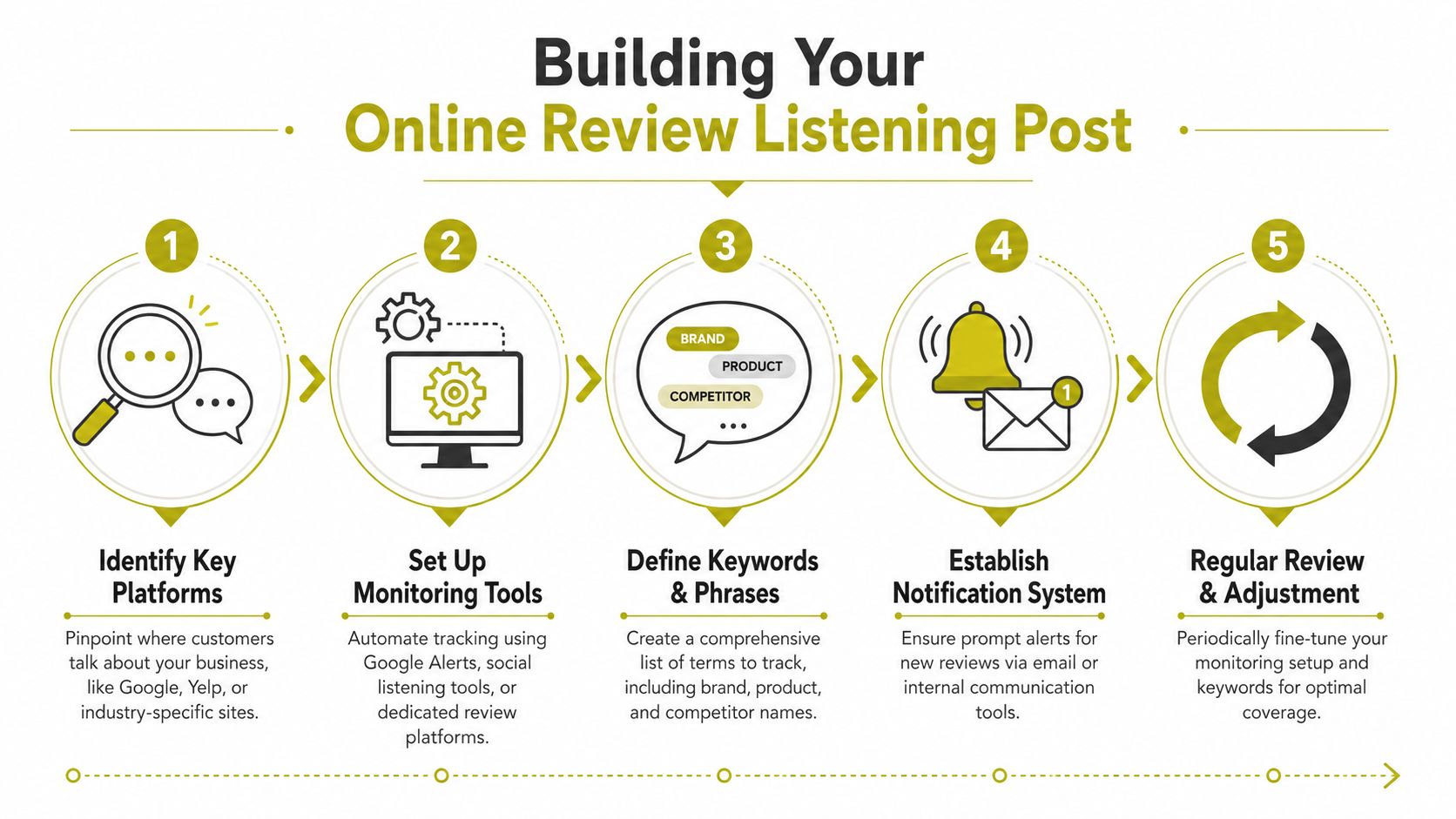
Build the basic system first
If you're a lean SME, start with free and native tools before spending on software.
Claim your profiles
Unclaimed profiles create delay and confusion. Make sure the business owns access to Google Business Profile, Facebook, Trustpilot, and any industry-specific review pages that matter in your market.Turn on platform alerts
Most major platforms allow email or app notifications. Route them to a shared inbox or a dedicated channel in your internal comms tool so they don't vanish when one person is on holiday.Set up Google Alerts
Use alerts for your business name, product names, founder names if they're public-facing, and common misspellings. Add brand-plus-complaint variations if your sector attracts forum chatter.Track variants, not just the official name
People rarely write reviews using the exact company name registered at Companies House. Include abbreviations, trading names, location names, and service descriptors.Check manually on a schedule
Automation helps, but it won't catch everything. Put a recurring check in the diary for priority platforms.
For businesses looking to formalise how they request and manage feedback, the Polaris Marketing Solutions review guide is a useful companion read because it focuses on practical setup rather than theory.
Assign one point person
Many SMEs frequently come unstuck. Everyone thinks someone else is looking.
Your listening post needs a named owner. Not necessarily the owner of the business, but one person who is responsible for spotting issues, triaging them, and triggering the right workflow. That person can pull in others, but the accountability has to sit somewhere specific.
Use a simple internal rule set:
- Low-risk reviews go to the customer service or operations lead.
- Pattern complaints go to whoever can fix the root problem.
- Sensitive allegations go straight to senior management.
- Anything legal, discriminatory, safety-related, or threatening skips the normal queue.
A more detailed set of reputation basics sits in these online reputation management tips, especially if you're building from scratch.
Listen for themes, not just mentions
Monitoring isn't only about spotting your business name. It's about spotting repeat issues while they're still manageable.
Watch for recurring phrases such as:
- Delivery complaints that point to fulfilment issues
- Rude staff comments that suggest a training problem
- Hidden fee language that signals pricing confusion
- No response accusations that expose a process gap
A listening post isn't glamorous. It is, however, the difference between a controlled response and a messy scramble after the damage is already visible.
The Art of the Reply With Workflows and Templates
A response doesn't need to be long. It needs to be deliberate.
The best review replies follow the same discipline as a decent public statement. They acknowledge what's happened, avoid inflaming the situation, and give the audience confidence that the business is paying attention. They don't ramble. They don't guess. They don't sound like they were generated in bulk and pasted by someone who hasn't read the complaint.
Use a framework instead of winging it
For most SMEs, a simple structure works well:
- Acknowledge the experience or concern.
- Appreciate or apologise depending on the review.
- Add light context only if needed and only if it helps.
- Act by stating the next step or inviting direct contact.
That's enough. Most poor replies fail because they add too much, not too little.
Review Response Framework
| Review Type | Core Principle | Response Outline |
|---|---|---|
| Positive | Reinforce what you want repeated | Thank them, mention the service or product they praised, invite them back or stay connected |
| Neutral or mixed | Show curiosity, not defensiveness | Thank them for the balanced feedback, acknowledge what fell short, offer a route to share more |
| Genuine negative | De-escalate in public, resolve in private | Apologise for the experience, avoid arguing facts in detail, invite direct contact, commit to reviewing the matter |
| Unfair or inaccurate | Correct carefully without sounding combative | Acknowledge the comment, state you can't verify parts of it or that it doesn't reflect records, invite offline discussion |
| Abusive or suspicious | Protect the brand and preserve evidence | Avoid emotional engagement, respond briefly if needed, document it, consider platform reporting |
Positive reviews deserve proper replies
Too many businesses ignore positive reviews because they don't feel urgent. That wastes an easy trust-building opportunity.
A good positive reply is short, specific, and human.
Weak reply: Thanks for your review.
Stronger reply: Thanks for taking the time to leave this. I'm glad the installation went smoothly and that the team kept things tidy. We appreciate the feedback.
The difference is small but important. The second version sounds read, not processed.
Negative reviews need calm, not courtroom tactics
If the review is fair, say so without grovelling. A public apology doesn't need to admit legal liability to be effective. It needs to show you've understood the concern and are prepared to deal with it.
Bad response: That's not what happened at all. You were told about the delay and were rude to staff throughout.
Good response: I'm sorry to read this and it's not the experience we want people to have. I'd like to look into what happened properly, so please contact us directly with your booking details and we'll review it.
The bad version may feel satisfying for ten seconds. The good version protects the business and reassures everyone else reading.
Mixed reviews are often the most useful
A three-star review with one specific complaint is gold if you're paying attention. It often comes from someone who wanted to like your business and may still be persuadable.
Use replies like this:
- Thank them for the detail rather than treating it as faint praise.
- Acknowledge the point they raised so the response doesn't feel generic.
- Offer a channel to continue if the issue is fixable.
- Feed the point internally so it doesn't recur.
Templates that don't sound templated
Use these as structures, not scripts.
For a positive review
Thanks for leaving this feedback. It's great to hear that [specific service or product element] stood out. We appreciate you choosing us and hope to see you again.
For a genuine negative review
I'm sorry to hear this was your experience. Thank you for raising it. We're reviewing the matter now and would like to understand the detail properly, so please contact us directly at [best contact route].
For an inaccurate or unfair review
Thank you for your comment. We take feedback seriously, but we haven't been able to match the details here with our records. If you'd like to contact us directly, we'll look into it promptly.
Tone is part of the strategy
What you say matters. How it sounds matters just as much. If your replies swing between overly formal, chatty, stiff, and defensive, the brand feels disorganised. A clear set of tone of voice guidelines helps keep different team members aligned, especially when reviews arrive outside office hours or under pressure.
One final rule matters more than any template. Never reply while angry. Draft it, step away, read it again as a stranger, then publish.
Escalation Protocols for When a Review Goes Critical
Most reviews can be handled through a normal response process. Some can't.
A review becomes a crisis issue when it alleges something that threatens trust at a deeper level. Think accusations around discrimination, safeguarding, dangerous products, fraudulent conduct, professional misconduct, data mishandling, or criminal behaviour. At that point, you are no longer just managing a customer comment. You are managing risk.

Improvisation is what gets businesses into trouble
Here's a familiar scenario. A boutique hotel receives a scathing review accusing staff of discriminatory treatment. The management team believes the post came from a competitor using a false name after a commercial dispute. The duty manager, angry and under pressure, replies publicly that the reviewer is lying and threatens legal action. Screenshots spread. Local press starts calling. The original allegation is now only half the story. The hotel's response has become the other half.
That's why escalation protocols matter.
When a serious allegation appears, follow this order:
Pause public reaction
Don't let the nearest available staff member improvise.Preserve evidence
Capture screenshots, timestamps, usernames, platform details, and any internal records connected to the claim.Verify what you can
Check booking records, staff rotas, call logs, emails, CCTV policies, delivery notes, or transaction history as relevant.Assess the category of risk
Is this a service complaint, a reputational allegation, a legal threat, or all three?Limit the public line
If you respond publicly at all, keep it factual, brief, and non-inflammatory.
What the holding response should do
For critical reviews, the first public reply is often a holding statement, not a full rebuttal.
We take concerns of this nature seriously and are reviewing the matter as a priority. We'd ask the reviewer to contact us directly so we can investigate fully.
That doesn't solve the issue. It buys time without looking absent.
When to escalate beyond the business
Bring in senior leadership when the review could affect staff safety, regulatory standing, legal exposure, investor confidence, or media interest. Bring in legal counsel when the allegation is potentially defamatory, factually false in a damaging way, or touches regulated issues where a careless public statement could create new problems.
If the review appears fake, report it through the platform's formal process. Do this with evidence, not outrage. Platforms are far more likely to act on clear documentation than emotional language. For businesses operating in sensitive sectors or facing more serious threats, specialist support in legal crisis management becomes important very quickly.
For frontline teams dealing with heated direct complaints before they spill into public reviews, AgentStack's guide to de-escalating customers is worth reading because the principles of calm language and controlled escalation apply well before a matter reaches a review site.
The line you must not cross
Don't publish personal details. Don't shame the reviewer. Don't disclose internal records in public to prove your point. Even when the business is in the right, that approach often makes the brand look reckless.
The core value of a crisis protocol is simple. It stops emotion outrunning judgement. When the stakes rise, that discipline is what protects the business.
Turning Insight into Action Through Measurement
If your review handling ends with “reply sent”, you're missing the best part of the exercise.
Reviews are operational intelligence in public view. They tell you where your promises and customer experience line up, and where they don't. Done properly, online review management becomes a feedback system for sales, service, fulfilment, hiring, training, and even web usability.
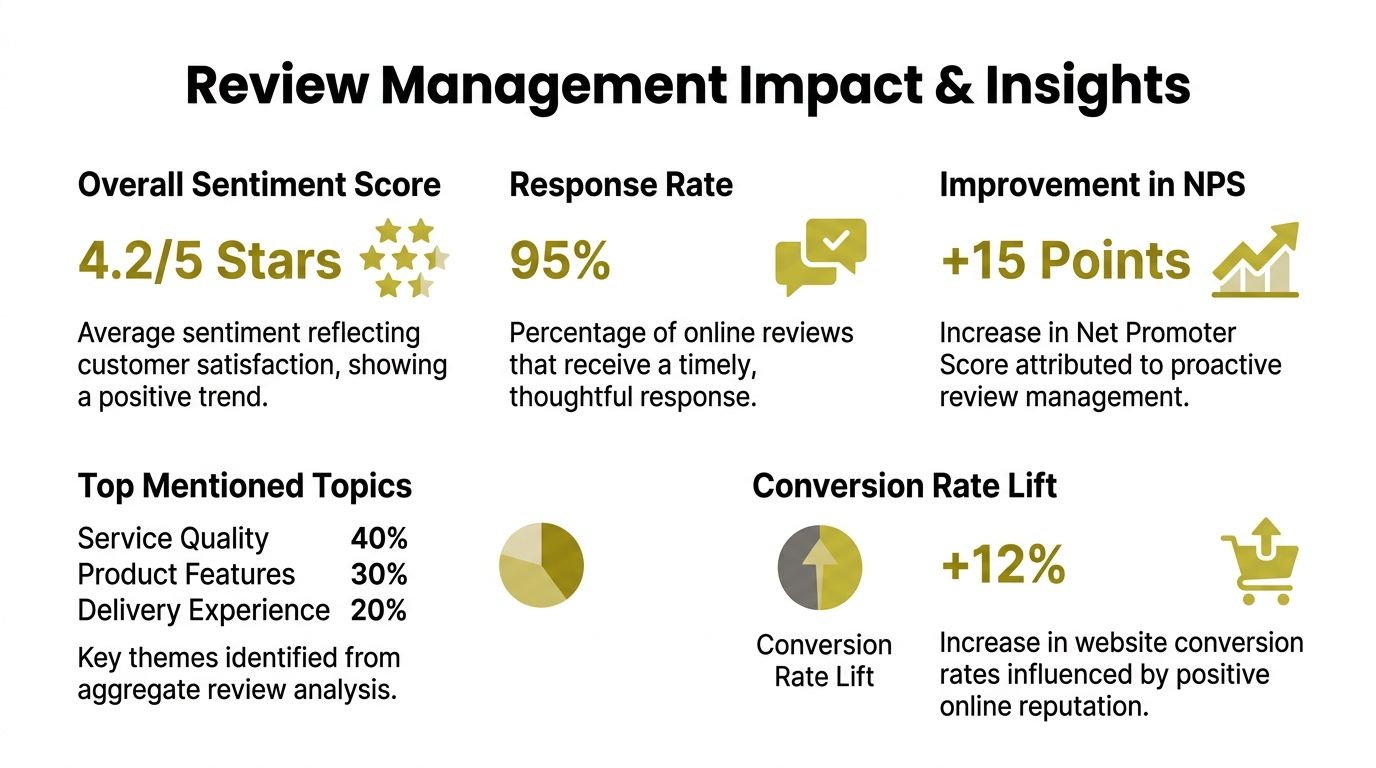
Track patterns, not vanity
The obvious metric is the star rating. It's not useless, but on its own it tells you very little about what to fix.
Look instead at a broader set of signals:
Response consistency
Are reviews being answered in a timely and on-brand way across platforms?Sentiment direction
Is the language around your business becoming warmer, more frustrated, more confused, or more transactional?Recurring keywords
Do the same complaints keep showing up around delivery, cleanliness, communication, billing, wait times, or product reliability?Platform differences
Does one platform attract more severe complaints because customers use it later in the journey?Resolution themes
Which issues disappear after action, and which keep resurfacing?
Turn complaints into changes
A review trend only matters if someone acts on it. If customers repeatedly mention slow callback times, unclear pricing, awkward booking, confusing returns, or staff attitude, that is not a marketing issue. It is an operational issue with public evidence attached.
Create a simple internal review loop:
- Collect the themes each month
- Rank them by business impact
- Assign an owner for each fix
- Report back on what changed
- Watch whether the language in reviews shifts
Smaller businesses are able to outperform larger ones. SMEs can often change scripts, processes, or customer journeys quickly if someone is paying attention.
The best review programmes don't just answer complaints. They remove the reason the complaint keeps appearing.
Use praise more intelligently
Positive reviews have value beyond morale. With permission and proper context, they can strengthen website copy, landing pages, sales decks, brochures, social content, and recruitment pages. They give you language customers already use to describe your strengths.
Be selective. The best testimonials are specific. “Great service” is pleasant but forgettable. A review that highlights responsiveness, clarity, speed, workmanship, or aftercare is much more useful because it addresses real buyer hesitation.
Keep the measurement simple enough to maintain
You do not need a sprawling dashboard to make this work. A spreadsheet can do the job if it captures platform, theme, tone, owner, action taken, and outcome. What matters is consistency.
If your business grows, move to a proper tool. Until then, don't let the search for the perfect reporting setup stop you from learning from what customers are already telling you in plain English.
Conclusion Your Reputation is Your Most Valuable Asset
Online review management works best when you stop treating it as a nuisance and start treating it as an ongoing public narrative.
The practical model is straightforward. Monitor what matters. Respond with control. Escalate when risk rises. Optimise based on patterns. Those steps sound simple because they are simple. The hard part is doing them consistently, especially when a review feels unfair or lands on a busy day.
That's where a newsroom mindset helps. Good operators don't react to every development with the same level of urgency, emotion, or detail. They assess. They verify. They decide who speaks. They understand that the audience is watching not only what happened, but how the organisation behaves once something goes wrong.
For SMEs, that discipline is often the difference between looking established and looking exposed. A calm, credible response can steady a prospect who is on the fence. A sloppy or aggressive one can confirm every doubt they already had. That's why review handling should sit alongside wider reputation planning, not outside it.
If you want another practical perspective on building a sustainable system, this playbook for local business review success offers a useful reference point. The businesses that get this right rarely rely on charm or luck. They rely on process.
Reputation isn't built only through campaigns, launches, and polished messaging. It's built in the unglamorous moments too. A complaint answered properly. A false allegation handled without panic. A pattern spotted early and fixed before it becomes a brand problem. That's the true work.
Treat your reviews like live reputation signals, because that's what they are. If you do, they stop feeling like random public threats and start becoming a manageable, valuable part of how your business earns trust.
If you need senior-level help without big-agency overheads, Carlos Alba Media offers exactly that. Carlos Alba Media is a specialist consultancy where everyone is a former national news journalist or has agency experience of working with international brands, which means clients get disciplined PR, crisis communications, and digital reputation counsel grounded in real-world media pressure, not theory.