
You probably already have a competitor list. A few bookmarked websites. A Slack thread where someone drops screenshots of a rival's latest ad, landing page, or LinkedIn post. It feels organised. It feels informed.
It usually isn't.
A real competitor analysis framework has less to do with collecting snippets and more to do with building a case. At Carlos Alba Media, that distinction matters. Our team is made up of former national news journalists and agency operators who've worked with international brands, so we don't treat competitor research as passive monitoring. We treat it like an investigation. We look for motive, positioning, timing, narrative, gaps, and the difference between what a competitor says and what the evidence supports.
That approach is especially useful in the UK, where most businesses aren't up against one obvious rival. They're navigating crowded sectors, overlapping services, and fast-moving local competition. A framework gives you something far more useful than a pile of observations. It gives you a way to decide what matters, what doesn't, and where your best move sits.
Why Most Competitor Analysis Falls Short
Most businesses don't fail at competitor analysis because they ignore rivals. They fail because they confuse watching with understanding.
A common pattern looks like this. A company notices a competitor has refreshed its homepage, launched a podcast, changed its pricing page, or started posting more often on LinkedIn. The reaction is immediate. Should we do that too? Should we lower prices? Should we copy the format? Should we push more budget into the same channel?
That's not analysis. That's chasing surface movement.
Observation is not insight
The UK is densely competitive. The country had about 5.5 million private sector businesses in 2024, and roughly 99.8% were small businesses, which means most firms are competing in fragmented SME-heavy markets rather than against a handful of giant national players, as noted in this UK business density overview. In that kind of market, shallow reviews create bad decisions quickly.
If you only track visible outputs, you miss the underlying story:
- Why they changed messaging. Was it strategic repositioning, weak lead quality, or poor conversion?
- Why they cut prices. Was it confidence, or margin pressure?
- Why they hired in a certain area. Was it expansion, or patching a capability gap?
- Why their content volume increased. Was it working, or were they trying to compensate for weak brand recall?
Good competitor analysis asks the question behind the move, not just whether the move happened.
A newsroom mindset helps. Journalists don't stop at the press release. They ask who benefits, what's missing, what changed, and what the source wants you to believe. That same discipline sharpens commercial analysis.
Copycat marketing usually weakens your position
Reactive competitor watching often produces bland sameness. One agency copies another agency's tone. One consultancy mirrors another's service naming. One founder sees a rival talk about “AI-powered growth” and rewrites the homepage by Friday.
The result is predictable. Messaging gets flatter. Differentiation disappears. Buyers struggle to tell firms apart, so price starts doing too much work.
A better starting point is to use a structured model for market intelligence and then pressure-test what you're seeing. If you want a useful external perspective on how teams organise that work, Salesmotion for market intelligence offers a practical overview of framework thinking without reducing the exercise to a simple feature comparison.
What usually goes wrong
A weak framework tends to show the same faults:
| Problem | What it looks like | What it causes |
|---|---|---|
| Too broad | Tracking everyone in the market | Noise, not clarity |
| Too shallow | Looking only at websites and socials | False conclusions |
| Too reactive | Responding to every visible move | Copycat strategy |
| Too static | One-off audit in a slide deck | Outdated decisions |
The fix isn't more data. It's better questions, tighter scoping, and a method for separating signal from theatre.
Setting Your Investigative Scope
The biggest mistake in a competitor analysis framework is simple. Businesses analyse the wrong competitors for the wrong reason.
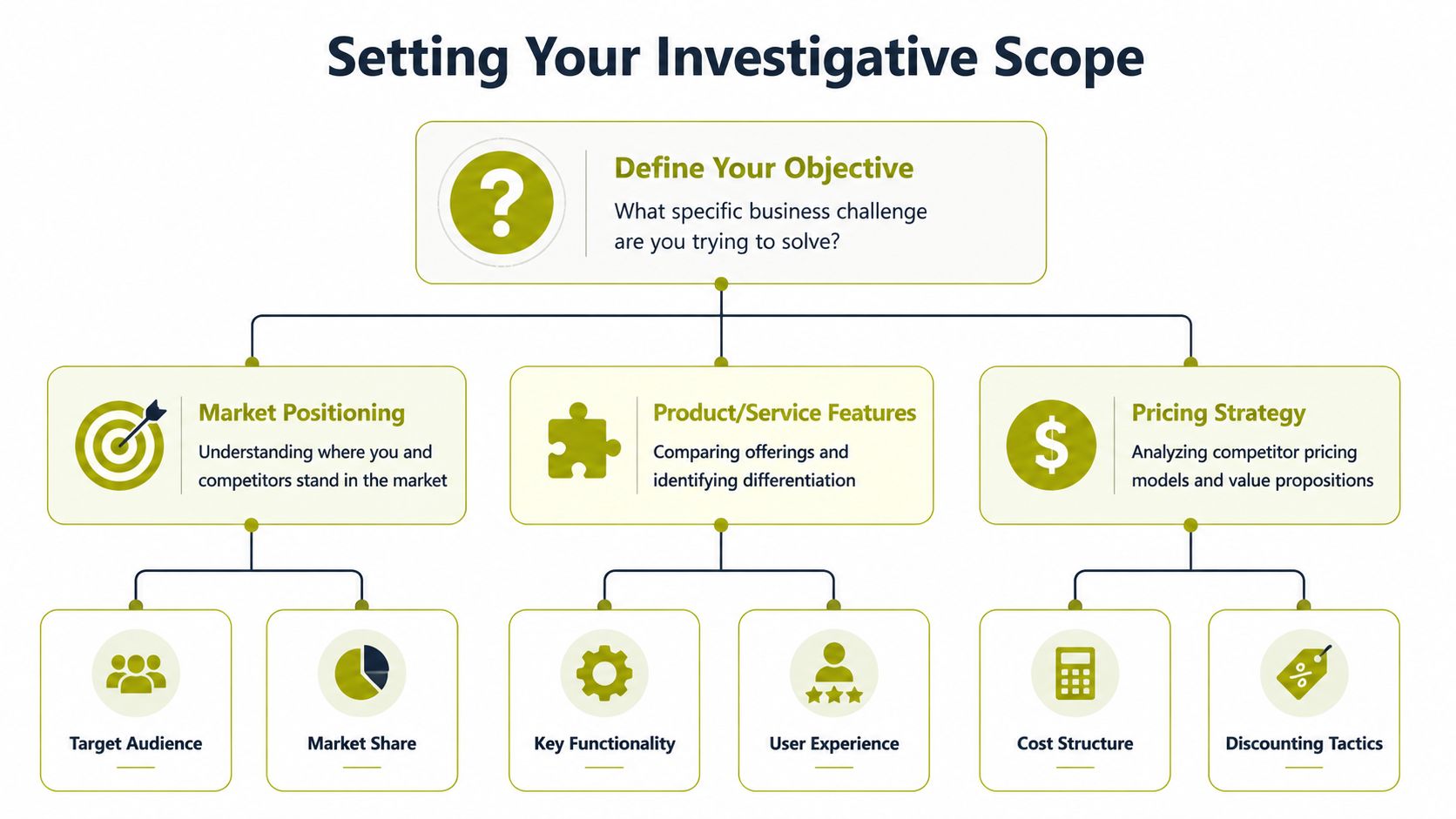
If you're trying to fix lost proposals, you need one comparison set. If you're shaping long-term brand positioning, you need another. If you're trying to understand where search visibility is slipping, the rivals that matter might not even be the ones your sales team mentions first.
Start with the decision, not the spreadsheet
Before you gather anything, pin down the question. Be blunt about it.
- Sales problem: Are we losing on price, trust, speed, or offer clarity?
- Marketing problem: Are rivals owning a message we should challenge?
- Search problem: Are we invisible for commercial terms that matter?
- Positioning problem: Are buyers struggling to understand why we're different?
Without that question, the framework bloats. Teams gather screenshots, lists, and links that feel productive but don't change a decision.
Practical rule: If your analysis can't answer a specific commercial question, it's research theatre.
Use a three-tier competitor set
In practice, most SMEs need three categories.
Direct competitors
These are the businesses a buyer is likely to compare against you in a live decision. Similar offer, similar audience, similar budget range.
If you're a Scottish PR and digital agency targeting SMEs, your direct competitors are not every agency in London. They're the firms clients shortlist alongside you.
Indirect competitors
These solve the same problem through a different route. A client may choose an in-house hire, a freelance consultant, a specialist SEO provider, or a performance-only shop instead of a full PR and digital partner.
These competitors matter because they shape buyer expectations, even when they don't look like your twin.
Aspirational competitors
These aren't your pricing peers, but they may influence how you think about service design, brand presentation, authority, or category leadership.
They're useful for inspiration. They're dangerous if you use them as a direct benchmark for pricing or resourcing.
Why tiering matters more now
This distinction matters in the UK because adjacent competition is getting wider, not narrower. The UK's digital ad market was forecast to reach about £40.5 billion in 2025, which increases the number of overlapping players across search, social, content, and PR, as discussed in this competitive tiering framework. That means SMEs can easily overcount rivals and muddy their own view of the market.
A clean scope prevents that.
Here's a simple way to frame it:
| Tier | Best used for | Risk if misused |
|---|---|---|
| Direct | Pricing, proposition, objection handling | Too narrow if used alone |
| Indirect | Market alternatives, substitution threats | Can distract from true peers |
| Aspirational | Messaging, brand cues, format ideas | Can distort budget and positioning |
Add an AI visibility lens
A growing blind spot is answer-engine discovery. Buyers increasingly encounter brands through summarised results, AI assistants, and zero-click experiences rather than a classic search journey. That changes who your visible competitors are. A firm with weaker branding but clearer structured content can appear in the places that shape perception first.
If that's part of your market, this guide to AI answer engine visibility is useful for thinking about how competitor sets shift when discovery doesn't begin on a standard search results page.
The point is simple. Define the question. Tier the field. Ignore the temptation to analyse everybody.
Uncovering the Data Story
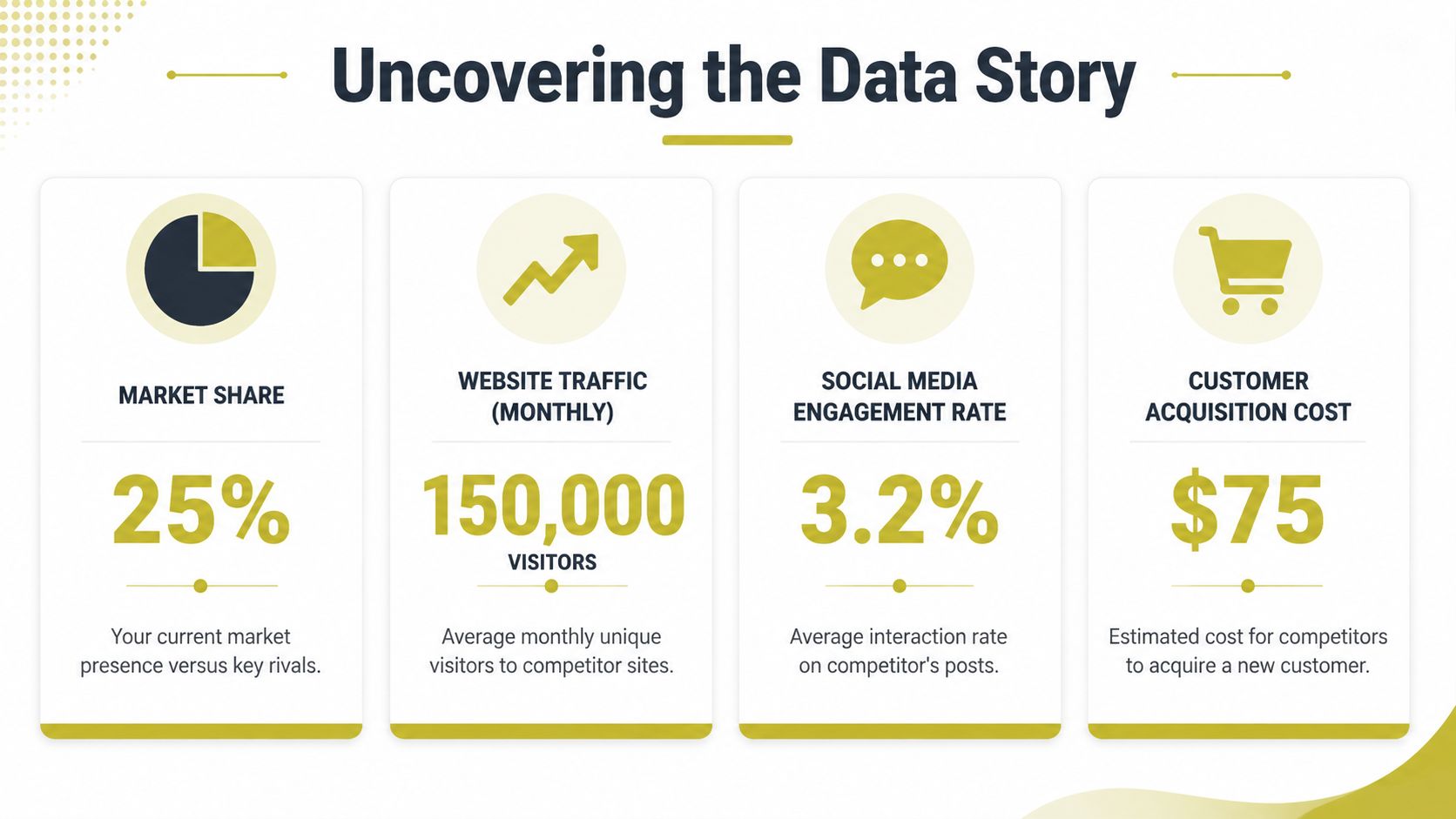
Qualitative judgement matters, but instinct without evidence turns into office folklore. The strongest competitor analysis framework combines primary research with secondary research, including public filings, SEO analysis, review sites, job posts, and social monitoring. A practical output is a competitor matrix covering products, pricing, audience, and distribution channels, as outlined in this competitor matrix approach.
That mix matters because different sources answer different questions. Reviews expose delivery gaps. SEO data shows demand capture. Hiring patterns hint at future moves. Sales debriefs reveal why deals went elsewhere.
The metrics that matter only if you interpret them
A metric on its own rarely tells you much. The value sits in the question behind it.
- Search visibility asks who's being found when buyers are actively looking.
- Backlink profile asks who has earned authority, and from where.
- Review language asks what customers consistently praise or resent.
- Traffic source mix asks whether growth depends on search, referrals, paid channels, or branded demand.
- Content gaps ask where rivals have left an opening.
If you're auditing your own visibility while benchmarking competitors, a solid starting point is this SEO audit checklist from Carlos Alba Media. It helps stop competitor analysis from becoming detached from your own actual weaknesses.
Build a matrix you'll use
Most competitor matrices fail because they're overloaded. Keep it lean enough that your team will maintain it.
A useful version usually includes:
| Dimension | What to record | Why it matters |
|---|---|---|
| Offer | Core services or products | Shows overlap and white space |
| Pricing model | Visible structure, tiers, retainers, packages | Reveals commercial strategy |
| Target audience | Who they speak to most clearly | Exposes positioning focus |
| Distribution | SEO, PR, social, partnerships, paid | Shows how they reach buyers |
| Proof signals | Reviews, case examples, media presence | Indicates trust architecture |
That's enough to spot patterns without drowning in admin.
Don't ignore primary intelligence
The best insights often come from conversations your business already has but fails to document properly.
- Sales debriefs reveal recurring objections.
- Lost deal reviews show where a rival looked safer, cheaper, faster, or clearer.
- Client onboarding calls often expose who else was considered.
- Delivery teams notice where expectations have been shaped by another provider.
The sharpest clue in a competitor review is often a sentence from a prospect, not a graph from a tool.
Later in the process, it helps to support those findings with tooling. If your team wants help sorting large datasets, clustering themes, or pulling patterns from messy exports, these best AI tools for data analysis are worth reviewing as working aids rather than decision-makers.
The video below gives a useful visual primer on turning competitor research into a repeatable process.
Read the movement, not just the snapshot
A one-off comparison misses the point. What matters is movement.
If a competitor's reviews suddenly change tone, if hiring shifts from account management to technical SEO, if thought leadership narrows around one niche, if backlinks begin coming from trade publications rather than local directories, those changes tell a bigger story than a static list of features ever will.
That's the data story. Not just what exists, but what's changing and why.
Decoding Your Competitor's Message
Numbers tell you where a competitor is visible. Messaging tells you why people remember them.
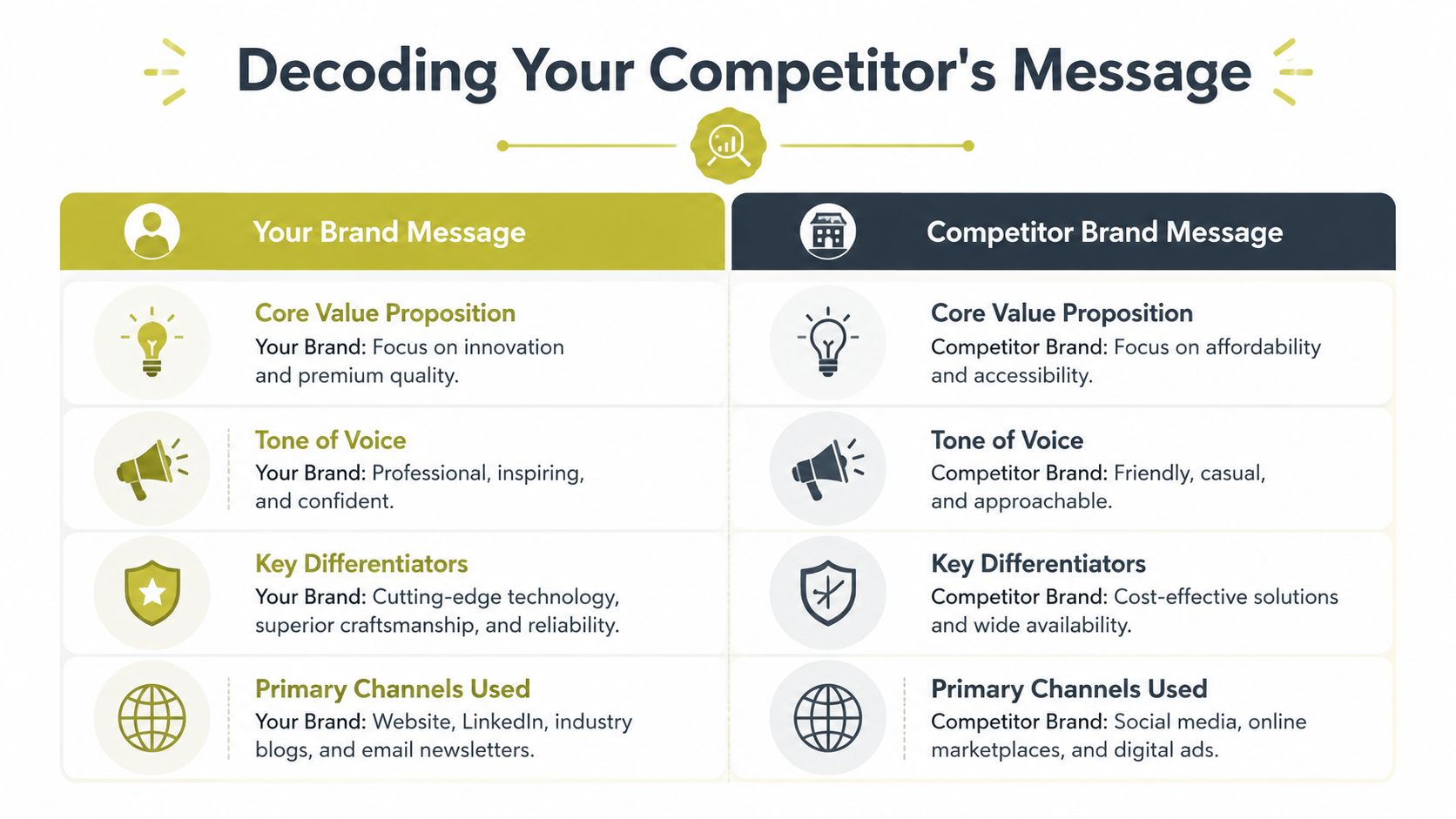
This is the part many frameworks handle badly because they reduce brand analysis to a slogan comparison. Real message analysis is broader than that. It looks at how a business presents authority, how it frames risk, how it speaks to buyer anxiety, and what kind of identity it invites the customer to join.
For a team with a journalism background, this part feels familiar. You're reading for line, angle, omission, repetition, and subtext.
What to examine in competitor communications
Start with public-facing material, but don't stop at the homepage.
Brand claim
What's the central promise? Faster growth, safer delivery, lower cost, premium expertise, simplicity, specialist knowledge?
If you can't identify the promise quickly, their message may be too vague. If you can identify it quickly, ask whether they've built evidence around it.
Tone of voice
Are they formal, warm, technical, blunt, polished, founder-led, institutional? Tone shapes perceived trust more than many teams realise.
Proof architecture
Look at where they place proof. Reviews. Media logos. credentials. Client names. Awards. Methodology. Team bios. Process detail.
A weak brand often overstates. A strong one usually supports.
Executive and spokesperson presence
Study how leaders show up. Interviews, LinkedIn posts, quoted commentary, opinion pieces, event appearances. In many sectors, trust is attached to the face of the business before it's attached to the business itself.
Build a qualitative checklist
Use a short checklist as you review each competitor:
- Headline test. Can you tell what they do and for whom in seconds?
- Trust test. Do they prove claims or just state them?
- Consistency test. Does the same message appear across site, social, media, and sales material?
- Audience test. Are they speaking to a specific buyer or everyone at once?
- Differentiation test. Remove the logo. Could the copy belong to any competitor?
If the answer to that last question is yes, the market may have room for a clearer voice.
For a deeper look at how to sharpen your own side of the equation, this guide on brand positioning in marketing is a useful companion to message benchmarking.
Use a 2×2 map to expose white space
A 2×2 positioning map is one of the most useful ways to make qualitative findings usable. Modern guidance recommends plotting competitors using variables such as customer satisfaction, proxied by reviews, against market share, proxied by web visibility, to cluster rivals and expose under-served positions, as set out in this 2×2 positioning map method.
You can also choose more narrative-led axes if they fit your market better:
| Axis one | Axis two |
|---|---|
| Approachable to Authoritative | Generalist to Specialist |
| Low-friction to High-touch | Tactical to Strategic |
| Budget-led to Premium-led | Local to National |
Plot the field accurately. Then ask the harder question. Is the white space commercially viable, or just aesthetically appealing?
Some gaps are empty because nobody owns them. Some are empty because buyers don't want them.
Look for narrative contradictions
Journalist instincts prove most helpful here. If a competitor says it is premium but looks templated, says it is strategic but produces only reactive content, says it is specialist but publishes generic copy, there's a disconnect. Those disconnects create openings.
The strongest positioning doesn't shout the loudest. It aligns message, proof, delivery, and reputation tightly enough that buyers don't need convincing twice.
Adapting Your Analysis for Your Industry
A generic framework is only the starting point. Industry pressure changes what matters.
Take tourism first. A visitor attraction, destination brand, or hospitality operator competes in a market shaped by seasonality, image, sentiment, partnerships, and user-generated proof. The useful signals are often visual and behavioural. Reviews. Influencer collaborations. Search demand around key periods. Repeated complaints about queues, booking, value, or service. If you were analysing a tourism brand such as The Johnnie Walker Experience or VisitScotland, the framework would need to give much more weight to public perception and experience-led storytelling than to a simple service comparison.
Now compare that with a regulated sector such as law, finance, or high-risk advisory work. The analysis shifts quickly. Here the question isn't only who looks visible. It's who looks safe, credible, and compliant. You would examine how firms discuss regulation, whether they publish thought leadership on industry changes, how they present credentials, and how carefully they handle claims. Trust signals do more work in these sectors because buyers are often choosing caution as much as capability.
The UK regulatory layer matters
In the UK, competitor analysis also has a formal market structure dimension. The Competition and Markets Authority provides a regulatory foundation for competition, which means serious analysis has to account for market structure, barriers to entry, and the possibility of scrutiny around dominance and conduct, as discussed in this overview of the CMA and UK competition framework.
That changes how you read the landscape.
- In tourism, you may focus on reputation, regional demand, channel partners, and customer experience signals.
- In regulated sectors, you may focus on trust language, compliance positioning, and evidence of authority.
- In concentrated markets, you also need to understand how structure itself limits movement, pricing, or expansion.
What adaptation looks like in practice
| Industry context | Signals to prioritise | Common mistake |
|---|---|---|
| Tourism and hospitality | Reviews, seasonality, influencer partnerships, visual storytelling | Overweighting product description |
| Regulated services | Credentials, compliance messaging, expert commentary, trust proof | Copying promotional tone from less regulated sectors |
The framework stays. The weighting changes. That's where judgement comes in.
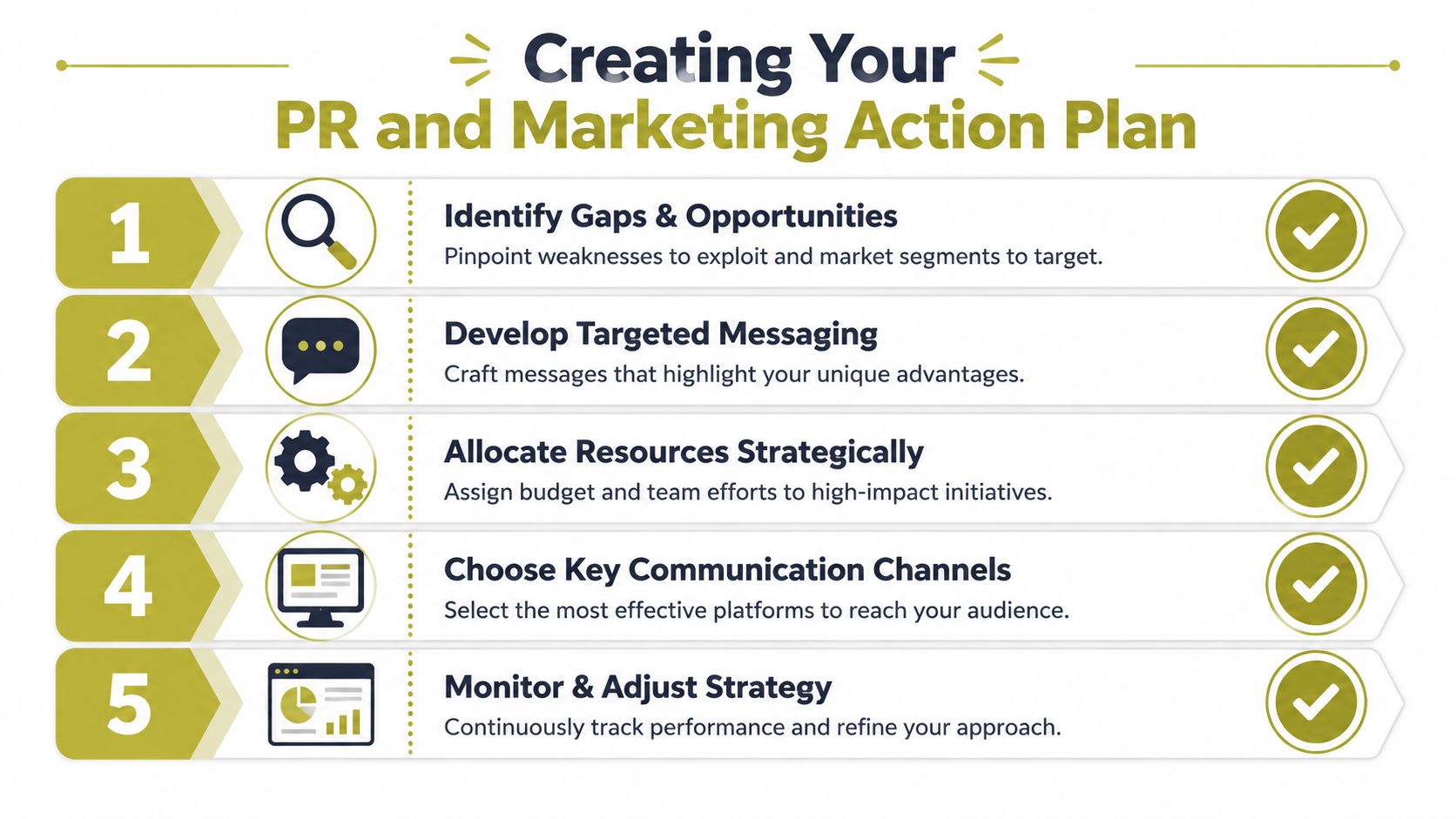
Creating Your PR and Marketing Action Plan
Analysis is only useful when it changes action. If your competitor analysis framework ends as a document nobody uses, it hasn't done its job.
The strongest teams convert findings into moves. Not general intentions. Actual tasks, owners, deadlines, and commercial reasoning.
Turn findings into actions
A simple translation model works well:
| Finding | Strategic meaning | Action |
|---|---|---|
| Competitor owns a category phrase in search | You're absent at discovery stage | Build a targeted content and SEO page set |
| Rival wins trust through third-party proof | Your proposition may lack external validation | Strengthen PR, testimonials, case evidence, and expert commentary |
| Competitor message is broad and vague | There may be room for sharper niche positioning | Rewrite messaging around a clearer audience and problem |
| Review themes show recurring service frustration | Market is vulnerable on delivery experience | Create campaigns that foreground speed, clarity, or responsiveness |
That's where PR and digital strategy should meet. Search visibility, media coverage, thought leadership, case studies, and review management all influence how a buyer compares providers.
Prioritise by leverage, not by noise
Not every finding deserves action. Prioritise based on commercial advantage.
High-priority actions
These affect conversion, visibility, or trust directly. Pricing clarity. Core landing pages. Reputation proof. Proposal messaging. Search terms with clear buying intent.
Medium-priority actions
These support the journey but don't usually decide it alone. Secondary social formats. Supporting blog content. Newsletter redesign. Minor service-page refinements.
Low-priority actions
These are easy to obsess over and rarely move the outcome much. A competitor's latest visual style. One isolated ad variation. Cosmetic copy changes with no strategic shift behind them.
The right response to competitor activity is often restraint. You don't need to answer every move. You need to answer the ones that change buyer behaviour.
If you need a structure for aligning message, channels, and objectives around those decisions, this explainer on what a communications strategy is is a practical reference point.
Keep the framework live
This work cannot be annual and still be useful. Capability shifts now change competitor sets faster than many firms realise. The Office for National Statistics reported that 11.5% of UK businesses were using AI technologies in 2024, up from 9.3% in 2023, which is a clear sign that operational capability is moving quickly and changing how firms position themselves, as covered in this UK AI adoption summary.
That matters because today's competitor advantage may not come from better pricing or a prettier website. It may come from faster response times, stronger research workflows, broader output capacity, or sharper targeting enabled by internal capability.
A live framework should monitor:
- Message shifts across homepage, social, and media commentary
- Channel shifts such as a new push into PR, SEO, partnerships, or paid
- Capability shifts including AI use, hiring patterns, and service expansion
- Proof shifts such as stronger reviews, new client types, or different authority signals
If a business wants external support in turning that intelligence into action, agencies such as Carlos Alba Media can combine PR review, messaging analysis, search benchmarking, and competitor environment assessment into a working strategy rather than a static report.
The test is simple. After reviewing your competitor analysis, can your team answer three questions clearly?
- What do we now know that we didn't know before?
- What will we do differently because of it?
- Who is responsible for making that change happen?
If those answers are fuzzy, the framework still needs work.
Carlos Alba Media helps organisations turn competitor insight into practical PR, SEO, messaging, and communications strategy. If you want a sharper view of where your brand stands, where rivals are vulnerable, and how to turn that intelligence into action, speak to Carlos Alba Media.