
Your business already has a story. The problem is getting anyone important to care. Founders usually hit the same wall. They've outgrown ad hoc press outreach, they need stronger visibility, and they know a top public relations agency could help, but the market feels crowded with big promises and vague case studies.
That's where most buying mistakes happen. Companies pick the flashiest name, the nicest credentials deck, or the agency with the broadest service list, then realise six weeks later they're paying for process instead of traction. If you're an SME, that mismatch hurts fast.
The UK PR market is far from niche. It generated about £4.6 billion in 2023 according to Statista, which tells you two things. First, demand is established. Second, agencies have to differentiate on more than media lists alone. The stronger firms now blend reputation work, digital thinking, content and crisis handling.
If your team also works with creative suppliers, it's worth thinking about how PR fits alongside animated video solutions for agencies, content production and search visibility. The best agency relationship isn't just about headlines. It's about making your brand easier to trust, quote and choose.
1. Carlos Alba Media
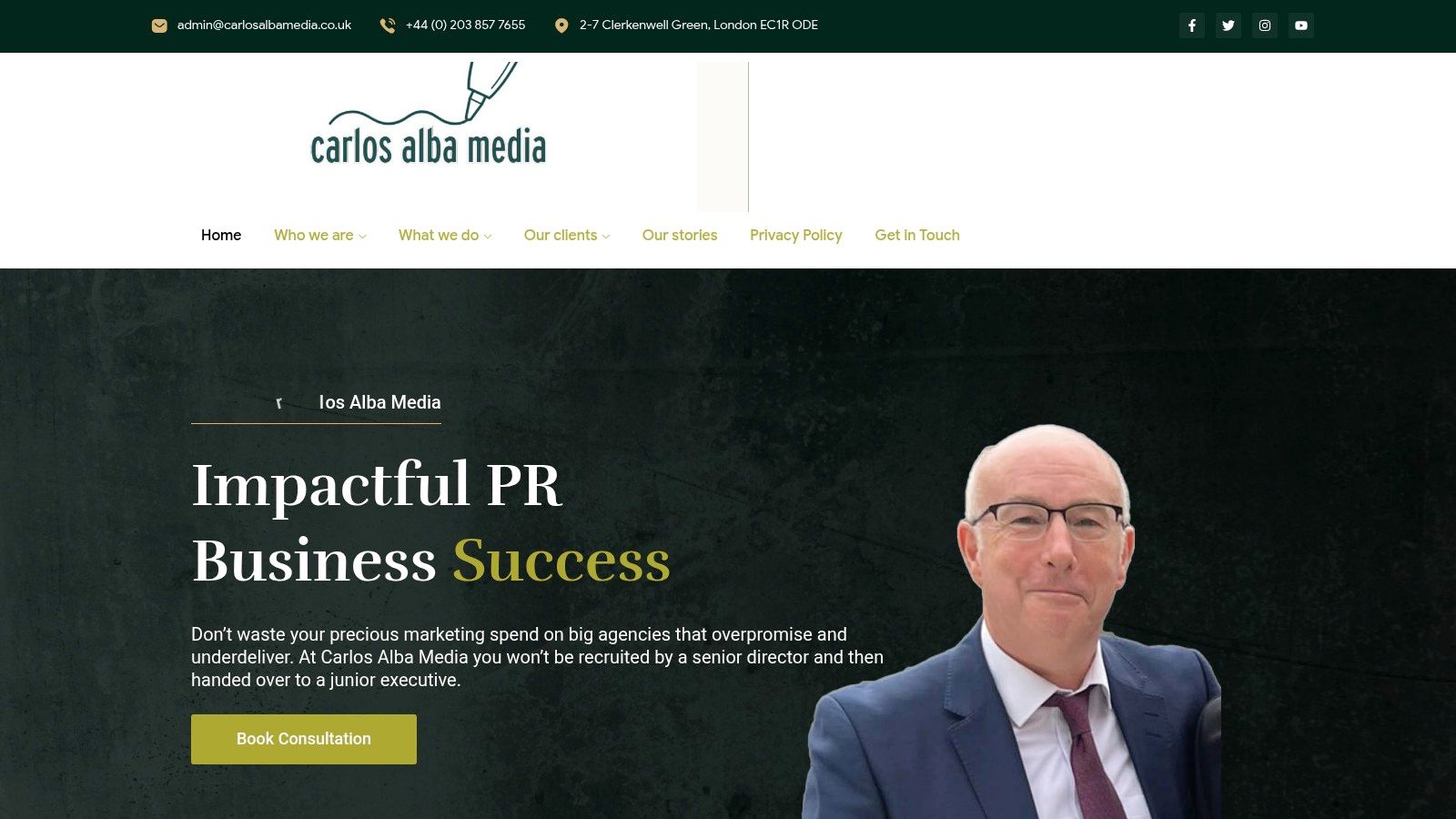
A common SME brief sounds like this. The founder wants credible press coverage, the website is underperforming, and nobody in-house has time to coordinate PR, content, social, and spokesperson prep across three separate suppliers. That is the kind of brief Carlos Alba Media is built for.
Carlos Alba Media is a smaller, senior-led agency founded by former national newspaper editor Carlos Alba. The newsroom background matters. Teams with reporting experience usually spot weak angles faster, tighten messaging earlier, and understand what an editor will reject before a pitch goes out. For founders, that often means fewer vanity ideas and more usable media opportunities.
The service mix is broader than straight press office support. It covers media relations across broadcast, print, online and social, plus SEO content, web design and development, social media marketing, media training, and crisis support with UK media lawyers. If you are comparing agencies and need a better buying checklist, this guide on how to choose a PR agency is worth reading before you ask for proposals.
Where it fits
This agency makes the most sense for SMEs that want experienced handling without paying for multiple layers of account management. That includes tourism brands, property businesses, founder-led companies, and organisations with reputation risk that need careful message control.
The client roster shows useful range, including The Johnnie Walker Experience, VisitScotland, Scotia Homes and Hamilton & Inches. That matters because PR buying decisions should be based on fit, not just fame. An agency that can handle destination marketing, property communications and reputation-sensitive work is often better prepared for the mixed commercial pressures SMEs face.
Hiring test: If you need coverage, better message discipline, and a site that turns attention into enquiries, one joined-up team can save time and reduce internal friction.
Trade-offs and budget questions
The upside is clear. Senior people stay close to the work, the offer is practical, and the agency covers more of the communications stack than many boutique PR firms.
There are trade-offs. Pricing is not published, so budget alignment needs to happen early. Ask what is included in the retainer, who will manage the account, how crisis support is scoped, and whether web or SEO work sits inside the monthly fee or as a separate project.
This is also not the obvious pick for a multi-country rollout that needs local teams in several markets at once. A larger network agency may be better for that model.
For SMEs building a shortlist, Carlos Alba Media is a strong option if the goal is senior counsel, UK media credibility, and practical support that connects PR with commercial outcomes.
2. The Romans

The Romans is the agency you call when safe won't do. Its reputation is built on earned-first creative work that lands in mainstream media and social feeds, and it has become a serious name for brands that want conversation, not just coverage.
Backed by Mother, The Romans has worked with names such as Lidl, Dove, Candy Crush and OnePlus. It also has offices in London, Amsterdam, Berlin, Dubai and New York, which makes it useful for brands that want campaign ideas that can travel.
Where it fits
This is a strong option for consumer brands, sport, launches and influencer-led activity where cultural timing matters. The team has the kind of creative confidence that helps when a brand needs fast-reacting ideas, punchy hooks and campaigns that get people talking.
If you're trying to work out whether that style is right for your company stage, this guide on how to choose a PR agency covers the core buying questions better than most agency shortlist pages do.
Creativity only matters if it fits the brief. A challenger food brand may need noise. A founder in a regulated market usually needs control first.
Pros and cautions
The upside is obvious. The Romans is consistently associated with strong creative output, quick turnaround thinking and campaigns designed for mass reach. It's a good fit when your PR brief overlaps heavily with brand fame.
The caution is also obvious. Premium creative reputations usually come with premium fee expectations, and the agency's strongest positioning leans consumer. If your brief is investor relations, public affairs, legal sensitivity or complex corporate reputation management, a more corporate specialist may fit better.
Visit The Romans.
3. Hope&Glory PR
Hope&Glory PR has a clear market position. It's an independent London agency known for big earned ideas, strong consumer instincts and campaigns that often extend into social and experiential territory.
The client mix says a lot. IKEA, Greggs, Trainline, Pokémon, CALM and the V&A all sit in very different spaces, yet each needs work that can reach broad audiences without feeling generic. That's where Hope&Glory tends to be strongest.
Why buyers shortlist it
This is a useful agency to consider if your brand sits in retail, entertainment, tech, charity or culture and you need ideas with a wide national audience. It has depth across categories and a long record of turning earned concepts into broader campaigns.
For brands worried about the downside of attention, it's also worth understanding when a creative campaign needs a stronger issues plan behind it. If that's a concern, Carlos Alba Media's page on a crisis communications agency is a sensible reminder that visibility and risk management should be planned together.
What to watch
Hope&Glory is best when the brief calls for energy, relevance and strong consumer understanding. It's a serious contender if you want national media traction without losing the social and event layer that often supports modern PR.
A few trade-offs come with that. Availability can tighten during busy periods, and the agency's centre of gravity is still consumer-facing work. If your brief leans into policy, investor communications or tightly regulated sectors, you may need a more specialist corporate team.
Visit Hope&Glory PR.
4. Tin Man
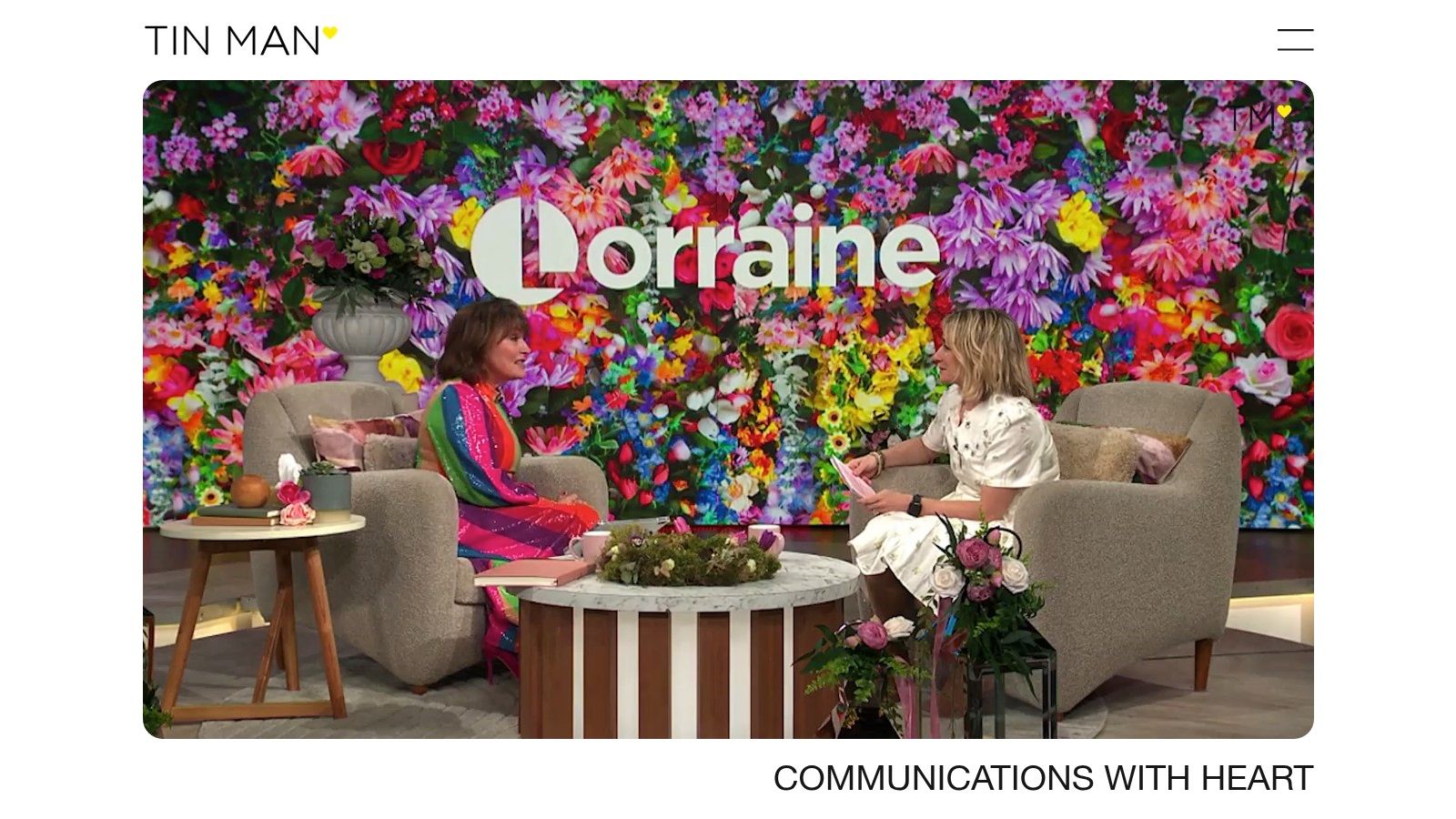
Tin Man is often a smart middle ground. It isn't trying to be the biggest agency in the room. It's trying to be the one that combines creativity, purpose and enough senior attention to keep the work sharp.
That profile suits many SMEs. You want ideas with range, but you also want to know senior people are close to the account.
Why it earns consideration
Tin Man works across travel, tourism, tech, FMCG and the third sector, with clients including Tourism New Zealand, Tesco, EDF, Guide Dogs and Vodafone/Google Pixel. That spread matters because it shows the team can shift tone. Travel needs aspiration. Charity work needs sensitivity. Tech often needs clarity more than hype.
The agency's positioning around communications with heart won't suit every buyer, but when it's backed by disciplined execution it can be a strength. Brands with a purpose-led angle often need an agency that understands message discipline as much as creative storytelling.
- Good for travel and lifestyle brands: The portfolio makes it a natural option for destination, leisure and consumer-facing briefs.
- Good for SMEs that still want creativity: You're more likely to get a close-working team than you would with a huge global network.
- Less ideal for heavyweight multinational complexity: If your brief spans multiple markets and major corporate stakeholders, larger network firms may have the edge.
The best boutique and mid-sized agencies usually win on judgment and speed, not on the number of office locations.
Trade-off in plain terms
Tin Man is a credible choice when you want smart creative without the feel of a huge agency machine. The main limitation is footprint. It's primarily London-based, so regional and Scottish delivery may rely more on remote management or partner support than on local embedded teams.
Visit Tin Man.
5. MHP Group including Mischief and Accord
Some briefs are too politically sensitive, too regulated or too multi-layered for a pure creative PR shop. That's where MHP Group becomes interesting.
The combination of MHP, Mischief and Accord gives it unusual range. You can bring consumer creativity, corporate reputation, public affairs, health communications and behavioural advisory into one group structure. For businesses dealing with government, regulators, campaign groups, media and customers at the same time, that's useful.
What it does well
This is one of the stronger options for complex stakeholder environments. If a business launch, reputation challenge or policy issue is likely to spill across multiple audiences, MHP Group is built to coordinate that. Consumer-facing attention can sit alongside board-level counsel rather than compete with it.
Its broader positioning also matches a wider UK market reality. IBISWorld identifies Publicis Groupe SA as the largest player in the UK public relations firms market, with Omnicom Group Inc. and Computershare Limited also among the biggest companies operating in the sector, and estimates the market at $25.5bn in 2026 with 4.1% CAGR between 2021 and 2026. That concentration is one reason integrated capability still matters when national campaigns go beyond publicity.
The hiring reality
MHP Group makes sense when you need depth across public affairs, financial or health work, but still want creative options in the same group. It's especially relevant for larger SMEs, scale-ups entering scrutiny-heavy sectors, and established brands with a board that wants reassurance.
The trade-off is weight. A larger structure can feel heavier than a boutique if your need is a fast, contained project with direct founder access every day.
Visit MHP Group.
6. The PHA Group
The PHA Group is one of the more practical choices for businesses that need growth PR and protective counsel in the same relationship. That's a useful combination because many SMEs don't need a pure fame machine. They need an agency that can build visibility and steady the ship when scrutiny arrives.
Its service mix includes consumer and corporate PR, crisis and issues support, digital, creative and advisory work. The client roster includes SharkNinja, Huel, Octopus Energy and Blue Cross, which points to a blend of commercial and reputation-sensitive briefs.
Why SMEs often like this model
The PHA Group has offices in London, Manchester and Leeds, plus partner support in the US. For UK businesses with regional operations, that footprint can be more practical than a London-only setup, especially when local media and regional stakeholder work matter.
This is also a good fit for category-diverse companies. The agency works across technology, healthcare, fitness, sustainability and the third sector, so it's built around specialism rather than one creative identity.
Hiring lens: If your leadership team keeps saying “we need PR, digital and crisis support, but not three separate agencies”, this kind of integrated independent often deserves a serious look.
Where it may not lead
If your brief is dominated by public affairs and heavy lobbying, there are more specialised firms. And if you want headline-grabbing stunts as the centrepiece, other consumer boutiques may push harder on that front.
Still, for many growing companies, that balance is exactly the appeal. The PHA Group feels less like a one-note shop and more like a durable operating partner.
Visit The PHA Group.
7. The BIG Partnership
If your business operates in Scotland or across the north of the UK, The BIG Partnership deserves attention. It has long been one of Scotland's most recognisable independent communications agencies, with offices in Glasgow, Aberdeen and Manchester.
That footprint matters because local relationships still count in PR. Regional media, public sector stakeholders and sector-specific networks often decide whether a story travels or stalls.
Where it's strongest
The BIG Partnership combines PR, creative, digital, social and public affairs. It has worked with clients such as Loganair, Scottish Building Society and Transport Scotland, which makes it a strong regional option for property, construction, leisure, tourism, financial services and energy.
Global scale isn't its main selling point, and that's fine. UK clients often overbuy international footprint they don't need. At the same time, footprint can still be a useful proxy for capacity in some comparisons. BrandMentions' roundup places firms such as Edelman, Weber Shandwick, BCW, FleishmanHillard, Ketchum, MSL, Hill+Knowlton Strategies and Ogilvy among leading PR agencies, noting that Ketchum operates in more than 70 countries, Hill+Knowlton Strategies has more than 80 offices globally, and Ogilvy has more than 450 offices in 120 countries. That's helpful context, but it doesn't automatically make a network agency the right choice for a Scottish growth business.
Straight assessment
The BIG Partnership is a solid option when you want strong Scottish market understanding with the ability to deliver wider UK work. It also has credibility with regulated and public-sector communications, which many creative-led agencies don't prioritise.
The limitation is style as much as scale. If your brief is pure brand-fame consumer PR, some London boutiques may feel more culturally wired for that.
Visit The BIG Partnership.
Top 7 Public Relations Agencies Comparison
| Agency | 🔄 Implementation complexity | ⚡ Resource requirements | ⭐ / 📊 Expected outcomes | 💡 Ideal use cases | ⭐ Key advantages |
|---|---|---|---|---|---|
| Carlos Alba Media | Low–medium; senior-led bespoke projects with few decision layers | Small, senior team; project-based quotes; cost-conscious for SMEs | ⭐⭐⭐⭐ National broadcast/print/online coverage and measurable digital growth | Start-ups, SMEs, founders, regulated sectors, tourism/lifestyle needing UK visibility | Senior ex-national editor counsel; fast execution; strong media contacts |
| The Romans | Medium–high; multi-office coordination for creative, travel-ready campaigns | Larger creative & influencer teams; premium retainers for multi-market work | ⭐⭐⭐⭐⭐ High-impact, culturally resonant campaigns that generate mass conversation | Consumer, sport and influencer-led launches seeking viral/multi-market reach | Award-winning creativity; in-house influencer/social; multi-market capability |
| Hope&Glory PR | Medium; integrated earned, social and experiential campaigns with event logistics | Mid-to-large team; event budgets and seasonal lead times | ⭐⭐⭐⭐ Consistent national media results and digitally amplified experiential impact | Retail, entertainment, tech and charities needing experiential earned ideas | Strong awards record; broad category experience; experiential expertise |
| Tin Man | Low–medium; mid-sized agency blending PR and social workflows | Senior attention without network overhead; regional delivery often remote | ⭐⭐⭐ Fresh creative with measurable PR/social outcomes and solid reporting | SMEs in travel, leisure, lifestyle and third sector seeking purpose-led work | Purpose-led creativity; balanced portfolio; measurable outcomes |
| MHP Group (Mischief & Accord) | High; multi-specialist coordination across corporate, consumer and public affairs | Large multidisciplinary teams; higher budgets; proprietary research & behavioural science | ⭐⭐⭐⭐⭐ Comprehensive reputation management, policy influence and consumer reach | Complex corporate, financial, health, public affairs and multi-stakeholder briefs | Full-spectrum services; behavioural science and issue-resolution expertise |
| The PHA Group | Medium; integrated PR plus dedicated crisis/issues capability | Multi-city UK footprint; flexible "fractional" resourcing; moderate budgets | ⭐⭐⭐⭐ Strong growth PR combined with robust crisis and reputation protection | SMEs needing growth PR with protective crisis/issue support across UK markets | Strong crisis expertise; flexible resourcing; regional UK presence |
| The BIG Partnership | Medium; integrated PR, digital and public affairs across regional offices | 80+ specialist team; regional offices (Glasgow/Aberdeen/Manchester) with national reach | ⭐⭐⭐⭐ Solid regional media and stakeholder influence with national delivery | Scottish and northern‑UK briefs; public sector, regulated and B2B/B2C clients | Deep Scottish/local media relationships; public affairs experience; accessible scale |
Your Next Move From Shortlist to Partnership
Monday morning, your founder gets a call from a journalist. They want comment by noon. At the same time, sales wants coverage that helps close pipeline, your website still undersells the offer, and nobody internally agrees on the key message. That is usually the point when a PR agency choice starts to show its quality.
The right hire fits your growth stage, risk level, internal bandwidth and budget. Fame matters less than fit. A well-known agency can still be the wrong call if your team needs direct senior counsel, tighter turnaround times, or stronger message work before any media outreach starts.
This is why agency selection should be handled as a hiring decision, not a popularity contest. Before you sign anything, get clear on five points: what success looks like in six months, who approves messaging, who the day-to-day lead will be, how much access you get to senior counsel, and what work sits outside the retainer. Founders often compare monthly fees and miss the bigger cost. Weak account leadership, vague scope and slow response times burn more budget than a higher retainer with the right team.
Industry rankings still have their place. O'Dwyer's view of the sector shows that fee income and market influence remain standard reference points, and its salary context underlines a basic truth. You are paying for judgement, media understanding and issue handling, not just press office output.
Keep the shortlist tight. Three agencies is enough.
Then pressure-test each one properly. Ask who writes the story angles. Ask what happens in a quiet news cycle. Ask how they handle message disagreement inside your business. Ask what they need from your leadership team every month. Ask what they will not promise. In my experience, that last answer tells you more than the pitch deck.
If your visibility plan also depends on search, content and partner delivery models, Sight AI's white label SEO guide gives useful context on how PR now fits into a wider demand-generation mix.
A good PR partner helps you say the right thing, to the right audience, at the right time, and holds up when the pressure is on.
If senior-led counsel, fast message development and practical media support matter more than big-agency layers, Carlos Alba Media is one option to review from your shortlist. As noted earlier, its mix of former national news journalists and agency operators suits founders, SMEs and Scottish growth companies that need credible coverage and quick, experienced handling.