
You're probably in one of two positions right now. Either your website and social channels feel busy but not commercially useful, or you've reached the point where doing marketing in-house is stealing time from running the business. So you search for a digital marketing agency york, open a dozen tabs, and find the same promises repeated with different branding.
That confusion is normal. Most agency pages sell services. Few help you decide what kind of partner you need, what good looks like, or how to avoid signing up for activity that never turns into enquiries, sales, or stronger market position.
This decision matters because the right agency doesn't just post content or tweak ads. It helps you clarify demand, sharpen positioning, fix attribution, and choose a channel mix your business can afford to sustain.
Why Every York Business Is Suddenly Searching for a Digital Agency
York businesses aren't imagining the shift. Demand for agency support is rising, and the local market is getting more crowded at the same time. According to Acquisition International's reporting on York's marketing growth, Google searches for “SEO agency York” doubled year on year, rising from 70 in August 2023 to 140 in August 2024. The same report says newly registered active advertising agencies in York increased by 229% from 2022 to 2023, which was higher than Leeds at 124% and Sheffield at 175%.
That combination matters. More local firms are looking for help, and more agencies are launching to meet that demand. For a business owner, that creates a harder buying environment, not an easier one. More choice often means more noise.
Why this matters commercially
The practical issue isn't whether digital marketing matters. It does. The issue is whether the agency you hire can connect marketing work to the thing you care about:
- Lead quality: not just more form fills, but better-fit enquiries
- Sales support: content and campaigns that help close business, not just attract traffic
- Brand authority: especially if buyers need to trust you before they contact you
- Operational clarity: clean reporting, realistic priorities, and no mystery around performance
A lot of York firms are now competing in a market where buyers research more, compare more, and often delay contact until they're already close to a decision. If you want a useful outside view of where search, AI, content and paid media are heading, this round-up of top digital marketing trends 2026 is a sensible place to pressure-test your own assumptions before you brief any agency.
Practical rule: If an agency conversation starts with channels before business goals, you're already in the wrong meeting.
First Define Your Destination Not Just the Vehicle
Start with the outcome. Don't start with SEO, PPC, LinkedIn, video, or “we need to be more visible”. Those are vehicles. They only make sense once you know where you're trying to go.

A York law firm, a hospitality group, a manufacturer and a founder-led consultancy can all hire the same type of agency and still need completely different plans. One might need better local intent capture. Another might need reputation-building content. Another might need to stop wasting money on broad paid campaigns and rebuild owned media first.
Match the goal to the channel
A simple way to approach it is to write down the business problem in plain English.
“We need more qualified enquiries.”
That usually points to search strategy, service-page content, conversion-focused landing pages, and clearer enquiry journeys.“We get traffic, but it doesn't convert.”
That's often a UX, messaging, offer, or tracking problem before it's a traffic problem.“People know our name locally, but not outside York.”
That tends to call for authority-led PR, expert content, brand positioning, and selective paid amplification.“Our sales cycle is long and trust matters.”
That requires case-led content, founder or expert profiling, email nurture, and stronger proof assets.
A common point of failure in agency procurement arises. Businesses ask for a service list. Better agencies ask what must change in the business if the engagement is going to be judged a success.
AI search has raised the bar
The old model of publishing generic SEO content at volume is weaker than it used to be. UK marketers now have to account for generative search, shrinking click opportunities on some informational searches, and increased scrutiny around AI use in marketing. As noted in Semrush's York agency commentary, Google's AI Overviews are reducing clicks for informational queries, while the UK's ICO and CMA are increasing scrutiny around AI, transparency and data handling. That pushes buyers toward agencies that can produce authority-led PR, expert content and compliant AI-assisted workflows, rather than just offering “more SEO”.
That distinction matters if your firm operates in a category where trust is part of the sale.
What sophisticated buyers should ask for
If you're comparing agencies, ask to see how they define authority, not just reach.
Look for things like:
- Expert-led content plans that are built around your real subject matter, not recycled keyword briefs.
- Editorial standards for claims, sourcing and tone. Former journalists often outperform generic content teams through their adherence to these standards.
- A clear AI policy covering drafting, fact-checking, data handling and human review.
- Channel logic that explains why a business should invest in owned media, paid media, PR, or a combination.
For smaller firms that need a practical starting point, Carlos Alba Media's guide to digital marketing for small business is useful because it frames digital activity around commercial priorities rather than platform obsession.
A specialist team with newsroom and agency experience can be especially effective here. Carlos Alba Media's model is relevant because everyone working there is either a former national news journalist or has agency experience with international brands. That's a different skill mix from a standard content shop. It tends to show up in sharper messaging, better media judgement, and stronger editorial discipline.
The Local vs National Debate Finding the Right Expertise for York
A common hiring question is whether to choose a York agency or a national specialist. The wrong way to answer it is by treating “local” as automatically better or “national” as automatically more advanced. Neither is true on its own.
The better question is this. What kind of expertise does your growth problem require?
When local knowledge is genuinely useful
A local York agency can be a strong fit when your marketing depends on local search visibility, regional relationships, in-person collaboration, or a close feel for the commercial character of the area.
That can matter if:
- Your customer base is concentrated nearby
- You want regular face-to-face workshops
- Your offer is shaped by local competition or local seasonality
- You need fast access to a team that understands York as a place, not just a keyword target
For some businesses, that proximity is valuable. It can reduce briefing friction and improve speed.
When broader exposure matters more
There are also cases where local familiarity is less important than specialist depth. If you need national media positioning, technical SEO beyond basic local optimisation, higher-end paid media strategy, or experienced brand storytelling, a narrow local team may not be enough.
That's especially true if your buyers aren't limited to York, or if your category is crowded and credibility-heavy.
A useful mental model comes from looking outside the region. Strong strategy in competitive markets usually depends on systems, positioning and execution quality more than postcode. This breakdown of 2026 NYC SEO strategies is relevant not because York businesses need New York tactics, but because it shows how mature operators think about search in more demanding environments.
Buyers don't pay for geography. They pay for judgement, execution and fit.
The hybrid option is often the smartest one
The strongest answer for many York firms is a hybrid model. That means working with a team that understands regional business reality but brings experience shaped by larger, more complex campaigns.
Some consultancies stand apart from both tiny local agencies and large national networks. A firm with senior teams in major UK hubs can often bring stronger editorial standards, more strategic challenge and broader brand experience, without the layers and overhead that slow down bigger agencies. For businesses comparing options beyond their immediate area, Carlos Alba Media's digital marketing agency Scotland page gives a clear sense of that kind of senior-led model.
The key is not where the agency is based. It's whether the people doing the work have solved problems like yours before, and whether they can adapt that experience to York rather than forcing a London-shaped playbook onto a regional business.
How to Vet an Agency Like a Journalist
Hiring an agency should feel closer to hiring a senior employee than buying a software subscription. You're giving people access to your brand, your data, your market narrative and often your budget discretion. That deserves proper scrutiny.
A journalist's instinct helps here. Don't ask what they claim. Ask what they can prove, how they know it, who did the work, and what happened when things didn't go to plan.
Start with the missing details
Most weak agency pitches fail under basic questioning. The proposal sounds polished, but the specifics are absent.
Ask these first:
Who will actually work on the account?
Not the founder in the pitch meeting. The day-to-day team.What happens in the first month?
If they can't explain discovery, audit, priorities and decision points, they're guessing.How do you decide which channel gets budget first?
A serious answer should mention business model, sales cycle, margins, demand capture and existing assets.What would make you advise against paid spend right away?
Good agencies know when not to launch.
Interrogate case studies properly
A lot of case studies are dressed-up activity logs. They show impressions, rankings, clicks, or “brand awareness” with no commercial context.
Ask for the chain of logic:
- What was the business problem?
- What hypothesis did you form?
- What did you change first?
- What metrics mattered?
- What did you learn that changed the plan?
If they can only speak in platform outputs, not business outcomes, be careful.
Editorial test: If a claim would fail fact-checking in a newsroom, it should fail your procurement process too.
Agency Vetting Checklist Beyond the Basics
| Area of Inquiry | Key Question to Ask | What to Listen For (Green Flag / Red Flag) |
|---|---|---|
| Team structure | Who will manage strategy and who will execute day to day? | Green flag: named people, clear roles, senior oversight. Red flag: vague “our team” language |
| Discovery process | What do you need from us before recommending channels? | Green flag: wants access to sales insight, CRM context, current analytics, customer objections. Red flag: recommends tactics before diagnosis |
| Content quality | How do you develop messaging and approve factual claims? | Green flag: interviews experts, uses editorial review, validates claims. Red flag: depends on generic AI copy with light editing |
| Reporting | What will your monthly report help us decide? | Green flag: includes interpretation and next actions. Red flag: dashboard dump |
| Paid media | What conditions need to be in place before ads scale? | Green flag: mentions landing pages, tracking, offer strength, conversion path. Red flag: “we'll just test and see” |
| SEO approach | How do you prioritise between technical work, content and authority? | Green flag: ties priorities to business intent. Red flag: talks mainly about ranking volume terms |
| Outsourcing | What parts of delivery are outsourced? | Green flag: transparent about partners and quality control. Red flag: evasive or defensive |
| Communication | How often will we review strategy, not just tasks? | Green flag: regular strategic review rhythm. Red flag: only ad hoc updates |
| Risk handling | What do you do when a campaign underperforms? | Green flag: explains diagnosis, testing and reset process. Red flag: blames algorithm changes |
| Asset ownership | Who owns the creative, ad account data and website assets? | Green flag: client ownership is clear in writing. Red flag: murky answers |
Watch how they ask questions
The best agencies aren't the slickest talkers. They're usually the ones who slow the meeting down and ask uncomfortable but useful questions about margins, capacity, sales quality, compliance and internal bottlenecks.
That's often where journalist-trained strategists stand out. They're used to testing assumptions, spotting weak evidence, and tightening a story until it holds up under pressure.
Decoding Proposals Pricing and Contract Red Flags
Once proposals arrive, many businesses compare the monthly fee first. That's understandable, but it's not enough. The bigger issue is whether the scope matches the objective, whether the work is senior-led, and whether the contract gives you a fair operating position.
Many UK SMEs are trying to make careful budget decisions in a market where competition for attention is expensive. As noted in Atomic Social's discussion of SME digital growth pressures, the UK digital ad market reached £35.5bn in 2024, while many smaller firms still face tight digital budgets and need clearer answers on what they get for their money.
The main pricing models
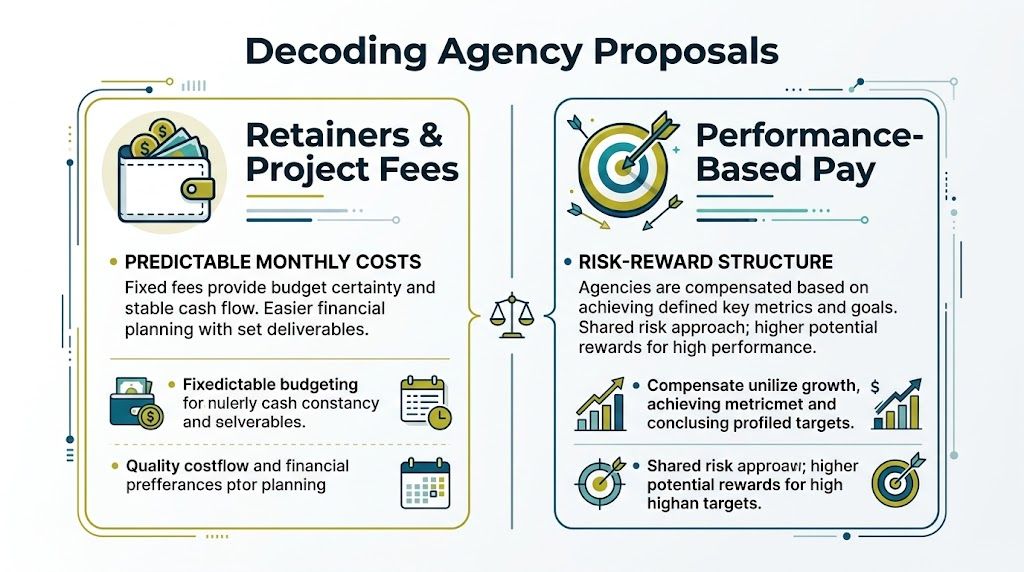
Each pricing model suits different situations. None is universally right.
Retainer
A retainer works best when you need ongoing strategic input, regular execution, and continuity across channels. It's often the right fit for SEO, content, PR, organic social, CRO and integrated campaigns.
The upside is consistency. The risk is drift. If the scope is vague, retainers can become a monthly list of tasks detached from commercial priorities.
Project fee
Project pricing suits a defined piece of work such as a website rebuild, a content sprint, a messaging overhaul, or a one-off audit.
This model is easier to budget for and easier to judge. The limitation is that many growth problems don't end neatly when the project ends.
Performance-based pay
This sounds attractive because it appears to reduce risk. In practice, it can create distorted incentives unless the attribution model is very clear.
If the agency is paid only when a narrow metric moves, they may prioritise short-term gains over long-term brand value, or avoid important but less immediately measurable work like positioning, UX improvements or authority-building content.
What a proposal should make obvious
A good proposal should tell you, in plain language:
- What problem the agency thinks it is solving
- What it will do first and why
- What is included and excluded
- Who is responsible for approvals, assets and access
- How performance will be reviewed
- What happens if priorities change
If a proposal is heavy on deliverables and light on rationale, that's a warning sign.
Cheap scope often becomes expensive rework.
Contract terms that deserve scrutiny
Do not skim the legal pages. Avoidable pain hides in those sections.
Look closely at:
Lock-in periods
A long commitment can be reasonable if the strategy needs time, but it should be balanced by review points and clear obligations on both sides.Notice periods
If the exit terms are harsh, you may end up paying through months of low confidence.Asset ownership
You should know who owns ad accounts, copy, design files, tracking setup and website assets.Scope wording
If everything is framed as “support” or “assistance”, accountability can become slippery.Approval dependencies
Agencies shouldn't be blamed for delays caused by missing client approvals, but the process should be explicit.
A lower fee with poor scope, junior staffing and unclear ownership isn't a better deal. It's just a cheaper way to buy uncertainty.
From Kick-off to KPIs Measuring What Matters
A strong agency relationship becomes obvious in the first month. Not because results fully arrive by then, but because the foundations are either being built properly or they aren't.
The first technical checkpoint is measurement hygiene. According to Improvado's guidance on agency measurement setup, if conversion tracking or UTM tagging is missing, the first month often gets spent repairing attribution. The same guidance warns that disconnected data blocks any serious attempt to prove business impact, which is why auditing tracking and connecting CRM and ad platforms should happen before performance campaigns are pushed live.

What good onboarding looks like
A proper kick-off should involve more than a welcome call and a request for admin access.
A serious agency will usually want to review:
- Current analytics setup
- CRM stages and lead handling
- Sales objections and close patterns
- Existing landing pages and offers
- Past campaign history
- Internal approval routes
This is not admin for its own sake. It determines whether future reporting means anything.
Stop rewarding vanity metrics
Traffic, reach, impressions and follower growth can all be useful context. None of them should sit at the top of the reporting hierarchy unless they clearly support a business outcome.
Better KPI conversations usually sound like this:
| Weak KPI focus | Strong KPI focus |
|---|---|
| More clicks | Better-quality enquiries |
| More followers | More sales conversations from the right audience |
| Higher traffic | Stronger conversion rate on priority pages |
| More leads | Better lead-to-sale visibility |
| More rankings | More demand capture on commercially relevant searches |
A board or founder doesn't need a colourful dashboard. They need a view of what changed, why it changed, and what should happen next.
The report should help you decide something
The best monthly reports do three jobs.
- They explain performance in business terms.
- They separate signal from noise.
- They recommend specific next actions.
If the report can't tell you whether to increase spend, cut a channel, change the message, improve a page, or fix a tracking problem, it's not strategic reporting. It's admin.
For businesses that want to tighten this side before they appoint anyone, this SEO audit checklist is a practical starting point because it forces a look at the underlying site and tracking issues that often distort agency performance from the outset.
If you want a wider perspective on commercial accountability, even outside SaaS, this guide on maximizing marketing returns for SaaS is worth reading because it reinforces the same principle. Marketing only becomes useful when measurement connects spend to outcomes.
A campaign can look busy for months while the business learns almost nothing from it.
Your Agency Brief Template and Final Check
Before you contact agencies, write a brief that covers your goals, current challenges, budget range, timelines, internal resources, existing tracking setup, and what success would look like after the engagement. Keep it plain. Clarity beats polished language.
Then do one final check. Are you hiring a supplier to complete tasks, or a partner to improve decisions? The best relationships do both, but the second part matters more. A good digital marketing agency york should bring judgement, challenge weak assumptions, and give you confidence that the work is tied to revenue, reputation, or market position.
If an agency can't explain the commercial logic behind its plan, don't sign the contract.
If you want a senior-led second opinion before appointing an agency, Carlos Alba Media can help assess your brief, pressure-test proposals, and shape a digital strategy grounded in PR judgement, editorial discipline and measurable business goals.