
You're probably in one of two positions right now. You run a small or mid-sized UK business, you've spent money on social media and maybe a bit on paid search, and you're still asking the most sensible question in marketing: what gives me a reliable return? Or you've already got a list sitting in Mailchimp, Klaviyo, HubSpot or somewhere similar, and it's underused, badly segmented, or one compliance mistake away from becoming a headache.
That's where a serious email marketing service uk discussion starts. Not with flashy templates. Not with AI jargon. Not with a giant list of platforms copied from affiliate sites.
It starts with control.
Email gives you a direct line to customers, prospects, guests, investors, partners and past buyers. For UK SMEs, especially in tourism, hospitality, property, professional services and B2B tech, that matters because your margins are tighter, your sales cycles can be uneven, and your brand reputation often carries more weight than brute-force ad spend. At Carlos Alba Media, the thinking is shaped by former national news journalists and agency professionals who've worked with international brands. That changes the advice. Journalists know the value of a trusted contact list. Good marketers should treat an email list the same way.
Why Email Marketing is Your Secret Weapon in the UK Market
A hotel owner in the Highlands, a restaurant group in Glasgow, a software founder in London. They often make the same mistake. They chase attention on rented platforms while ignoring the audience they could own.
That's why email still punches above its weight. UK email advertising spend is forecast to reach £883.46 million in 2025, and the channel delivers an average ROI of £38.33 for every £1 spent, according to Charle's email marketing statistics summary. Those numbers matter because they cut through the waffle. Businesses aren't spending that kind of money on a dead channel.
The primary advantage isn't only return. It's resilience. Social reach changes. Ad costs rise. Search results fluctuate. Your email list remains an asset you can keep building.
Practical rule: If your business depends on repeat custom, seasonal demand, local loyalty or long consideration cycles, email should sit near the centre of your marketing, not at the edge.
A good list also behaves like a newsroom contact book. You don't buy trust at the last minute. You build it over time, contact by contact, message by message. The businesses that understand that tend to get better responses when they launch a new offer, announce an event, push a booking window, or need to steady nerves during a difficult patch.
That's why email works well inside a broader strategy such as digital marketing for small business. It supports search, strengthens PR, feeds remarketing, and gives you a channel that doesn't vanish when an algorithm decides your visibility has peaked.
Where UK SMEs get it wrong
Many SMEs treat email as a bulletin board. A monthly update. A discount blast. A last-minute panic send when sales are slow.
That approach wastes the channel.
A better model is simple:
- Capture intent: Use sign-up points on your site, booking flow, enquiry forms and lead magnets.
- Segment early: Separate past customers, prospects, trade contacts and inactive names.
- Automate key moments: Welcome emails, follow-ups, reminders, abandoned enquiries and reactivation messages.
- Write like a person: Clear subject lines, one main point, one sensible next step.
If you only remember one thing, remember this. Email works best when it behaves less like advertising and more like informed, timely communication.
Assessing Your Business Needs Before You Shop
Most businesses choose an email platform the wrong way. They pick the one they've heard of, the one with the prettiest interface, or the one a salesperson made sound “scalable”. Then they discover it doesn't fit how they sell.
Start with your operation, not the software.

Ask what email must do for the business
A tourism brand and a B2B tech firm may both need email marketing. They do not need the same setup.
If you run hospitality, leisure or retail, you may need strong design tools, booking-linked campaigns, event pushes, seasonal promotions and simple automations. If you run B2B, you may need lead nurture sequences, webinar follow-up, sales alerts, CRM syncing and cleaner reporting across a longer buying journey.
Write down answers to these questions:
- What are you trying to generate? Bookings, enquiries, repeat purchases, demo requests, footfall, attendance, referrals.
- Who are you emailing? Consumers, trade buyers, business decision-makers, past customers, warm leads, lapsed contacts.
- What triggers matter? Sign-up, purchase, quote request, abandoned basket, brochure download, event registration.
- What systems must connect? Shopify, WooCommerce, a CRM, event software, booking tools, forms, analytics.
The point isn't to produce a masterpiece. The point is to stop yourself buying a platform built for someone else.
Separate needs from wish-list nonsense
Senior strategy matters at this stage. At Carlos Alba Media, work typically starts with counsel before execution, because tools don't rescue fuzzy thinking. If you need support shaping that before choosing a system, consultant email marketing advice is the sensible place to start.
Use this simple distinction:
| Business reality | What you need |
|---|---|
| Small list, limited time, basic sales cycle | Straightforward automations, clean templates, easy reporting |
| Growing ecommerce operation | Product-linked triggers, revenue tracking, abandoned basket flows |
| B2B lead generation | CRM integration, pipeline visibility, multi-step nurture journeys |
| Regulated or reputation-sensitive sector | Strong consent handling, permissions records, controlled workflows |
Don't pay for complexity because you feel you should be “future-proofing”. Most SMEs need fewer features and better discipline.
Build a one-page requirements brief
Before you speak to any vendor, create a document with five headings:
- Audience groups
- Essential integrations
- Must-have automations
- Compliance requirements
- Monthly budget tolerance
That one page will save you from bad demos and worse contracts.
It also helps you spot the difference between a useful service and a bloated platform. If a vendor can't explain clearly how their system handles your actual list, your actual customer journey and your UK compliance needs, move on.
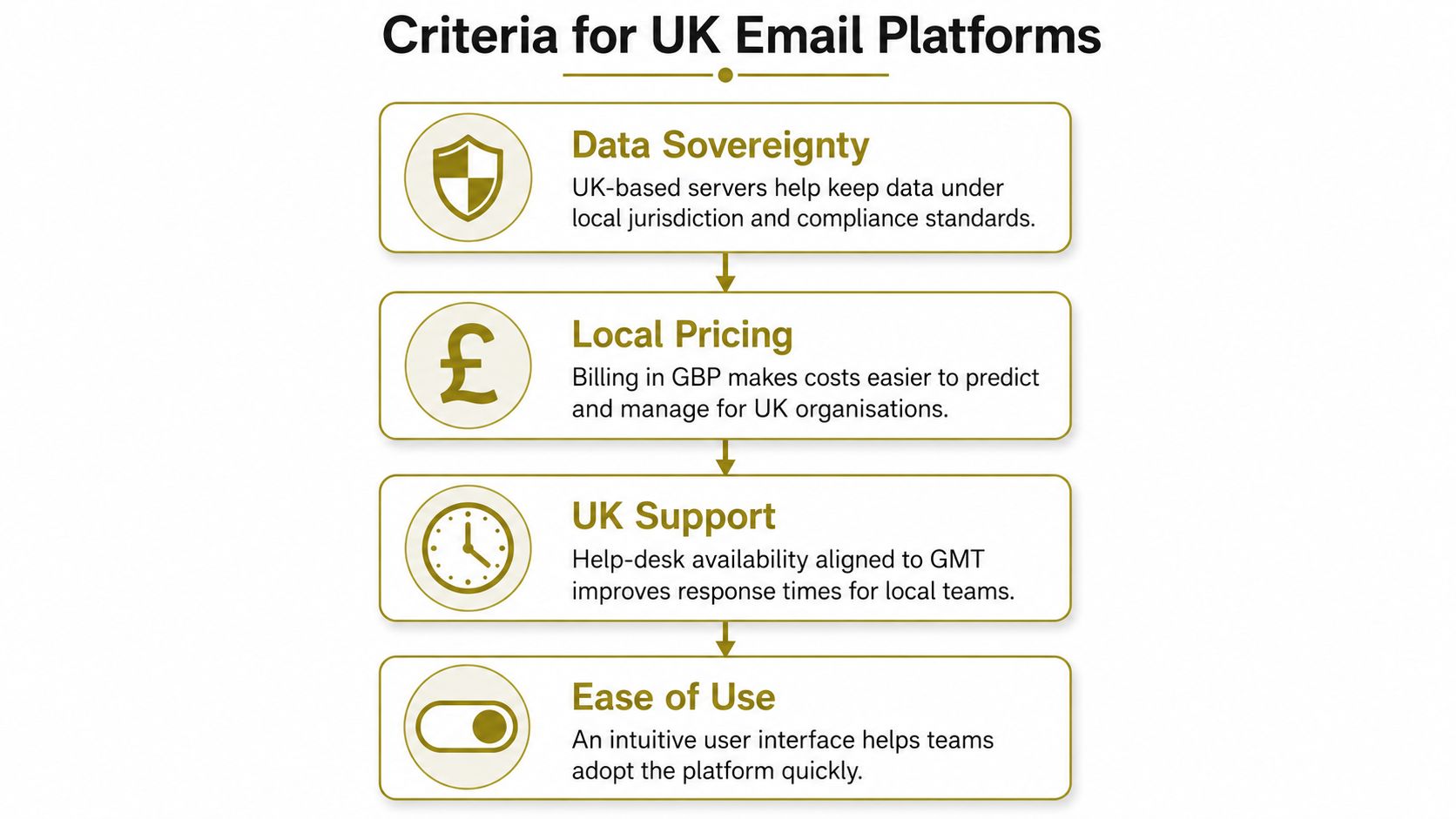
Evaluating UK-Friendly Email Marketing Services
A proper platform review isn't about who has the most features. It's about who solves your problems without creating new ones.
Essential features versus expensive distractions
The market is full of overbuilt tools. Most SMEs need a platform that handles list management, segmentation, automation, templates, reporting and consent records well. That's the core.
AI features are where many providers now try to inflate the bill. AI in email can lift open rates by 35%, but premium features often start at £200 per month and price out 70% of UK start-ups, according to Encharge's UK email marketing analysis. That doesn't mean AI is pointless. It means you should be ruthless about whether you need it now.
A sensible rule is to buy automation before AI. If your welcome journey is weak, your abandoned basket flow is missing, and your segmentation is crude, paying extra for AI subject line suggestions is cosmetic.
What to score in a platform demo
When you sit through a demo, ignore the polished dashboard and test these points instead:
- Automation depth: Can it trigger emails based on sign-up, purchase, enquiry, inactivity or form behaviour?
- Segmentation logic: Can you build useful groups without needing a data engineer?
- Template control: Can your team produce mobile-friendly emails without constant developer help?
- Permission tracking: Can you see when and how someone consented?
- Reporting quality: Can it show more than opens and vanity charts?
One practical resource worth reading alongside vendor claims is this guide to ReachInbox on email deliverability. It's useful because deliverability is where flashy sales decks often go quiet.
Deliverability is not a technical footnote
If your emails don't land properly, nothing else matters.
Deliverability depends on sender reputation, authentication, list quality, sending behaviour, and relevance. A vendor can help, but the platform alone won't save poor practice. That's why any serious email marketing service uk decision should include questions about authentication support, suppression handling, bounce management and how easy it is to remove stale contacts.
A cheaper platform with clear deliverability controls is often a better investment than a premium system packed with features your team won't use.
Integrations decide whether the platform helps or hinders
Many businesses get trapped here. A platform looks fine in isolation, then turns awkward once it meets your website, CRM or ecommerce setup.
Check these areas:
| Integration area | What to ask |
|---|---|
| Website forms | Does subscriber data pass in cleanly and with consent records? |
| Ecommerce | Can product, purchase and basket behaviour trigger emails? |
| CRM | Will sales and marketing see the same contact status? |
| Analytics | Can you track clicks, journeys and conversions clearly? |
For some SMEs, a light setup in Mailchimp or Brevo will be enough. For others, HubSpot or Klaviyo may make more sense. There's no universal winner. There's only fit.
Carlos Alba Media can also be used as one option where businesses want campaign strategy and execution support around newsletters and sales-focused sequences, rather than relying only on in-house setup. That matters if your issue isn't software selection alone but message quality, timing and integration with PR and digital activity.
Navigating GDPR, PECR and UK Data Residency
If a provider brushes past compliance in two sentences, don't hire them.
Too many “email marketing service uk” pages mention GDPR because they have to, then leave SME owners to figure out the hard part alone. That's reckless. Email law in the UK isn't background noise. It's part of your brand protection.

Know the difference between GDPR and PECR
Here's the plain-English version.
GDPR governs how you collect, store and use personal data. PECR governs electronic marketing communications, including many marketing emails. You need to think about both.
That means asking two separate questions:
- Do I have a lawful basis to process this person's data?
- Do I have permission to send them this kind of marketing email?
Those questions overlap, but they aren't the same.
Consent is where SMEs get casual and then get hurt
Business owners still say things like, “I met them at an expo, so I can email them,” or “They downloaded a brochure, so they're fair game.” Sometimes that thinking is wrong. Sometimes it's dangerously wrong.
The ICO can issue fines for PECR non-compliance, with some reaching £130,000 in 2024, according to Clutch's overview of UK email marketing agencies and compliance considerations. You don't need a six-figure fine to have a serious problem. One complaint, one bad screenshot, one angry LinkedIn post can damage trust faster than most SMEs expect.
Newsroom view: Reputational damage rarely starts with the headline. It starts with a preventable mistake that gave someone a reason to complain publicly.
If you want a practical companion piece on consent-led sending, this comprehensive 2026 email marketing guide from EmailScout is worth your time because it focuses on permission-based practice, which is the right default mindset.
Real-world questions to ask before you send
Use this quick test with your team.
- Trade show contact: Did the person explicitly opt in to marketing, or did they exchange details for one conversation?
- Website enquiry: Did your form make it clear they were joining a marketing list, or did they only request a callback?
- Past customer: Are you sending about similar services, and did you give a clear opt-out when collecting details?
- Purchased list: Don't use it. It creates legal, reputational and deliverability risk in one move.
A lot of compliance trouble comes from sloppy internal assumptions, not malice.
Here's a useful explainer to watch if your team needs the topic translated into simpler terms before platform setup or campaign planning:
Data residency is a commercial question too
If a provider stores data outside the UK, don't panic, but don't shrug either. Ask where data is hosted, what safeguards are in place, how cross-border transfers are handled, and what contractual terms support that arrangement.
For some SMEs, especially in regulated sectors or public-facing organisations, this becomes a procurement issue as much as a legal one. You may need a provider that can answer data handling questions cleanly, in writing, and without evasive language.
Your email platform is not just a marketing tool. It is part of your data supply chain. Treat it that way.
Understanding Pricing and Avoiding Contract Traps
The cheapest plan is often the most expensive mistake.
A lot of SMEs compare headline subscription prices and stop there. That's how they end up with an account that looks affordable until the contact list grows, automations are locked behind upgrades, or support becomes mysteriously unavailable when something breaks.
Read pricing pages like a sceptic
You'll usually see one of three charging models:
- Per subscriber: Fine if your list is lean and regularly cleaned.
- Per send: Better if you have a larger database but mail selectively.
- Tiered bundles: Common, but often loaded with feature gates.
None is automatically wrong. The problem is hidden cost.
Watch for these questions:
- Are key automations included, or reserved for higher plans?
- Do archived or unsubscribed contacts still count toward billing?
- Will you pay more for extra users, advanced reporting, or premium templates?
- Is support email-only unless you upgrade?
One useful perspective comes from Mailtani's guide on stop overpaying for email marketing, which is worth reading before you talk to sales teams.
Monthly versus annual contracts
If you're still testing fit, choose monthly. It gives you room to discover whether the platform works with your team, your list and your commercial reality.
Annual contracts make more sense once you know three things: your contact growth is predictable, your required features are stable, and your team can use what you're paying for. Too many SMEs lock into annual pricing because the discount looks attractive, then spend a year compensating for a poor setup.
Buy software the way you'd hire a supplier. Test responsiveness, clarity and fit before making a longer commitment.
What to negotiate
Vendors expect negotiation more often than SMEs realise. Ask directly about:
| Contract area | What to push for |
|---|---|
| Onboarding | Setup support or migration help |
| Contact limits | Breathing room before automatic jumps |
| Support | Named help during initial rollout |
| Exit terms | Clean export rights and contract clarity |
The worst trap isn't price. It's being tied to a platform that your team avoids using because it's too fiddly, too opaque or too expensive to run properly.
Your Smooth Migration and Onboarding Checklist
Migration is where businesses create avoidable damage. They rush imports, ignore consent history, skip authentication, and then wonder why performance tanks.
Slow down and do it properly.
Clean the list before it enters the new system
A migration is the best moment to get rid of clutter.
Remove old duplicates, obvious junk addresses, role-based addresses you shouldn't be marketing to casually, and contacts whose consent status you can't explain. Tag groups clearly before import so you don't dump every name into one giant list and lose all context.
Use labels that reflect business reality, not internal chaos. “Past guests”, “trade leads”, “demo requests”, “newsletter sign-ups”, “inactive subscribers”. That will make your first automations far easier to build.
Authenticate the domain before your first serious send
This part isn't optional. Implementing SPF, DKIM and DMARC properly can boost UK email deliverability by up to 98%, and misconfigurations are linked to an estimated 40% of emails being blocked by ISPs, according to RD Marketing's email marketing statistics summary.
If that sounds technical, the business meaning is simple. Authentication tells inbox providers your emails are legitimate. Without it, you're making life harder for yourself from day one.
Your onboarding checklist should include:
- Confirm sending domain ownership
- Set up SPF, DKIM and DMARC with the platform
- Verify branded sending addresses
- Test internal and external delivery
- Check spam folder placement before scaling sends
Build two automations before anything fancy
Don't start with a labyrinth of journeys. Start with the two sequences almost every SME should have.
- Welcome email or welcome series: Sent when someone joins your list. Introduce the brand, set expectations and give one clear next step.
- Behaviour-based follow-up: For ecommerce that might be abandoned basket. For B2B it might be a follow-up after a guide download or enquiry.
Get the first ten operational details right before chasing advanced segmentation. Clean data and proper setup beat clever ideas badly executed.
Run a controlled first month
For the first few weeks, watch responses closely. Check unsubscribes, replies, deliverability warnings, suppression lists and how different segments behave. Migration isn't finished when the contacts appear in the new dashboard. It's finished when the new setup sends reliably and your team trusts it.
Sample Workflows and Measuring What Matters
Most email programmes fail because they're built around sends, not journeys.
A Scottish tourism operator might use a simple welcome sequence like this. First email: thanks for signing up, with a local guide or seasonal highlight. Second: a story-led email on nearby experiences or reasons to visit at a quieter time. Third: a booking prompt tied to interest, such as family breaks, whisky tourism or walking routes. That sequence respects intent and builds desire before asking for action.
A London B2B tech SME needs something different. The first email after a content download should clarify the problem your service solves. The second should offer a proof point or useful insight. The third should invite a conversation, demo or consultation without sounding desperate.
For performance context, UK B2B email campaigns average an 18% open rate and a 0.9% click-through rate, while automated workflows and personalised content can drive engagement that is 2 to 3 times higher than standard broadcasts, according to B2B Marketing's UK email benchmark report.
That benchmark is useful, but don't obsess over opens alone.
The metrics worth your attention
Track these in priority order:
- Clicks: They show real interest better than opens.
- Conversions: Bookings, leads, purchases, calls, quote requests.
- List growth quality: Are the right people joining?
- Reply signals: Especially valuable in B2B and service businesses.
- Segment performance: Which audiences move?
Open rate still has directional value, but it shouldn't run your strategy. If more people open and nobody acts, your issue isn't distribution. It's relevance, offer, landing page, or timing.
That's also why email should connect with broader content marketing for lead generation. The strongest programmes don't treat email as an isolated channel. They use it to amplify stories, support launches, extend PR coverage, revive dormant interest and turn attention into commercial action.
If you want an email programme that's compliant, commercially sensible and written with the judgement of people who understand both headlines and conversions, Carlos Alba Media can help shape the strategy, sharpen the messaging and build campaigns that fit how UK SMEs operate.