
Brand positioning is the strategic process of carving out a unique space in your customer’s mind so they see you as the right answer to a specific problem. In the UK, brands with strong, differentiated positioning achieved 23% higher market share growth than those without.
If you’re a founder, you’ve probably felt the problem already. Two firms can offer near-identical services, charge similar rates, and target the same audience, yet one gets remembered, recommended and covered, while the other gets ignored. That gap usually isn’t explained by effort. It’s explained by position.
In practical terms, what is brand positioning in marketing? It’s the decision about what you want to be known for, by whom, and in contrast to what alternatives. It shapes the story people tell themselves about your business before they buy, after they buy, and when they describe you to someone else.
That matters even more for SMEs. You rarely have the budget to outspend bigger competitors, so you have to out-clarify them. At Carlos Alba Media, that’s how we approach it. Our team is made up of former national news journalists and agency professionals who’ve worked with international brands. We know how stories earn attention, how messages survive contact with real audiences, and how a vague proposition collapses the moment it faces a newsroom, a search result, or a sceptical buyer.
Defining Brand Positioning and Its True Purpose
A useful way to understand positioning is to compare two businesses that look similar on paper.
One describes itself as a “full-service marketing agency for all businesses”. The other says it helps regulated UK SMEs turn complex offers into media-ready stories that build trust with buyers and stakeholders. Same category. Very different position. The second is easier to remember, easier to refer, and much easier to pitch.
That’s the fundamental purpose of positioning. Not to sound clever in a workshop, but to help the right people understand why your brand exists and why they should choose it over other options. A good position narrows your message so your relevance gets sharper.
Positioning is what you want to own in the mind
Positioning isn’t a slogan and it isn’t your logo. It’s the idea you want to own. Sometimes that idea is expertise. Sometimes it’s speed, trust, design quality, local insight, or a distinctive way of solving a known problem. The point is that it must be specific enough to matter.
Strong positioning answers three questions fast: what you do, who it’s for, and why your version is different.
That’s where many SMEs get stuck. They describe their services accurately but not memorably. They list features. They pile on generic promises like “cutting-edge”, “customized”, and “customer-centric”. Buyers skim that language because every competitor says the same.
A clearer way to get there is to first define your brand's voice, then test whether that voice supports a distinct market position rather than just a preferred tone. Voice helps you sound consistent. Positioning decides what consistent message you keep repeating.
Why newsroom thinking helps
Former journalists look for angle before output. We ask what makes this story worth covering now, who it matters to, and what tension or contrast makes it land. Brands need the same discipline.
If your business can’t be summed up in a sharp, believable line, your marketing gets expensive. Your PR pitch lacks a hook. Your website drifts into abstraction. Your sales conversations become longer than they need to be.
That’s why positioning sits upstream of communications planning. If you need a deeper look at how that translates into action, this guide on what a communications strategy is is useful because it shows how your message, channels and commercial goals need to line up.
Why Positioning Is Your Most Important Marketing Decision
A founder sits down to review a disappointing quarter. The website traffic looked healthy. Paid campaigns generated clicks. A few journalists even opened the pitch. Yet sales calls kept drifting into long explanations, prospects pushed on price, and referrals were vague. The problem often is not effort. It is position.

Positioning shapes how the market interprets everything you do. It affects who pays attention, what they expect to pay, how quickly they understand your offer, and whether your story travels beyond your own channels. For SMEs, that makes it one of the few marketing decisions that directly affects commercial efficiency, not just brand appearance.
In practice, weak positioning creates friction across the whole business. Marketing attracts attention from people who were never a fit. Sales teams spend time translating what the company does. PR loses force because there is no sharp angle for an editor or producer to grab. Partnerships look attractive on paper but blur the brand in the market.
Strong positioning reduces that drag.
It gives every team a clearer filter for decisions. Which audience matters most. Which claims are worth repeating. Which opportunities support the business and which ones send it sideways. I have seen this repeatedly in PR work with growing brands. The companies that get coverage, trust and conversion more efficiently are rarely the ones saying the most. They are the ones the market can place quickly.
Clear positioning improves commercial outcomes
Better positioning changes buyer behaviour because it makes choice easier. Buyers do not study every option in depth. They use shortcuts. They look for the brand that feels most relevant, most credible and easiest to understand.
That has direct commercial consequences. A clear position supports stronger pricing because the offer feels more specific. It improves conversion because prospects arrive with a better grasp of why the business exists. It also lowers wasted spend. If the message is fuzzy, even a well-run campaign can bring in the wrong traffic, the wrong enquiries, and the wrong expectations.
For founders, the trade-off is real. A sharper position usually means ruling some people out. That can feel uncomfortable, especially in a small business where every lead looks valuable. But broad, cautious messaging often costs more than it saves. You get a wider top of funnel and a weaker middle and bottom.
It makes every downstream decision easier
Once the position is clear, several hard calls become simpler:
- Pricing gets easier to defend because the business is framed around a distinct outcome, not a generic service list.
- Content gets tighter because the team knows which topics reinforce the brand and which ones dilute it.
- PR gets more usable because there is a defined audience, a stronger point of view, and a clearer story hook.
- Partnerships get easier to assess because you can judge whether an opportunity strengthens recognition or creates confusion.
- Sales conversations get shorter because prospects understand the category, the problem and the difference earlier.
Practical rule: if a competitor could copy your positioning line with minor edits and it would still sound believable, the position is still too weak.
This matters even more in crowded UK SME categories where buyers compare several similar providers at once. Positioning gives them a reason to remember one.
What doesn’t work
Three mistakes come up again and again.
The first is trying to sound broad enough for everyone. That usually produces language no one remembers. The second is treating design, tone or a new website as the answer. Good branding helps, but it cannot carry a business that has not decided what distinctive place it wants to hold in the buyer’s mind. The third is claiming a difference that operations cannot support. If the delivery does not match the promise, the market corrects the story quickly.
Good positioning has to survive contact with reality. It has to work in a sales deck, on a homepage, in a media pitch, and in the experience clients receive. That is why this decision sits so high up the chain. Get it right, and PR, digital marketing and sales all work harder from the same starting point.
The Core Frameworks for Defining Your Position
A good strategy isn’t built from instinct alone. It needs a few working tools. For SMEs, three frameworks do most of the heavy lifting: the positioning statement, the value proposition lens, and the perceptual map.
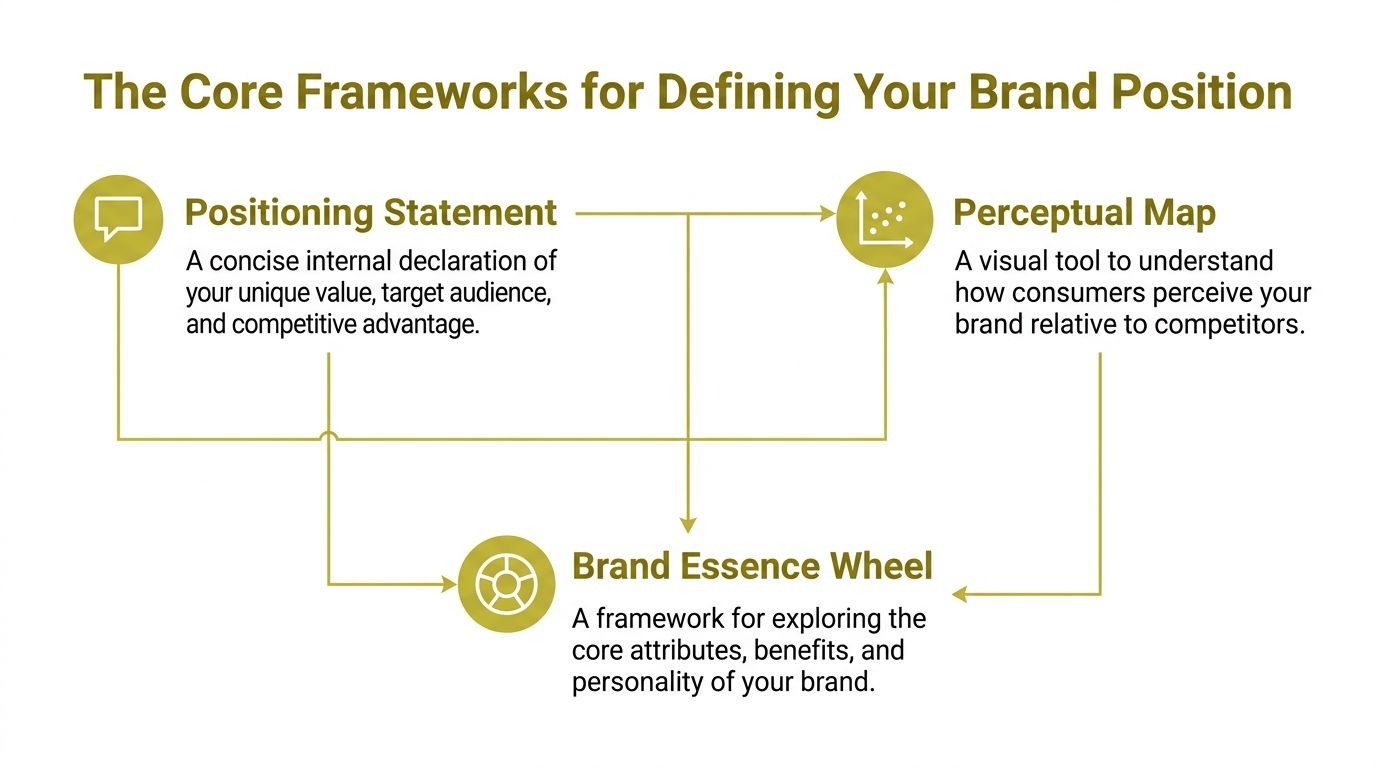
Each has a different job. Don’t use one tool for all three.
The positioning statement
This is an internal line, not public-facing copy. Its job is to force strategic precision. It should tell your team who you serve, what category you’re in, what outcome you deliver, and why your offer is meaningfully different.
A simple version looks like this:
| Element | Description | Example |
|---|---|---|
| Target audience | The specific group you want to win | UK tech founders entering regulated markets |
| Category | The market or service space you compete in | PR and digital communications consultancy |
| Primary benefit | The main outcome the audience gets | Clearer visibility and stronger trust |
| Differentiator | Why your offer is not interchangeable | Former national news journalists shaping media-ready narratives |
| Reason to believe | Proof that your claim is credible | Senior counsel, newsroom experience, cross-channel delivery |
This statement keeps teams from drifting into generic language. If a campaign idea doesn’t support the statement, it probably weakens the brand.
The value proposition lens
A position only works if it intersects with something buyers care about. That’s where the value proposition lens comes in. You look at customer needs, pains and desired outcomes, then test whether your brand’s strengths connect with them in a credible way.
Founders often overrate what they find impressive and underrate what buyers value. A business may be proud of its process, internal structure or technical depth. The customer may care more about speed to answer, low-risk delivery, or having a partner who can explain complexity in plain English.
A sharp value proposition doesn’t describe everything you do. It foregrounds the part that matters most to the audience you want.
The perceptual map
Perceptual maps are one of the most practical positioning tools because they show the market visually. You plot brands against attributes that matter to buyers. For a consultancy, that might be “senior expertise” on one axis and “commercial accessibility” on the other. For a consumer product, it might be “premium feel” and “simplicity”.
For UK SMEs, using perceptual maps has been shown to reduce customer acquisition costs by up to 35%, according to a 2023 Institute of Practitioners in Advertising analysis cited in this Qualtrics guide to brand positioning.
A perceptual map stops you guessing who your competitors are. It shows who buyers compare you with in their heads.
That distinction matters. Your real competition is not always the company with the same service list. It’s often the brand occupying the same mental space.
How the frameworks work together
Use them in sequence:
- Map the market to understand how people currently perceive the category.
- Identify the gap where your offer can credibly stand apart.
- Write the positioning statement so the whole team can align around that choice.
Some teams also use a brand essence wheel, which can be useful for exploring personality and emotional associations. It’s helpful, but for most SMEs it should come after the harder commercial work. If your market position is unclear, brand personality alone won’t save it.
A Practical Guide to Creating Your Brand Position
Positioning sounds abstract until you turn it into a working process. The good news is that the process is not mysterious. It’s close to how a journalist finds a story angle. You look at the field, decide what matters, then identify what makes your version worth attention.

According to a 2024 British Chambers of Commerce survey, 68% of UK SMEs reported an improved competitive edge through targeted brand positioning strategies, leading to 32% faster customer acquisition, as summarised in this brand positioning overview. That’s why this work deserves founder attention early, not once the website is already live.
Start with the category story
Before writing anything about your own brand, look at how the category talks.
What words come up repeatedly on competitor sites? Which promises have become empty? Who owns premium language? Who is trying to be the “friendly” option? Who leans technical? Who sounds safe but bland?
This scan helps you spot two useful things: overcrowded territory and neglected angles. In our experience, founders often discover they’ve been borrowing the category’s weakest habits without noticing.
Narrow the audience harder than feels comfortable
Most positioning improves the moment the target customer gets sharper. “SMEs” is usually too broad. “Founder-led B2B software firms with long sales cycles” is more useful. “Hospitality brands that need national visibility without a London agency model” is more useful again.
A clear audience changes the language, proof points and channels you choose. It also affects naming. If you’re still at that stage, this breakdown of the qualities of a standout brand name is worth reading because names work best when they support a positioning idea rather than sitting apart from it.
Find the differentiator buyers will care about
This step is where many teams drift into self-congratulation. A differentiator isn’t “we care” or “we offer a bespoke service”. Buyers assume competence. They don’t reward clichés.
Better differentiators tend to fall into a few types:
- A distinctive method that changes the outcome or reduces friction.
- A specific audience specialism that makes your insight more credible.
- A delivery model that solves a common frustration in the category.
- A point of view that challenges the usual way buyers have been told to think.
If your differentiator can’t survive the question “so what?”, keep digging.
For some firms, newsroom-informed storytelling is the differentiator. For others, it may be technical depth, regulatory fluency, local market understanding, or a clearer route from awareness to conversion.
Draft the statement, then pressure-test it
Write the internal positioning statement. Keep it concise. Then test it against real scenarios:
- Sales test. Does it help someone explain your offer in one minute?
- Homepage test. Can it guide the headline and proof points?
- PR test. Would a journalist understand why your story matters?
- Referral test. Could a client repeat it accurately to someone else?
A useful companion to this stage is understanding what brand storytelling is, because storytelling works when the strategic position is already clear. Storytelling without position becomes noise with nicer wording.
After that, refine. Strip out broad terms. Replace internal jargon with buyer language. If you need external support, one option is Carlos Alba Media, which works on brand strategy, PR and digital content through former national journalists and agency specialists. The value of that mix is practical. It helps turn positioning into messages that can travel across media, search and sales.
A helpful final sense-check is this: if you removed your logo from the statement, would a prospect still know it was you?
Here’s a short explainer that captures the process in a simple way:
Real-World Brand Positioning Examples
A founder asks why press coverage is inconsistent, paid traffic is expensive, and referrals are vague. The answer is often the same. The market does not have a clear handle for the business.
You can see it fast in side-by-side examples.
An IT consultancy says it provides “end-to-end digital solutions for modern businesses”. That could describe hundreds of firms. A sharper rival says it helps mid-sized UK law firms modernise operations without disrupting fee-earning workflows. That gives a buyer, a problem, and a reason to care. It also gives a journalist or podcast host a cleaner story angle.
The same applies in consumer brands. “Handmade coffee roasted with care” sounds pleasant but interchangeable. “Scottish small-batch coffee for home brewers who want café-level flavour without complicated kit” is more useful. It signals audience, preference and personality in one line.
Good positioning has a job to do in the world. It should help sales conversations move faster, make homepage messaging easier to write, and give PR a story that stands out from category noise.
What good positioning looks like in practice
Strong positions tend to share four qualities:
- Specificity. People remember clear claims more than broad ambitions.
- Relevance. The promise connects to a defined buyer and a real problem.
- Difference. It separates the brand from close substitutes in the market.
- Credibility. The offer, proof and customer experience support the claim.
Weak positioning usually breaks at one of those points. It is too broad to stick, too generic to matter, too ambitious to trust, or too detached from what buyers need.
A recognisable UK tourism example
VisitScotland is a useful case because destination brands face the same challenge as SMEs. They need a clear story strong enough to guide campaigns, partnerships, media coverage and search visibility without trying to say everything at once.
Its “Scotland Welcomes the World” platform works because it frames the country through a human promise, not a list of features. That gives marketing teams a consistent editorial lens. It also gives media and travel partners a simple angle to repeat.
That is the lesson worth taking. Good positioning does not summarise the whole business. It picks the most persuasive truth and builds visibility around it. For founders trying to apply that across search, PR and AI discovery, this guide to AI search visibility is a useful companion read.
SME example through a PR lens
Take two cybersecurity founders.
One says, “We provide cyber solutions for businesses of all sizes.”
The other says, “We help scaling UK firms in regulated sectors prepare for cyber incidents without freezing day-to-day operations.”
The second version is stronger for practical reasons. A prospect can recognise themselves in it. A PR team can build commentary around regulation, resilience and incident readiness. A content team can turn it into case studies, search-led articles and founder commentary without guessing what the brand is trying to own.
Newsroom experience matters. Former journalists are trained to ask, “Why this company, for this audience, right now?” Strong positioning answers that question early. Weak positioning leaves everyone else to fill in the gaps.
That is the standard to use. If your position makes the business easier to explain when you are not in the room, it is doing its job.
Measuring Positioning and Avoiding Common Mistakes
Positioning only matters if it changes perception and behaviour. That means you need measures that go beyond design feedback and anecdotal reactions.

Measurement is one reason positioning deserves serious management attention. A 10% improvement in key perception drivers can drive 27% loyalty retention, while UK SME aided awareness averages 45% and reaches 68% for top-quartile performers, according to this positioning measurement guide.
What to measure
Don’t rely on one metric. Use a small group of indicators that show whether the market is understanding and valuing your position.
- Aided awareness asks whether people recognise your brand when prompted.
- Message association shows whether people connect you with the attributes you want to own.
- Share of voice helps assess whether your PR and content are making your position visible in the category.
- Lead quality tells you whether your message is attracting the right kind of prospect, not just more of them.
- Sales call language is an underrated qualitative signal. If prospects repeat your own framing back to you, the position is landing.
You should also watch search behaviour, social discussion and AI-surfaced brand mentions. Traditional visibility metrics don’t tell the full story anymore. This guide to AI search visibility is useful for understanding why brand recall and discoverability are changing together.
The mistakes that weaken positioning
Most positioning problems aren’t creative failures. They’re discipline failures.
First, businesses try to appeal to everyone. That usually strips out the exact language that would have resonated with the right buyer. Second, they choose a position the delivery can’t support. If you claim strategic seniority but every touchpoint feels junior, trust falls.
Third, they fail to repeat the position consistently. The website says one thing, the founder says another, and the sales deck drifts into generic claims. Inconsistency doesn’t create nuance. It creates doubt.
Watch for this warning sign: if your team can’t describe the business in roughly the same way, your positioning still lives in a document, not in the company.
A practical review rhythm
A sensible routine is to review positioning signals regularly through:
- Customer interviews for language and objections.
- Competitor monitoring for shifts in category messaging.
- Content audits to check whether outputs still reinforce the chosen position.
- Sales feedback to catch where the message is strong or where it breaks down.
That process keeps positioning active. It should guide decisions, not gather dust in a strategy folder.
How Strong Positioning Fuels PR and Digital Marketing
A founder hires a PR agency, briefs a paid social campaign, refreshes the website, and still gets patchy results. The usual problem is not channel choice. It is a weak or inconsistent position feeding every channel with vague inputs.
Strong positioning gives PR and digital work a clear centre of gravity. From a newsroom perspective, that changes the quality of the story straight away. Journalists do not cover businesses for being competent. They respond to a sharp angle, a clear stake in the wider conversation, and a reason the company matters now. For SMEs and start-ups trying to earn attention against larger brands, that difference is practical, not theoretical.
The same position improves digital performance. SEO gets tighter because keyword choices reflect the market you aim to win. Content gets easier to plan because themes, tone and proof points stop drifting. Website messaging gets clearer because visitors can grasp the offer quickly and decide whether it fits.
For UK SMEs outside the usual media centres, that clarity carries extra weight. A business in Scotland, the North, or the Midlands often has to work harder to become visible nationally. Positioning helps close that gap because it gives PR, search, social and founder communications the same story to repeat, adapt and prove.
Integrated work tends to outperform disconnected tactics for exactly that reason. A strong position can shape the media angle, the headline on the homepage, the founder LinkedIn post, the case study, and the search brief without losing consistency. If that is the objective, it helps to understand how marketing public relations connects brand story, media coverage and digital performance.
If your business is good but still hard to explain, the problem may not be your service. It may be your position. Carlos Alba Media helps founders and SMEs define a clearer brand story, turn it into messages that are effective in practice, and carry that position across PR, digital content and media visibility.