
Your business is doing something worth talking about. You’ve launched the product, hired the team, refined the offer, and maybe even won loyal customers. Yet outside your existing circle, hardly anyone knows you exist.
That’s where most founders start thinking about PR. Usually too narrowly.
They picture a press release, a media list, and a burst of emails to every journalist who looks vaguely relevant. Then they wait for coverage that never comes, or they land a weak mention that doesn’t move anything that matters.
Press relation management isn’t that. It’s the discipline of turning your business into a credible source of stories the media wants, then handling those relationships well enough that journalists come back to you again. If your reputation also lives across owned channels, it helps to understand how media coverage and public perception connect. The PostOnce insights on social media reputation are useful for seeing how these signals reinforce each other.
What Is Press Relation Management Really
Founders often treat PR as borrowed advertising. It isn’t. You don’t buy the exact wording, choose the placement, or control the headline.
That’s the point.
Press relation management is the work of earning attention from editors, producers, reporters, and commentators by giving them something with editorial value. Sometimes that’s a sharp news line. Sometimes it’s expert commentary. Sometimes it’s data, access, or a human story that says something bigger about the market.
Earned media carries different weight
An advert says you’re good. A credible news outlet saying you matter lands differently because someone outside your business has judged the story worth publishing.
That’s why press coverage can influence trust faster than self-promotion. It also forces discipline. If your story only works when nobody questions it, it probably isn’t ready for the press.
For a straightforward breakdown of how the media side of this works in practice, Carlos Alba Media has a useful explainer on what media relations involves.
It’s less about output and more about positioning
A founder might ask, “How many press releases should we send each month?” That’s the wrong starting point. The better question is, “What can we say that a journalist would regard as timely, relevant, and credible?”
That shift changes everything.
Practical rule: If the story only matters to your sales team, it probably isn’t a press story yet.
Good press relation management sits at the intersection of business strategy and newsroom judgement. It asks:
- What’s new: Launches, hires, partnerships, funding, research, milestones, sector shifts
- Why now: Timing drives editorial interest
- Why this outlet: A trade title, regional paper, broadcaster, and national business desk all need different angles
- Who should say it: Founders aren’t always the best spokespeople
The strongest PR work doesn’t start with formatting a release. It starts with deciding what kind of company you want the market to recognise, trust, and quote. That takes message discipline, media judgement, and patience.
It also takes realism. Journalists don’t owe you coverage. Your job is to make covering you the sensible editorial choice.
The Five Pillars of Effective Press Relations
One good hit can come from luck. Repeat coverage comes from a system.
The companies that earn useful press attention over time usually do five things well. They know what they want to be known for. They keep materials ready before a deadline hits. They build working relationships with the right reporters. They pitch with judgement. They prepare for the day the story turns against them.
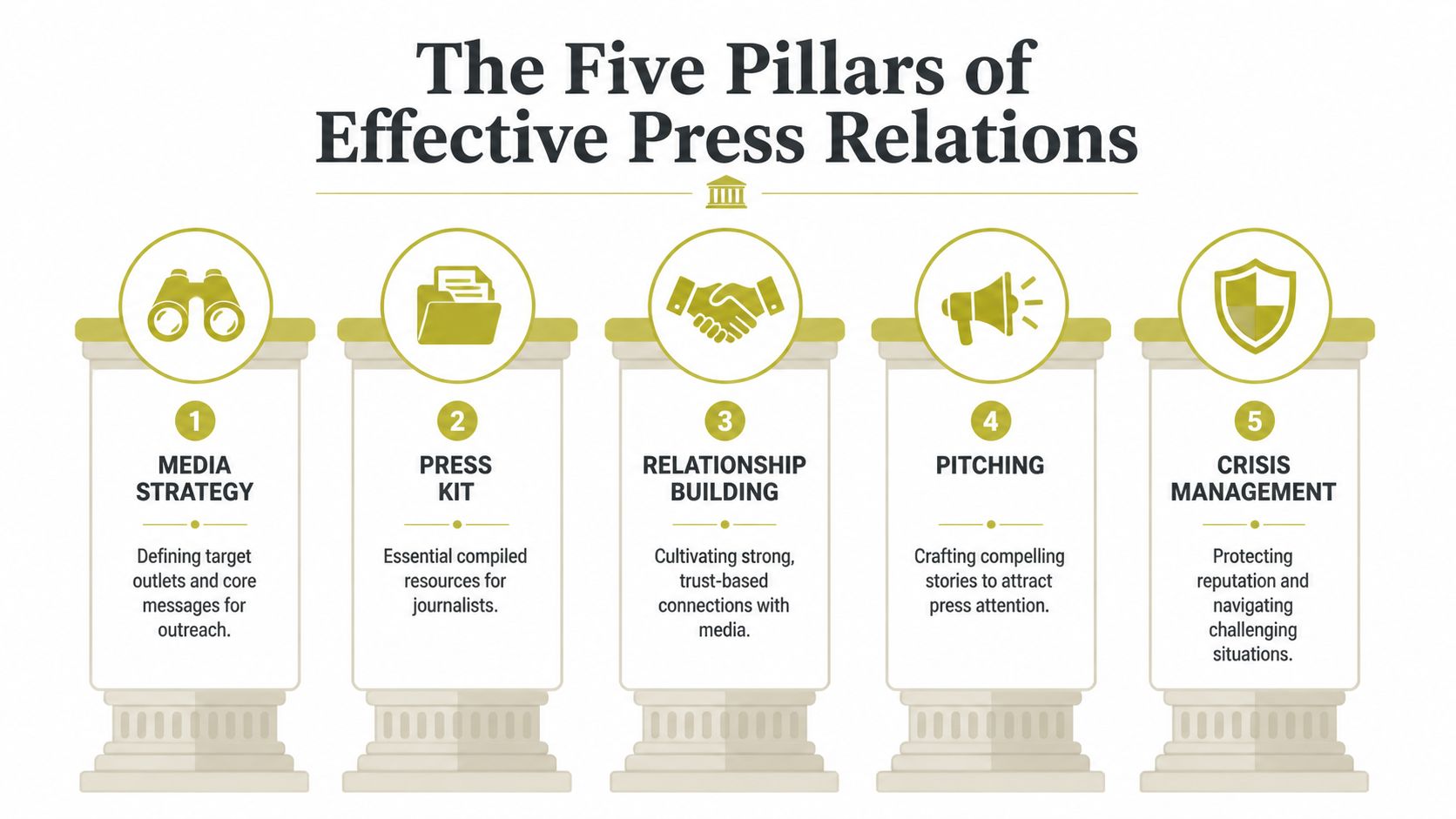
From the newsroom side, these pillars are not theory. They are the practical signals journalists use to decide whether a company is worth dealing with. Founders often assume PR means sending announcements. Editors care more about whether you can produce a clear story, a credible source, and usable material without wasting time.
Media strategy
Weak press relations usually start with a basic mistake. The company starts producing activity before it decides what space it wants to occupy in the market and in the media.
A workable media strategy sets a few things in plain terms. What themes can you speak on with authority? Which outlets matter enough to justify effort? Which audience sits behind each title? What proof do you have that makes your claims believable?
This is also where trade-offs get real. A regional business desk may care about jobs and local growth. A trade title may care about technical detail and sector implications. A national outlet may only care if your story reflects a broader shift. One announcement rarely serves all three without rewriting the angle.
Newsrooms are leaner than they used to be, so vague outreach gets ignored faster. A tighter media market leaves less room for long explanations, generic releases, or founders who need three rounds of internal approval before saying anything useful.
Press materials
Prepared materials save time, and time is what journalists never have enough of.
If a reporter is interested at 4:40 pm, they need facts, names, images, and a clean quote quickly. If your team replies with “we’ll pull something together tomorrow,” the window often closes. Another source gets the slot.
Keep these ready:
- A one-page company fact sheet: What the business does, who leads it, where it operates, and how to reach the right person
- A short boilerplate: Clear wording a stranger can understand on first read
- Approved photography: Headshots, product images, team photos, location images where relevant
- Background notes: Timeline, market context, and evidence for any claim that could be challenged
- A press release template: Useful for formal announcements such as funding, partnerships, appointments, or regulatory updates
Good materials do not need to sound polished. They need to be accurate, current, and easy to lift into copy.
Relationship building
This is the part founders usually misread.
Good media relationships are rarely built over coffee. They are built by being accurate on a Tuesday afternoon, reachable when the deadline is tight, and honest when the answer is “we can’t confirm that yet.”
Journalists remember who replies fast, who gives straight answers, and who sends stories that fit the brief. They also remember the opposite. A bad pitch wastes five seconds. A misleading one can close the door for months.
Be useful before you ask for coverage.
That may mean offering a quick reaction on an industry story, pointing a reporter to relevant data you already hold, or saying clearly that your company is not the right source for that piece but suggesting who might be. Former journalists spot this immediately. The best PR people are not just chasing mentions. They are becoming dependable contributors to coverage.
Pitching
A strong pitch makes one clear editorial case.
It tells the journalist why this matters now, why their audience should care, and why your company has the right to comment. It does not read like a brochure. It does not bury the angle in paragraph four. It does not force the reporter to work out what the story is.
Format matters too. An exclusive can work when the story is strong and you are prepared to commit to one outlet. A short, sharp email is often enough for comment opportunities. A full release earns its place when the news is formal, sensitive, or needs supporting documents.
I learned this in newsrooms long before agency life. Reporters are not asking, “Is this interesting to the company?” They are asking, “Can I stand this up quickly, and will my editor care?” Build your pitch around that question and your hit rate improves.
Crisis management
A crisis exposes every weakness you ignored during quieter periods.
If a complaint becomes a legal issue, a customer issue, and a press issue on the same day, confusion spreads fast. Someone posts too early. Someone else says “no comment” when a holding line would have done the job. Legal and leadership disagree. The journalist senses disorder and keeps digging.
Basic crisis preparation is unglamorous but effective. Decide who approves statements. Decide who speaks on the record. Keep holding statements ready for likely scenarios. Make sure facts can be checked quickly. Know when legal input is needed and when over-lawyering a simple response will make the situation worse.
The aim is not to sound perfect. It is to stay credible under pressure.
How to Think and Act Like a Journalist
The easiest way to improve your media results is to stop thinking like a promoter and start thinking like the person opening your email.
A journalist is usually working under deadline, covering multiple live threads, filtering a crowded inbox, and answering to an editor who wants something specific. Your announcement enters that environment. It doesn’t arrive in a vacuum.

At Carlos Alba Media, the team comes from national newsrooms and agency work with international brands. That background matters because former journalists don’t just know how to write a release. They know what editors cut, what reporters ignore, and what makes a producer call back.
What journalists actually want
The UK data is blunt. 72 per cent of UK journalists prefer news announcements and press releases, yet 90 per cent say the ones they receive lack relevance. The same reporting says 54 per cent prioritise compelling data or statistics and 49 per cent want unique angles, based on Cision findings discussed in Meltwater’s PR KPI guide.
That tells you two things at once. Journalists still want releases. They just don’t want bad ones.
A useful release gives them a clear line, a reason to care, a quote that sounds human, and enough supporting material to assess whether the story is real. A useful pitch goes even further. It shows that you understand the outlet and haven’t sent the same email to fifty unrelated people.
Newsroom test: Can an editor explain your story in one sentence to a colleague and get immediate interest?
The shift founders need to make
Many SMEs pitch the company they want to talk about, not the story the outlet can publish. That’s why so many emails read like internal marketing copy.
Journalists don’t wake up wanting to promote your business. They want stories that are fresh, credible, and relevant to their audience. If your business helps explain a wider trend, solves a visible problem, or gives access to something others can’t offer, you’re much more useful.
Three habits help immediately:
- Read before you pitch: Study the last few pieces from the journalist or desk
- Lead with the angle: Put the story first, not your brand slogan
- Offer evidence: Data, customer behaviour, expert interpretation, access, imagery, or a real-world example
A short briefing on interviews and delivery is useful before you put a founder in front of a camera or across the table from a sceptical reporter.
What former editors spot immediately
A former editor can usually tell within moments whether a pitch was sent thoughtfully or sprayed across a list.
If the email could have been sent to anyone, it feels like it was sent to everyone.
That’s the unwritten rule many inexperienced founders miss. Relevance is respect. A clean, accurate, outlet-specific pitch isn’t a courtesy. It’s the entry price.
Your Press Relations Starter Kit
Most founders don’t need a huge PR machine to get started. They need a small set of basics done properly.
If you’re building press relation management from scratch, start with these five tasks and do them in order.
Clarify your three core messages
Write down the three things you want the market to associate with your business. Keep them specific.
Not “we’re cutting-edge”. Try a specific commercial position instead. For example: we help boutique hotels increase direct bookings, we specialise in retrofit projects in listed buildings, or we provide software for compliance-heavy teams that need an audit trail.
These messages should appear across interviews, press materials, and your website. If you can’t state them plainly, journalists won’t pull them through clearly.
Build a shortlist, not a giant list
Start with 10 journalists who specifically cover your sector, geography, or customer world. That’s enough.
Look at bylines in titles your customers trust. Check what each journalist has covered recently. Note whether they write news, features, comment, or analysis. A focused list beats a bloated database every time.
Create one strong fact sheet
A one-page fact sheet saves time and reduces mistakes. Include:
- What the company does: One sentence, plain English
- Who it serves: Customer type and market focus
- Who leads it: Named spokespeople and titles
- What’s newsworthy: Recent developments, launches, partnerships, or research
- How to verify facts: Website, contact details, and source documents if needed
If you’re preparing formal announcements, it helps to understand the difference between a release that informs and one that clogs an inbox. Carlos Alba Media’s guide to press release writing is a practical starting point.
Prepare one spokesperson properly
Pick one main spokesperson and brief them well. Media performance is a skill, not a personality trait.
They should know the three key messages, the likely awkward questions, and how to answer without rambling. Short, clear answers travel further than clever ones.
Set up basic monitoring
If you don’t track coverage, you can’t learn from it. Google Alerts can help at the simplest level. More advanced teams may want a dedicated monitoring platform, and if you’re comparing tools, this roundup of best Meltwater competitors is useful for seeing the options.
Keep a simple log of what was covered, where it ran, what angle landed, and whether any inbound enquiries followed. That record becomes far more valuable than a stack of PDFs nobody reads.
Measuring the ROI of Your PR Efforts
A founder lands a strong piece in a national title, posts it in Slack, gets a round of congratulations, then asks the question that matters. Did it change anything?
That is the right question. Good press relations should influence something concrete: better leads, warmer investor conversations, stronger hiring interest, more trust in sales meetings, or repeat requests from journalists who now see you as a useful source.
The hard part is that PR rarely works in a straight line. A buyer may read about you in March, visit your site in April, hear your name again on LinkedIn in May, and only book a call in June. That does not mean ROI cannot be measured. It means you need a better method than counting clips and calling it success.
Stop treating volume as proof
Big numbers can flatter you and still tell you very little.
Reach, impressions, and raw coverage totals are only useful if the coverage appeared in places that matter to your business. Ten mentions in irrelevant outlets can produce less value than one well-placed trade piece read by the people who buy, partner, regulate, or invest.
The test is simple. Measure influence, not noise.
Measurement rule: Judge coverage by who saw it, what they understood, and what happened next.
The KPI mix that actually helps SMEs
Small and mid-sized firms do not need an elaborate reporting stack. They need a scorecard that links media activity to commercial movement. Social distribution also matters, especially when earned coverage keeps working through your own channels. This enterprise guide to PR in social media is useful if you want to connect press coverage with wider reputation work.
Use a mix of editorial and business signals:
| KPI | What It Measures | Why It Matters |
|---|---|---|
| Coverage quality | Whether you appeared in outlets that influence customers, partners, investors, or sector peers | One relevant hit can outperform a pile of low-value mentions |
| Message pull-through | Whether your main points appeared accurately in the coverage | It shows whether the story strengthened your market position or blurred it |
| Share of Voice | Your media presence relative to competitors | It shows whether your brand is part of the right conversations often enough to matter |
| Referral traffic from earned media | Visitors arriving via links in coverage | It connects placements to site visits and on-site behaviour |
| Inbound enquiry quality | The relevance of leads, partnership approaches, or investor interest after coverage | Better PR improves who contacts you, not just how many people vaguely recognise your name |
| Spokesperson opportunities | Requests for comment, interviews, podcasts, panels, and expert reaction | Repeat invitations usually mean journalists now trust you as a source |
Why Share of Voice earns its place
Share of Voice is one of the few PR metrics I would defend in a board meeting.
It is useful because it is comparative. Your coverage total alone can look healthy until you see that a competitor owns the key themes in your sector and gets quoted every time the story moves. Analysts at PA Media in their discussion of PR metrics describe SOV as a way to track a brand’s media presence against competitors by looking at coverage volume and prominence.
Used well, SOV helps you spot a real market issue. If your firm only appears around company announcements, while competitors appear in reaction pieces, trend features, and expert comment, the press sees them as the authority. That gap affects more than vanity. It shapes trust.
What good reporting looks like
A useful PR report is short, specific, and tied to an objective.
If the goal was credibility in a new sector, report on the titles that covered you, the messages that appeared, the quality of inbound interest, and whether sales teams used that coverage in live conversations. If the goal was founder profile, track interview requests, speaking invitations, podcast bookings, and journalist callbacks.
I would also keep one simple habit. After every meaningful piece of coverage, ask three questions: Did the right people see it? Did the article say what needed saying? Did it lead to any next step worth having?
That is how experienced teams measure PR. Not as a scrapbook. As a business function with clear signals, imperfect attribution, and a very practical standard: did this coverage move us closer to the outcome we wanted?
Three Press Relation Mistakes to Avoid
Most PR failures aren’t dramatic. They’re predictable. Someone moves too fast, assumes too much, or avoids a difficult conversation until the market notices first.
The spam cannon
A founder exports a media list, writes one generic email, and sends it to everyone from consumer lifestyle writers to industrial trade editors. Nobody replies.
The mistake isn’t just poor manners. It signals that the sender hasn’t done the basic work of relevance. Journalists spot mass outreach immediately, and once you’ve trained them to ignore your name, future good stories have a harder path.
A better approach is narrower and slower. Fewer contacts. Better fit. Clearer angles.
The control freak approach
A business lands interest from a journalist, then starts trying to script the article like paid copy. They want headline approval, quote rewrites after the fact, and removal of any context they don’t like.
That doesn’t work. Editorial independence is the bargain. You can correct factual inaccuracies. You can’t demand advertorial treatment from a news desk.
The press is not your design team. Give accurate facts, useful access, and strong quotes. Then let journalists do journalism.
The ostrich tactic
Bad review. Negative claim. Unhappy former employee. Product issue. Many businesses go quiet and hope it passes.
Silence can sometimes be sensible for minor noise. In real reputational issues, silence often reads as disorganisation or indifference. The stronger move is controlled responsiveness: verify facts, decide the line, prepare the spokesperson, and answer what should be answered without panic or speculation.
Newsroom experience helps most. People who’ve worked on the receiving end of fast-moving stories know what reporters ask next, what gaps they’ll chase, and what language makes a problem worse.
When to Partner with a PR Agency
A founder gets a call from a journalist at 4:20pm. The company is announcing funding next week, a competitor has just had a product issue, and the reporter wants comment before close. That is usually the point where businesses realise PR is not just writing a release. It is judgement under pressure.
You do not need an agency to get your first few pieces of coverage. Plenty of SMEs can handle early outreach themselves, especially when the story is simple and the founder still has time to drive it properly.
The calculation changes when the stakes rise. A major launch, a new market, fundraising, regulatory scrutiny, or a push into national and broadcast media all carry a higher cost for getting the story wrong. At that stage, you are not paying for extra hands. You are paying for better decisions, sharper angles, tighter handling, and access built over years.
Founder bottlenecks are another clear signal. If every quote, pitch, approval, and journalist reply sits with one overloaded person, media opportunities slow down or go cold. Newsrooms do not wait for internal alignment.
I usually tell founders to ask a blunt question. Is PR still a task, or has it become a function? Once it affects sales conversations, hiring, investor confidence, or reputation risk, it needs proper ownership.
Some categories need that ownership earlier. Health, finance, legal services, education, public sector supply, and any business operating in a contentious field face tougher questions and less room for error. In those situations, an agency earns its keep by preparing spokespeople, pressure-testing lines, and spotting the holes a reporter will go after before the interview happens.
If you are comparing support options, this guide on how to choose a PR agency will help you assess fit, experience, and whether you need strategy, execution, or crisis support.
Carlos Alba Media is one agency in that market. The fit matters more than the logo on the proposal. Look for people who understand how editors decide what makes the cut, can tell you directly when your announcement is not yet a story, and know how to turn expertise inside the business into coverage that helps the company grow.