
Only 49% of UK businesses have a formal crisis communications plan, and businesses without one face 30% longer recovery times after a crisis, with average financial losses reaching £1.2 million during major disruptions, according to the Business Continuity Institute’s guidance on crisis communication planning.
That figure should change how most leaders think about crisis planning. This isn’t a corporate nice-to-have. It’s part of business survival.
The organisations that handle a crisis well rarely look calm by accident. They’ve already decided who speaks, who approves, where the facts go, and what happens when the phones start ringing. In practice, crisis communications sits right beside continuity planning. If you’re reviewing operational resilience, a practical checklist for maintaining cloud contact center operations is worth reading alongside your comms plan, because customers don’t separate service failure from reputational failure.
At Carlos Alba Media, the lens is different because the background is different. The team is made up of former national news journalists and agency professionals who’ve worked with international brands. That matters when pressure hits. Journalists know how a story moves, how rumours harden into headlines, and how a weak statement creates a second crisis on top of the first.
A strong plan doesn’t just help you react. It helps you shape the first credible version of events. That is often the difference between a difficult day and a prolonged reputational problem.
The Uncomfortable Truth About Being Unprepared
Most businesses assume they’ll improvise well under pressure. Most won’t.
In a live issue, time compresses. A customer post becomes a reporter call. A staff concern becomes a regulator question. A technical fault becomes a story about leadership. The problem usually isn’t that a company has no intelligent people in the room. It’s that nobody has agreed in advance how to turn information into action.
A crisis communications plan fixes that. It gives people a route map when facts are incomplete, emotions are high and public scrutiny is moving faster than internal approvals. Without that route map, teams waste the first hour debating basics. Who owns the response? What can we say? Who signs it off? Which channel goes first? By the time those answers arrive, the narrative often belongs to somebody else.
Former journalists tend to look at this differently. In a newsroom, you don’t wait for perfect clarity before organising coverage. You establish what’s known, what’s verified, what the risks are, who the audience is, and when the next update lands. That discipline translates directly into crisis planning.
The first public statement rarely wins because it says the most. It wins because it says enough, credibly, before confusion fills the gap.
That’s why learning how to develop a crisis communications plan is less about producing a polished document and more about building response muscle. A plan should help leaders act fast without sounding reckless, and sound human without creating legal exposure.
For Scottish SMEs, founder-led brands and growth-stage tech firms, this is especially important. Smaller teams often move quickly in normal trading conditions. During a crisis, that same informality can become a weakness if there’s no command structure, no agreed holding line and no process for media, customers and staff.
Mapping Your Risk Landscape Like a Journalist
A useful crisis plan starts where a good investigation starts. Ask one hard question. What are the most plausible bad stories about this organisation?
That’s a better opening than a generic risk workshop because it forces specificity. Journalists don’t think in abstract categories. They think in angles, facts, impact and exposure. A hospitality brand doesn’t just face “reputation risk”. It may face a food safety allegation, a booking system collapse, a staff misconduct claim or a viral complaint filmed on a phone in reception.

A UK-specific risk assessment should include the issues most likely to create both operational and reputational harm. D4H’s guidance on building a crisis communications plan notes that data breaches affected 32% of UK SMEs in 2024, while reputational attacks on social media spiked 40% in Scotland following tourism-related incidents.
Start with scenarios, not labels
Write your first draft of the risk environment as scenarios you can picture happening on a Tuesday morning.
For example:
Tech SME scenario
A customer reports unauthorised account activity on LinkedIn. A trade journalist emails asking whether customer data was exposed. Your engineering lead is still investigating.Tourism business scenario
A guest video alleging unsafe conditions gains traction overnight. Local media start calling before the duty manager has written an incident summary.Professional services scenario
A former employee publishes allegations online. Staff begin forwarding screenshots internally before leadership has agreed a position.
Each scenario should answer four practical questions:
- What happened, in plain English?
- Who’s affected first?
- What makes this newsworthy?
- What evidence would we need before speaking publicly?
If you can’t answer those questions, the scenario is too vague to prepare for.
Build a reporter’s contact sheet of vulnerabilities
Journalists work quickly because they know where to look first. Crisis teams should do the same.
Create a risk register with these fields:
| Risk scenario | Early warning signs | Likely first audience | Required facts | Decision owner |
|---|---|---|---|---|
| Data breach | Unusual account activity, customer complaints, IT alerts | Customers, regulator, media | Scope, systems affected, timing, containment status | Senior exec plus legal |
| Social media allegation | Viral post, influencer attention, staff screenshots | Public, customers, employees | Source material, timestamp, response history, verification | Communications lead |
| Product or service failure | Refund requests, service outage, supplier warning | Customers, partners, staff | Scale, cause, workaround, customer impact | Operations lead |
| Executive conduct issue | Internal complaint, legal letter, media inquiry | Staff, investors, media | Complaint status, process followed, who can comment | Senior leadership |
This isn’t paperwork for its own sake. It lets you identify where your blind spots are. Many organisations know their technical risks but haven’t considered how a story spreads once it leaves internal channels.
Practical rule: If a scenario would force you to explain yourself to customers, staff, regulators or reporters, it belongs in the plan.
Rank what could hurt you most
Not every problem deserves the same level of preparation. A journalist weighs a lead by significance and likely public interest. You should weigh business risks the same way.
Use two filters:
Impact on people and operations
Could this affect safety, customer access, legal obligations, revenue or leadership credibility?Speed of external exposure
Would this stay internal for a while, or could it appear publicly within minutes through social media, trade press or staff messages?
That second filter matters more than many teams realise. A moderate operational problem with high visibility can become a severe communications problem very quickly.
Test the assumptions behind your calmest risks
The danger in workshops is familiarity. Teams downplay scenarios they’ve “handled before”. But repeated issues often become more damaging because audiences read them as patterns, not one-offs.
Challenge each risk with newsroom questions:
- What would a hostile headline be?
- What screenshot would travel fastest?
- Which stakeholder would say we were too slow?
- What fact, if missing, would make us look evasive?
Those questions sharpen the plan. They also force leaders to separate operational confidence from reputational exposure.
Don’t outsource judgement to a template
Templates help. Generic lists don’t think for you.
A Glasgow software firm, a Scottish tourism operator and a London consumer brand can all own the same crisis template and still need very different scenario planning. What matters is relevance. The risk environment has to reflect your sector, your regulators, your customer expectations and the channels where your reputation lives.
Assembling Your Crisis Response Team and Triggers
When a crisis starts, the biggest delay often isn’t drafting the statement. It’s deciding who’s in charge.
A proper crisis team should be small enough to move and senior enough to decide. If every update needs a round of introductions or a separate debate over authority, the plan is already failing. The best teams look less like a committee and more like a news desk covering a major breaking story.
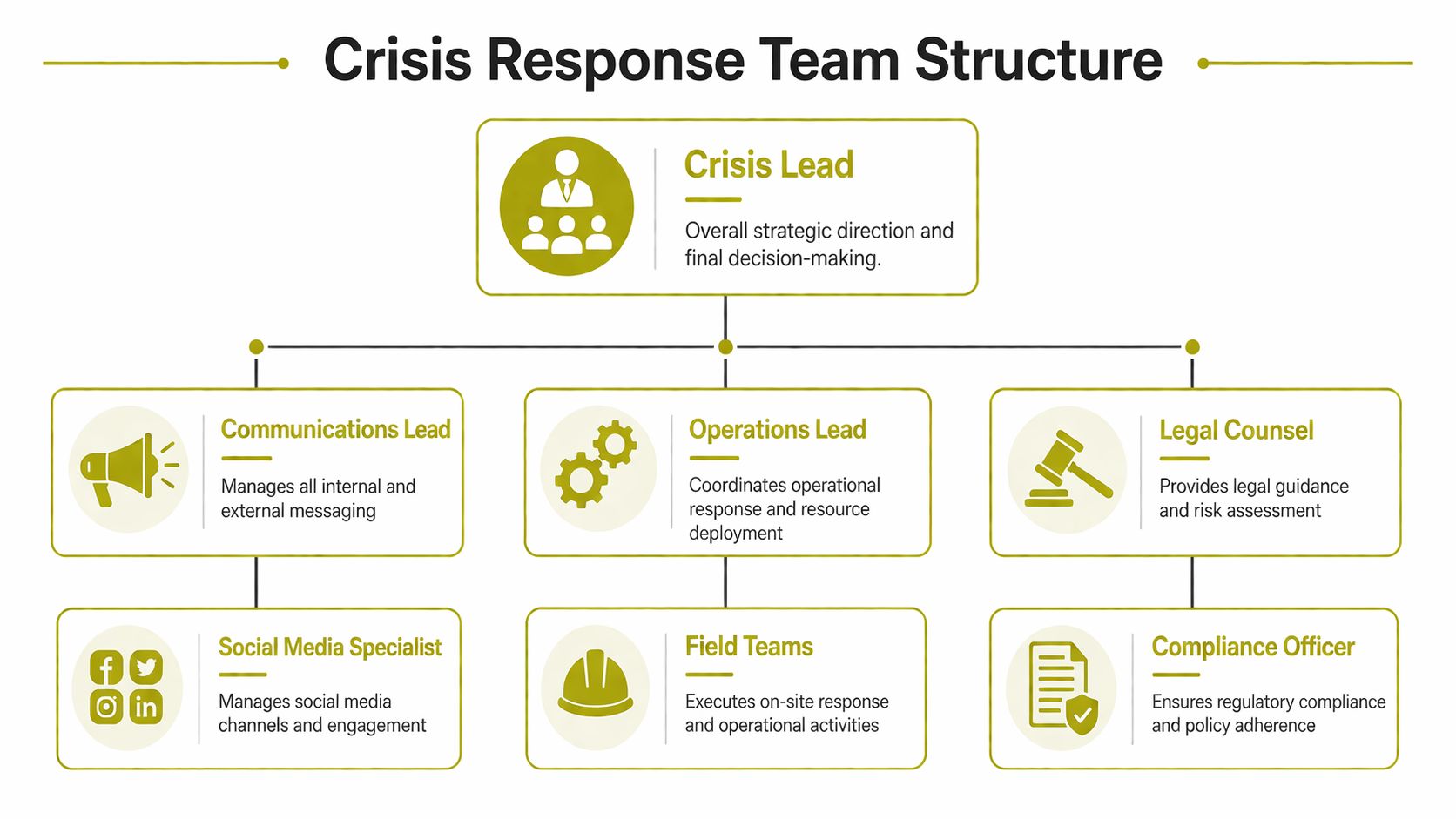
Guidance based on crisis communications frameworks recommends stratifying risks into Levels 1 to 3, with Level 1 requiring full team activation within 15 minutes. The same guidance links integrated legal and spokesperson roles with 92% stakeholder retention among UK SMEs.
Who needs a seat at the table
Your crisis response team doesn’t need titles for show. It needs decisions covered.
A practical core team usually includes:
Crisis lead
One senior person with final authority. Usually a CEO, founder or managing director. This person resolves disputes fast.Communications lead
Owns message development, media handling, internal updates and channel coordination.Legal counsel
Checks exposure, preserves evidence, advises on wording and reporting duties.Operations lead
Confirms what is happening on the ground. This role stops comms teams from publishing assumptions.People lead or HR
Essential where staff safety, conduct, internal morale or employment issues are involved.Digital monitoring lead
Tracks social reaction, misinformation, customer queries and escalation points online.
You may add technical specialists depending on the issue, but the command group should stay disciplined. Too many people slow response and muddy accountability.
Build triggers before you need them
The phrase “we’ll know a crisis when we see one” sounds sensible until half the business thinks the issue is minor and the other half is already drafting an apology.
Write down activation triggers. Make them observable. Make them boringly clear.
Here is a simple activation matrix you can adapt.
| Level | Description | Activation Trigger | Core Team Activated |
|---|---|---|---|
| Level 1 | Major incident with immediate reputational, legal or operational threat | Credible allegation or event with significant public, customer, staff or regulatory impact. Full activation required within 15 minutes. | Full crisis team |
| Level 2 | Serious issue with potential to escalate quickly | Confirmed incident affecting customers, staff or service, but facts are still developing and exposure is contained | Crisis lead, comms, operations, legal |
| Level 3 | Contained issue or complaint with limited exposure | Localised complaint, service issue or online criticism that can be managed through normal escalation unless it spreads | Relevant departmental lead plus communications oversight |
The point of the matrix isn’t bureaucracy. It removes the emotional argument from the first minutes.
If your team spends the first half hour debating whether this “counts” as a crisis, you’ve already lost useful time.
Name one spokesperson, not five
Media pressure makes organisations overstaff the public-facing part of the response. That’s a mistake. One trained spokesperson should handle external broadcast and press unless there’s a strong operational reason to split roles.
Why? Because consistency builds confidence. Reporters compare answers. Customers compare wording across channels. Regulators notice when an organisation sounds fragmented.
A spokesperson should know three things before any interview:
- what’s verified
- what can’t yet be confirmed
- when the next update will be available
That’s enough for a credible first engagement. It’s far better than sending out a senior executive who knows the business well but hasn’t been briefed under pressure.
Put the contact logic in writing
The team list shouldn’t just include names and job titles. It needs practical instructions.
Include:
- primary mobile number
- secondary number
- who can authorise out-of-hours activation
- who covers annual leave or travel
- preferred platform for urgent group alerts
- where the latest statement and fact sheet live
Many plans become decorative. The document looks polished, but nobody has tested whether the right people can be reached quickly on a Sunday evening.
Building Your Message Toolkit for Speed and Accuracy
A weak first statement usually comes from one of two failures. Either nobody prepared for the scenario, or too many people are writing at once.
In a newsroom, speed never excuses sloppiness. The same rule applies in a crisis. Your organisation needs prepared materials that can be updated fast without sounding canned, evasive or cold. That means building a message toolkit before you need it.
Write holding statements for likely scenarios
A holding statement is not your final explanation. It is the first verified public marker that says you are aware, engaged and taking action.
The best holding statements do four things:
- acknowledge the issue
- show that action is underway
- avoid speculation
- tell people when they’ll hear from you next
The worst ones are stuffed with corporate filler, legal defensiveness and phrases that sound as though nobody in the room has spoken to a real customer in years.
Strong holding statement
“We’re aware of the incident affecting some customers and are investigating urgently. Our team is working to establish the facts and limit disruption. We’ll provide a further update as soon as we have verified information.”
Weak holding statement
“We take these matters very seriously and are committed to the highest standards while undertaking a full review of the circumstances.”
The second version says almost nothing. It may satisfy an internal drafter who wants safe language, but it won’t satisfy customers, staff or journalists trying to understand what is happening.
Build a message map, not just a statement bank
A statement alone won’t carry a live response. You need a message map that gives every channel the same factual spine.
A simple message map includes:
| Element | What it covers |
|---|---|
| Core line | The single sentence that defines your position |
| Confirmed facts | What you know and can stand behind |
| Action line | What the organisation is doing now |
| Stakeholder relevance | Why this matters to customers, staff, partners or regulators |
| Next update | When more information will be issued |
This prevents one common failure. The website says one thing, the spokesperson says another, customer support improvises a third, and social media replies turn into a fourth version. From the outside, that looks like confusion or concealment.
A message map also helps when new facts come in. You update one central framework, then push the same line through each channel in the right format.
Prepare scenario packs in advance
For most SMEs, a useful starting set includes pre-drafted materials for:
- cyber incident
- product or service failure
- executive or employee misconduct allegation
- supplier or operational disruption
- customer safety issue
- social media reputational flare-up
Each pack should contain a draft holding statement, internal staff note, customer-facing Q&A and spokesperson brief. If your business operates in a sensitive sector, add regulator-specific language and approval notes.
Examples help teams understand the level of detail expected. A practical library of crisis communications examples is useful when shaping tone, sequencing and message discipline under pressure.
Treat GDPR and breach wording with care
For regulated sectors, cyber and data breach scenarios need extra precision. Everbridge’s crisis communication planning guidance highlights that the ICO recorded 2,345 data breach notifications in Q1 2026, while FSB data shows 47% of Scottish SMEs faced fines for non-compliant crisis communications.
That should change how you draft these messages. Data incidents are not just technical events. They are legal, customer and trust events.
Your breach messaging pack should answer:
- What systems or data categories may be involved?
- What is confirmed versus still under investigation?
- What steps should affected people take now?
- What reporting obligations apply?
- Who can answer customer and media queries?
The legal review matters, but legal wording alone is not enough. A statement can be technically cautious and still sound indifferent. The public hears tone as much as content.
A compliant statement that creates panic or anger is still a bad statement.
Write for the channel, not for the boardroom
One of the oldest crisis mistakes is trying to make every audience read the same long paragraph.
That won’t work. A media line, a staff note, a customer email and a social post serve different jobs.
Use this approach:
- Employees need clarity on what happened, what they should say, and where questions go.
- Customers need immediate relevance. Are they affected? What should they do?
- Media need a concise line, access to a spokesperson and a timetable for updates.
- Regulators need factual precision and promptness.
- Investors or partners need implications, response steps and assurance on continuity where possible.
If your team has to choose between speed and elegance, choose speed with accuracy. A clean, verified short statement beats a beautifully written delayed one every time.
Activating the Plan and Managing Communication Channels
A plan becomes real at the moment somebody says, “We need to activate.”
Take a familiar example. A Scottish tech SME discovers a product fault that may affect customer access. Support tickets climb. Screenshots appear on X. A trade journalist emails asking whether the issue is wider than the company has admitted. That is the point where operational response and communications response have to run together.

The first move is internal. Staff must hear from leadership before they hear the full story through social media or a journalist’s call. If employees feel blindsided, they can become accidental amplifiers of confusion. A short internal note gives them the holding line, confirms who is handling inquiries, and tells them where updates will appear.
The first hour in practice
A disciplined activation sequence usually looks like this:
Confirm the incident class
The crisis lead decides whether the issue meets the activation threshold.Open one decision channel
Use a single group thread or incident platform for approvals and verified facts.Issue the internal holding line
Staff need usable language quickly.Publish the external first statement
Website, status page or owned channel first. Then adapt for social and direct outreach.Route media inquiries centrally
One spokesperson. One media contact route. No freelancing.Log decisions and timestamps
This helps legal review, post-crisis learning and message consistency.
Process beats personality. In calm periods, companies sometimes overvalue creative messaging. In the first hour of a crisis, clarity wins.
Channel discipline matters more than volume
Many teams react to pressure by posting everywhere at once. That often creates duplication, contradictions and reply chains the business can’t manage.
Use channels for their proper role:
- Website or newsroom page for the main public statement and updates
- Email for affected customers, partners or staff who need direct instructions
- Social media for concise acknowledgement, signposting and correction of false claims
- Press handling for reporter queries and interview management
- Customer support scripts for frontline consistency
If your content team already works from a structured publishing calendar, a practical step-by-step guide for social media scheduling can help tighten workflow discipline in normal periods. During a live crisis, though, scheduled content should be reviewed immediately. Nothing undermines credibility faster than a cheerful promotional post landing in the middle of a serious issue.
AI monitoring has changed the pace
The social layer can’t be treated as a side task anymore. UK guidance on crisis comms planning states that 68% of UK businesses faced social media crises in 2024. The same guidance says AI users reduced response times by 65%, and that 55% of UK crisis amplification now happens on platforms such as X and TikTok.
That matters because human monitoring alone is often too slow once a narrative starts moving across multiple channels. AI-assisted listening can help teams spot sentiment shifts, repeated claims, impersonation risks and the accounts driving momentum.
What works is a hybrid model:
- machine-led monitoring for speed
- human review for judgement
- legal input where allegations or privacy issues are involved
- a comms lead deciding when to respond, correct or hold
What doesn’t work is replying to every hostile post, or pretending silence will slow down an algorithm-driven pile-on.
Respond to patterns, not provocation. You are managing the public understanding of the event, not trying to win every comment thread.
Media handling under pressure
Former journalists tend to be blunt on this point. Reporters don’t need perfection. They need a credible point of contact, a useful line, and confidence that the organisation isn’t hiding behind vagueness.
If a media inquiry comes in, the spokesperson brief should contain:
- the agreed holding line
- the latest verified facts
- what cannot yet be confirmed
- what action is underway
- when the next update is expected
If you need a formal statement for media distribution, keep it tight and usable. A good process for press release writing during fast-moving situations helps teams avoid bloated statements that read like legal committee output.
Here’s a useful reference for media interview dynamics in a crisis:
The practical rule is simple. Never guess. Never over-promise. Never let five different people explain the same issue in five different ways.
The Crucial Loop of Testing Training and Post-Crisis Review
A crisis plan that hasn’t been tested is a theory.
On paper, almost every plan looks competent. The names are there. The flowchart is neat. The sample statements sound calm. Then the exercise starts, somebody can’t be reached, legal is in a meeting, the spokesperson hasn’t seen the latest facts, and customer support is using old wording. That’s why testing matters. It exposes the gap between the plan you own and the response you can deliver.

Run exercises that feel real enough to sting
The best drills create pressure without creating chaos. Start with a tabletop exercise and give the team a realistic scenario, incomplete facts and timed developments. Add a journalist inquiry. Add an angry customer post. Add a staff message that leaks outside the business.
That’s when weak spots emerge.
Useful tests include:
- Tabletop walkthroughs for decision-making and escalation
- Live drafting drills for holding statements and internal notes
- Mock media interviews for spokesperson control under pressure
- Channel checks to confirm alerts, approvals and access work
A proper drill should leave people slightly uncomfortable. That’s a good sign. It means the exercise found something worth fixing.
Train the people, not just the document
Even strong plans fail when untrained leaders deliver muddled messages. Spokespeople need rehearsal. Senior decision-makers need practice balancing speed, accuracy and legal caution. Frontline teams need usable scripts, not a PDF hidden in a folder.
That’s why training has to sit beside planning. Practical media and PR training for spokespeople and leadership teams helps turn written guidance into repeatable behaviour when the pressure is real.
The organisations that look composed in public usually earned that composure in private, during training that felt inconvenient at the time.
Review every incident and every drill
Post-crisis review is where resilience is built. If you skip it, you waste the lesson.
Keep the review focused:
| Review question | Why it matters |
|---|---|
| What did we know first, and when? | Exposes information bottlenecks |
| Which approval slowed us down? | Identifies structural delay |
| Did every channel carry the same line? | Tests message discipline |
| What did stakeholders ask that we hadn’t prepared for? | Reveals gaps in scenario planning |
| What should change before the next incident? | Turns experience into improvement |
The tone matters. This shouldn’t become a blame session. The point is to improve the system, not punish the people navigating it.
A good crisis plan is a living operating tool. It should change after restructures, new product launches, regulatory developments, leadership changes and meaningful incidents. If your business has changed but the plan hasn’t, the plan is already old.
From Plan to Resilience A Final Word
A crisis communications plan is not a binder, a template or a policy document that exists to reassure the board. It is a working capability.
The organisations that handle pressure best do a few things consistently. They identify realistic risks early. They assign authority before emotions rise. They prepare message tools before they need them. They know which channel does what. They rehearse. Then they review and improve.
That newsroom mindset is useful because it strips away comforting fiction. In a live story, nobody cares that your intentions were good if your facts were late, your wording was vague and your teams contradicted one another. Preparation is what creates calm. Process is what protects trust.
That’s the practical answer to how to develop a crisis communications plan. Build something your team can use at speed, under scrutiny, with incomplete facts and real reputational stakes. If the document doesn’t help people make better decisions in the first hour, it needs more work.
Crises can’t always be prevented. Reputational freefall often can be. The difference usually comes down to whether the organisation prepared when the stakes felt hypothetical.
Frequently Asked Questions
How long should a crisis communications plan be
Shorter than commonly believed. It should be long enough to cover roles, triggers, approvals, key contacts, holding statements, channel workflows and review process. It should also be short enough that a senior team can use it during a stressful live issue. If it reads like a manual nobody would open under pressure, trim it.
Who should own the plan
One senior person should own activation authority, but ownership of the document is usually shared between communications, leadership, operations and legal. In smaller businesses, that may still mean one person coordinates updates. What matters is clarity. Everyone should know who can trigger the plan, who approves messages and who speaks externally.
What is the difference between a crisis communications plan and a crisis management plan
A crisis management plan covers the broader operational response. A crisis communications plan focuses on the flow of information. It covers what you say, who says it, to whom, on which channel, and in what order. The two should work together. Communications can’t compensate for operational confusion, and operations can’t protect reputation if the public story is unmanaged.
Do small businesses really need a formal plan
Yes. In some ways, smaller organisations need one more. They often have fewer layers, fewer backup people and less room for trial and error. A concise plan gives founders and senior staff a shared playbook when the issue lands outside office hours or hits before all the facts are known.
How often should we review the plan
Review it after any meaningful incident, after major business changes and on a regular schedule that keeps contacts, scenarios and approvals current. If your products, leadership team, legal exposure or communication channels have changed, the plan should too.
Should legal approve every crisis statement
Legal should be involved early where risk is material, especially in regulated sectors, employment matters, allegations and data issues. But legal review shouldn’t become a bottleneck that stops timely communication. The balance is preparation. Pre-approved wording, clear escalation rules and scenario packs make it easier to move quickly without creating unnecessary exposure.
What is the biggest mistake businesses make
They confuse awareness with readiness. Leaders know a crisis could happen, but they haven’t translated that awareness into triggers, team roles, message tools and rehearsed decisions. When the issue arrives, they’re smart but unprepared. That’s a costly combination.
If your organisation needs senior-level support to build, test or strengthen its crisis response, Carlos Alba Media brings a rare mix of newsroom judgement, agency experience and practical 24/7 crisis counsel. Founded by former national newspaper editor Carlos Alba, the team includes former national journalists and brand advisers who know how stories move, how pressure builds and how to protect trust when reputation is on the line.