
The call usually comes at the worst possible time. A journalist wants a comment on a fast-moving story. They need it within the hour. Your founder, chief executive or technical lead now has to decide whether to step forward, stay silent or say something that won’t create a bigger problem.
That’s where most businesses realise media confidence and media readiness aren’t the same thing. Plenty of leaders know their subject. Far fewer can land a clear message under pressure, answer a hostile follow-up, avoid legal or regulatory traps, and still sound human on camera.
For start-ups and SMEs, that gap matters. A single interview can open doors with customers, investors and partners. It can also create confusion if the spokesperson rambles, overclaims or gets pulled into a journalist’s framing. Larger companies have the same issue, just with more stakeholders watching.
The right media training company helps you practise the moment before it matters. The good ones don’t just teach presentation polish. They pressure-test your messages, adapt to your sector, and show you how broadcast, print, online and crisis interviews work now. If you’re also building a media operation around monitoring and response, it’s worth understanding the benefits of speech-to-text for media monitoring, because speed and accuracy before an interview often shape the outcome.
Below are seven media training companies worth considering in the UK. The key difference in this guide is fit. Some providers are better for regulated sectors. Some suit SME budgets and founder-led brands. Some are built for listed companies, investor scrutiny or full crisis simulations. If you’re choosing between them, focus less on glossy claims and more on who’ll prepare your spokesperson for the exact conversations they’re likely to face.
1. Carlos Alba Media
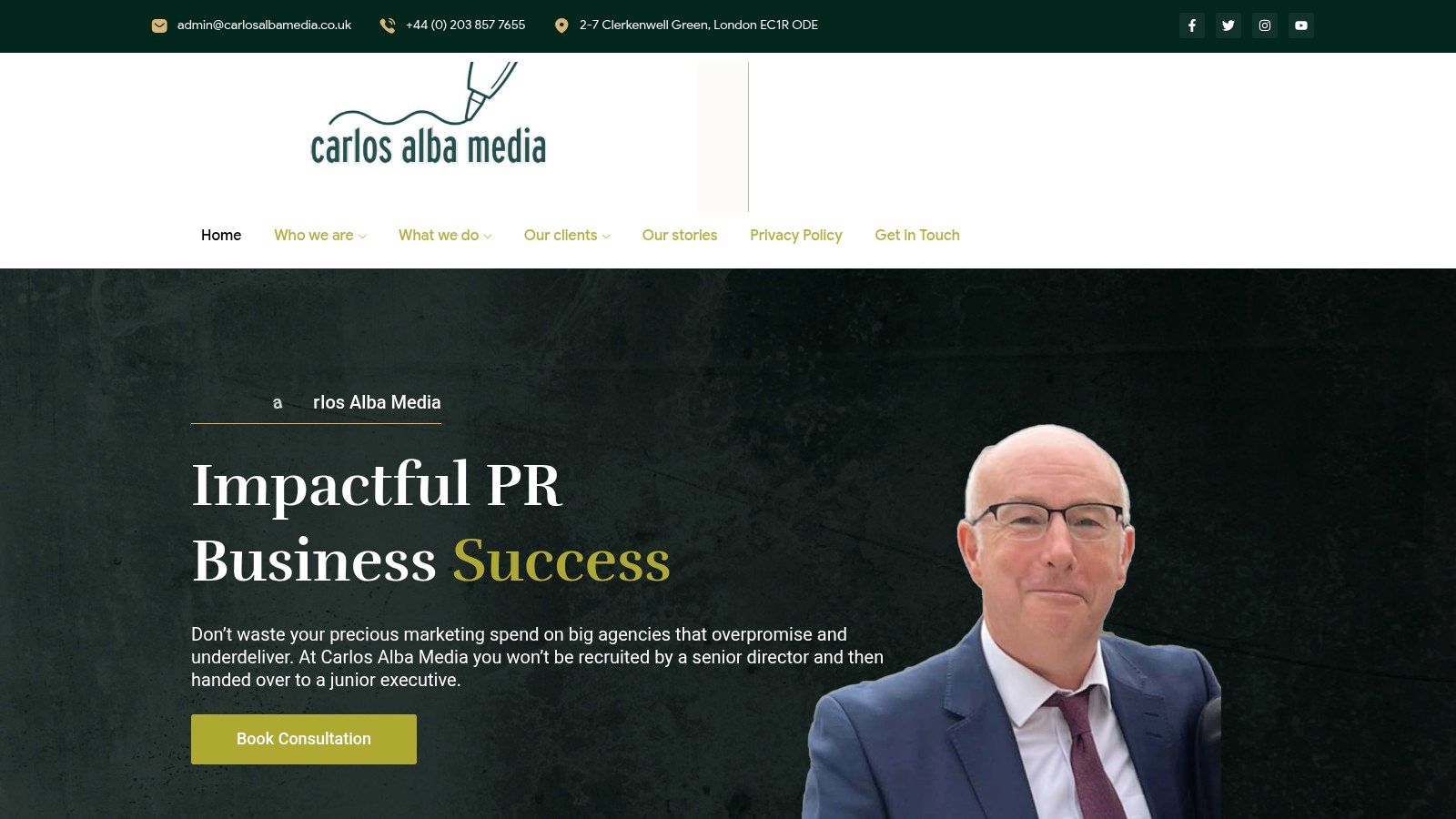
A founder gets a call for a broadcast interview after a funding round, product issue, or industry comment request. They know the business inside out. What they often do not have is a tested way to answer in 12 seconds, hold a line under pressure, and avoid handing over a quote that creates tomorrow’s problem. That is the kind of gap Carlos Alba Media is set up to address.
Carlos Alba Media is a specialist consultancy rather than a high-volume training provider. It was founded by former national newspaper editor Carlos Alba, and the team draws on former national journalists and communications professionals. That background matters if you want more than presentation tips. Good media training depends on editorial judgement, clear message discipline, and the ability to spot where an answer could drift into overclaim, legal risk, or needless defensiveness.
The firm operates from London and Glasgow and also works across wider communications support. For some buyers, that is a real advantage. If a founder’s interview messages need to line up with PR, search visibility, crisis handling, and digital content, a provider with that broader view can save time and reduce mixed messaging.
Where Carlos Alba Media fits best
This is a sensible option for founder-led businesses, SMEs, and senior spokespeople who want experienced people involved early. It also suits organisations that do not need a giant training programme spread across multiple countries, but do need senior counsel adapted for a specific reputational risk, launch, or profile-raising push.
That makes it a better fit for some businesses than providers built mainly for large corporate cohorts. A small leadership team often needs bespoke prep, sharper message work, and direct access to senior trainers. They do not always need a large programme architecture.
For buyers weighing practical fit, the company’s media training in the UK service page gives a useful picture of how it frames that offer.
One more point matters here. If you are in a regulated sector, or your leadership team operates close to investor, legal, or reputational scrutiny, training has to go beyond delivery. It needs to cover what not to say, what must be evidenced, and how to decline a question without sounding evasive.
What stands out
The strongest part of the offer is judgement under pressure.
I would put Carlos Alba Media on the shortlist when the spokesperson needs help with both the interview itself and the wider communications context around it. That includes founder profiling, high-stakes announcements, crisis response, and situations where a weak answer can affect brand perception beyond the immediate piece.
The agency’s broader services include media relations, digital content, SEO, web design, social media marketing, media skills training, and crisis support with legal input available through partner arrangements. That range will not matter to every buyer. It does matter if your media trainer also needs to understand how a statement will play across search, social clips, trade press coverage, and stakeholder reaction.
The client list also suggests range across consumer, tourism, property, and premium brand work, with names such as The Johnnie Walker Experience, VisitScotland, Scotia Homes, and Hamilton & Inches. That does not prove fit on its own, but it does indicate the consultancy can work in sectors where tone and message control matter.
Trade-offs to weigh on a consultation call
There are some clear trade-offs.
Pricing is not published, so you will need a conversation before you can compare cost against other providers. That is common with boutique consultancies, but it slows procurement if you are trying to benchmark several firms quickly.
Scale is the other question. If you need training rolled out across large international teams, multiple languages, or repeated sessions for big internal groups, a larger provider may be easier to deploy.
For many SMEs and founder-led brands, though, those limits are acceptable. The value here is likely to come from senior attention, customized prep, and a closer link between media handling and the wider reputational brief.
If you speak to them, ask direct questions. Who runs the session? How much time is spent on message development versus camera practice? Can they tailor scenarios for regulated or high-risk interviews? What follow-up support do they provide after the training day? Those answers will tell you more than a polished credentials deck.
2. Media First
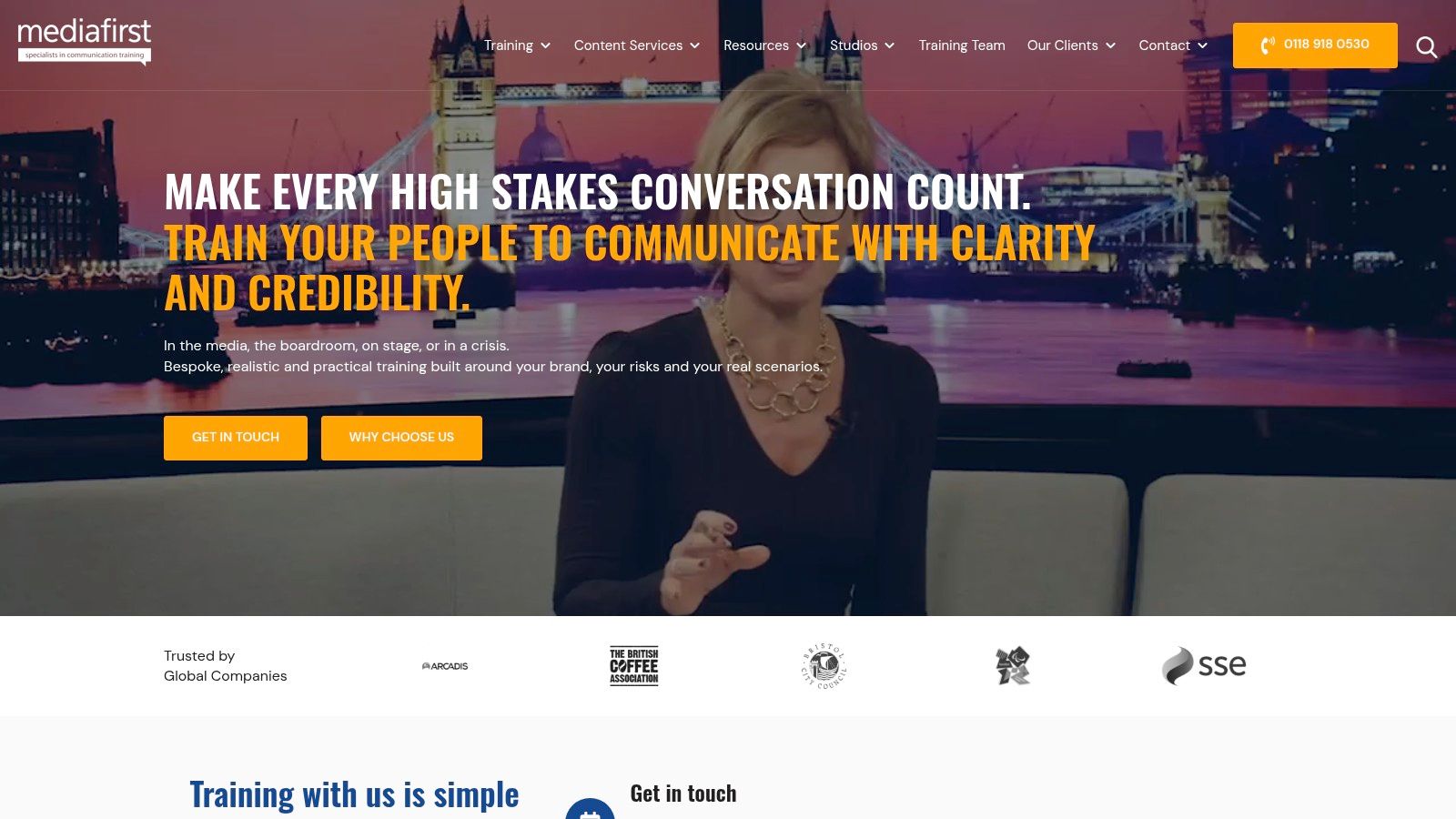
A founder walks into a results presentation feeling prepared, then gets hit with a hostile follow-up, a shorter answer window, and a question that cuts across legal, commercial and reputational risk at the same time. That is the moment media training either holds up or falls apart.
Media First is built for that kind of pressure. Its offer is centred on realistic interview practice, journalist-led sessions, studio facilities in Reading and London, and delivery that can also happen at your site. If you are choosing between providers, the practical question is simple. Do you want a classroom-style confidence session, or do you want spokespeople tested in conditions that feel closer to actual conditions?
Where Media First fits best
Media First is a better fit for teams that expect regular media exposure and want a provider they can use more than once.
That matters for in-house comms leads at larger organisations, regulated businesses with recurring press interest, and senior teams who do broadcast, trade press, podcasts and internal video updates as part of the same role. In those cases, one training day rarely fixes the full problem. Spokespeople need repetition, sharper message discipline, and practice across different formats.
Its wider offer helps here. Podcast, livestreaming and video support suggest a provider that understands how media performance now stretches beyond the classic TV or radio interview. For teams working through hybrid briefings and remote appearances, that is useful.
For senior leaders comparing specialist providers, Carlos Alba Media’s page on executive media training for leadership spokespeople is a useful reference point because it highlights a different buying lens: senior counsel and executive-specific coaching rather than a broader training platform.
Strengths and limits
The main strength is realism. Current or former journalists tend to spot weak phrasing quickly, interrupt when an answer drifts, and push on the line a reporter is most likely to pursue. That usually gives better value than a session where everyone stays polite and lets vague messaging pass.
The studio option also matters more for some buyers than others. If you are an SME preparing a founder for occasional trade media, you may not need formal studio time every round. If you are a listed business, a regulated brand, or a leadership team with broadcast exposure, camera pressure and playback can justify the extra spend.
There are trade-offs. Pricing is quote-led, which slows comparison if procurement wants a clean side-by-side review. The ongoing CPD route also appears to depend on prior training and defined access terms, so ask exactly what follow-up support is included, for how long, and for whom.
Use the consultation call to test fit, not just credentials. Ask who runs the training on the day, whether they have handled your sector before, how they adapt scenarios for legal or regulatory sensitivity, and whether the session focuses more on message development, hostile interview handling, or on-camera performance. Those answers will tell you whether Media First suits a fast-growing SME that needs practical basics, or a larger organisation that needs repeatable spokesperson development across several teams.
Direct website: Media First
3. Bluewood Training
Bluewood Training is easier to shortlist when you know your interview risk profile already.
This isn’t a generalist “we train everyone on everything” proposition. Its distinct tracks for print, broadcast, financial media and crisis media training make it a better fit for businesses that need sector-specific preparation, especially in regulated industries, investor relations and capital markets contexts.
Strong choice for financial and regulated environments
Many media training companies say they can support regulated sectors, but the detail is often thin. Bluewood’s positioning is more concrete. Financial media training, investor-focused presentation coaching and messaging workshops suggest a provider that understands the different demands of market-facing communication.
That matters because media exposure in these sectors isn’t just about sounding polished. A spokesperson may need to explain complex information with clarity, avoid creating unintended signals, and handle hostile or technical questioning without drifting into unsafe language.
For teams with crisis exposure, there’s also a useful overlap between media training and structured response planning. If your main concern is preparing spokespeople for difficult interviews during a reputational issue, it’s worth comparing that approach with Carlos Alba Media’s crisis communications management positioning, especially if you want legal sensitivity and round-the-clock support alongside training.
What buyers should like, and what they should check
Bluewood’s appeal is focus.
The provider has been operating since 2006 and presents a clear specialism around high-stakes communications. For investor-facing businesses, listed environments or regulated services, that narrower angle can be more valuable than a broad “executive presence” course.
Its learning hub and practical guidance content are also useful signals. Firms that publish applied thinking around messaging, interview performance and sector scenarios usually have a more disciplined point of view than firms that rely only on generic sales copy.
The limitations are straightforward.
Pricing isn’t public, so you’ll need an enquiry to understand cost. And because the primary facilities appear to be London-based, organisations training teams elsewhere in the UK should ask about travel, on-site logistics and whether the delivery model changes outside London.
Bluewood is not the obvious choice for every SME. If you’re a creative brand, hospitality operator or founder-led consumer business, you may find the offer more specialised than you need. If you’re dealing with investor scrutiny or regulated messaging, that specialisation becomes a strength.
Direct website: Bluewood Training
4. Electric Airwaves
Electric Airwaves is the enterprise option on this list.
If you’re buying for a large listed company, a high-profile chief executive, or a communications team that needs layered training options from junior spokespeople up to board level, its structured offer is likely to appeal. The company has operated since 1983 and presents itself as one of the larger dedicated media training companies in the UK, with central London TV and radio studios, a broad trainer bench and programmes ranging from basic courses to CEO one-to-one coaching.
Built for scale and visibility
The big advantage here is range.
Electric Airwaves offers basic, standard, advanced and CEO-level training, alongside crisis planning, simulations, story development and preparation for Parliamentary or Select Committee appearances. That mix makes it relevant for organisations with several spokesperson tiers and different levels of public exposure.
For communications directors, that structure often makes procurement easier. You can train the executive team, the subject-matter experts and the press office through one provider without forcing everyone into the same course shape.
Its in-house studio capability also matters if visual realism is part of the requirement. Some firms can run a strong messaging workshop but struggle to recreate the pressure of television or radio formats. Electric Airwaves appears better set up for that side of the brief.
Where caution is sensible
Large providers can do impressive work. They can also feel more standardised.
That’s the main question to test in a consultation. Will the company tailor scenarios to your exact regulatory, reputational or market context, or will it map your team into an existing tiered package with only light customisation? Bigger capability doesn’t always mean better fit.
There’s also the budget point. Pricing isn’t published, and enterprise-focused offers are often pitched accordingly. If you’re an SME or founder-led business paying directly from a constrained budget, this may sit outside what feels proportionate.
Ask who will actually run the session. The proposal may be excellent, but the trainer quality and sector understanding matter more than the brand name on the deck.
Another point worth checking is how the firm substantiates broad market-positioning claims in a proposal. Scale can be a real strength, but buyers should still request relevant trainer bios, sample session formats and references that match their own needs.
Direct website: Electric Airwaves
5. Communicate Media Training
Communicate Media Training is a sensible shortlist option for buyers who want boutique delivery and a more bespoke feel.
Established in 1994, it has long positioned itself around bespoke media, crisis and presentation training, with sector-specific modules for professions including lawyers, architects and financial services teams. That narrower, hands-on setup often suits smaller teams better than a large provider’s standardised menu.
Good fit for SMEs, scale-ups and specialist spokespeople
The practical appeal here is agility.
If you need a trainer-led process from scoping through to delivery, rather than a large handover chain, Communicate Media Training looks well aligned. Its model appears particularly useful for scale-ups, professional services firms and specialist spokespeople who need training shaped around their real media risks rather than a generic executive communications course.
The firm also references refresher formats and post-course support. That’s worth paying attention to. Most spokespeople won’t retain much from a single training event unless the provider builds in reinforcement, further rehearsal or follow-up guidance.
Communicate Media also notes that it has been delivering media training for over 30 years in its own content, which at least signals continuity and long-term presence even though that isn’t industry-wide market data. For many buyers, longevity matters less than trainer quality, but it can still be a useful sign of operational consistency.
Why it won’t suit every brief
This looks like a good boutique choice, but not necessarily a scale machine.
If you’re trying to train multiple teams across many regions at once, or you need a provider with obvious in-house studio infrastructure and a very large trainer bench, you may find larger competitors more suitable.
Pricing also isn’t public. You’ll need to request a proposal, which is common in this category but less helpful when comparing options quickly.
On the other hand, if you’re a smaller organisation trying to avoid overbuying, that boutique shape can be an advantage. You’re less likely to get lost inside a corporate process and more likely to get senior attention.
Direct website: Communicate Media Training
6. Rough House Media
Rough House Media’s strength is pressure.
Some spokespeople don’t need help sounding smoother. They need to experience a fast-moving, messy, adversarial scenario before a critical scenario unfolds. Rough House Media is a good option if that’s your requirement, especially for charities, public bodies, NGOs and SMEs with operational or reputational risk.
Where Rough House is strongest
Its crisis interview training and crisis management training are the main draw.
The firm offers realistic interview practice, bespoke scenarios and live crisis simulations that can include social media injects and mock journalist calls. That format tends to reveal weaknesses quickly. Who approves statements too slowly. Who starts freelancing. Who confuses empathy with liability. Who keeps answering the question they wish had been asked.
For teams that need role clarity as much as media polish, that’s useful. A newsroom-style simulation often teaches more than a calm classroom discussion because people show you how they’ll behave when time pressure and ambiguity hit at once.
The company also offers a 15% charity discount, which gives it a clearer affordability signal than most providers in this space.
Practical trade-offs
Rough House Media looks especially relevant if your organisation’s main risk is a difficult issue rather than a planned brand campaign. If you’re preparing a founder for broadcast interviews around growth, investment or thought leadership, another provider may be a closer fit.
For buyers who want full TV or radio studio realism, it’s sensible to ask whether external studio hire is needed for certain formats. Some crisis trainers are excellent on scenario design but lighter on dedicated broadcast facilities.
There’s also no public pricing beyond the charity discount point, so a scoping call is still needed.
One wider market trend makes this kind of crisis preparation more timely. Content around media training often underplays hybrid virtual simulations for Scottish and regulated sectors, even though the Throughline Group research page highlights a 40% surge in demand for affordable virtual sessions in the context it cites, as well as noting stronger confidence outcomes in a UK Media Trust pilot for newsroom-insider approaches. The exact fit of those external figures should always be checked carefully, but the direction of travel is clear. Buyers increasingly want realistic virtual prep, not just in-person workshop theatre.
Direct website: Rough House Media
7. HarveyLeach Media Training
HarveyLeach Media Training earns a place on this list for a simple reason. It gives buyers something rare in this category, which is clearer pricing guidance up front.
That won’t matter to everyone, but it matters a lot if you’re trying to build a shortlist quickly, manage procurement expectations, or decide whether external media training is realistic within budget.
Best for budget visibility and straightforward planning
Most media training companies require a consultation before giving any firm pricing indication. HarveyLeach is more transparent about guide rates for common full-day configurations. That makes early-stage comparison easier and reduces the number of speculative calls a founder or communications lead has to sit through.
Its offer includes press and broadcast interview coaching, options for dual tutors and filming, and London-area on-site delivery with international availability. For teams that want a fairly traditional media training setup with camera feedback and a clear course structure, that can be enough.
The filming element is important. Many spokespeople don’t really understand their habits until they watch themselves back. They hear the filler phrases, see the defensive body language and notice where an answer became far too long. Video review often accelerates learning faster than verbal feedback alone.
What to confirm before booking
Published guide prices are useful, but they’re still guide prices. Location, custom scenarios and more complex delivery needs will affect the final quote, so buyers shouldn’t assume the online figures are the whole picture.
I’d also want to understand more about facility setup if studio realism is a priority. HarveyLeach publishes fewer obvious details about in-house studio infrastructure than some competitors that foreground their own studio environments.
That said, transparency itself is a competitive advantage. If you’re an SME deciding whether to invest now or later, visible guide pricing makes the conversation easier internally. You can assess fit before committing too much time to the sales process.
Direct website: HarveyLeach Media Training
Media Training: 7-Company Comparison
| Provider | 🔄 Implementation complexity | ⚡ Resource requirements | 📊 Expected outcomes | 💡 Ideal use cases | ⭐ Key advantages |
|---|---|---|---|---|---|
| Carlos Alba Media | Moderate, bespoke, senior‑led coordination across PR and digital | Moderate, senior time, digital/SEO/web resources; pricing by proposal | Measurable national coverage, traffic and conversions; crisis safety net | Start‑ups, SMEs, tourism, hospitality, regulated/high‑risk sectors | Senior ex‑editor counsel; integrated digital + 24/7 crisis support |
| Media First | Low–Moderate, structured studio/on‑site training with CPD follow‑up | Moderate, studio hire or on‑site logistics; subscription CPD options | Improved broadcast/presentation skills with reinforced learning | Organisations needing realistic broadcast practice and ongoing CPD | Current journalist tutors; studio realism and post‑course CPD |
| Bluewood Training | Moderate, bespoke sector tracks (print, broadcast, financial, crisis) | Moderate, London‑based delivery; tailored workshops and learning hub | Sector‑aligned readiness for high‑stakes and investor interviews | Regulated sectors, capital markets, investor relations | Financial/sector focus; longstanding blue‑chip experience |
| Electric Airwaves | High, tiered programmes, crisis simulations and select‑committee prep | High, in‑house London studios, large trainer bench; enterprise scope | Strong crisis preparedness and executive‑level media readiness | FTSE‑level, high‑profile brands, parliamentary appearances | Large trainer pool; CEO 1:1 tiers and measurable messaging focus |
| Communicate Media Training | Low–Moderate, agile, trainer‑delivered bespoke sessions | Low–Moderate, boutique team; cost‑efficient for smaller groups | Practical skills, refreshed messaging and post‑course support | SMEs and scale‑ups seeking senior trainers on budget | Sector‑specialist modules; agile, up‑to‑date delivery |
| Rough House Media | Moderate, bespoke interview practice and multi‑channel crisis sims | Moderate, full simulations may need external studios; charity discounts | Pressure‑tested crisis response and interview readiness | NGOs, public bodies, charities, SMEs | Realistic simulations by ex‑journalists; charity pricing |
| HarveyLeach Media Training | Low, standard press/broadcast formats with filmed practice | Low, published guide pricing for common configurations | Filmed interview practice and clearer budgeting for procurement | Teams wanting transparent pricing and camera feedback | Published guide rates; straightforward booking and experienced trainers |
Making Your Choice Key Questions for Your Consultation
A founder joins a consultation call expecting a quick chemistry check. Ten minutes in, the provider is still talking about their course format, their studio, and their client list. Nobody has asked about the upcoming funding round, the regulator, or the difficult interview that prompted the enquiry in the first place. That is usually the signal to keep looking.
The consultation is where you work out fit. Not just whether a provider can run media training, but whether they can prepare your team for the kind of scrutiny you face.
Start with the context, because a good choice for one business can be the wrong one for another. An SME founder usually needs senior attention, message sharpening, and training that reflects limited time and budget. A FTSE100 team may need a larger provider with studio access, crisis capacity, and enough trainers to support multiple spokespeople across markets. Regulated sectors need trainers who understand legal sign-off, disclosure risk, and how to answer without sounding evasive. Creative brands can often push harder on tone, personality, and live interview style.
Ask who will train your people on the day. Ask for names, not just credentials at company level. If the sale is led by a senior consultant but delivery is handed to a junior trainer, you need to know that before you buy. I also look for relevant pressure experience. A former broadcast journalist can be useful, but only if they can apply that experience to your setting, whether that means investor interviews, charity crisis response, or consumer product launches.
Customisation is the next test.
A serious provider will want pre-work. They should ask for recent coverage, likely interview topics, known pressure points, competitor context, previous spokesperson issues, and any legal or compliance limits. If the conversation stays at the level of "we usually do a half-day session with filmed practice," you still do not know whether the training will be specific enough to help.
You also need to test their judgement on answer handling. Some firms teach media lines in a rigid way that makes spokespeople sound rehearsed. Better firms coach people to answer clearly, hold their ground, and still sound like themselves. That distinction matters more in live interviews than it does in a sales pitch.
Use a simple checklist on every consultation call:
- Who exactly delivers the training? Ask for the trainer's name, background, and sector fit.
- What do you need from us in advance? Look for requests that show they build around your real issues.
- How will you tailor scenarios? Ask whether they use your current risks, likely questions, and stakeholder pressures.
- How much filmed practice is included? Repetition and review usually matter more than slide content.
- How do you define improvement? Ask how they assess clearer answers, message control, brevity, and composure under pressure.
- What happens after the session? Check for refreshers, interview rehearsals, and senior top-up coaching.
- Can you support urgent issues? This matters if your sector faces fast-moving reputational or regulatory risk.
- What is included in the fee? Confirm travel, studio costs, extra attendees, follow-up support, and cancellation terms.
A good consultation should sharpen your view of the risk.
Budget needs the same practical lens. Training spend remains high across the wider communication and L&D market, as noted earlier, because poor public communication is expensive. That still does not tell you what your session should cost. What matters is whether the proposal matches your exposure. A founder preparing for occasional trade press interviews does not need the same setup as a listed company preparing a CEO for hostile broadcast, investor, and parliamentary scrutiny.
Format also affects value. Some teams benefit from an in-person studio day with intensive camera practice. Others get more from shorter virtual sessions before a funding announcement, product issue, or campaign launch. If you want to reinforce learning after the live session, Training Video Software can help teams review recorded practice and build internal refreshers without booking another full workshop.
Do not choose on name recognition alone. Choose the provider whose questions show the best judgement about your business, your spokespersons, and your risk profile. If a firm can explain why its approach suits an SME better than a large corporate, or why a regulated business needs different rehearsal from a consumer brand, that is usually a stronger sign than a polished proposal.
If you want senior-led media training grounded in real newsroom experience, Carlos Alba Media is worth a conversation. The consultancy combines former national news journalists, agency experience with international brands, and support across media training, PR, digital strategy, and crisis response. That makes it a sensible option for founders, SMEs, and organisations that want experienced counsel without large-agency overheads.