
Video is no longer a nice extra in UK marketing. It is part of the core mix. In 2025, 89% of UK marketers adopted video content and 93% rated its ROI as strong, according to HereNow.film’s analysis of video marketing statistics. That matters because it changes the fundamental question. It is no longer “should we use video?” It is “what kind of video will move the needle for this business, and how do we produce it without waste?”
For many SMEs, that is where confusion starts. Video productions services can look opaque from the outside. One supplier talks about cameras. Another leads with editing software. A third gives a quote with no explanation of how the budget maps to the business result.
A better approach starts with story, audience and distribution. That is the practical advantage of working with teams shaped by newsrooms and agency environments. At Carlos Alba Media, the people behind the work are former national news journalists or professionals with agency experience on international brands. That background creates a different discipline. You learn to find the strongest angle quickly, ask sharper questions on camera, work efficiently under pressure and make every second of footage earn its place.
Why Investing in Video is No Longer Optional for UK Businesses
As noted earlier, UK marketers already report strong returns from video and widespread adoption is now the norm. For a UK business, that shifts video from a marketing extra to a practical tool for sales, trust and visibility.
The pressure is commercial. A prospect comparing two firms will usually favour the one that explains its offer clearly, shows real people on screen and answers obvious objections before a sales call. Video does that well because it compresses proof, tone and context into a format people can absorb quickly. A good video can show how a product works, what a client experienced and why a team is credible, all in under two minutes.

Shorter formats matter here too. Businesses that publish regularly across LinkedIn, Instagram, YouTube Shorts or paid social often need a faster production model than a traditional campaign shoot. In those cases, working with a specialized short form video agency can make sense if the brief depends on volume, testing and quick turnaround. The trade-off is simple. Short-form output can drive reach and attention, but it still needs a clear message and editorial discipline or it becomes forgettable very quickly.
Why many firms still hesitate
The hesitation is reasonable. Many business owners have seen video sold as a glossy deliverable rather than a business asset, and they are right to question the cost.
Common concerns include:
- Oversized crews: More people on set than the objective requires.
- Slow delivery: Timelines stretched by weak planning and too many approval layers.
- Foggy ROI: Plenty of production activity, little link to leads, conversion or retention.
- Paying for overhead: Budget absorbed by process instead of senior judgement.
I have seen all four. The expensive part of video is rarely the camera. It is wasted time, weak editorial choices and filming material nobody will use.
What changes the result
The strongest projects start with one hard question. What job does this video need to do?
That sounds obvious, but it is where many productions drift off course. A founder profile needs authority and warmth. A recruitment video needs culture, clarity and honesty. A press-ready clip package needs tight soundbites, clean visuals and statements a journalist can use without heavy rewriting. The production method changes with the purpose.
A journalist’s approach helps here. It forces the brief into sharper focus, trims waffle from interviews and finds the line that holds attention. For SMEs, that matters because the budget usually has to cover more than one use case. The footage may need to work on a homepage, in a sales deck, in a LinkedIn campaign and in outreach to trade press. Planning for that upfront is how you avoid paying twice for the same story.
Tip: The lowest quote often produces the highest replacement cost. The better investment is footage you can cut into multiple assets and still use six months later.
For UK firms that want credible marketing without bloated production, video is now part of basic business communication. The question is not whether to use it. The question is how to produce it with enough editorial rigour to make every shoot day earn its keep.
What Are Video Production Services Really
When many hear “video production services” and think cameras, lighting and editing. Those matter, but they are only the visible layer.
The better definition is simpler. Video productions services are a structured way to solve a communication problem using moving image, sound and story.
Think like a building project
Hiring a production partner is closer to hiring an architect than hiring someone to deliver bricks.
You do not begin with windows or concrete. You begin with the purpose of the building. Who will use it? What must it do? What pressures does it need to handle? A retail unit, a family home and a warehouse all require different plans.
Business video works the same way. A founder introduction, a recruitment film, a product demo and a press clip package may all use the same camera on the day, but they are not the same product. They need different scripts, pacing, interview questions, shot choices and calls to action.
What sits inside the service
A proper video brief includes more than filming. It involves:
- Strategy: Clarifying audience, objective and channel.
- Creative development: Turning a message into a watchable concept.
- Editorial judgement: Deciding what to include and what to cut.
- Project management: Scheduling, location planning, permissions and logistics.
- Production: Filming interviews, cutaways, events or scripted scenes.
- Post-production: Editing, sound, colour, graphics and versions for different platforms.
- Distribution thinking: Advising on where the asset should live and how it should be adapted.
Why story comes first
A lot of weak corporate video fails before the camera turns on. The problem is rarely technical. It is editorial.
The message is too broad. The spokesperson sounds over-rehearsed. The script is full of internal jargon. Nobody has identified the one point the audience should remember.
Journalists are trained to fix exactly those issues. They look for tension, relevance, proof and human detail. They know that audiences do not stay with content because a brand wants attention. They stay because the material gives them something useful, memorable or credible.
That discipline is especially important in short-form formats. If your team is exploring fast-turnaround social content, a specialized short form video agency can be a useful benchmark for understanding how platform-native thinking differs from generic repurposed footage.
Key takeaway: The deliverable is not the file. The deliverable is a piece of communication built to do a job.
That is the mindset buyers should bring into every discussion about video productions services. Ask less about the camera package at the start. Ask more about the audience problem being solved.
Choosing The Right Type of Business Video
Picking the wrong format is one of the most expensive mistakes in video. Not because the footage will always be bad, but because the asset will be misaligned with the task.
A polished brand film cannot replace a clean training video. A social reel is not a substitute for a press-ready interview package. A testimonial clip may support conversion, but it will not necessarily brief staff or satisfy a broadcaster.
At-a-Glance Guide to Business Video Types
| Video Type | Primary Goal | Ideal Audience | Typical Length |
|---|---|---|---|
| Corporate video | Build trust and explain the business clearly | Prospects, investors, partners, stakeholders | Short to medium length |
| Social media video | Stop the scroll and drive fast engagement | Social audiences, new prospects, community followers | Very short |
| Promotional video | Support a specific launch, offer or event | Buyers close to action | Short |
| Training video | Standardise learning and reduce repeat explanations | Staff, teams, franchisees, partners | Medium to longer |
| PR and broadcast video | Give media outlets and press teams usable material | Journalists, producers, news desks, public audiences | Short, modular clips |
Corporate video for credibility
Corporate video works best when a business needs to be understood quickly and taken seriously. It often lives on a homepage, proposal deck, investor page or About section.
The mistake many firms make is turning it into a slogan reel. A stronger version answers practical questions. What do you do? Who is it for? Why should anyone trust you? What proof can you show on screen?
This format benefits from disciplined interviews, confident b-roll and tight scripting. The tone should feel human rather than grand.
Social video for attention and frequency
Social media video has a different job. It needs to earn attention fast and fit platform behaviour.
That changes the edit. Openings matter more. Captions matter more. One point per clip is usually enough. The audience is not sitting down for a polished corporate narrative. They are scanning.
Useful categories include:
- Founder clips: Quick point-of-view videos that build authority.
- How-to snippets: Practical demonstrations that solve a specific problem.
- Behind-the-scenes footage: Light-touch access that makes the brand feel real.
- Event highlights: Immediate social proof after launches, conferences or activations.
For teams planning educational social content, this guide to social media how-to videos is a practical reference point because it shows how teaching-led clips can support visibility without feeling overproduced.
Promotional video for conversion moments
Promotional work is tied to a specific action. Buy this. Register now. Visit this location. Launch this product. Attend this event.
That focus is useful. It forces decisions. The creative should support one clear commercial move, not ten half-priorities.
Promotional videos often work well when they include:
- A clear opening hook: Show the benefit or problem quickly.
- Proof in the middle: Product in use, customer reaction, venue energy or on-screen demonstration.
- A clean close: One action, one destination, one reason to act now.
Training video for consistency
Training videos are rarely glamorous, but they can be among the most commercially useful assets a business owns.
They reduce repeat explanations. They create consistency across locations. They help new hires learn the same process in the same way. In regulated or quality-sensitive environments, that consistency matters.
The best training videos avoid over-stylisation. Clarity comes first. Clean audio, logical sequencing and visible demonstrations matter more than flashy transitions.
Tip: If staff need to rewatch a process, your training video should be searchable, chaptered and plainly worded. Style should support comprehension, not compete with it.
PR and broadcast video for media use
This category is often misunderstood. A video made for your own channels is not automatically useful to news desks or producers.
Broadcast-ready content needs editorial discipline. That may include concise interviews, strong actuality, clean cutaways, clear rights handling and clips that can stand alone without brand-heavy framing.
Former journalists tend to be strong here because they understand what a newsroom can and cannot use. They know the value of a sharp answer, a credible contributor and pictures that tell the story without over-explanation.
How to choose properly
If you are unsure which format fits, ask four questions:
- What action should the viewer take after watching?
- Where will they watch it first?
- What do they already know before pressing play?
- Does the asset need a long shelf life or a short burst of impact?
Those questions narrow the choice faster than discussing style references. The right type of video is the one designed for the actual decision the audience needs to make.
The Video Production Process From Brief to Broadcast
Most production problems start before filming. Not with cameras, but with ambiguity.
When businesses say a shoot “went fine” but the final video still falls flat, the cause is one of three things. The brief was loose, the interviews were weak or the edit had too much to rescue.
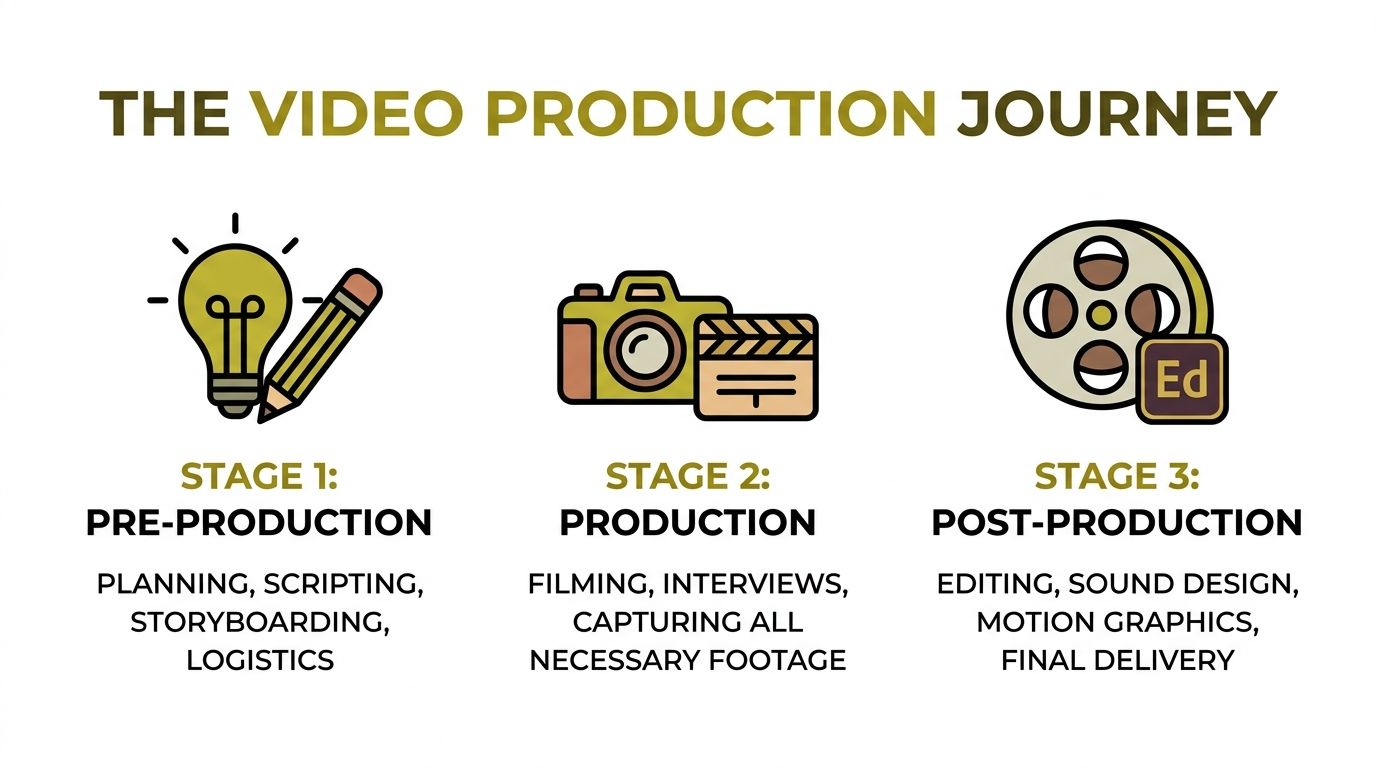
Pre-production decides whether the day works
Pre-production is the planning stage that prevents expensive improvisation later.
A strong pre-production phase covers:
- The brief: Audience, objective, message and channel.
- The editorial angle: What the story is really about.
- The script or interview framework: Not every project needs a full script, but every project needs a structure.
- The shot list: What must be captured to make the edit work.
- Logistics: Timings, locations, permissions, contributors and contingency planning.
Journalistic experience is powerful here. Reporters are trained to identify the strongest line of enquiry fast, pressure-test assumptions and spot what is missing before a deadline exposes it. That instinct saves time on set.
If your spokesperson is inexperienced on camera, preparation matters just as much as the camera setup. Calm briefing, message discipline and rehearsal of likely questions can transform the quality of the shoot. That is also why media skills support often sits close to production planning. A practical example is the kind of preparation covered in media training in the UK, where delivery, tone and message handling are treated as performance factors rather than afterthoughts.
Production is about control without stiffness
The filming day should feel calm, not chaotic.
That does not mean rigid. Good crews leave room for strong spontaneous moments. But they work from a clear plan, capture clean sound, manage eyelines, protect the schedule and keep the contributor focused on simple, usable answers.
Former journalists are often especially effective interviewers because they know how to get to substance quickly. Instead of asking generic prompts that produce canned answers, they ask questions that unlock examples, specifics and emotion.
Common production ingredients include:
- Interviews: Founders, customers, staff, partners or subject experts.
- B-roll: The visual layer that covers cuts and shows the business in action.
- Piece-to-camera delivery: Useful for explainers, authority clips and PR use.
- Event capture: Atmosphere, key moments, reactions and speaker content.
For readers comparing live action with more design-led approaches, this overview of 3D animation services in the UK, from pitch to delivery is a useful contrast. It shows when animation can clarify a message more effectively than filming a real environment.
A simple example of production style in action helps. This embedded video gives a feel for how visual communication can be structured for audience attention:
Post-production is where clarity is won or lost
Editing is not administrative. It is editorial decision-making. Here, the team selects the strongest takes, tightens the pace, layers in supporting visuals, removes repetition, cleans the audio, grades the image and adds graphics where needed. The difference between a usable video and a forgettable one often sits in tiny editing choices. How soon the best quote appears. Whether the opening earns attention. Whether the ending lands on a clear action.
Tip: Ask for deliverables by channel, not one master file. A homepage version, a square social cut, captioned clips and short quote extracts deliver more value than a single polished edit.
Well-run post-production also depends on disciplined feedback. If five stakeholders give conflicting comments with no decision-maker, the edit drifts. One lead approver. One round of consolidated notes. Clear priorities. That is how good work stays on time and on budget.
Understanding Video Production Pricing Models
Pricing in video often feels opaque for a simple reason. Many proposals bundle strategy, crew, filming, editing and usage into one figure, which makes it hard for SMEs to see what they are buying. For UK businesses comparing quotes, the primary job is to separate production effort from production value.

A newsroom mindset helps here. In journalism, every assignment is shaped by deadline, access, complexity and what must make the final cut. Business video works much the same way. A short interview-led case study with one location is priced differently from a brand film with multiple contributors, location changes and several channel versions, not because one sounds more impressive, but because one requires more planning, more shooting variables and more editorial decisions.
The three pricing models most businesses see
The first is a fixed project fee. This suits a clear brief with agreed deliverables, such as a homepage brand video, a customer testimonial or a recruitment piece. It gives finance teams certainty, but only if the scope is properly defined at the start.
The second is a day-rate model. This works well for event filming, content capture days and projects where the brief may evolve once filming starts. It offers flexibility, though the final cost can climb if nobody controls priorities.
The third is a retainer or ongoing content agreement. This suits businesses that need regular filming, monthly edit cycles or a steady stream of social and campaign assets. The main advantage is efficiency. Planning improves, crews work faster, and footage gets used across more than one objective.
What usually pushes cost up
Equipment rarely explains the biggest jump in price. Time, complexity and decision-making usually do.
Typical cost drivers include:
- More filming days: More crew time, scheduling and footage to review.
- Multiple locations: Travel, recce time, access coordination and setup delays.
- Larger crews: Helpful for live environments, tighter schedules or more polished coverage.
- Motion graphics or animation: Extra design, scripting and revision time.
- Music and stock licensing: Rights need to match the intended use.
- Versioning: A master edit plus social cutdowns, captions and format changes takes real edit time.
- Senior creative input: Strong scripting, interview preparation and editorial direction reduce waste on the shoot and in the edit.
One trade-off matters more than many buyers expect. A lean crew can keep costs down, but it also slows coverage if the brief asks for interviews, b-roll, sound control and quick turnarounds in the same day. The cheaper option on paper can become the slower and less efficient one in practice.
What good buyers ask before approving a quote
A proposal becomes easier to judge once the assumptions are visible.
Ask:
- What deliverables are included?
- How many filming days and edit rounds are covered?
- Who is handling strategy, scripting and interview preparation?
- Are captions, graphics, music licences and cutdowns included?
- What changes would create extra cost?
Those questions expose whether two quotes are comparable. One supplier may include planning, producer oversight and channel-specific edits. Another may price only the shoot and one master cut. The totals can look similar while the actual scope is miles apart.
Why cheaper is not always better value
Low pricing often strips out the parts that protect results. Pre-production gets rushed. Interviewees are underprepared. Shoot days overrun. The edit has no room for refinement, so the final video is serviceable but flat.
Good value comes from clear scope and sharp editorial judgement. That is the part many businesses miss. Broadcast-quality thinking is not about adding expensive flourishes. It is about asking better questions, capturing cleaner material first time and shaping footage into assets that work across website, sales, social and PR use.
Key takeaway: The strongest quote is rarely the lowest. It is the one that shows exactly what is included, what affects cost, and how the production will create usable business value.
How to Evaluate and Select a Video Partner
Most buyers ask the wrong questions first.
They ask what camera a supplier uses. They ask how fast they can turn a video around. They ask whether drone footage is included. Those are fair questions, but they are not the ones that decide whether the work will persuade anyone.
The better test is simple. Can this team understand the business problem, shape a clear story and run a smooth process under pressure?
What to look for in a portfolio
A portfolio should show more than attractive shots.
Look for evidence of:
- Narrative control: Does each piece have a clear point?
- Interview quality: Do people sound natural, specific and credible?
- Range: Can the team handle corporate, social, training and PR contexts?
- Editorial judgement: Is the work concise, or padded?
- Channel awareness: Do the assets feel suited to where they will be watched?
A flashy montage proves very little. A clean, persuasive customer story or a strong spokesperson clip tells you much more about a team’s actual usefulness.
Questions worth asking in the first meeting
Some of the best supplier questions are unglamorous.
- How do you shape the brief if our objective is still fuzzy?
- Who writes or structures the script?
- How do you prepare nervous interviewees?
- What happens if filming conditions change on the day?
- How do you manage feedback and approvals?
- What do you need from us to avoid delays?
These questions expose process maturity. They also show whether the supplier thinks like a partner or like a pair of hands.
Why storytelling ability matters more than gear lists
The latest camera does not fix a weak message. It does not help a founder who rambles. It does not make a customer testimonial believable. It does not create a better opening line.
Storytelling does that. So does interview technique. So does knowing when to cut a sentence, when to hold a reaction shot and when to strip a script back to plain English.
This is one reason newsroom backgrounds are so valuable in video. Journalists learn to work with imperfect conditions, pull clarity from busy contributors and find the angle that makes a story matter to an audience that owes you nothing.
Tip: Ask to see examples where the supplier handled a complex subject, a senior spokesperson or a time-pressured brief. That reveals more than a polished showreel.
Signs you may have the wrong partner
Proceed carefully if a supplier:
- Leads only with equipment
- Struggles to talk about audience
- Cannot explain their process clearly
- Avoids discussing approvals or scope
- Pushes one style of video for every problem
The right video partner is not a technician. They are a strategic editor, calm producer and reliable guide through a process that can otherwise become expensive noise.
Measuring Success and Real-World UK Examples
A finished video is not the result. The result is what the video changes.
That is why success measurement needs to start with the job the asset was built to do. A recruitment film should not be judged like a social teaser. A product page video should not be judged like a PR clip package.
The KPIs that matter more than views
Views are easy to report and easy to misread. Better measures depend on context.
Useful KPIs include:
- Audience retention: Are people still watching past the opening?
- Click-through behaviour: Did viewers take the next step?
- Lead quality: Did the video attract the right enquiries?
- Page performance: Did the asset help visitors understand the offer?
- Media pickup: Did journalists or outlets use the content supplied?
- Internal completion and reuse: For training assets, are teams using them?
For brand-led work, qualitative signals matter too. Are prospects referencing the video in meetings? Are partners sharing it? Are sales teams using it because it explains the offer better than a PDF?
What strong UK work tends to have in common
Campaigns for organisations such as The Johnnie Walker Experience, VisitScotland and Hamilton & Inches show a useful pattern. The strongest work is rarely the loudest. It combines clear narrative intent, disciplined visuals and a sharp understanding of audience context.
For a tourism or visitor experience brand, the video may need to create desire while also making the proposition easy to grasp. For a heritage retailer, the challenge may be trust, craft and tone. For a destination or public-facing campaign, distribution matters as much as the shoot itself.
A story-led approach helps because it gives every asset a reason to exist. That same principle sits behind effective brand messaging more broadly. This piece on what brand storytelling is is useful reading if you want to connect video decisions with the larger narrative your business is trying to build.
A practical way to review performance
After launch, ask three questions.
- Did the right audience watch it long enough to understand it?
- Did it support the intended action or outcome?
- Can the material be reused across other channels without weakening the message?
If the answer to those is yes, the production likely did its job. If not, the post-mortem should focus on message, format and distribution before blaming the edit alone.
Frequently Asked Questions
| Question | Answer |
|---|---|
| How long does a business video take to produce? | It depends on complexity, approvals, filming access and how much planning is done upfront. A simple interview-led piece can move quickly. A multi-location campaign with several stakeholders, graphics and multiple versions takes longer. The biggest delays come from unclear briefs and slow feedback, not the edit software. |
| Should we film in-house or outsource? | Many businesses use a hybrid model. In-house works well for regular updates, simple social clips and fast reactive content. Outsourcing makes sense when the message is vital, needs shaping, the spokesperson needs guidance or the final asset must work across web, PR, sales and social. |
| What should we prepare before speaking to a production partner? | Bring clarity on audience, objective, deadline, likely filming locations and where the video will be used. If you already have brand guidelines, an existing deck, web copy or example videos you like, share them early. That gives the production team something concrete to work from and reduces wasted rounds later. |
If you want senior, practical guidance on video productions services from a team shaped by national newsrooms and international brand experience, Carlos Alba Media is well worth a conversation. The agency works with ambitious UK businesses that need sharp storytelling, efficient production and clear thinking without big-agency overheads.