
Picture this: your brand becomes the name people drop at dinner parties, the one they genuinely recommend to friends. That’s not just good luck; that’s the result of smart consumer public relations. It’s the craft of building a stellar reputation through compelling stories, not just shouting about your products with expensive ads.
What Is Consumer Public Relations and Why Does It Matter?
At its heart, consumer public relations (or consumer PR) is all about building a positive, authentic connection between your brand and the people you want to reach. It’s fundamentally different from traditional advertising. While advertising involves paying for space—a billboard, a magazine ad, a TV spot—consumer PR is about earning that attention.
Think of it this way: anyone with a budget can buy a billboard. But getting featured in a national newspaper because your product is genuinely changing the game? That’s earned. That’s PR.
This isn't a new idea, but it has certainly changed. The digital boom of the early 2000s completely reshaped consumer PR in the UK. By 2010, with 37% of Brits active on social media, brands could no longer just talk at their customers; they had to talk with them. This was reflected in business spending too. A notable 2012 report highlighted a 150% increase in PR budgets for small businesses as they realised earned media was delivering more bang for their buck.

The Power of Earned Credibility
For a small or medium-sized enterprise (SME) in the UK, understanding the difference between earned and paid media is crucial. Getting your story into the press provides a level of third-party validation that advertising can never quite replicate. When a respected journalist, publication, or influencer gives your brand a nod, it builds instant trust with thousands of potential customers.
To make this distinction crystal clear, here’s a simple breakdown of how the two approaches stack up.
Consumer PR vs Traditional Advertising At A Glance
| Aspect | Consumer Public Relations (Earned Media) | Traditional Advertising (Paid Media) |
|---|---|---|
| Credibility | High – seen as an unbiased, third-party endorsement. | Low – audiences know the brand paid for the message. |
| Control | Low – you pitch the story, but the media outlet controls the final narrative. | High – you have full control over the message, creative, and placement. |
| Cost | Generally lower cost, paying for strategy and time, not ad space. | High cost, as you are paying directly for media placement. |
| Longevity | High – a good story can live on for years online, boosting SEO. | Short – the impact stops the moment you stop paying for the ad. |
| Measurement | Can be complex, focusing on reach, sentiment, and brand awareness. | Direct and straightforward, focusing on metrics like impressions and clicks. |
Ultimately, while advertising tells people you’re great, PR gets other people to say you’re great. And in business, that's a world of difference.
The real job of consumer PR is to find the interesting stories within your business—your company values, your product innovations, your origin story—and turn them into narratives that the media and the public genuinely care about. It’s about showing, not just telling.
This is where real expertise comes in. At Carlos Alba Media, for instance, our entire team is made up of former national news journalists or professionals with agency experience working with international brands. We don't just understand PR; we've been on the other side of the desk, deciding what makes a story newsworthy. That insider’s perspective gives our clients an incredible advantage, helping them cut through the noise and land meaningful coverage.
This journalist-led approach helps SMEs achieve a few key things:
- Building Brand Trust: A feature in a reputable outlet is a powerful seal of approval.
- Driving Awareness: You can reach a far wider audience than your own marketing channels could ever manage alone.
- Generating Leads: Positive press sends curious, high-intent customers straight to your website.
- Establishing Authority: It positions you as a go-to expert or innovator in your industry.
In short, a strong consumer PR strategy gives your brand a voice people actually want to hear. It's an indispensable part of building a modern brand that connects with the hearts and minds of customers. For a closer look at how this works in practice, you can learn more about the role of media relations in our detailed guide.
The Core Pillars Of A Modern PR Strategy
A great consumer PR strategy isn't built on guesswork. Think of it as a solid blueprint, with several key components that must work together. For any UK business, getting these right is the first step toward building a reputation that actually fuels growth. The old approach of just firing out press releases is long gone; today, it’s all about weaving multiple channels into a single, compelling brand story.
This doesn't mean you need to be everywhere at once. It’s about being smart and focusing your energy where it will make the biggest difference. By blending the authority of traditional media with the direct connection of digital platforms, you can create a powerful narrative that genuinely clicks with modern consumers.
Media Relations: The Foundation of Credibility
At the heart of any consumer public relation campaign is good old-fashioned media relations. Getting your brand featured in a respected newspaper, mentioned on a popular TV or radio show, or reviewed on a major website gives you a level of third-party approval that money just can't buy. This is earned credibility; it tells potential customers that an unbiased expert rates what you do.
But catching a journalist’s eye takes more than just having a great product. You have to understand what makes a story newsworthy from their point of view. This is where specialist experience really pays off.
Expert Insight: When your PR team includes former national news journalists, as is the case at Carlos Alba Media, you get a true insider’s advantage. These are professionals who have spent years on the other side of the fence, sitting in news conferences and deciding which stories get published. They have an instinct for how to frame your story to grab media attention.
That newsroom background, combined with agency experience working with international brands, ensures your story isn't just interesting—it’s built to fit the demanding agenda of a modern news cycle.
Influencer and Creator Partnerships
While media coverage builds broad credibility, partnerships with influencers and creators build trust within specific communities. People are increasingly looking to creators they follow for honest recommendations. A great collaboration isn’t about a one-off sponsored post; it’s about finding partners whose audience and values are a perfect match for your brand.
The real goal is to create content together that feels authentic and genuinely helps the creator’s followers. This could look like:
- Long-term brand ambassadorships where a creator can naturally weave your product into their content over time.
- Gifting programmes that get your product into the hands of the right people without the obligation of a paid post, often resulting in genuine, organic shout-outs.
- Collaborative content creation, where you and a creator team up on a project, like a how-to guide, a video series, or even a unique product.
Digital Community Building and Experiential Moments
Your social media channels shouldn't just be a megaphone for your marketing messages; they should be buzzing community hubs. The aim is to spark two-way conversations, answer questions, and build real relationships. Doing this well turns passive followers into vocal brand advocates who feel like they belong.
Finally, experiential moments are what bridge the gap between your online world and the real one. Hosting a memorable event, a launch party, or an interactive pop-up shop creates powerful, shareable content that gets people talking. These real-world experiences forge a much deeper emotional connection with your brand, leaving a lasting impression that a simple social media post never could. To keep up with how tech is changing the game, you can find more insights from the Lunabloom AI blog.
Put together, these pillars create a robust and adaptable framework for any modern consumer PR strategy.
How To Craft A Story The Media Wants To Cover
In the world of consumer public relations, your story is everything. It’s what separates a pitch that’s immediately binned from a narrative that lands you front-page coverage. So, how do you discover and shape a story that journalists—and their audiences—simply can't ignore?
The secret isn’t about fabricating a sensational headline. It's about finding the newsworthy gold that already exists within your business. Every brand has a story to tell; the real skill lies in spotting it and framing it in a way that resonates. This is precisely where having people with newsroom experience on your side makes all the difference.
At Carlos Alba Media, every consultant is either a former national news journalist or has deep agency experience with global brands. We’re trained to think like editors because we’ve been in their shoes, knowing exactly which angles will get championed in a morning news conference. This insight lets us turn a simple business update into a story with genuine public interest.
This entire process starts by digging deep to find your unique hook.
Uncovering Your Newsworthy Angle
Imagine a journalist’s inbox. It’s flooded with hundreds of pitches every single day, so yours has to grab them by the collar. A story angle is the specific hook that makes your news relevant to people outside your company. It has to answer that all-important question: "Why should anyone care?"
Here are a few powerful angles you can almost certainly find within your own business:
- The Founder's Journey: Is there a compelling backstory to your company’s origins? Maybe you overcame incredible odds or had a lightbulb moment in a really unusual setting.
- A Genuinely Disruptive Product: Does your product or service fix a common headache in a completely new way? Don’t just sell the features; sell the solution and how it changes someone's life.
- A Powerful Ethical Stance: Are you fiercely committed to sustainability, supporting your local community, or ethical sourcing? In a market where people buy with their values, this is a potent story.
- Major Business Milestones: Have you just landed significant funding, created a large number of local jobs, or hit a massive sales landmark? These aren't just internal wins; they're solid news hooks.
Once you have that story, you need a plan to get it out there. The modern PR process isn't just about sending a press release; it's about amplifying your story across multiple channels.
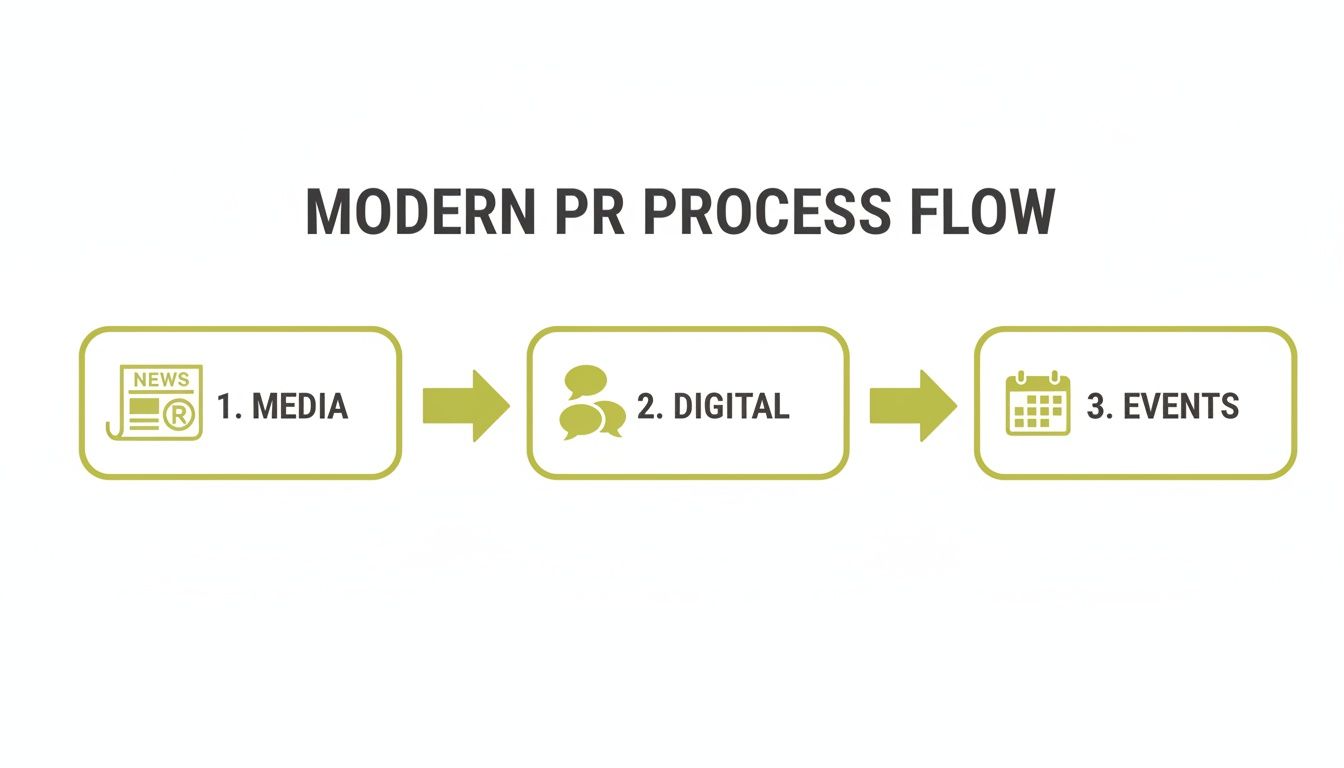
As you can see, a single strong story can be strategically pushed through media outreach, digital marketing, and live events to create a much bigger impact.
Structuring A Pitch That Cuts Through The Noise
With your story angle locked in, the next challenge is packaging it into a pitch a journalist can’t resist. This isn’t a new problem. In fact, modern PR in Britain was practically born when the journalist Basil Clarke founded Editorial Services back in 1924. He used his reporting instincts to connect businesses with the media—a principle that's more crucial than ever today.
Considering that 78% of UK consumers now trust earned media (like news articles) more than advertising, Clarke's idea was clearly ahead of its time.
A core skill in this process is knowing how to write a press release that does the heavy lifting for a journalist. Your pitch needs to be sharp, clear, and straight to the point.
Here’s a simple, battle-tested framework:
- A Killer Subject Line: Keep it short, specific, and intriguing. It should give the editor the core of the story in a single glance.
- The Direct Hook: The very first sentence of your email must state your news angle. Don't make them hunt for it.
- The "Why Now": Connect your story to the present moment. Is it tied to a current trend, a seasonal event, or a recent news story?
- The Core Details: Briefly lay out the key facts and figures that back up your story. Bullet points are your best friend here—they’re easy to scan.
- A Clear Call to Action: Make it easy for them. End by offering an interview with the founder, more information, or a product sample.
When you focus on telling a strong, human-centric story, you create a real connection with your audience. To get this right, you need to master the art of narrative—for more on that, take a look at our guide on what is brand storytelling. This approach is the heart of great consumer PR, turning your brand from just another name in the marketplace into a story people actually want to follow.
Measuring The True Business Impact Of Your PR
So, you’ve landed some fantastic press coverage. That’s great, but how do you actually prove it’s growing your business? It’s a question every smart business owner asks. The key is to look past simple vanity metrics, like how many articles you got, and focus on what really matters: drawing a straight line from that media mention to tangible results like sales and customer loyalty.
Great PR doesn’t just make a lot of noise; it makes things happen. When you start tracking the right data, you can see exactly how your consumer public relation efforts are paying off, justify the investment, and fine-tune your strategy for even better results.
Moving Beyond Outdated Metrics
For years, the go-to metric in PR was something called Advertising Value Equivalency (AVE). It was a simple, but deeply flawed, calculation that tried to put a price on press coverage by comparing it to the cost of advertising space.
Thankfully, the industry has moved on. We now recognise that treating a hard-won, credible news story like a paid-for advert completely misses the point. The true value of earned media isn't in column inches; it’s in the trust and authority it builds, something money can't buy. Today, measurement is all about tracking how PR genuinely influences what customers think and do.
A key strength of the Carlos Alba Media team is our blend of journalistic insight and commercial acumen. Our professionals, who are all former national news journalists or have agency experience working with international brands, understand that a story's success isn't just about getting it published—it's about the business impact it creates afterwards.
Key Performance Indicators That Actually Matter
To get a true picture of your PR performance, you need to track a blend of metrics. Think of it like a business health check – you wouldn't just look at one number, you'd look at a combination of indicators to understand the full story. These KPIs give you that holistic view, showing you how your brand is perceived and how that perception is driving action.
The most effective way to understand these metrics is to see what they measure and, crucially, why they are so important for your SME’s growth.
Modern PR KPIs And What They Tell You
Here’s a breakdown of the modern KPIs we focus on. They move beyond guesswork and give you concrete data on what’s working.
| KPI (Key Performance Indicator) | What It Measures | Why It Matters For Your SME |
|---|---|---|
| Share of Voice (SOV) | Your brand's visibility compared to your direct competitors within media coverage. | It tells you how much of the conversation in your industry you currently own. Increasing SOV means you are becoming more prominent and relevant than your rivals. |
| Sentiment Analysis | The tone of the conversation around your brand—positive, negative, or neutral. | This qualitative metric shows whether the coverage is building a positive reputation. It helps you understand if your PR efforts are creating goodwill. |
| Website Referral Traffic | The number of visitors who arrive at your website by clicking a link from a media article or online mention. | This is a direct line from PR to your digital doorstep. It shows that coverage is not just being seen, but is compelling enough to drive immediate action. |
| Lead Generation & Sales | The number of new leads or direct sales that can be attributed back to a specific PR campaign or piece of coverage. | This is the ultimate proof of ROI. By tracking how customers found you, you can directly connect media mentions to revenue growth. |
| Message Resonance | Whether your core brand messages and key talking points are being accurately and consistently reported in the media. | This shows if your story is being understood and repeated correctly. High message resonance means your brand narrative is clear and compelling. |
By tracking these KPIs, you shift the conversation from "we got some press" to "our press coverage generated a 20% increase in web traffic and a 15% uplift in qualified leads". This is how you prove the value of your consumer public relation strategy and make confident decisions that will truly grow your brand.
Protecting Your Brand When a Crisis Hits
It’s a scenario no brand wants to face, but one every brand must prepare for. In the time it takes to finish your morning coffee, a negative story can spread across the internet. Good consumer public relations isn't just about sharing positive news; it’s about having a robust plan to defend the reputation you’ve painstakingly built when things go wrong. The only real defence is being prepared.
When a crisis erupts, your response has to be swift, utterly transparent, and consistent. A single, clear voice is crucial. Panic breeds chaos, but a calm, measured response is what reassures customers and protects trust.

Why You Need Specialist Support on Speed Dial
When you’re in the thick of a crisis, the last thing you need is general advice. You need battle-tested experts who have been in these high-stakes situations before and know the way out. Trying to manage a major reputational threat on your own is a gamble you can't afford to take.
This is precisely why Carlos Alba Media provides a dedicated 24/7 crisis management service. It’s a unique partnership, combining journalistic instinct with the expertise of leading UK media lawyers. When your brand's future is at stake, that immediate blend of legal and media savvy is indispensable.
The Decisive Role of Media Training
One of the most critical elements of crisis preparation is making sure your spokespeople can deliver your message with authority, especially when they’re under a microscope. Media training isn’t a nice-to-have; it's essential for any leader who might one day have to face a barrage of difficult questions.
The real goal of crisis communication is to maintain control and project confidence. A well-trained spokesperson knows how to navigate a hostile interview, land the most important messages, and convey a sense of calm leadership. This is often the difference between containing a crisis and watching it spiral.
At Carlos Alba Media, our bespoke media training is run by former national news journalists. They know exactly how the media thinks, what questions will be asked, and the traps to avoid. Every member of our team has either worked as a journalist or managed PR for international brands, giving you an insider's understanding of how to handle the pressure.
This need for clear communication during difficult times isn't new. Back in the turbulent UK economy of the 1970s, consumer public relation was a crucial tool for brands fighting inflation and widespread public distrust. The UK's first consumer-focused PR work coincided with the 1974 Consumer Credit Act, tying brand transparency directly to consumer protection.
This history echoes today, where trust remains the most valuable currency. A 1982 National Consumer Council survey revealed that 55% of Britons preferred buying from brands with transparent PR.
To see how these principles work in practice, take a look at these real-world crisis communications examples. Ultimately, a crisis doesn’t have to be the end of your brand's story. With the right preparation and expert guidance, it can be a moment to prove your company’s character and emerge even stronger.
Choosing The Right PR Partner For Your Brand
Finding the right PR partner is one of the most critical moves you’ll make for your brand. This isn't just about outsourcing a task; it's about finding a team that genuinely clicks with your business and operates as a seamless extension of your own crew.
A slick pitch deck and a fancy website are one thing, but you need a genuine strategic partner, not just a supplier. So, how do you cut through the agency jargon and find a team that will actually deliver? A practical checklist is your best tool for making a confident, informed decision.
Key Questions To Ask A Potential PR Agency
Before you even think about signing a contract, you need to dig deep to see if an agency’s approach and expertise genuinely match your needs. Their answers to the right questions will tell you everything you need to know about what the partnership will really be like.
Think of this as your buyer's guide. Here are the essential questions every UK SME should ask:
- Does the team have direct media experience? Have the people who will actually run your account ever worked as journalists? There's simply no substitute for the insight that comes from being on the other side of the fence.
- Will we have direct access to senior strategists? You need to know if you'll be working with the experienced pros you met in the pitch, or if you’ll be passed down to a junior account manager once the ink is dry.
- Do you have proven experience with brands of our size? An agency used to working with massive corporate budgets might not understand the nimble, results-focused reality of an SME.
- Is your pricing transparent? Be on the lookout for clear, straightforward pricing. Avoid the heavy overheads and hidden costs that often come with large, traditional agencies.
This is where a specialist agency like Carlos Alba Media makes a real difference. Every single professional on our team is either a former national news journalist or has deep agency experience with top international brands. It's a unique blend that guarantees impactful storytelling, guided by senior-level strategic thinking.
The Value Of Newsroom Insight
When your PR team is built from ex-journalists, you gain an almost unfair advantage. They don't just blindly fire off press releases and hope for the best. They know how to shape a story that an editor will actually want to run—because they used to be that editor.
This journalist-led approach is the difference between hoping for media coverage and strategically earning it.
This philosophy is the very foundation of the Carlos Alba Media model. You get direct access to senior strategists who think and act like journalists. It’s a powerful combination of newsroom instinct and modern digital strategy, all designed to deliver measurable growth and handled by seasoned pros who are invested in your success.
Frequently Asked Questions About Consumer PR
Stepping into the world of consumer public relations can feel a bit daunting, and it's only natural to have questions. We get it. Here are some honest answers to the queries we hear most often from UK business owners, designed to give you a clear path forward.
What Is The Real Difference Between PR And Marketing?
This is probably the most common question we get, and the answer is fundamental. Think of it this way: marketing pays to get your message out there. It’s the adverts, the promotions, the direct sales emails – all aimed squarely at generating revenue.
Consumer PR, however, is all about earning your reputation. It’s the art of convincing others to talk about you because your story is worth telling. We’re talking about getting featured in the news or mentioned by a trusted influencer, all without a media budget. These two things shouldn't fight for attention; when they're working together, sharing the same core message, the results are powerful.
How Long Does It Take To See Results From PR?
Let's be realistic. Unlike a paid ad that delivers immediate clicks, consumer PR is a marathon, not a sprint. It’s about building genuine relationships with journalists and crafting a narrative that sticks. This takes time and consistent effort.
While you might score some quick wins early on, the real magic happens over months. That’s when the momentum builds. A single great article can create a ripple, but it’s the sustained, strategic work that transforms you into a go-to name in your industry.
Can Small Businesses Really Afford PR?
Yes, one hundred percent. The idea that PR is only for huge corporations with bottomless budgets is a complete myth we're happy to bust. In reality, a smart PR strategy often delivers a much better return on your investment than pricey advertising campaigns, especially for an SME.
It’s not about how much you spend, but how smart you are with your story.
The key is finding a partner who understands the SME landscape. At Carlos Alba Media, for instance, our model is designed to deliver senior-level counsel without the big-agency overheads. Because every member of our team is a former national news journalist or has agency experience with global brands, you get top-tier expertise that is both effective and accessible.
What If My Business Doesn't Have Any 'News'?
So many business owners feel this way, but from our experience, it's almost never true. "News" isn't just about a flashy product launch or a multi-million-pound funding announcement. Your story is often hiding in plain sight.
Your "news" could be:
- Your unique founder story: Why did you start this business? What's the human journey behind it?
- Your company values: Are you fiercely committed to sustainability or your local community? That’s a story.
- Your own data: You're sitting on a goldmine of insights from your customers. What trends can you share?
- A key milestone: Celebrating a company anniversary or welcoming your 1,000th customer is newsworthy.
A good PR pro, especially one with a journalist's nose for a story, is trained to find these angles. They can spot the headline in the things you might consider "business as usual."
Ready to build your brand’s reputation with stories that matter? Carlos Alba Media combines newsroom insight with modern digital strategy to get your brand seen and trusted. Discover how we can help your business grow.