
Forget about chasing fleeting trends or pouring your limited budget into paid ad campaigns that disappear the second you stop paying. For a tech startup, real, lasting growth comes from a smart SEO strategy. It’s about building a direct line to the people actively looking for what you offer, creating an asset that pays you back over and over.
Why SEO Is Your Startup’s Ultimate Growth Lever

With ad costs spiralling and engagement on social platforms feeling like a lottery, SEO for tech startups has become more than just a marketing tactic—it's a core business strategy. It's the fundamental difference between temporarily renting an audience through ads and truly owning the relationship with customers who are already searching for your solution. When you're a startup running on a tight budget, that distinction changes everything.
Our team's specialist perspective at Carlos Alba Media is shaped by our unique backgrounds. Everyone on the team is either a former national news journalist or has agency experience working with international brands. This gives us a unique take on SEO: we know how to build a compelling narrative and establish genuine authority, which are the absolute cornerstones of getting search right.
The Financial Case For Startup SEO
It helps to think of SEO as an investment in a long-term asset. Every blog post you publish, every helpful guide you create, and every backlink you earn methodically builds your website's value and authority in the eyes of Google. A PPC campaign vanishes the moment the budget runs out, but your SEO efforts keep delivering traffic and leads, compounding in value long after the initial work is done.
The numbers back this up. Our research shows that tech startups in the UK can see an average SEO ROI of 862%. To put it another way, that's a return of £8.62 for every £1 spent. This figure, based on real-world B2B campaign data, shows exactly why so many successful SMEs are shifting their focus to organic search. You can dig into the full SEO ROI data to see how the returns break down across different industries.
SEO isn’t a quick fix. It’s about building a sustainable, cost-effective engine for growth. It’s the most powerful lever a startup can pull to build brand equity and generate a predictable stream of high-intent customers.
This long-term value is especially important when you need to show investors and stakeholders a clear, scalable path to repeatable growth. A strong organic presence is a massive tick in that box.
Moving Beyond Paid Channel Dependency
Relying entirely on paid channels is like building your business on rented land. Sure, it can deliver quick results, but the model is inherently fragile and expensive. A well-planned SEO strategy is your path to independence and resilience.
A quick look at the numbers shows why organic search is the smarter long-term bet for most tech companies.
SEO vs Paid Channels ROI Comparison for Tech Startups
| Metric | SEO (Organic Search) | Paid Search (PPC) | Paid Social |
|---|---|---|---|
| Cost Over Time | Decreases as authority builds | Stays high; can increase | Constantly fluctuating |
| Trust Factor | High (users trust organic results) | Medium (users know it's an ad) | Low (often seen as disruptive) |
| Sustainability | High (value compounds) | Low (stops when you stop paying) | Low (requires constant spend) |
| Audience Intent | High (actively searching for solutions) | High (intent-based) | Low (passive audience) |
The comparison makes it clear why SEO for tech startups is the superior play for building lasting value. It perfectly mirrors how modern B2B buyers actually find and choose technology. They use search engines to identify solutions, read documentation, and compare different providers. If you're not visible at every step of that journey, you're leaving money on the table. SEO is how you build a business that isn't vulnerable to the whims of ad auction prices.
Building Your Technical SEO Foundation

Before you even think about content or keywords, we need to talk about your website's plumbing. So many startups get this wrong. They build a beautiful site but neglect the technical architecture, essentially making themselves invisible to Google from day one.
Think of it as building a house. You wouldn’t start decorating the living room before you've laid a solid foundation. Getting your technical SEO right at the start is that foundation—it prevents a world of headaches and expensive fixes down the road.
Getting Your Core Analytics and Search Tools in Place
First things first: you need your eyes and ears on the ground. That means installing and correctly setting up Google Search Console (GSC) and Google Analytics 4 (GA4). These free tools are the command centre for your entire SEO operation.
- Google Search Console: This is your direct hotline to Google. It tells you exactly how the search engine sees your site, what technical snags it’s hitting, and which keywords are actually bringing people to your door.
- Google Analytics 4: This tool shows you what people do once they arrive. Where are they coming from? Which pages do they visit? Where do they drop off? Linking GA4 with GSC gives you the full story, from the initial search query right through to a sign-up or purchase.
Don't just install them and forget it. A proper setup is critical; this data will guide every strategic decision you make from here on out.
At Carlos Alba Media, our team's experience with international brands has taught us that data integrity is paramount. We've seen firsthand how a flawed analytics setup can lead to months of wasted effort. Ensuring your tracking is clean from the start is non-negotiable.
Conducting Your First Technical Health Check
With your tracking live, it’s time for a quick health check. A crucial part of building your technical SEO is to run a thorough website audit to see what’s working and, more importantly, what isn’t. You don't need to be a developer to spot the big issues.
Just focus on these three pillars to begin with:
- Crawlability: Can Google find its way around your site? Your
robots.txtfile is the bouncer at the door—make sure it isn't accidentally blocking Googlebot from important pages. A clean XML sitemap is the map you give it, pointing out all your most valuable content. - Indexability: Once Google finds your pages, can it actually add them to its search results? A rogue "noindex" tag can make a critical page completely invisible. GSC’s "Pages" report is your best friend here; it will flag these problems for you.
- Mobile-First Performance: With over 60% of searches happening on mobile, Google now ranks you based on your mobile site. A slow, clunky experience on a phone will directly tank your rankings. It's no longer optional.
This initial check gives you a punch list of the most urgent fixes. For a more exhaustive review, you can work through our comprehensive SEO audit checklist to make sure no stone is left unturned.
Demystifying Key Technical Concepts
As a founder, you'll hear a lot of jargon. Knowing what a few key terms actually mean will help you have much more productive conversations with your team or agency.
Schema Markup
This is just a bit of code that gives search engines extra context about your page. For a tech product, you can use it to highlight things like:
- Your software's key features and pricing tiers.
- Answers to frequently asked questions.
- Information about your company.
The payoff? Schema can unlock "rich snippets" in search results—things like star ratings or expandable FAQs right on the results page. These make your listing stand out and can seriously boost clicks.
Site Speed and Core Web Vitals
Google has been clear: a slow website is a bad website. They measure user experience with a set of metrics called Core Web Vitals, which look at how quickly your page loads, becomes interactive, and stays visually stable. A fast site is no longer a luxury; it's a direct ranking factor.
Our team at Carlos Alba Media—made up of former national news journalists and agency veterans—brings a newsroom mentality to technical SEO. We cut through the noise and focus on what actually moves the needle. Your technical foundation is the engine for your startup's growth, and it's worth getting right.
Finding the Keywords That Actually Drive Growth
Forget chasing massive search volumes. For a tech startup, successful SEO is about getting inside your ideal customer's head and finding the exact words they type into Google when they’re struggling with a problem your product solves. When you get this right, search stops being a guessing game and becomes a reliable source of high-quality leads.
It all starts with knowing who you're selling to. Before you even think about keywords, you have to create buyer personas. If you don't have a crystal-clear picture of your audience—their job title, their biggest headaches, how technical they are—your entire keyword strategy is just a shot in the dark.
Our approach at Carlos Alba Media is a bit different because of our specialist team. We’re all either ex-journalists from national newsrooms or have worked in agencies on major international brands. This mix means we don't just see a list of keywords; we see the story and intent behind the search, which is absolutely critical for connecting with savvy tech buyers.
The Three Types of Keywords Your Startup Can't Ignore
Your customers don't just wake up one day and decide to buy your software. They go on a journey, and your keyword strategy needs to be there to meet them at every turn. This means thinking about keywords in three distinct stages.
Problem-Aware Keywords (Top of Funnel): This is where it all begins. People are searching because they know they have a problem, but they don't know your solution exists yet. These queries are often questions. For a project management tool, you'd see searches like “how to improve team collaboration remotely” or “project timeline tracking issues.”
Solution-Comparison Keywords (Middle of Funnel): Now, your prospect is aware that solutions like yours are out there, and they're weighing up their options. Keywords get more specific, often including terms like “vs”, “alternative”, or “review”. A classic example is “Trello vs Asana for small teams” or “best agile project management tool.”
High-Intent 'Money' Keywords (Bottom of Funnel): These are the ones that lead directly to conversions. The searcher is ready to pull the trigger, and their queries are transactional or branded. Think “ClickUp pricing plans” or “monday.com enterprise demo.”
A common mistake I see startups make is focusing only on those 'money' keywords. It’s tempting, but you end up missing out on the huge pool of potential customers who are still figuring things out. A smart strategy targets all three to build a complete funnel that brings people in and guides them toward a decision.
Keyword research isn’t a one-and-done task. It's a living process. The language your customers use will change, your competitors will adapt, and your product will evolve. Your keyword strategy needs to keep pace.
Finding Gaps in Your Competitor's Armour
Your competitors are basically giving you a roadmap to their strategy. By analysing what they're doing, you can uncover some real golden opportunities they’ve overlooked. Start by identifying who’s ranking for your main 'money' keywords, then use an SEO tool to dig into every single term they get traffic from.
You're looking for long-tail keywords—those longer, super-specific phrases. Pay close attention to terms where they rank, but haven't actually created any dedicated content. For example, a competitor might be on page two for “AI-powered bug tracking for mobile apps” just because their homepage happens to mention those terms. That's your opening to swoop in with a highly targeted landing page or blog post and steal that traffic.
This tactic is especially potent in the UK. Here, organic search is responsible for 50.5% of all website traffic, making it the single most important channel for startups that don't have a massive ad budget. For a lean team in Scotland or London, outmanoeuvring a competitor on a few specific, high-intent long-tail keywords can make a world of difference. You can read more about the numbers in these SEO ROI statistics from Limelight Digital.
Ultimately, a clever keyword strategy is the bedrock of good SEO for tech startups. It’s about listening to your market, understanding exactly what users want, and building a content plan that answers their questions at every stage. This is how you turn your website from a simple online brochure into a customer acquisition engine.
How To Create Content That Ranks and Converts

So, you’ve done your keyword research. Now for the fun part: turning that data into content that actually gets seen and, more importantly, gets results. In SEO for tech startups, your content is the engine. But we’re not just talking about firing up a blog; we need a strategic mix of assets built for different people at different stages of their buying journey.
Our specialist approach at Carlos Alba Media comes from our team's expertise. Every one of us is either a former national news journalist or has agency experience working with international brands. That background means we know how to do more than just tick SEO boxes—we know how to tell a story that builds trust and persuades a sharp, technical audience. It’s a skill that’s absolutely vital in the tech space.
The Three Pillars of a Startup Content Strategy
As a lean startup, every piece of content has to pull its weight. There's no room for fluff. Your entire content plan should stand on three essential pillars, each serving a distinct business goal.
High-Intent Product Pages: These are your money-makers. They need to be laser-focused on those 'bottom-of-funnel' keywords you found, speaking directly to people who are ready to make a choice.
Problem-Solving Blog Posts: Think of these as your top-of-funnel magnet. The articles here should target 'problem-aware' keywords, grabbing the attention of users who are just starting to look for a solution.
Detailed Technical Documentation: Never underestimate the power of your docs. Your tutorials, API guides, and technical deep dives are an SEO goldmine. They attract developers and other technical users, building huge credibility and ranking for very specific, long-tail searches.
Weaving these three types of content together creates a complete funnel. You capture attention, educate prospects, and then guide them straight to conversion.
Structuring Content for Authority and Readability
How you organise your content is just as crucial as what you write. Tech audiences, especially developers, won’t stick around for a wall of disorganised text. The key is to build authority by creating comprehensive resources, which is often called building topic clusters.
A topic cluster works like this: you create a central "pillar page" on a broad subject (like "Agile Project Management") and then create several "cluster pages" that go deep on related subtopics (e.g., "What is a Sprint?" or "Scrum vs Kanban"), all linking back to the main pillar. This structure proves to Google that you’re a genuine expert on the subject.
Your job isn't just to write an article. It's to create the single best, most helpful resource on the internet for that specific search query. That shift in mindset is what separates content that gets buried from content that owns the search results.
This structured approach is more critical than ever. In the UK, where Google commands a 92.4% search share, the SEO game is getting more sophisticated. By 2026, 91% of UK companies confirmed their SEO efforts boosted website performance, and that figure climbs to 97% for businesses with mature SEO programmes. You can read more in the latest UK SEO statistics from The SEO Works. Investing in quality, organised content is how you get into that top tier.
From Content Creation to Conversion Optimisation
Creating brilliant content is only half the job. You have to make sure it’s actually designed to turn visitors into leads or customers. This is where user experience (UX) and conversion rate optimisation (CRO) become your best friends.
Every single page should have a clear, logical next step. What do you want the reader to do when they’re done?
- On a blog post? Point them to a relevant product feature page or invite them to join your newsletter.
- On a technical guide? Nudge them towards starting a free trial or booking a demo.
- On a product page? Your call-to-action (CTA) should be bold, clear, and impossible to ignore.
Fine-tuning these details can have a surprisingly big impact on your growth. We've seen firsthand how small tweaks can deliver major results, which we explore in our guide on how to increase website conversion rates. This is where your SEO strategy stops being about traffic and starts delivering real, measurable business value.
Earning Authority Through Digital PR
Even with killer content and a technically perfect website, you'll struggle to gain traction without one key ingredient: authority. For Google, authority is all about trust, and the most powerful signal of trust comes from high-quality backlinks from other respected sites. Forget the old-school, spammy tactics you might have heard about. Today, building real authority is a PR game.
This isn't about buying links or trying to trick an algorithm. It's about earning your place in the conversation by crafting compelling stories and data-driven insights that journalists genuinely want to cover. When they do, you get powerful backlinks as a natural by-product.
Here at Carlos Alba Media, this is where our unique background gives us a serious edge. Our team is built from former national news journalists and senior agency pros who have worked with international brands. We don't just think like journalists; many of us were journalists. We instinctively know what makes a story tick and how to pitch it so it lands.
Think Like a News Editor, Not a Marketer
If you want to succeed with digital PR, you have to shift your mindset. Stop thinking like a marketer who wants to push a product, and start thinking like a news editor looking for a great story. Journalists couldn't care less about your new features; they care about data, emerging trends, sharp expert opinions, and compelling human angles.
This flowchart maps out the three core ways to earn the kinds of links that actually move the needle.
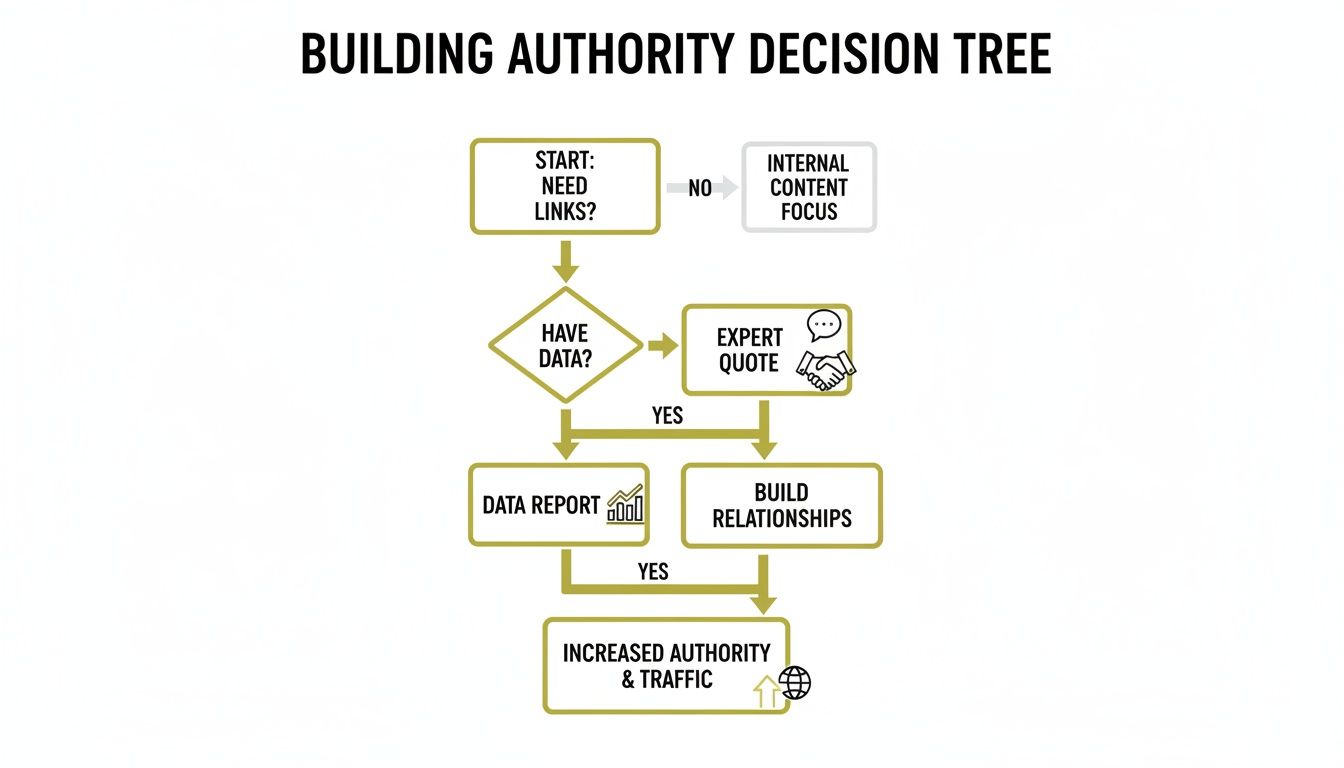
The central idea is simple: every authoritative link you earn comes from providing genuine value to journalists and their audience, not from asking for favours.
So, how do you put this into practice? For a tech startup, here are three strategies that we’ve found to be incredibly effective.
Create Your Own Data: Use your internal product data or commission a quick, affordable survey to create a unique report. A cybersecurity startup, for instance, could analyse its own threat data to release a report on the "Top 5 Phishing Scams Targeting UK SMEs". This creates an original asset that journalists will cite and link back to as a source.
Jump on Breaking News (Newsjacking): When a big story breaks in your industry—a new regulation, a competitor's data breach, a major AI update—be ready with your expert take. Reaching out to journalists who are covering the story with a sharp, insightful quote can be a fast-track to getting featured in high-profile articles.
Play the Long Game with Relationships: Identify the top 20-30 journalists and publications covering your space. Follow them on social media, share their articles, and offer help or insights with no strings attached. When you eventually have a story to pitch, you’ll be sending it to a warm contact, not a cold inbox.
From Pitch to Placement: A Real-World Scenario
Let's say you're a fintech startup launching a new budgeting app for freelancers. The old way would be to send out a press release with the headline, "New App Launch." It would be ignored.
Instead, you apply a digital PR mindset.
You run a survey of 500 UK freelancers and discover that 78% of them struggle with the stress of irregular income. You turn this into a data-led story, "The Freelancer Financial Squeeze," complete with punchy infographics and a quote from your CEO offering practical advice.
Your pitch is no longer a self-serving announcement. It's now a valuable, newsworthy story about a widespread problem—a problem your product just happens to help solve.
You pitch this story not to tech blogs, but to personal finance editors at national newspapers and to writers at freelance-focused publications. The result? You land coverage in several authoritative outlets, all linking back to your report as the source. These are the kinds of links that transform your rankings and drive a steady flow of high-quality traffic. This PR-led approach to link building is a core specialism for top-tier technology PR agencies that know how to find the sweet spot between business goals and media interests.
Building authority is a marathon, not a sprint. It takes creativity, persistence, and a real commitment to creating value. But for a tech startup, the rewards—trust, visibility, and sustainable organic growth—are well worth the effort.
Measuring SEO Success and Prioritising What's Next
In any startup, time is the one resource you can't get more of. That means wasting it on SEO activities that don’t move the needle simply isn’t an option. This is where ruthless prioritisation and smart measurement come into their own. Forget complex, enterprise-level dashboards; you need simple, clear signals that tell you what’s actually working.
You can get started with a basic dashboard using nothing more than Google Search Console and Google Analytics 4. Honestly, these free tools give you everything you need to make intelligent decisions without getting bogged down in vanity metrics.
Key Performance Indicators That Actually Matter
Focus your attention on a small set of KPIs that are directly tied to business growth. Everything else is just noise.
Your dashboard should give you an at-a-glance view of:
- Organic Traffic Growth: Is your organic traffic trending up month-on-month? This is your top-level health check.
- Keyword Ranking Movements: Are you climbing the SERPs for your high-intent 'money' keywords? Keep a close eye on your top 10-20 commercial terms.
- Organic Conversion Rate: What percentage of organic visitors are taking a valuable action, like signing up for a trial or booking a demo? Traffic is worthless if it doesn't convert.
- Backlink Velocity: How many new, high-quality referring domains did you earn this month? This is a direct measure of your authority-building efforts.
At Carlos Alba Media, our team has seen countless startups get completely lost in data. The goal isn’t to track everything under the sun. It's about tracking the right things that lead to tangible business growth—more sign-ups, more demos, more revenue.
A Simple Framework for Prioritisation
Armed with this data, you can start making some real decisions. Double down on what works and kill what doesn’t.
Did a specific blog post drive a surprising number of trial sign-ups? Great, plan a follow-up piece or even a webinar on that topic. Is a key landing page getting plenty of traffic but has a terrible conversion rate? That’s your cue to prioritise A/B testing the headline and call-to-action.
To make this process systematic, use a simple Impact vs Effort matrix. It’s a brilliant way to visualise where your team's energy should go.
- High Impact, Low Effort (Quick Wins): Do these right now. We're talking about things like updating meta descriptions on high-traffic pages or adding internal links from older posts to your shiny new pillar page.
- High Impact, High Effort (Major Projects): These are your bigger strategic bets. Think about commissioning that data-driven report or building out a new product feature hub. They take time but offer huge rewards.
- Low Impact, Low Effort (Fill-ins): These are the tasks you can chip away at when you have a bit of downtime.
- Low Impact, High Effort (The Time Sinks): Just ignore these. Seriously. Your time is too valuable.
Using a straightforward framework like this ensures your limited resources are always channelled into activities that deliver the most tangible results. It’s how you turn your SEO for tech startups strategy into a predictable engine for growth.
Got Questions About Startup SEO? We’ve Got Answers
Let's cut to the chase. Founders and marketing leads always have a few big questions when it comes to SEO. Having been in the trenches with countless tech startups, we've heard them all. Here are the straight answers to the ones that come up most often.
How Long Until We See SEO Results For Our Startup?
Everyone wants to know this, and the honest answer is it takes time. You might see some small wins from technical fixes in a matter of weeks, but for the kind of results that actually move the needle, you should plan for 6 to 12 months.
Why so long? Because you're not just ticking boxes; you're building genuine authority and trust with Google and your audience. Expect to see early glimmers of hope, like a rise in search impressions, within the first 3-4 months. The real, tangible impact on traffic and leads, however, builds steadily over that first year. It’s a long game, and consistency is everything.
At Carlos Alba Media, our team of former national news journalists and agency veterans who've worked with international brands helps founders find that sweet spot, creating a balanced strategy that respects their budget while hitting growth targets.
Should We Invest In SEO Or Paid Ads First?
This isn't really an either/or question. The two work best together.
Think of paid ads as your rapid-feedback loop. You can use them for immediate lead generation and, crucially, to test which messages and keywords actually resonate with your audience. That data is gold, and you can pour it straight into your SEO strategy to make it smarter from the get-go. While ads deliver instant traffic, SEO is what builds you a sustainable, long-term asset that keeps generating leads without you paying for every click.
If the budget is really tight, get your foundational SEO in place from day one. Its value compounds over time, making it one of the best long-term investments you can make.
What Is The Single Most Important SEO Factor For A Tech Startup?
If I had to boil it all down to one thing, it would be this: create expert-driven content that solves a specific, painful problem for your ideal customer.
For a tech company, your content needs to work twice as hard. It has to rank well, but it also has to prove your product's worth and build trust. This is where your expertise becomes your biggest marketing asset.
Focus on creating content that your sales team will love, such as:
- Detailed feature comparisons that honestly stack you up against competitors.
- In-depth product tutorials that show off your user interface in action.
- Case studies packed with real, hard data that prove your value.
This is the bedrock of effective SEO for tech startups. It’s not just about keywords; it’s about creating content that builds confidence and directly drives sales conversations.
Ready to build an SEO and PR strategy that delivers real business growth? The team at Carlos Alba Media combines journalistic insight with digital expertise to get you seen, trusted, and chosen. Learn more and get in touch with us.