
Thought leadership isn’t just about sharing what you know. It's about fundamentally shifting perspectives. It’s the art of building genuine trust by offering up your most insightful, forward-thinking expertise. This moves you far beyond standard marketing, positioning you and your brand as the go-to authority in your field.
What Is Thought Leadership Content Really?
Imagine traditional content marketing as a helpful tour guide, pointing out well-known landmarks and explaining what they are. Thought leadership, on the other hand, is the seasoned expert who joins the tour, challenges a few common assumptions, and points out the subtle, unseen connections that tell the real story of the city.
It’s the difference between reporting the news and providing the sharp analysis that explains what that news actually means for the future. For UK SMEs and founders, this distinction is everything. It's how you can effectively build brand awareness without needing a colossal advertising budget. If you want to dive deeper into the strategy, it's worth understanding what is thought leadership marketing entails.
Ultimately, this approach is about earning trust, not just chasing clicks. Instead of pushing a sale, you’re offering undeniable value through your unique viewpoint and deep knowledge. This is exactly where the team at Carlos Alba Media comes in. Everyone who works for Carlos Alba Media is a former national news journalist or has agency experience of working with international brands. We apply that journalistic discipline to your business, unearthing the compelling stories and data-driven insights that others miss, then crafting them into content that truly commands attention.
Thought Leadership vs Traditional Content Marketing
Seeing the two side-by-side is the clearest way to grasp the difference. While both are crucial parts of a healthy marketing strategy, they play very different roles.
This table breaks down those core distinctions.
| Attribute | Thought Leadership Content | Traditional Content Marketing |
|---|---|---|
| Primary Goal | To build authority and influence industry conversation. | To attract, engage, and convert a target audience. |
| Core Focus | Presents new ideas, unique perspectives, or original research. | Provides helpful, practical information based on known topics. |
| Tone of Voice | Provocative, insightful, and authoritative. | Informative, helpful, and educational. |
| Audience Outcome | Shifts the audience's perspective and builds deep trust. | Helps the audience solve an immediate problem or learn a skill. |
Understanding this difference is becoming more important by the day. Decision-makers are actively tuning out the noise and seeking credible, authoritative voices to guide their thinking.
The numbers back this up. A significant 52% of UK organisations are set to increase their spending on this kind of content by 2026. Why? Because the people at the top are paying attention. Right now, 54% of UK CEOs spend over an hour every week consuming thought leadership, using it as a primary source for fresh ideas and strategic direction. You can read more about the rise of thought leadership investment in the UK.
The Four Pillars of Powerful Thought Leadership
Great thought leadership doesn't come from a clever marketing slogan or a bold, unsupported claim. It’s built on a solid foundation. Think of it as a structure resting on four essential pillars. Get these right, and you create content that doesn't just get noticed but genuinely earns respect and influences decisions.
At its core, this kind of content has two jobs: it needs to shift how people see a problem while building up your credibility.
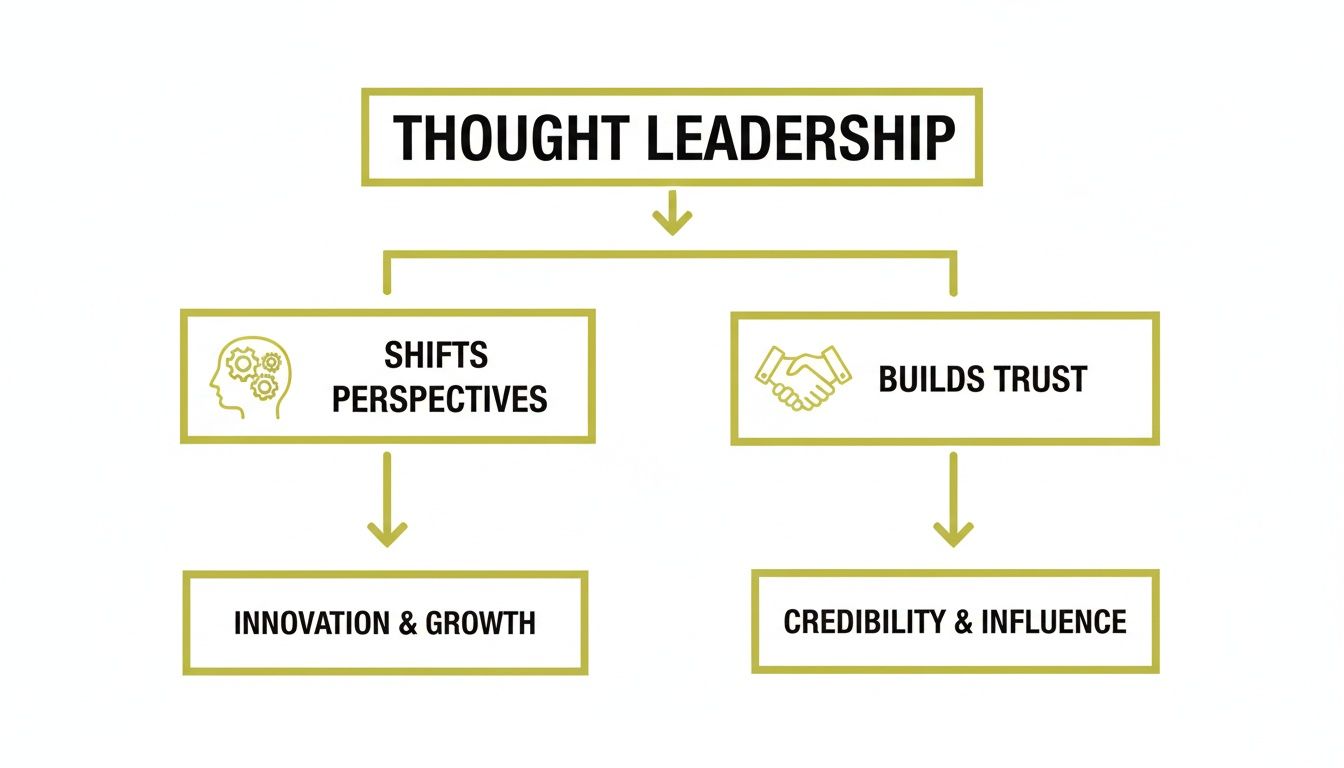
This isn’t just theory. When you share unique, well-argued insights, you are directly contributing to your authority. Each pillar supports the others, creating a powerful framework for your voice to stand out.
Authenticity and Credibility
Authenticity is all about having a real, human voice. It means ditching the corporate jargon and stiff, faceless language. Your content should sound like it came from you—reflecting your actual expertise, your personality, and the values of your brand. It’s what makes you relatable.
Credibility is the other side of that coin. It’s about proving you know what you’re talking about. This is where evidence becomes your most powerful tool.
True credibility isn't just about what you know; it's about what you can prove. Building arguments based on evidence, not just opinion, is what separates genuine leaders from the noise.
This is precisely where the journalistic discipline we bring at Carlos Alba Media makes a huge difference. As everyone on our team is a former national news journalist or has agency experience working with international brands, we’ve spent our careers hunting for proof—the data, the case studies, the real-world examples—that turns a simple opinion into a compelling argument.
Relevance and Insight
For your content to matter, it has to be relevant. It must connect directly with your audience's biggest challenges, frustrations, or ambitions. If you can’t answer their unspoken question, "Why should I care?", your message will simply get lost. This requires a genuine curiosity about who you’re talking to.
Finally, we have insight. This is the pillar that truly separates real thought leadership from the rest. It isn't enough to just state the obvious or summarise what everyone else is saying. You need to offer a fresh take, challenge a common assumption, or point out a connection no one else has seen. This is what delivers that "aha!" moment.
The best content weaves all these elements together seamlessly. Buyers today are quick to dismiss anything that feels like a sales pitch. As research shows, they’re looking for educational content that demonstrates clear expertise through authentic human storytelling. You can explore the research on crafting impactful thought leadership to see for yourself.
That's why pushing a hard sell is the fastest way to break trust. Your most sustainable asset for growth is demonstrating you have genuinely insightful expertise to share.
Choosing Your Format for Maximum Impact

Even the most brilliant idea can fall flat if it isn't packaged properly. The format you choose for your thought leadership is the vehicle that carries your expertise. Pick the right one, and your message connects; pick the wrong one, and it gets lost in the noise. This isn't just about churning out another blog post—it’s about strategically matching your unique insight to the most effective delivery method.
Think of it like this: if you’ve conducted in-depth research packed with data, a detailed white paper is the perfect stage to build your argument. But if you have a bold, sharp opinion on a current trend, it will have far more punch as a concise LinkedIn article or a short, compelling video.
At Carlos Alba Media, this is exactly what we do. Our specialist team is made up entirely of former national news journalists or professionals with agency experience working on international brands. We rely on those newsroom instincts to find the perfect angle, format, and channel for your story, ensuring your expertise gets in front of the decision-makers who really matter.
Aligning Format With Platform and Purpose
Where you share your content dictates the best format to use. For anyone targeting a B2B audience, LinkedIn is the undisputed champion. But its fast-scrolling feed means you have seconds, not minutes, to make an impression.
Your format needs to work with the platform, not against it.
- LinkedIn Articles and Posts: Perfect for sharing timely opinions, quick-fire insights, and personal reflections. Keep your paragraphs short, use bold text, and add a visual to stop the scroll.
- Data-Driven Reports: These are fantastic for building deep credibility. Use original research or a unique analysis to create a genuinely valuable asset people will download in exchange for their contact details.
- Webinars and Live Events: Nothing beats a live session for interactive discussion. It’s a chance to answer questions in real-time and show you know your stuff without a script.
- Video Content: Video is exceptionally powerful for building a personal connection. Short clips are great for social media, while longer interviews allow you to explore complex topics in more detail.
The Rise of Video in B2B Strategy
Video, in particular, is reshaping thought leadership strategies across the UK. A recent study shows a staggering 61% of organisations plan to increase their video spending by 2026. This is closely tied to the dominance of LinkedIn, which now reaches 81.8% of UK adults.
The catch? The average user spends just two minutes per day on the platform. Your content has to be incredibly sharp to cut through. Yet the effort pays off: 89% of B2B marketers use LinkedIn for lead generation, and 62% confirm it actively produces leads for them. You can dive deeper into the latest content trends for 2025 to see where things are headed.
While major corporations have big budgets for glossy productions, SMEs can be just as effective with a smarter approach. Authentic, high-quality videos—filmed with a good microphone and camera—often build more trust. If you need some pointers, check out our guide on creating social media how-to videos. The real key is delivering genuine value, no matter the production scale.
Real-World Examples of Thought Leadership in Action

It’s all well and good to talk about thought leadership in theory, but what really matters is seeing it work in the real world. The right approach turns your expertise into something you can actually measure: high-value media mentions, invites to speak at major events, and a steady stream of qualified leads knocking on your door. That's how you prove the ROI.
At Carlos Alba Media, our team of specialists—all former national news journalists or professionals with agency experience on international brands—has seen this play out time and time again. We know how to find the story within a business and package it for real impact, because we’ve spent our careers on the other side of the desk.
Think about a boutique professional services firm struggling to compete with giants in their industry. They can't possibly outspend them. So, they have to out-think them. By commissioning and publishing an original data report on a tiny, overlooked industry problem, they instantly create an asset nobody else has. That’s the core of great thought leadership.
The Professional Services Firm
Let’s take a UK-based accountancy firm that specialises in the tech sector. They’re brilliant, but they’re fighting to attract high-growth start-ups who are naturally drawn to the big, established names.
- Business Challenge: To stand out and compete against big-name consultancies for valuable tech clients.
- Content Approach: They surveyed 100 UK tech founders about their biggest financial headaches after securing funding. They then published the unique findings in a report called "The Founder's Financial Blind Spot."
- Channels Used: The report was a free download on their site (behind a simple form), promoted with targeted posts on LinkedIn, and sent directly to key journalists covering the UK tech scene.
- Measurable Results: The firm landed stories in two major tech publications. The founder was invited onto a popular industry podcast, and, most importantly, they generated over 50 high-quality leads from start-up CFOs in just three months.
The Hospitality Brand
Now, picture a luxury hotel group that wants to be recognised as a true leader in sustainable tourism. Their goal is to attract eco-conscious travellers and corporate clients who care about their ESG credentials.
A common business challenge can be reframed as an opportunity. By owning a specific conversation, you move from being just another option to becoming the definitive authority.
The hotel’s General Manager, drawing on years of hands-on experience, decided to write a bold opinion piece.
- Business Challenge: To differentiate the brand on something more meaningful than just price or amenities.
- Content Approach: The GM wrote an article with a deliberately provocative title: "Why Your Hotel's 'Green' Program Is Probably Greenwashing." It called out superficial industry habits and laid out a clear, actionable framework for genuine sustainability.
- Channels Used: The article was first published on the GM’s LinkedIn profile to build initial buzz, then pitched as an exclusive op-ed to a top-tier hospitality trade journal.
- Measurable Results: The piece ignited a huge debate across the industry. This led to an invitation for the GM to speak on a panel at a national hospitality conference and directly influenced two major corporate event bookings from companies with strict ESG policies.
To see how this works in other sectors, take a look at these potent thought leadership content examples for founders and investors. They clearly show the direct line you can draw from a smart content idea to tangible business growth.
Building Your Thought Leadership Strategy Step by Step
You don’t just stumble into becoming a recognised expert. Great thought leadership is the result of a deliberate plan, not an accident. It’s about building a repeatable system that turns your hard-won expertise into genuine authority and influence in your field.Before you even think about writing a single word, you need to know what you're aiming for. What does success actually look like for your business? Are you trying to attract top talent, break into a new market, or simply become the go-to name for a specific problem? Getting clear on this goal from the very beginning will shape every decision you make.
This is where a journalist’s mindset gives you a serious edge. At Carlos Alba Media, our team's specialist nature comes from our backgrounds: every one of us is either a former national news journalist or has agency experience working with international brands. We start by asking the tough questions, applying a newsroom-style approach to help our clients find the unique, data-backed stories that will really connect with their audience.
Identifying Your Niche and Core Ideas
You can't be a thought leader on everything. The most powerful strategies are built on a tightly defined niche where you can realistically claim to know more than anyone else. This focus lets you build real depth and authority far more quickly than if you try to cover too much ground.
Once you’ve found your sweet spot, it's time to dig for those experience-backed ideas.
- Ask yourself: "What do we know that others don't?" Look at your own data, your unique processes, or the painful lessons you learned from your biggest mistakes.
- Challenge the status quo. Is there a common industry belief that you fundamentally disagree with? A well-argued, contrarian point of view is often the bedrock of powerful thought leadership.
- Zero in on your audience's real-world problems. What are the nagging, persistent issues your clients are always wrestling with? True thought leadership offers fresh solutions and new ways of thinking about old problems.
This isn’t about guesswork; it's an investigation. By talking to your sales teams and listening to the conversations happening in your market, you’ll uncover the topics that genuinely matter.
Structuring and Distributing Your Content
With your core ideas locked in, you can start building a content plan. The secret here is to structure your expertise for maximum impact. Don't just list facts; weave them into a compelling narrative that grabs attention, builds a convincing case, and leaves your audience with a clear takeaway. This is how you turn complex knowledge into content people actually want to read.
Of course, incredible content is worthless if nobody sees it. A multi-channel distribution plan is absolutely essential.
You have to move beyond a "publish and pray" approach. A well-thought-out distribution plan ensures your expertise reaches the right people on the right platforms, multiplying its impact and driving real results.
This means actively promoting your work on the channels where your audience spends their time, like LinkedIn, and pitching your key insights to respected industry publications. For a deeper look at turning this into direct business, our guide on using content marketing for lead generation breaks down the process further.
Measuring What Truly Matters
Finally, it's time to look beyond vanity metrics like likes and shares. To prove the real value of this investment, you need to track Key Performance Indicators (KPIs) that connect directly to your business goals. These might include:
- Share of Voice: How often are you being mentioned in important industry conversations compared to your competitors?
- Inbound Enquiries: Are new prospects mentioning your content when they get in touch?
- Media Mentions and Backlinks: Is your work being cited and linked to by other authoritative sources?
Tracking these kinds of metrics gives you solid evidence of your growing influence and shows the tangible return on your thought leadership efforts.
Your Starter Checklist for Thought Leadership
Feeling overwhelmed about where to start? Let’s cut through the noise. Here’s a simple, actionable plan to get your thought leadership off the ground in the next few weeks.
This isn't just theory; it's the exact framework we use at Carlos Alba Media to build high-impact strategies for our clients. Our specialist expertise comes from the fact that everyone who works for us is a former national news journalist or has agency experience with international brands, allowing us to build a professional strategy that gets results, without the eye-watering overheads.
Week 1: Define Your Expertise
First things first, you need to plant your flag. You can't be an expert on everything, and trying to will only dilute your message. The goal here is to carve out a very specific niche where your voice is the most credible.
- Identify 2-3 Core Topics: Where does your experience give you an undeniable edge? List the subjects you could talk about for hours.
- Articulate Your Unique Angle: What’s your unconventional take? Do you have an opinion that goes against the grain? This is what will make people listen.
- Gather Initial Proof Points: Jot down the internal data, client success stories, or personal anecdotes that back up your claims.
Week 2: Map Your Audience’s Pain Points
With your expertise defined, it’s time to stop thinking about yourself and start thinking about them. Great thought leadership isn't a megaphone for your own ideas; it's a direct solution to your audience's biggest headaches.
- List Top 5 Customer Challenges: What are the real-world problems that keep your ideal clients up at night?
- Identify Their Misconceptions: What common industry "wisdom" is actually holding them back? Your content can be the myth-buster they need.
- Find Where They Seek Information: Make a note of the publications, podcasts, or influencers they already follow and trust.
Laying this groundwork is everything. When you connect your unique perspective to a genuine audience need, you're not just creating content—you're building trust and establishing real authority.
Common Questions About Thought Leadership
As you start picturing how thought leadership could work for your business, a few practical questions are bound to pop up. It’s only natural. Let's tackle some of the most common queries we hear from UK founders and SMEs.
This is where our background at Carlos Alba Media makes a real difference. Our specialist nature is defined by our team: everyone is a former national news journalist or a seasoned pro with agency experience on international brands. We provide that senior-level guidance to help you navigate these questions and build a professional strategy, but without the eye-watering costs of a big agency.
How Much Does It Cost to Create Thought Leadership Content?
The investment can be as little as your own time. You could start by writing a few insightful articles yourself, focusing on getting one great piece out there rather than ten average ones. However, if you're after a professional polish, a clear strategy, and a plan to get it seen, working with a specialist is a game-changer.
Think of it less as a cost and more as an investment in your brand's authority, media presence, and—most importantly—your ability to attract high-quality leads. At the end of the day, the quality of your insight will always deliver more value than the sheer volume of content you produce.
My Market Is Crowded—How Can I Stand Out?
In a noisy market, your unique perspective is your greatest weapon. The goal isn't just to report on the latest trends; it's to interpret them. What does that new development really mean for your clients?
Find a specific, underserved niche. Use your own business data to tell a story nobody else can. Or, be brave and challenge a long-held belief in your industry. This is exactly where our expertise at Carlos Alba Media comes in. Our entire team has a background as national news journalists or in agencies working with global brands, so we’re experts at digging for those distinct angles and compelling narratives that cut through the noise, making you the one person everyone wants to listen to.
How Long Does It Take to See Results?
Thought leadership is a marathon, not a sprint. You'll likely see early flickers of success—a jump in social media engagement or more traffic to your site—within the first few weeks. But building genuine, unshakeable authority takes time and consistency.
It's a common mistake to expect overnight fame. The real win is in building a library of valuable content that creates cumulative trust over 6-12 months. This sustained effort is what positions you as the go-to expert people seek out.
Ready to build your authority and become the recognised expert in your field? At Carlos Alba Media, our team of former journalists and senior agency experts can help you uncover your unique story and turn it into high-impact thought leadership. Let's talk about building your strategy.