
Think of a crisis management agency as the corporate equivalent of an A&E department. You hope you never need them, but when disaster strikes—a damning news story, a product recall, or a major data breach—they are the specialists you call for immediate, expert intervention. Their one job is to control the damage and protect your brand.
What Happens When Your Brand Is Under Fire?
Imagine a fire alarm shrieks through your building. You don't grab the safety manual and start reading chapter one. You follow a well-practised evacuation plan led by people who know exactly what to do. A modern brand crisis is that fire alarm—an urgent, chaotic event that demands instant, decisive action, not theory.
In a world where everyone is connected, a single negative tweet, a customer complaint going viral, or a supply chain disaster can become a full-blown reputational inferno in a matter of hours. This is where standard public relations often falls short. Your day-to-day PR is fantastic for building your brand over the long haul, but a crisis isn't business as usual. It’s the difference between a routine health check and emergency surgery; both are critical, but they demand entirely different skills and nerve.
The Corporate Emergency Room
This is precisely the moment a specialist crisis management agency proves its worth. They aren't your general PR practitioners; they are the seasoned experts who thrive under immense pressure. Their role is to get in, stabilise the situation, take control of the story, and steer your organisation through the storm with a clear-headed strategy.
It’s why, at Carlos Alba Media, our team is built on specialist expertise. Everyone who works for Carlos Alba Media is a former national news journalist or has agency experience of working with international brands. This background isn't just a nice-to-have; it's a critical advantage:
- They Think Like Journalists: Former reporters know exactly how a newsroom operates during a breaking story. They anticipate the questions, understand the angles, and know how to frame your response to prevent the media from filling in the blanks themselves.
- They Shape the Narrative: This isn't about just sending out a press release and hoping for the best. It's about actively getting ahead of the story, correcting misinformation, and making sure your side is heard clearly and credibly.
- They Bring Strategic Calm: Having worked in high-stress news environments or for global brands, they provide the cool, objective counsel needed to make smart decisions when everyone else is panicking.
A Growing Need for Preparedness
The public's confidence in official crisis handling is incredibly low. A recent government report on risk perception found that a mere 15% of the UK public feels the country is ready for major emergencies. What's more, 66% believe these events will become more frequent over the next decade, with threats like cyber incidents already happening at a rate of one hack per minute.
This widespread scepticism puts the onus squarely on businesses to manage their own crises with competence.
In a crisis, perception becomes reality. The way you respond in the first few hours can define your company's reputation for years. Having an expert team on call ensures that response is measured, strategic, and effective.
Ultimately, having a crisis plan is a non-negotiable part of modern reputation management for businesses. It’s the simple acknowledgement that while you can't prevent every fire, you can have the best firefighters in the business on speed dial, ready to protect everything you've worked so hard to build.
The Core Services a Crisis Agency Provides
So, when the alarm bells start ringing and chaos descends, what do these specialists actually do? A first-rate crisis management agency isn’t about jargon; it’s about delivering a suite of concrete services designed to shield your business from every angle.
Think of these services as a protective ring around your organisation. They aren’t separate, isolated functions. Instead, they form an integrated defence system, executed with precision and speed to control the narrative, maintain trust, and navigate tricky legal waters all at once.
A brand crisis today can ignite from almost anywhere—a string of negative tweets, a sudden data breach, or a failing in your supply chain. It’s a modern-day brand fire.
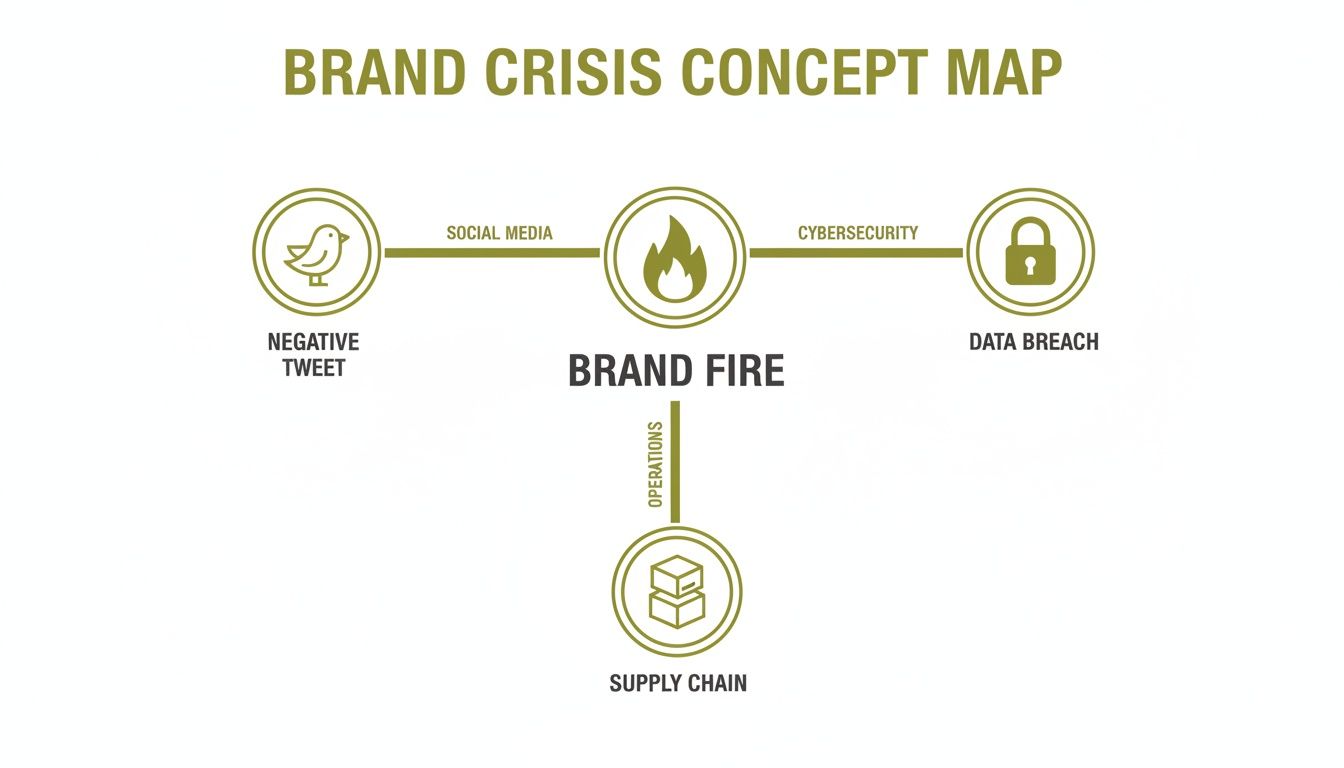
As this visual shows, what start as separate sparks can quickly merge into a full-blown inferno, demanding a response that’s just as multi-faceted.
To help clarify what this looks like in practice, here’s a quick breakdown of the core services you should expect.
Key Crisis Management Services at a Glance
| Service | Description | Primary Business Value |
|---|---|---|
| 24/7 Monitoring & Rapid Response | Constant scanning of media and social channels for threats, enabling immediate deployment of holding statements. | Buys crucial time, prevents misinformation from spreading, and shows proactive control from the outset. |
| Strategic Media Handling | Expert management of press interactions, shaped by former journalists who understand the news cycle. | Shapes the narrative, ensures accurate reporting, and turns the media into an asset rather than an adversary. |
| Stakeholder & Digital Comms | Coordinated communication to employees, customers, and investors to maintain internal and external confidence. | Prevents panic, retains loyalty, and establishes your channels as the definitive source of truth. |
| Integrated Legal & PR Counsel | A unified approach where legal and PR strategies are developed together to protect against all forms of risk. | Balances legal liability with reputational damage, ensuring that public statements are both safe and effective. |
Each of these elements plays a vital role in building a comprehensive defence, turning a chaotic situation into a managed, strategic response. Let's dig a little deeper into what each one involves.
24/7 Monitoring and Rapid Response
A crisis rarely sticks to a 9-to-5 schedule. The most damaging stories have a nasty habit of breaking overnight or during a bank holiday weekend. That’s why genuine crisis management has to be an always-on operation.
This service is your organisation’s early-warning radar. It involves specialists constantly scanning media outlets, social media, and online forums for the slightest hint of trouble. The moment a potential issue surfaces, the agency can deploy a pre-approved holding statement in minutes. This buys you precious time to get the facts straight.
This speed is non-negotiable. It stops falsehoods from taking root and shows the world you're taking the situation seriously. Without it, you’re forever playing catch-up.
Strategic Media Handling
This is where having an agency staffed by former journalists, like Carlos Alba Media, becomes an absolute game-changer. Dealing with the media during a crisis isn’t about firing off press releases and hoping for the best; it’s about getting inside the news cycle and shaping the story.
An ex-journalist knows exactly what a reporter needs to file their story: a clear narrative, a credible spokesperson, and fast access to the facts. By giving them this, you become a helpful source, not a corporate wall.
This insider knowledge allows the agency to frame your response in a way that resonates with news editors. They can anticipate the tough questions, coach spokespeople to steer interviews towards key messages, and tap into their network to make sure your side is heard accurately. Our complete guide on crisis communication management digs into these strategies in much more detail.
Stakeholder and Digital Communications
A crisis doesn't just play out on the evening news. It lands directly in the inboxes and social feeds of your employees, customers, investors, and partners. A good agency coordinates all of these communications, ensuring every group gets clear, consistent, and timely updates.
This is what prevents internal panic and shores up external confidence. A huge part of this work involves using tools like specialised reputation management software platforms to monitor online sentiment and directly counter falsehoods. It’s digital firefighting, correcting rumours at the source and making your own channels the single source of truth.
Integrated Legal and PR Counsel
In almost any crisis, legal risks and reputational risks are completely intertwined. A statement that makes your legal team happy might be a complete PR disaster, and vice versa.
The best crisis management agencies work in lockstep with your lawyers. This integrated approach means every public-facing move is scrutinised for both legal exposure and its impact on your reputation. This has never been more vital, especially as the Serious Fraud Office (SFO) has secured £1.7 billion in penalties from Deferred Prosecution Agreements in just the last five years.
With stakes this high, you need an agency that can expertly balance the court of law with the court of public opinion. Ultimately, these services are about bringing in specialists who have built their careers in high-pressure rooms, turning sheer chaos into a controlled, strategic response.
Warning Signs You Need an Agency Now

Most businesses only think about calling a crisis team when the fire alarms are blaring and they can smell smoke. Think of this guide as your smoke detector. Recognising the early signs of trouble lets you bring in the experts before a small spark turns into a five-alarm fire, helping you stay in control of the story.
Of course, some red flags are impossible to miss. A customer complaint going viral, a sudden product recall, or whispers of executive misconduct spreading online—these aren't just warning signs; the crisis has already begun. In these moments, there's no time to wait and see. You need to act.
But the most dangerous threats often aren't so loud. They're the subtle, quiet creaks that happen long before a structure collapses, the kinds of things that are easy to dismiss until it’s far too late. Learning to spot these is what separates the prepared from the panicked.
Recognising the Subtle Red Flags
Often, the biggest risks are built right into your organisation. Are you working in a high-stakes sector like finance, healthcare, or housing without a solid, pre-vetted crisis plan? That’s like trying to walk through a minefield blindfolded. The danger isn’t just what could happen; it's being completely unprepared when it does.
Another huge, yet often overlooked, sign is a lack of real media experience in-house. If nobody on your team has actually worked inside a national newsroom, you have a massive blind spot. You won’t truly grasp the relentless 24/7 pace, the constant hunt for a new angle, or the subtle tactics journalists use to get the story they want.
This is precisely where a specialist agency like Carlos Alba Media makes a difference. Everyone who works for Carlos Alba Media is a former national news journalist or has agency experience of working with international brands. They don’t just get the media; they’ve been on the other side of the desk.
This insider knowledge means they can spot the tell-tale signs that a reporter is digging for a bigger story, predict the questions designed to do the most damage, and know exactly how to frame your response to shut down harmful speculation.
When Operational Issues Become Public Crises
Sometimes a crisis doesn’t start with an angry tweet but with a slow-burning internal problem. What seems like a contained operational issue can quickly spill out into the open, creating a major media headache and putting your reputation on the line.
Just look at the connection between systemic failures and public perception. For example, a 2026 study by Heriot-Watt University for the charity Crisis found that systemic breakdowns in housing and support services led to a 45% surge in acute homelessness since 2012. This situation, worsened by factors like a 37% spike in homelessness from asylum accommodation evictions, cost councils an eye-watering £2.7 billion in temporary accommodation in the last year alone. For any organisation in a related sector, it’s a stark reminder of how internal or policy-level failures can become front-page news. You can discover more about these findings on the official Crisis UK report.
Here are a few more signals that it might be time to call for specialist support:
- A Sudden Spike in Negative Mentions: Is your social listening tool suddenly lighting up with angry comments? This could point to a coordinated negative campaign or a customer service issue that’s about to boil over.
- Impending Bad News: Are you about to release poor financial results, announce redundancies, or deal with regulatory action? A crisis agency can help you prepare the ground and manage the fallout.
- Losing Control of the Narrative: Do you feel like journalists, competitors, or even disgruntled ex-employees are the ones defining your company’s story? That’s a clear sign you need professional help to take it back.
Ignoring these warnings is a massive gamble. Bringing a crisis management agency in early isn’t admitting defeat—it’s a sign of smart, proactive leadership.
How to Choose the Right Crisis Management Partner
Picking a crisis management agency isn't like finding an accountant or an IT provider. This isn't a typical supplier relationship. You're choosing a team you will have to trust implicitly during what could be the most intense, high-stakes period your business ever goes through.
Think of it like choosing a surgeon. You wouldn't be swayed by a glossy brochure; you'd want someone with steady hands, a proven record in the operating theatre, and precisely the right specialist skills. When the pressure is on, you need a team that has been in the trenches and knows how to navigate the chaos, not just talk a good game. Making the wrong choice can be just as damaging as the crisis itself.
The Journalist Advantage
Here’s the single most important thing to look for: the background of the consultants themselves. While many PR professionals have theories about handling the media, a select few have actually lived it from the inside. This is where you find the decisive advantage of partnering with an agency staffed by former national news journalists.
At Carlos Alba Media, for instance, every senior consultant comes from this world. They haven't just studied the media; they are media veterans. They’ve spent their careers in loud, fast-paced newsrooms, making split-second decisions with a story’s fate hanging in the balance.
This kind of background delivers real, tangible benefits you simply won't find elsewhere:
- They Think Like a Reporter: A former journalist knows the questions the media will ask before they're even dialling your number. They spot the traps, see the angles, and can prepare your spokespeople to face down even the most aggressive interviews with calm confidence.
- They Understand the News Cycle: They know exactly when to release a statement for maximum impact or, just as importantly, when to issue it to bury the story. This insider timing gives you a level of control over the narrative that is otherwise impossible to achieve.
- They Have Unmatched Credibility: When your agency calls a newsdesk, having a respected former journalist on the other end of the line gets you instant attention. They speak the language, understand the pressures, and can build the trust needed to ensure your side of the story is heard accurately.
When you hire a crisis management agency of former journalists, you aren't just getting PR advice. You're getting the game plan from someone who used to write the rules. It's the difference between reading a book about war and hiring the general.
This deep, practical insight is often complemented by experience working with major international brands. This dual expertise means they don't just understand how the media works, but how a crisis ripples through every part of a business, from investor confidence to staff morale.
Key Questions for Vetting Your Agency
To get past the slick marketing and really understand who you’d be working with, you need to ask some direct, probing questions. Your goal is to find a true partner, not just a vendor.
Before you sign any contract, be sure to sit down with a potential agency and run through these essential checks. Their answers will tell you everything you need to know.
Crisis Agency Vetting Checklist
| Evaluation Area | Key Question to Ask | What to Look For in the Answer |
|---|---|---|
| Team Experience | Can you walk me through the specific newsroom or in-house crisis experience of the people who would be on our account? | Demand names and details. Look for specific roles at national newspapers, broadcasters, or well-known brands. Vague answers like "extensive media experience" are a red flag. |
| Proven Track Record | Could you share some anonymised case studies of crises you've managed within our industry or of a similar scale? | They should be able to clearly explain the problem, their strategy, and the outcome. You want to see their direct impact and how it relates to your own organisation. |
| Availability and Process | What does your 24/7 availability actually mean in practice? What happens if I call you at 2 AM on a Sunday? | You need a clear, direct line to a senior consultant, not a call centre. Ask for their specific out-of-hours protocol and who your first point of contact will be. |
| Pricing and Culture | How is your pricing structured, both on retainer and for a live crisis? How do you ensure you align with our company's values? | Look for transparency and flexibility. A good partner will ask thoughtful questions about your culture to ensure their approach fits your organisation's style and principles. |
Choosing the right crisis management partner is one of the most critical decisions you can make for the long-term health and reputation of your brand. By prioritising real-world journalistic experience and asking these tough questions, you can find a team you can genuinely trust when it matters most.
Building Your In-House Crisis Readiness Plan

A crisis management agency can be your cavalry, but you can’t expect them to win the war on their own. The best defence you have is the work you do long before the storm hits. When you’re prepared, you can face the unexpected with a clear head, not with frantic, last-minute decisions.
Think of it like this: emergency services tell people to get a kit ready before a hurricane, not during it. It’s the same in business. Having a solid internal plan is the bedrock of any successful crisis response. Here’s a practical checklist to get your organisation ready.
1. Assemble Your Core Crisis Team
Your first job is to decide who gets the call. This shouldn't be a company-wide committee; you need a small, decisive group with crystal-clear roles. Without that clarity, action grinds to a halt just when you need to move fastest.
This core team is your command centre and should include:
- The Decision-Maker: The CEO or a senior leader who has the authority to make the final call.
- The Communications Lead: Your Head of Comms or PR, who will actually execute the messaging strategy.
- The Legal Counsel: A lawyer who will vet every word to make sure you aren’t creating new problems.
- The Operational Lead: Someone who knows the business inside and out, like a Head of Operations, who can assess the real-world impact.
Everyone needs to know their exact job. This is what separates a coordinated response from a chaotic mess.
2. Conduct a Risk Assessment
You can't defend against threats you haven't even thought of. A risk assessment is really just a structured brainstorm, helping you identify the specific scenarios that could realistically derail your business. Where are you most vulnerable?
Think through the different kinds of trouble you could face:
- Operational Risks: A major product recall, a key supplier going bust, or a serious workplace accident.
- Reputational Risks: An executive scandal, a smear campaign, or a single damaging video going viral.
- Financial Risks: A sudden market crash, a dispute with major investors, or discovery of financial wrongdoing.
- Cyber Risks: A customer data breach, a crippling system outage, or a ransomware attack.
List them out, then rank them. Which are most likely to happen? And which would cause the most damage? This helps you focus your energy on the biggest, most probable fires first.
3. Pre-Approve Key Messages
When a crisis is unfolding live, you won’t have the luxury of time to debate your company’s core values. Your pre-approved messages are your anchor, ensuring every statement you make is consistent, authentic, and on-brand.
A holding statement is one of the most powerful tools in the first hour of a crisis. It should be a simple, pre-written statement that acknowledges the situation, shows you are taking it seriously, and promises more information shortly. It buys you crucial time.
Beyond this, it’s smart to draft foundational messages that reaffirm your commitments—to customers, to your staff, and to doing the right thing. These aren't full press releases, but templates you can quickly adapt, so your first response is swift, not sloppy.
4. Designate and Train Spokespeople
Putting an untrained person in front of a camera during a crisis is one of the most expensive mistakes you can make. A crisis interview isn’t a friendly chat. It’s a high-stakes performance where every single word is scrutinised.
You need designated spokespeople—and it’s wise to have a primary and a backup—who have been professionally trained to handle aggressive questioning. At Carlos Alba Media, our team is made up of former national news journalists who know exactly how to prepare leaders for this. We've been the ones asking the tough questions, so we know all the traps to avoid. If you want to give your leaders that "in-the-room" experience, you can learn more about our specialist media training for executives.
Proper training teaches spokespeople how to stay on message, project empathy, and maintain composure under immense pressure.
5. Set Up Monitoring Systems
Finally, you need an early-warning system. By the time a story is trending on social media or splashed across a news site, you're already on the back foot. Good monitoring helps you spot the smoke before it turns into a raging fire.
Get some basic systems in place to track:
- Media Mentions: Use tools that send you an alert the moment your brand is mentioned online or in the news.
- Social Media Sentiment: Keep an eye on keywords and hashtags related to your business to see what people are saying.
- Customer Feedback: Pay attention to review sites and support tickets for patterns of complaints.
While a crisis agency brings 24/7 sophisticated monitoring to the table, your internal setup is your first line of defence. Investing in this readiness means that if you do need to call in the experts, you’re ready to hit the ground running together.
Your Crisis Management Questions Answered
When you’re staring down the barrel of a potential crisis, or wisely trying to prepare for one, a lot of questions come to mind. Here are straight-talking answers to the things business leaders most often ask when thinking about bringing in a specialist agency.
How Much Does a Crisis Management Agency Cost?
There’s no single price tag, as the cost really depends on how you choose to work with an agency. Some firms are kept on a monthly retainer, which is your guarantee that they’re on call 24/7. This can run from a few thousand pounds to tens of thousands each month, depending on the agency's reputation and your company's risk profile.
The alternative is a project-based model, where you hire an agency to manage a specific, live crisis. This usually means a significant upfront fee, with the rest billed hourly as the team works on the problem.
At Carlos Alba Media, we’ve built our models with SMEs and founders in mind. You get direct access to senior experts—former journalists and international brand specialists—without the eye-watering overheads you’d find at a big London firm. The key is to have an open conversation about pricing before anything goes wrong, so you can find a setup that fits your budget.
Can My In-House PR Team Handle a Crisis?
Your in-house team is brilliant at building your brand day-to-day, but a full-blown crisis is a different beast altogether. It’s the difference between your local GP and an A&E trauma surgeon; both are medics, but their skills are sharpened for very different scenarios. A specialist crisis agency brings three things most internal teams just don't have.
- Battle-Tested Experience: They’ve been in the trenches for countless crises and have a playbook for almost every situation.
- An Objective Viewpoint: Because they're external, they can make the tough, logical calls your internal team might be too emotionally invested to see.
- Insider Media Knowledge: This is the real game-changer.
A firm like Carlos Alba Media is made up of people who were once national news journalists or managed crises for global brands. They know exactly how a newsroom thinks and reacts under pressure—a perspective an in-house team simply can't replicate. The best results often come from a partnership, where the agency’s specialist expertise enhances your own team’s deep knowledge of the company.
When Should I Hire a Crisis Management Agency?
The best time to bring a crisis agency on board is long before you need one. Getting a firm involved during ‘peacetime’ is always more strategic and budget-friendly than scrambling to find help while the fire is already raging.
Think of it like getting ready for a major storm. You don’t start searching for plywood and a hammer when the hurricane is already making landfall; you prepare your home and supplies well in advance. Getting ahead of it allows an agency to get to know your business, run a proper risk assessment, and help you build a crisis plan that actually works.
Having a crisis management agency on a pre-agreed retainer is the ultimate insurance policy. It means that when the worst happens, you have a team of experts who already know your business and can act instantly, without wasting precious time on introductions or contract negotiations.
If you operate in a high-risk or regulated industry, having a pre-vetted crisis partner isn't just a sensible move—it's a fundamental part of responsible business management.
What Is the First Thing an Agency Does in a Crisis?
That first hour is critical. When a professional agency steps in, their initial actions are all about discipline and executing a proven process. It boils down to three immediate steps: Triage, Assessment, and Control.
First, they triage the situation to stop the immediate ‘bleeding’. This nearly always involves gathering the core facts and issuing a carefully crafted holding statement. It acknowledges the problem and shows you’re taking it seriously, buying you valuable time.
Next, they assess the potential impact. They’ll quickly evaluate the threat to your reputation, operations, and finances to get a clear picture of just how big this problem could become.
Finally, they establish control. This means setting up a central 'war room' (virtual or physical) to manage all communications. It creates a single source of truth and stops the mixed messages that can pour fuel on a crisis fire. To dig deeper into the role of a crisis agency, it's worth understanding the core concepts outlined in What Is Crisis Management In PR.
In a crisis, the team you have in your corner is everything. At Carlos Alba Media, our consultants' unique backgrounds as former national news journalists give you a powerful advantage in navigating media scrutiny. We provide the senior-level counsel and hands-on support you need to protect your reputation when it matters most.
Protect your brand with an expert crisis management agency – contact us today