
When things go sideways—and eventually, they will—communications crisis management is the framework you use to defend your brand’s reputation. It’s not just about issuing statements; it’s about anticipating what could go wrong, preparing your response in advance, and communicating clearly to keep the trust of your customers, staff, and partners.
Anticipating Modern Brand Threats

In a world where a single disgruntled tweet can spark a wildfire, thinking a crisis might happen is a luxury you can't afford. It’s an inevitability. Threats come from everywhere: a sudden supply chain collapse, a devastating data breach, or a video taken out of context. Preparing for these moments isn't just good practice; it's fundamental to survival.
This is where you need to build resilience, shifting your mindset from "if" to "when." At Carlos Alba Media, our approach to communications crisis management comes directly from our team's specialist nature and expertise. Everyone who works for us is a former national news journalist or has agency experience working with international brands. This gives us a different kind of lens.
We teach our clients to adopt a newsroom mentality. You need to look at your own business and ask the tough questions: What could realistically go wrong here? And more importantly, what would make for a damaging headline?
The Newsroom Mentality
Thinking like a journalist forces you to spot your brand's weak points before a reporter does. It’s an insider’s perspective that helps you know the difference between a small, manageable issue and a full-blown catastrophe. A newsroom is designed to process information and make decisions under immense pressure—a skill that’s directly transferable to crisis planning.
Part of this involves keeping an ear to the ground. Getting real-time data from top social media monitoring API providers is a game-changer. It helps you catch negative chatter or false information before it gathers momentum and spirals out of control.
A crisis doesn't create character; it reveals it. Proactive preparation ensures the character revealed is one of competence, control, and care, turning a potential disaster into a moment that reinforces trust.
Learning From Past Failures
The cost of being unprepared is steep. The Grenfell Tower fire in 2017 stands as a harrowing UK case study in communications failure. The council’s inability to connect its decisions with its public messaging created a vacuum of trust and massively amplified the reputational damage.
It's a lesson the industry has taken to heart. A recent census revealed that issues and crisis management is now the fourth-largest service offered by UK PR agencies, a clear sign of its growing importance. You can read more in the PRCA UK PR Census 2026 report.
Spotting threats is just the start. If you're looking for more ways to be proactive, check out our guide on 10 actionable online reputation management tips to help you guard your public image.
Getting Ahead of the Storm: Building Your Crisis Response Playbook
When a crisis hits, you don’t have time to think. You only have time to act. Effective crisis communications management isn’t something you figure out on the fly; it’s a discipline you build long before the storm arrives, with a playbook that guides your every move.
Think of it as your team’s muscle memory. A solid plan gives you a clear framework, allowing you to act with precision and purpose when the pressure is on. It’s what ensures strategy, not panic, drives your response.
This isn’t about creating a massive, dusty binder that sits on a shelf. It’s about building a lean, practical guide that everyone can use instantly. At Carlos Alba Media, our unique expertise comes from our team's background. Everyone who works for us is a former national news journalist or has agency experience working with international brands. We’ve been on both sides of a crisis, and we know that a simple, actionable plan is what separates a manageable issue from a full-blown disaster.
Assemble Your Core Crisis Team
Your first move is to decide who needs to be in the room when a crisis breaks. Keep the group small. A large committee will slow you down, and speed is everything in the early hours.
This core team needs clear roles and the authority to make decisions quickly. It should typically include:
- The Crisis Lead: This is usually the CEO or a designated senior executive. They have the final say on the strategy and will often be the primary spokesperson for major incidents.
- The Communications Lead: Your Head of PR or Communications. They own the message—crafting it, getting it out, managing the media, and keeping a close eye on social media sentiment.
- Legal Counsel: An essential player who reviews every external statement to manage legal exposure and ensure you’re meeting any regulatory duties.
- The Operational Lead: Someone who knows the business inside-out, like a Head of Operations. Their job is to get the facts straight from the ground so your communications are always accurate.
Everyone on this team needs to know exactly what their job is before an incident occurs. Getting this structure agreed upon in peacetime prevents confusion and power struggles when you can least afford them. For a great starting point, you can use a free incident response playbook template to formalise these roles and responsibilities.
Create Your Crisis Toolkit
With your team in place, it’s time to build your toolkit. This is where you do the hard thinking while you have the time and headspace to do it properly. It's a shocking fact, but recent reports show a staggering 70% of businesses operate without a crisis plan, leaving them completely exposed.
Your toolkit should be a central, digital folder that the entire crisis team can access instantly, from anywhere.
A crisis playbook allows your team to skip the 'what do we do now?' phase and jump straight into focused, coordinated action. This is the difference between controlling the narrative and being controlled by it.
Before a crisis ever strikes, you should have a core set of documents prepared and ready to go. This toolkit is your first line of defence, containing the essential assets you'll need to respond effectively within that critical first hour.
| Your Core Crisis Communications Toolkit |
| :— | :— | :— |
| Asset/Document | Purpose | Key Elements |
| Key Stakeholder Contact List | To quickly notify everyone who matters—from employees and investors to key clients and regulators. | Names, roles, phone numbers, and email addresses. Include backup contacts. |
| Pre-Approved Holding Statements | To issue an immediate, empathetic, and controlled response within the first 60 minutes. | Draft templates for plausible scenarios: data breaches, service outages, employee misconduct, etc. |
| Crisis Scenario Plans | To outline specific, step-by-step actions for your most likely threats. | Detailed action plans that go beyond generic statements for your top 3-5 high-risk scenarios. |
| Spokesperson Briefing Materials | To prepare designated spokespeople with key messages and tough Q&As. | Core narrative, "Do's and Don'ts," background information, and anticipated questions from journalists. |
Having these documents drafted and signed off ahead of time means you're not trying to write and get legal approval for a statement while the world is watching.
Pressure-Test Your Plan with Simulations
A plan on paper is one thing. Knowing it actually works under pressure is another entirely. That's why crisis simulations aren’t a ‘nice-to-have’—they are an absolute necessity.
A crisis drill is the single best way to find the holes in your playbook. By running a realistic, high-pressure simulation—like a sudden product recall or a damaging story going viral on social media—you see what breaks.
This is a core service we provide because our ex-journalist team knows how to make a simulation feel uncomfortably real. We replicate the pace and intensity of a genuine media storm, giving your team the practice they need to stay calm and execute the plan. This is how you turn a static document into a living, battle-tested strategy.
Running Your First 24 Hours Like a Newsroom
The first 24 hours of a crisis are a frantic sprint, not a marathon. This is where the battle for the narrative is won or lost. You have to move with the speed and discipline of a national newsroom—something our team at Carlos Alba Media knows intimately, as we’re all former national news journalists or have agency experience working with international brands.
Think of it as your 'battle rhythm' for day one. It's about shifting from awareness to action in minutes, not hours. The moment a threat is flagged, the clock is on.
The All-Important Golden Hour
Those first 60 minutes are everything. In a newsroom, this is the chaotic scramble to verify the facts and break the story. Your business needs to operate with that same level of urgency. If you don't, you create an information vacuum that will be instantly filled with rumour and speculation.
Here’s what needs to happen, fast:
- Assemble the Crisis Team: Use your pre-agreed signal to get the core team on a call. This isn’t the time for a debate; it's go-time.
- Get the Facts—Straight: Your operational and comms leads must work together to figure out what you know for sure, and just as importantly, what you don’t.
- Release a Holding Statement: This is non-negotiable. A simple, empathetic statement that acknowledges the situation and promises more information is crucial. It buys you precious time and shows you're on top of it.
A swift, clear holding statement is your firebreak. It stops rumours in their tracks and shows your organisation is taking things seriously, even before you have all the answers.
What This Looks Like: A Product Recall Scenario
Let's say your SME makes a popular food product. A customer posts a photo on social media showing a piece of plastic they claim to have found in it. The post goes viral. Within an hour, your social media is a dumpster fire of angry comments, and a journalist from a national paper is in your inbox.
This is a classic consumer brand crisis, and your newsroom instincts kick in. The crisis team jumps on its pre-arranged conference call. The Head of Operations is already pulling the production records for that specific batch. At the same time, the Communications Lead is drafting the holding statement.
It’s direct and to the point: "We are aware of a serious issue raised by a customer and have launched an immediate and urgent investigation. The safety of our customers is our highest priority. We will provide a further update as soon as more information is available."
Within that first hour, this goes up on your website and social channels. It doesn't solve the problem, but it powerfully frames your response around safety and accountability from the outset.
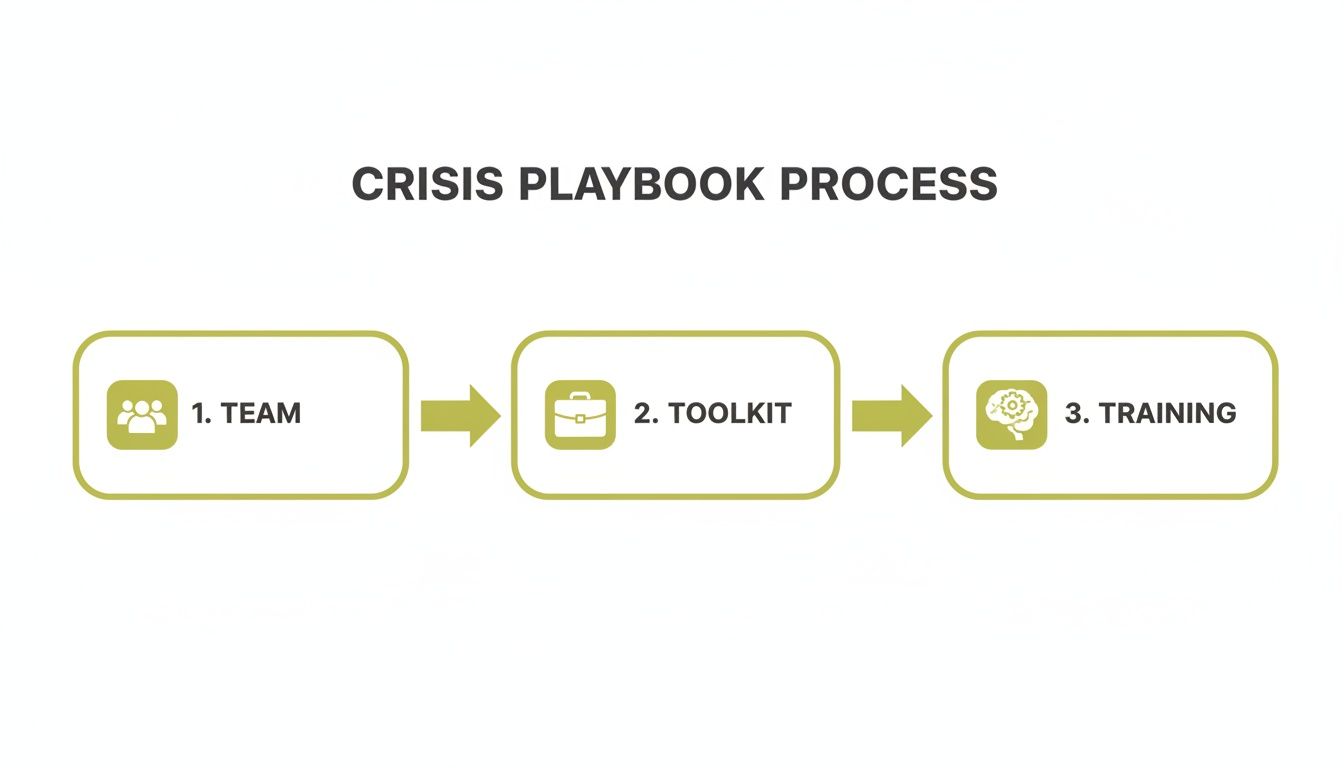
This kind of drilled response doesn't happen by accident. As this diagram shows, it’s built on three pillars: having the right Team assembled, giving them the right Toolkit of pre-written materials, and ensuring they’ve gone through realistic Training.
Setting Up Your Intelligence Hub
Once that first statement is out, you pivot to intelligence gathering. Any journalist will tell you that a story is a living, breathing thing that evolves minute by minute. You need a ‘listening post’ to monitor media and social channels in real time.
This goes far beyond just counting negative posts. You're trying to understand the shape of the conversation:
- What specific questions are customers and journalists asking?
- Is there misinformation spreading? What are the false claims?
- Which influential journalists or accounts are driving the story?
- What's the dominant emotion? Anger? Confusion? Fear?
This intelligence feeds straight back to the crisis team, helping you sharpen your next message and tackle specific concerns head-on. You’re now an active participant in the story, not just a bystander.
The UK government's own crisis response frameworks were overhauled after the COVID-19 pandemic, with a new focus on proactive communication to hold public trust. For a business, that means having the infrastructure ready for a surge in complaints or data requests—helplines, dedicated web pages, and social media teams primed for action. This is where specialist support makes a difference; Carlos Alba Media provides clients with a 24/7 service, backed by top media lawyers, to ensure even regulated businesses can respond with confidence. You can dig deeper into the UK's evolving official crisis management guidance from Chambers.
By treating the first day like a news-gathering operation, you shift from a defensive crouch to a position of authority. You become the most reliable source of information on your own crisis—which is exactly where you need to be.
Getting Your Message Right for Every Channel
Once you’ve managed to get the initial fire under control, the real work begins. Your focus has to pivot from a purely defensive, rapid-response mode to one of sustained, strategic communication. Every message you send out now needs to be clear, consistent, and—above all else—empathetic, no matter where it’s being seen.
One of the most common pitfalls I see is companies developing different stories for different audiences. While you might adjust the tone between an internal email and a public press release, the core facts and your organisation’s stance must be identical. Any hint of a conflicting message creates confusion and instantly burns through the trust you’re desperately trying to rebuild.
Shaping Your Core Message
Think of your message as having a non-negotiable core. This is the central truth of what happened, what you’re doing about it right now, and how you’re committed to making things right. Everything else is just how you frame that truth for different groups.
-
Your Employees: They are your most valuable ambassadors, so tell them first. Give them the facts before they stumble across them in the news. Your tone should be direct and reassuring, making it crystal clear how this impacts them and their roles.
-
Your Customers: They have one main question: "How does this affect me?" Is my data safe? Is the product I bought okay? Your messaging must acknowledge their concerns directly, show empathy, and give them clear, practical advice or reassurances.
-
Investors and the Board: This group needs a frank, sober assessment of the situation. They’ll want to understand the potential business impact and see a clear, strategic plan for containing the damage. They need to have confidence that leadership has a firm grip on the wheel.
-
Regulators: Communication here is a different beast entirely. It must be formal, precise, and strictly aligned with your legal duties. This is one channel where it’s only about facts, deadlines, and compliance.
Consistency is your greatest defence. A single source of truth, controlled by your crisis team, is the only way to prevent the fragmented, contradictory updates that can escalate a problem into a full-blown catastrophe.
Managing the Media and Social Channels
During a crisis, the media and social platforms aren’t your enemies; they're simply very powerful conduits to your audience. To handle them well, you need the discipline of a newsroom—a mindset that’s second nature to our specialist team at Carlos Alba Media. Every person who works here is a former national news journalist or has agency experience working with international brands.
We know exactly what journalists are looking for and how to give it to them. The goal is to project authority and transparency.
In a communications crisis, you must become the most credible source of information about your own problem. If you don't fill the information vacuum, someone else will, and you won't like what they say.
When you issue press statements or hold briefings, stick to the facts and focus on the future. Never speculate. Only state what you know for certain and what concrete actions you're taking. This is where a well-prepared spokesperson is worth their weight in gold. If your leaders need to sharpen their skills for these high-stakes moments, investing in professional media training for executives can be the difference between failure and success.
Social media requires a similar level of discipline, but with a different tactical approach. You have to establish a clear policy from the outset. Will you respond to individual comments or stick to broadcasting official updates? Trying to respond to everyone is often impossible and risks dragging you into public arguments.
A much better strategy is to:
- Pin an official statement to the top of all your social profiles.
- Funnel all questions to a single source, like a dedicated crisis page on your website.
- Correct genuinely dangerous misinformation calmly and firmly, but avoid getting into debates.
- Know when to stop talking and let your official statements speak for themselves.
Your Crucial Partnership with Legal Counsel
Throughout this entire process, your legal team should be your co-pilot. Every single message that goes public—from a single tweet to a full press release—has to be run past your lawyers. This isn't about letting legal dictate your comms strategy, which often results in cold, robotic language that nobody trusts.
Think of it as a strategic partnership. The comms team, with its finger on the pulse of public perception, crafts messages that are human and empathetic. The legal team then reviews those messages to ensure they don’t create unnecessary liability or violate any regulatory duties. Getting this partnership right is the sign of a truly effective crisis operation, protecting the brand both in the court of public opinion and an actual court of law.
Tackling the Modern Threat: The Cyber Crisis

Of all the crises a business can face today, a cyber attack is one of the most sudden and destructive. This isn’t just a tech issue; it’s a direct assault on the trust you’ve built with your customers. The damage—both financial and reputational—can unfold in a matter of hours, making a specialised communications crisis management plan absolutely essential.
Think about it. A cyber attack is an invisible threat. Unlike a fire or a product recall, you often have no idea what the full extent of the damage is. This information vacuum is a dangerous place, quickly filled by customer panic, media speculation, and rampant misinformation. Your customers are left asking themselves: is my personal data exposed? Is my money safe? How you answer those questions, and how quickly, will define the outcome.
The scale of this problem is genuinely staggering. The latest UK Government Cyber Security Breaches Survey reveals an estimated 8.58 million cyber crimes hit UK businesses in the last year. While most businesses (76%) log these incidents internally, a huge gap appears when it comes to talking to the outside world. Only 32% have any clear guidance on how to report them externally. This is a massive vulnerability, especially as more small businesses (29%) are starting to put external communication plans in place.
The Need for Radical Transparency
When a data breach hits, your first instinct might be to lock down all communications until you have all the facts. From experience, I can tell you this is a catastrophic mistake. In a cyber crisis, the golden rule is radical transparency, even when—and especially when—you don't have all the answers.
Your first statement needs to be fast and empathetic, and it has to be honest about what you know and what you don't know yet. This is often called a ‘holding statement’.
Something like this works well:
"We're writing to let you know we have identified and stopped a security incident on our network. Our investigation is in its earliest stages, and our team is working around the clock to understand exactly what happened. Our absolute priority is the safety of our customers, and we promise to provide a further update as soon as we have clear, confirmed information to share."
This approach immediately shows you’re on the front foot. It acknowledges the problem, demonstrates you’re taking it seriously, and, most importantly, establishes your company as the single source of truth. You’re setting the expectation for future updates and preventing others from controlling the narrative.
Balancing Legal Duties with Reputational Stakes
A data breach isn't just a PR problem; it triggers a minefield of legal obligations. In the UK, for example, you have a strict, limited window to report the incident to the Information Commissioner's Office (ICO). Get this wrong, and you could be facing severe fines on top of the public fallout.
This is where a joined-up response is non-negotiable. A proactive, controlled, and legally sound communications strategy actually reinforces your brand’s integrity. But it demands flawless coordination between your technical, legal, and comms teams—a discipline that must be practised long before a crisis ever hits.
It's precisely for this reason that having a specialist team on call is so critical. The team at Carlos Alba Media brings a unique level of expertise; everyone on our team is a former national news journalist or has agency experience working with international brands. We have been in the trenches, managing high-stakes digital threats for major brands. We know the relentless pace of the 24/7 news cycle and the precise, careful language required.
When a cyber crisis hits, you're fighting a war on two fronts: the technical battle to secure your systems and the communications battle to secure your reputation. Losing either one can be devastating.
Our 24/7 crisis service, run in partnership with some of the UK’s leading media lawyers, is built for these exact moments. The people who will be on the phone with you are experts trained to navigate that tricky intersection of media pressure and legal duty. We ensure your response is not only fast and empathetic but also compliant and strategically robust.
It’s this unique blend of newsroom instinct and high-level strategic counsel that protects your brand when it is at its most vulnerable.
From Recovery to Resilience: The Work After the Crisis
Once the initial chaos subsides and the media frenzy moves on, it's tempting to breathe a sigh of relief. But the real work is just beginning. This post-crisis period is your chance to rebuild what was lost and, more importantly, to fortify your business for whatever comes next. This is where true communications crisis management proves its worth, long after the first 24 hours have passed.
The very first thing you need to do is conduct a completely honest post-mortem. This isn't about pointing fingers; it’s about a frank assessment of your response to find the weak spots in your plan. Did your holding statements get approved and released quickly enough? Was your spokesperson fully equipped with the right information, or were they caught off guard? Pinpointing the exact bottlenecks and failures is the only way to ensure they don't happen again.
Turning Vulnerability Into Strength
This is where having an experienced partner look at your performance from the outside is invaluable. At Carlos Alba Media, every team member is a former national news journalist or has managed crises for major international brands. This specialist expertise allows us to dissect a response with a practised eye, spotting gaps that an internal team might miss simply because they were in the thick of it.
A well-managed crisis, followed by a transparent recovery, can become a defining moment of strength. It's an opportunity to show your stakeholders that your organisation has integrity, learns from its mistakes, and is committed to doing better.
Following this deep-dive analysis, you have to communicate the long-term fixes you're putting in place. Rebuilding trust is all about showing, not just telling. If you promised to overhaul a flawed process, you need to publish an update demonstrating exactly how it's been changed. If you committed to better staff training, share that story. This sustained, transparent follow-through is what turns your promises into proof of your accountability. To get a better handle on this long-term effort, our guide on what is reputation management offers a much deeper look into building and protecting your public image.
Ultimately, our job isn't just about firefighting. We partner with brands to build genuine, lasting resilience. It’s about transforming moments of intense vulnerability into powerful demonstrations of leadership and organisational integrity.
Answering Your Burning Crisis Management Questions
When it comes to crisis planning, business leaders tend to ask the same critical questions. Getting clear, no-nonsense answers is the foundation for building real resilience. Drawing from our team's frontline experience, let’s tackle some of the most common ones we hear.
Do We Really Need a Crisis Plan as a Small Business?
Yes, without a doubt. A crisis doesn’t care about the size of your company. In fact, for a smaller business, the reputational and financial hit can be devastating, far more so than for a large corporation with deep pockets.
Just because you have a small profile doesn't mean you're immune. A few negative social media posts, a key supplier going bust, or an internal staff issue can all spiral out of control. Your plan doesn't need to be a 100-page monster; a simple, practical framework that defines roles and immediate next steps is often all you need. It ensures you can act fast and professionally, protecting the very brand you’ve poured everything into building.
What Is the Biggest Mistake Companies Make?
The most damaging mistake, time and again, is responding too slowly. Or even worse, saying nothing at all. In an era of instant information, a vacuum is a dangerous thing. It gets filled—and fast—with speculation, rumour, and outright misinformation. Waiting until you have "all the facts" is a surefire way to lose control of the narrative for good.
The golden rule, taught by seasoned ex-journalists, is to communicate early. Acknowledging the situation with a holding statement within the first hour is vital. It shows empathy, confirms you're on top of it, and promises more information soon. It’s your first, best chance to start shaping the story yourself.
When Should We Bring in Crisis Experts?
Ideally, you bring in experts before a crisis hits. This gives you the chance to build a solid plan and then pressure-test it with realistic training simulations. However, the minute you spot an issue that could blow up into serious media attention or cause significant brand damage, you need to make the call.
At Carlos Alba Media, our specialist nature comes from our team's unique background. Every member is either a former national news journalist or has agency experience managing crises for international brands. We live and breathe the news cycle. We can provide that senior-level counsel to handle incoming media fire, sharpen your message, and ultimately protect your brand’s value when the stakes are highest.
Ready to build a communications strategy that can withstand a crisis? Contact Carlos Alba Media and let our newsroom experience and senior-level counsel protect your reputation. Learn more about our crisis management services.