

Crisis communications management isn't just a corporate buzzword. It’s the playbook an organisation uses to defend its reputation and hold onto stakeholder trust when things go badly wrong. It all comes down to a clear plan for delivering fast, transparent, and consistent communication to everyone who matters—employees, customers, the media, and the public—so you can steer the narrative, not just react to it.
Why Modern Crisis Management Is Non-Negotiable

These days, a crisis doesn't brew over a few days; it explodes in minutes. A single viral video, a damaging allegation from an employee, or a major service outage can spark a reputational firestorm before your leadership team has even had a chance to gather in a room. In this environment, crossing your fingers and hoping for the best is a guaranteed way to fail.
Proper crisis communications management is an essential operational function, not an optional extra. The fallout from getting it wrong can be catastrophic. In fact, recent studies show that nearly 70% of business leaders have had to steer their organisation through at least one major crisis in the past five years. Without a plan, you’re not just risking a bad news cycle; you're facing serious financial loss, regulatory penalties, and a long-term erosion of public trust.
The Newsroom Advantage in a Crisis
At Carlos Alba Media, our specialist approach to crisis communications is forged from decades of experience on the front line. Every member of our team is a former national news journalist or has agency experience of working with international brands. We don’t just understand the theory of how the media works—we know exactly how a newsroom thinks because we've lived it.
This background gives us a critical edge. We can anticipate a journalist's next move, we know the questions they'll ask before they even pick up the phone, and we understand what it takes to get control of a negative story. It’s this insider knowledge that shifts crisis management from being a purely defensive reaction into a proactive strategy.
When a crisis breaks, speed and accuracy are everything. As former journalists, we know that a news vacuum is always filled—either by your clear, controlled message or by speculation and rumour. Getting your voice out first isn't just an advantage; it's a necessity.
A communications crisis typically unfolds in four distinct stages. Having a clear understanding of each one helps you stay ahead of events rather than just reacting to them.
The Four Stages of a Crisis Response
| Stage | Core Focus | Essential Actions |
|---|---|---|
| 1. Preparedness | Proactive Readiness | Develop a crisis plan, assign roles, and run simulation drills. |
| 2. Immediate Response | Acknowledgement & Control | Issue a holding statement, brief your spokesperson, and monitor all channels. |
| 3. Ongoing Management | Information & Escalation | Coordinate with legal, update stakeholders, and manage the narrative. |
| 4. Recovery & Review | Reputation Repair | Launch recovery campaigns, analyse the response, and update your plan. |
Moving through these stages effectively requires discipline and a commitment to a few core principles. Getting this right is what separates the organisations that survive a crisis from those that don't.
Core Pillars of Effective Crisis Communications
A successful response is built on a solid foundation of preparation and a clear focus on your objectives. It’s not just about what you say, but how and when you say it. To truly protect your brand, your strategy must be built on these pillars:
- Speed and Acknowledgement: Your first move has to be fast. A quick, simple acknowledgement that you are aware of the situation and looking into it shows you're in control and buys you vital time.
- Transparency and Empathy: Honesty is your most valuable currency. Communicate what you know, be upfront about what you don't, and always lead with empathy for anyone affected. This is how you build credibility when it matters most.
- Consistency Across Channels: Your message must be identical everywhere, from internal memos to press releases and social media updates. Any contradiction, no matter how small, will create mistrust.
- Stakeholder-Centric Messaging: Employees, customers, investors, and regulators all have different questions and fears. Your communications need to be tailored to address the specific concerns of each group.
Ultimately, strong crisis communications is a vital part of a much bigger picture. For a more detailed look at protecting your brand's public image, you might find our guide on what is reputation management helpful. It provides a practical playbook for navigating the storm with confidence.
Building Your Crisis Readiness Playbook

You don’t manage a crisis when it happens; you manage it long before it ever starts. Real crisis communications is all about deliberate preparation, not panicked reaction. It’s shocking that a reported 70% of businesses still don’t have a crisis plan, but creating one is the single most important thing you can do to protect your brand when the pressure hits.
This isn't about writing a massive document destined to gather dust on a shelf. It’s about building a living, breathing toolkit your team can actually use to make smart decisions under incredible stress. The whole point is to bring clarity to chaos. When an issue explodes, you simply won’t have time to argue about who’s in charge or what to do first. A solid playbook answers those questions for you.
Assembling Your Core Crisis Team
First things first: you need to officially name your core crisis team. This can't just be a vague list of senior managers; it must be a designated group of people who each have a crystal-clear role. In the heat of the moment, any confusion over who does what is your worst enemy.
From our own specialist experience at Carlos Alba Media—where our team is comprised of former national news journalists or professionals with agency experience working with international brands—we know that a small, empowered group always beats a large committee. Your team needs to be built for speed and decisive action, not endless debate.
A strong crisis team usually includes:
- The Crisis Lead: This is your final decision-maker, often the CEO or a senior director who has the authority to approve statements and strategy.
- The Communications Lead: This will be your Head of Comms or PR agency lead. They own the messaging, deal with the media, and keep an eye on the public conversation.
- Legal Counsel: Getting your lawyers involved from the very beginning is non-negotiable. They need to vet every public statement to minimise legal risks.
- The Operational Lead: This is the person who knows the facts of the situation inside-out, like your COO or Head of Product. They provide the "ground truth."
Once you've defined this team, make sure everyone can reach each other 24/7. That contact sheet should be page one of your playbook.
Conducting a Vulnerability Audit
You can’t possibly prepare for a storm if you don’t know where the weak spots in your roof are. A vulnerability audit is simply a brutally honest look at the specific risks your organisation faces. It involves brainstorming the kinds of scenarios that could realistically spiral into a major crisis for you.
A good way to start is by thinking in categories:
- Operational Failures: What happens if your main product fails? What about a huge service outage or a critical supply chain collapse?
- Human Error: What if a key employee makes a terrible public mistake, or an executive gets caught up in a personal scandal?
- External Threats: How would you handle a cyberattack and data breach? A coordinated smear campaign on social media? Or a damaging story from an investigative journalist?
A vulnerability audit isn't about scaremongering. It's about developing foresight. If you can identify your top five most likely and high-impact scenarios now, you can start drafting response strategies and holding statements. That alone will put you miles ahead when a real crisis hits.
This kind of proactive thinking is the foundation of proper crisis management. It shifts your planning from something generic to a strategy that’s tailored to the real world you operate in.
Setting Up Your Early Warning System
As a team of former journalists, we live by one rule: information is power. The ability to spot smoke on the horizon before it becomes a raging wildfire is a genuine game-changer. An effective media and social monitoring setup is your early warning system.
This doesn't need to be overly complicated or expensive. Free tools like Google Alerts are a great start for tracking mentions of your brand, key people, and industry buzzwords. Of course, paid tools offer much more, giving you real-time sentiment analysis and tracking chatter across millions of online sources. The important thing is to have something in place.
This intelligence feeds directly into your crisis readiness. A sudden spike in negative customer service comments could be the first sign of a product flaw. A string of angry posts from a disgruntled ex-employee might be the prelude to a bigger story breaking.
Catching these signals early gives you precious time to investigate, get your response ready, and maybe even de-escalate the problem before it ever makes headlines. We cover this and other essential skills in our specialised media training for PR professionals.
Executing Your First-Hour Response
The moment a crisis hits, the clock starts ticking. Loudly. You don't have the luxury of a few days to get your story straight; you have about 60 minutes. This isn't an exaggeration—it’s what we call the 'golden hour'. What you do, or fail to do, in this initial window will define the narrative for weeks to come.
Getting this right is the absolute bedrock of effective crisis communications management. It’s not about having all the answers. In fact, you won’t. It’s about showing you’re in control, expressing genuine empathy, and buying yourself the time needed to get the facts straight. As a team of former national news journalists and senior agency pros at Carlos Alba Media, we’ve seen first-hand how speed and composure in that first hour can make or break a company’s reputation.
The Power of the Holding Statement
Your very first move? Get a holding statement out the door. This isn’t a detailed confession or a complex explanation. It's a short, pre-approved message designed purely to acknowledge you're aware of the situation and you're on it. This single act immediately fills the information vacuum that social media and news outlets feast on.
A strong holding statement shouldn't admit fault or speculate. It simply needs to:
- Confirm you are aware of an incident.
- State you are urgently investigating.
- Express concern for anyone who may be affected.
- Promise to share verified information as soon as you have it.
A holding statement is your firebreak. It projects calm and control when everything internally feels chaotic. Something as simple as, "We are aware of the incident and are taking immediate steps to understand what happened. Our first priority is the wellbeing of those involved," is infinitely better than silence.
Silence lets others tell your story for you. A holding statement establishes you as the official, credible source of information—a position you need to defend throughout the crisis.
Selecting and Briefing Your Spokesperson
With a statement out, you need to decide who will be the face of your response. Choosing the right spokesperson is non-negotiable. They are the human embodiment of your organisation during a turbulent time, and they must come across as credible, authoritative, and above all, compassionate.
Often, the CEO is the right call, especially for a major incident. But don't default to this. Sometimes a senior director with deep technical knowledge is more reassuring. The key is picking someone who can stay calm under fire and stick to the message, no matter how tough the questions get.
Once you’ve chosen them, they need a rapid-fire, intensive briefing. This is where our specialist expertise at Carlos Alba Media really pays off. We know how reporters think and the questions they'll ask because our team is comprised of former national news journalists. We train spokespeople to anticipate hostile lines of questioning, avoid speculating, and pivot back to their key messages. The briefing must cover:
- Only the facts that have been 100% verified.
- The approved key messages and lines to take.
- Words and phrases to avoid that could cause legal or reputational headaches later.
- How to lead with empathy in every answer.
Managing the Media and Social Media Firestorm
The second your holding statement is public, the floodgates open. Your phone will ring off the hook with media requests, and your social media mentions will explode with questions, fury, and speculation. You need a disciplined, centralised plan to handle it.
Funnel every single media enquiry to one person—your communications lead or PR agency. No exceptions. This prevents different people from saying different things, which is a recipe for disaster. The response to every journalist should be polite but firm: acknowledge their request, give them the official statement, and tell them you’ll update them when you have verified information to share.
At the same time, your social media team should be in monitor-and-respond mode. This isn't about picking fights online. It’s about sharing the official statement, correcting genuinely dangerous misinformation, and showing you are listening. A consistent, calm, and credible message, repeated everywhere, is the only way to cut through the noise in that critical first hour of your crisis communications management.
Coordinating Your Internal and External Message
Once the initial shockwave of a crisis passes, you enter a much more challenging phase. It’s a marathon, not a sprint. This is where many organisations stumble, not because of one big misstep, but from the slow erosion of credibility caused by a dozen small inconsistencies.
The absolute key to navigating this stage is ensuring what you say internally matches what you’re telling the world. Any gap between the two will be uncovered. I guarantee it. Leaks happen, screenshots get passed around, and your people talk. If your team is hearing one thing while the public hears another, your reputation is toast.
Getting this right means smashing the silos that often exist between your communications team and your legal counsel. It can be a tense relationship; comms folks are wired to be transparent, while lawyers are trained to minimise liability. The truth is, neither is wrong. They just have to work together.
The Comms and Legal Huddle
The only way I’ve seen this work effectively is by making a daily huddle mandatory. This meeting must include your crisis lead, communications head, and your legal advisor. No exceptions.
At Carlos Alba Media, our team is made up of former national news journalists. We’ve been on the other side, and we know exactly how a cold, lawyer-drafted statement lands—it sounds defensive and does more reputational damage than saying nothing at all. Our specialist nature means we insist on this collaborative structure.
The point of the huddle isn't for the lawyers to dictate PR strategy. It’s to find the sweet spot: language that protects the organisation legally while also reassuring stakeholders and the public.
- Scrutinise every external message. Legal needs to sign off on all press statements, social media updates, and website copy before it ever sees the light of day.
- Agree on your "lines to take." This should be a single, shared document of approved messages. It’s your bible for the crisis, ensuring everyone is singing from the same hymn sheet.
- War-game the tough questions. Your legal team can highlight the questions that carry the most risk, which allows the comms team to properly prepare spokespeople to answer them clearly and safely.
This disciplined approach means you present a single, confident front—one that holds up in the court of public opinion and a potential court of law.
Keeping Your Internal Ambassadors on Side
In the heat of managing the media storm, it's incredibly easy to neglect the most important audience you have: your own employees. They are your ambassadors on the ground. If they feel confused, scared, or out of the loop, that anxiety will inevitably spill outside the company walls.
Internal comms during a crisis isn't a fluffy extra; it's an operational necessity. Your staff must always hear bad news from you first, not from a push notification on their phone. It’s fundamental to maintaining morale and, more importantly, stopping damaging rumours before they start.
Your employees are on the front line. Friends, family, and even journalists will be asking them what’s really going on. Arming them with clear, consistent information turns a potential liability into your most powerful group of advocates.
A simple, regular internal briefing is often all it takes. This could be a straightforward email from the CEO or a quick all-hands video call. The only rule is that it must be honest and completely aligned with your external messaging.
This flowchart shows how to keep that message coordinated right from the start.
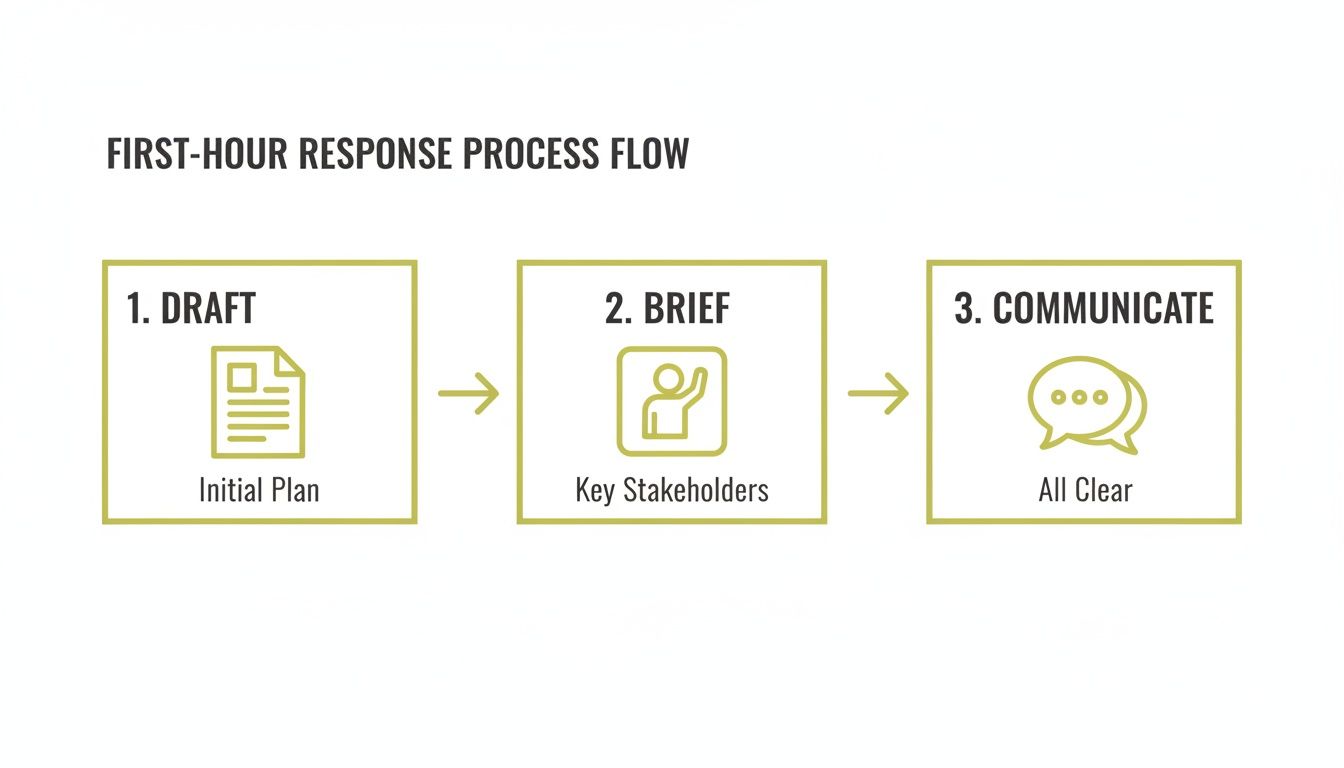
The simple flow—from drafting to briefing to communicating—ensures every message is vetted and aligned before it goes public.
Engaging Regulators and Key Stakeholders
As a crisis grows, you'll likely need to speak directly to other powerful groups like industry regulators, investors, or major partners. These are not public audiences, and they demand a different, more formal approach.
You have to get on the front foot here. Don't wait for them to call you. Reach out proactively to brief them on the facts, the steps you're taking, and your unwavering commitment to putting things right. This demonstrates control and respect.
For these high-stakes conversations, you need a senior leader who can speak with confidence and authority. This is where specialised training is worth its weight in gold. You can find out more about how we prepare leaders for these moments with our executive communications coaching. Taking this proactive stance helps build crucial alliances and can stop an operational issue from spiralling into a regulatory nightmare.
Leading the Recovery and Rebuilding Trust

Once the immediate fire is out, you enter the next, and in many ways, the most challenging phase of a crisis. The media storm might have moved on, but don't be fooled. Your stakeholders—from your staff to your most loyal customers—are watching. They want to see what you do next, and just getting back to business isn't good enough.
This is your chance to shift from defence to offence. It’s about more than just managing perceptions; it's a deliberate campaign to prove you’ve learned, changed, and are committed to doing better. Effective crisis communications management transitions into a meticulous process of rebuilding trust, one authentic action at a time.
At Carlos Alba Media, our expertise is built on our team's unique background: everyone is a former national news journalist or has senior agency experience working with international brands. We’ve managed these situations from both sides of the fence, and we know that trust isn't won back with a single press release. It's earned through sustained, visible effort that proves your accountability.
From Reactive to Proactive Storytelling
Your first job is to flip the script. Stop reacting and start setting the agenda. This means creating and driving stories that spotlight the concrete, positive changes your organisation is making.
This has to be more than just spin; you need to show your working. If a faulty product caused the crisis, your new story is about the tougher quality control systems you've put in place. If it was a cultural or ethical failure, your narrative has to be about the new leadership, rigorous training, and systemic changes you've implemented to prevent it from ever happening again.
We've launched dozens of reputation recovery campaigns for global brands by thinking like a newsroom. We find the most powerful proof points—the tangible evidence of change—and build compelling stories around them that resonate with the media and the public.
The goal of recovery isn't to make people forget the crisis happened. It's to change what they remember about it—shifting the focus from the problem to your powerful, transparent, and decisive solution.
Taking this proactive stance shows you’ve learned from the ordeal and have genuinely become a better organisation because of it.
Authentic Stakeholder Outreach
While public campaigns are essential, the real work of rebuilding trust is done up close. You have to engage in direct, honest conversations with the people who matter most to your business.
A generic email blast won't cut it. You need to show you’re listening and that you value the relationship. We often advise clients to hold:
- Employee town halls: Give your team a forum to ask leadership the hard questions. Their belief in the recovery is your foundation.
- Customer listening sessions: Invite key clients to a frank discussion. Hear their concerns firsthand and walk them through your action plan.
- One-on-one briefings: Meet personally with partners, investors, and regulators to reassure them about the business's long-term stability and direction.
This kind of direct outreach demonstrates respect and a genuine willingness to be held accountable. It’s far more powerful than any advertising campaign and a central part of our approach, combining high-level strategic advice with hands-on execution.
Reputation Repair Campaign Checklist
To give your recovery efforts direction, you need a clear campaign plan. This checklist acts as a roadmap, ensuring your actions are coordinated, consistent, and measurable.
- Define Your Core Recovery Message: What’s the single most important thing you want people to know about the changes you’ve made?
- Identify Your Proof Points: Make a list of every concrete action you’ve taken (e.g., new policies, leadership changes, product improvements, investments).
- Segment Your Stakeholders: Map out every audience—employees, customers, regulators, media—and plan tailored outreach for each one.
- Develop Proactive Content: Create stories, videos, and articles that bring your corrective actions and renewed commitments to life.
- Launch a Positive Media Push: Don't wait for journalists to call. Actively pitch stories about your recovery to trusted reporters and industry publications.
- Empower Your Leadership: Your leaders must be visible and vocal, communicating the recovery message with conviction and authenticity.
- Monitor Sentiment and Adjust: Keep a close eye on public and stakeholder sentiment. Use this data to fine-tune your strategy as you go.
Straight Answers to Your Toughest Crisis Comms Questions
When a crisis hits, theory goes out the window. The pressure is immense, you have minutes to make calls, and every single word matters. It’s a world away from a textbook. We get asked a lot of questions by leaders caught in the middle of it all, so we wanted to share some straight-talking answers based on what we’ve seen work (and what hasn't).
At Carlos Alba Media, our team is built differently, reflecting our specialist nature and expertise. We’re all either former national news journalists or senior agency pros who have steered international brands through some incredibly challenging situations. We’ve been on both sides of the phone call—in the newsroom chasing the story and in the boardroom managing it. That gives us a pretty unique perspective on what you’re up against.
How Can a Small Business Prepare for a Crisis on a Tiny Budget?
For any small or medium-sized business, smart preparation will always trump a huge budget. You don’t need fancy software or a costly retainer to build a robust defence. Honestly, your most powerful tools are a few hours of focused thinking and a bit of foresight.
Forget trying to plan for every wild possibility. Instead, zero in on your top three to five most likely scenarios. What keeps you up at night? For most SMEs, it's things like a customer complaint going viral, a messy employee issue hitting the public domain, or a major operational failure. Focusing on these specific, probable risks is far more practical.
With those scenarios in mind, you can take some simple, high-impact steps:
- Draft 'holding statements'. Write a few pre-approved sentences for each of your key scenarios. Something simple that buys you time. Having these ready to go is a game-changer when the clock is ticking.
- Decide who speaks. Officially appoint a primary spokesperson (usually the CEO or founder) and a deputy. Make sure every single person in the business knows that all media calls get passed directly to them. No exceptions.
- Build a 'first call' list. Create one simple document with the mobile numbers and emails for your key internal team, your lawyer, and anyone else you'd need to contact at 2 AM. Make sure it's accessible 24/7, not buried on a server.
- Set up simple monitoring. Use free tools like Google Alerts to keep an eye on mentions of your company name, your CEO, and your products. It’s a basic but surprisingly effective early-warning system.
Putting in a few hours on this kind of groundwork will put you miles ahead of most other companies when trouble strikes. It’s about being prepared, not about how much you spend.
When Do We Need to Bring in the Lawyers?
Immediately. From the very first minute. This is one of the most important lessons we’ve learned, and it's why we work so closely with leading media lawyers at Carlos Alba Media. Our expertise in working with international brands means we know that your legal and communication plans can't be separate workstreams; they have to be one and the same from the outset.
A statement that sounds perfect from a public relations angle—empathetic and apologetic—can sometimes open up a world of legal pain. It can be seen as an admission of fault, creating massive liability for the business. That's why your lawyer has to see every tweet, press release, and statement before it goes out.
This isn't about letting lawyers kill your message with cold, corporate jargon. It's about a strategic partnership. The real skill is finding that sweet spot—words that are legally robust but still sound human and empathetic. It's about protecting yourself in the court of public opinion and a court of law.
When you treat legal and comms as a joint effort, you end up with a message that's credible, responsible, and protects the entire organisation.
What's the Single Biggest Mistake Companies Make in a Crisis?
Without a doubt, the most common and damaging mistake is moving too slowly—or worse, saying nothing at all. When a story breaks, you create a "news vacuum." If you don't fill it with your voice, it will be filled instantly by speculation, rumour, and your harshest critics.
So many leadership teams get stuck waiting for "all the facts." It's a natural instinct, but it's a fatal one in a crisis. By the time you feel you have the full picture, the narrative has already been set by someone else. You’re left trying to correct a story that has already taken hold, and you'll be on the back foot from then on.
Every one of our team members who came from a national newsroom will tell you the same thing: speed is everything. A swift, initial response, even if it’s just, "We're aware of this, and we're looking into it as a matter of urgency," shows you are on top of the situation. It buys you breathing room.
A long silence is almost always read as guilt, incompetence, or a cover-up. That perception can cause far more long-term damage to your reputation than whatever the initial problem was.
Handling the intense pressure of crisis communications management takes experience, speed, and specialist insight. If you need senior-level support to protect your reputation, Carlos Alba Media is ready to help. We bring our newsroom instincts and strategic brand experience to get results when it matters most. Find out how we can support your organisation.