

When a crisis breaks, your communications response is a sprint, not a marathon. It’s about taking immediate, controlled action to protect the reputation you’ve worked so hard to build. The golden rule is to be fast, factual, and empathetic, especially when the pressure is immense. You have to own the narrative from the very first minute to stop speculation in its tracks.
Your First 60 Minutes In A Crisis
When the alarm sounds, the clock starts ticking. That first hour is pure chaos, but it’s also your biggest opportunity. It’s not about having all the answers; it’s about establishing control and showing you’re leading from the front while your employees, customers, and the media are all watching. What you do in these first 60 minutes will set the tone for everything that follows.
This is where a newsroom mindset becomes essential. Everyone who works for Carlos Alba Media is a former national news journalist or has agency experience working with international brands. We’ve spent our careers operating under crushing deadlines where speed and accuracy are everything. We know from experience that the first hour is a battle against the information vacuum—a void that will be filled with damaging rumours if you don’t fill it first with credible information.
Your Immediate Action Plan
Your primary goal is to cut through the noise and shift from a panicked reaction to a measured response. The initial moments of a crisis can feel overwhelming, but a simple, structured approach provides a much-needed anchor. Your focus should boil down to three things: activation, command, and communication.
Activate Your Crisis Team: The second a potential crisis lands on your desk, your pre-assigned team needs to be mobilised. This isn’t the moment to be scrolling through contacts trying to decide who should be in charge. Your crisis plan should have this spelled out so you can get the right people on a call immediately.
Establish a Command Centre: This is your operational hub for the entire crisis. It could be a physical war room or a virtual one, like a dedicated Slack channel and a permanent video call link. What matters is that it becomes the single source of truth for your team, a central point to share verified information and coordinate every single action.
Verify the Facts: Before a single word is said publicly, you must get to grips with the core facts. The worst mistake you can make is responding to hearsay or inaccurate social media posts. Our journalism background has taught us to be relentless in questioning sources, cross-referencing details, and confirming every piece of information before we act.
The single biggest mistake a business can make in the first hour is silence. In the absence of information from you, others will create the narrative—and you won't like the one they write.
The First Hour Checklist
To help you focus under pressure, here’s a simple checklist of what needs to happen immediately. Think of it as your emergency action plan to ensure you’re taking decisive, organised steps from the get-go.
Immediate Crisis Response Checklist
| Action Item | Objective | Lead Responsibility |
|---|---|---|
| Activate the Crisis Team | Get key decision-makers on a single call or channel. | CEO / Designated Crisis Lead |
| Confirm Known Facts | Verify what is 100% true, what is rumoured, and what is unknown. | Communications Lead |
| Establish Command Centre | Set up the central hub for all crisis communications (e.g., Slack channel). | Operations / IT |
| Draft Holding Statement | Create a brief, approved statement to acknowledge the situation. | Communications Lead |
| Pause All Outbound Comms | Stop all scheduled social media posts, emails, and ads immediately. | Marketing Lead |
| Set Next Check-in Time | Agree on a time for the crisis team to reconvene (e.g., in 30-60 mins). | Crisis Lead |
This checklist isn’t exhaustive, but it covers the non-negotiable actions that provide a foundation for a controlled response. Completing these steps ensures you’ve established a baseline of control and bought yourself vital time.
Drafting Your First Holding Statement
Within that first hour, you absolutely must issue a holding statement. This isn’t a detailed explanation or a lengthy apology. It’s a short, factual message designed to halt speculation in its tracks.
It simply acknowledges you’re aware of the situation, confirms you’re investigating, and promises that more information will follow once you have it. This small act signals that you’re in control and taking the matter seriously. It’s a critical first step that buys you breathing room to gather the facts without looking like you’re hiding, a key move in managing communications in a crisis.
Building Your Crisis Communications Playbook
When trouble hits, the absolute worst time to decide how you're going to respond is when the phone is ringing off the hook and your social media is on fire. Moving from that gut-wrenching, reactive panic to a state of proactive control all starts with having a solid crisis communications playbook.
This isn't just some document you create and forget about. Think of it as a living, strategic asset that gives your team the speed, consistency, and authority they need when the pressure is immense.
Our approach at Carlos Alba Media is built on our specialist nature and expertise. Everyone who works for us is a former national news journalist or has agency experience working with international brands. This means we understand both sides of the fence—the relentless pace of the newsroom and the strategic needs of a brand. It's why we build plans that aren't just theoretically sound; they're battle-tested and practical. We focus on turning potential chaos into a structured, decisive response.
Mapping Your Potential Crisis Scenarios
The first thing we do is anticipate the storms on your company’s horizon. You can’t predict everything, of course, but you can absolutely identify the most likely fires you'll have to put out. So many crises are foreseeable, which gives you the invaluable opportunity to prepare your response in advance.
This means getting honest about what could realistically go wrong for your business. It's different for everyone.
- For a tech startup: This could be a major data breach, a server outage that paralyses your clients, or even the theft of intellectual property.
- For a hospitality brand: You might be looking at a serious food safety incident, a damaging viral review from an influencer, or an accident on your premises.
- For a professional services firm: Scenarios could include a public scandal involving a senior leader, accusations of malpractice, or a significant client dispute spilling into the public domain.
By mapping these out, you can start thinking through the specific challenges each one throws at you. It stops being a vague, hypothetical exercise and becomes a practical planning session where you can develop specific protocols for each potential event.
A crisis playbook is your strategic insurance policy. You hope you never have to use it, but when you do, its value is immeasurable. It provides clarity and direction when your team is disoriented and under fire.
This is the simplified, core flow of how you kick things into gear: activate the team, establish a command centre, and get your initial statement out.
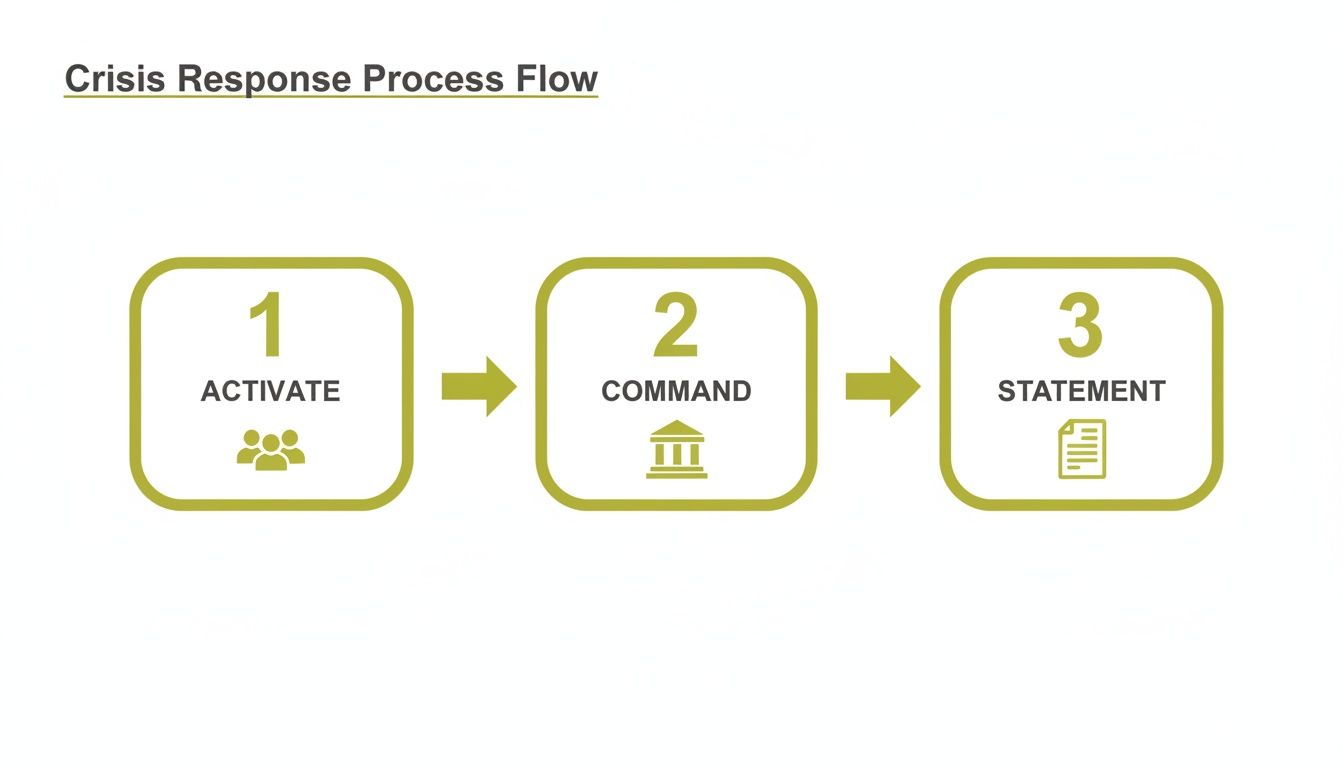
This workflow ensures that even in the most frantic moments, your first moves are logical, structured, and focused on regaining control of the narrative.
Defining Roles and Responsibilities
When a crisis erupts, ambiguity is your enemy. A key part of your playbook is defining, with absolute clarity, who does what. There should be zero confusion about who has the authority to sign off on decisions, who is cleared to speak to the media, and who is responsible for keeping your own team in the loop.
Your playbook needs to outline a clear Crisis Communications Team. This isn't a huge committee; it's a nimble group that typically includes:
- Crisis Lead: Often the CEO or a senior executive. This is the ultimate decision-maker who has the final say on the strategic response.
- Communications Lead: The person running the show on all communications, managing the team, and ensuring the message stays consistent. Our senior consultants often step into this role for clients.
- Spokesperson(s): The one or two designated people who are media-trained and authorised to speak publicly for the company.
- Legal Counsel: Essential for reviewing all statements to advise on potential liability and legal exposure.
- Operational Leads: The heads of the relevant departments (like IT for a data breach or HR for an employee issue) who provide the ground-truth facts.
Make sure you have contact information and designated backups for every role. This structure stops internal chaos and ensures you present a unified front—something that’s fundamental to any successful public relations campaign, crisis or not.
Pre-Approved Messaging and Templates
Perhaps the most valuable part of any playbook is its library of pre-approved messaging. In the heat of the moment, you simply won't have the time or headspace to craft the perfect turn of phrase from scratch. Having templates ready to go is what allows for a rapid, consistent, and calm response.
Your playbook should contain drafts for:
- Holding Statements: Short, initial statements for various scenarios (e.g., a technical issue, a personnel matter, a safety incident).
- Internal Memos: To inform employees and arm them with the facts before the story breaks publicly.
- Social Media Posts: Initial acknowledgements for platforms like X (formerly Twitter) and LinkedIn.
- Customer Service Scripts: To give your support team approved, empathetic language to use with concerned customers.
- Press Release Shells: Structured templates that are ready to be filled in with the specific details of the situation.
These aren't rigid, word-for-word scripts. They are flexible frameworks. They allow your team to respond in minutes, not hours, with messaging that’s already on-brand, on-message, and pre-approved by leadership. This preparation is what truly transforms a chaotic situation into a managed one.
Getting Your Message Right When Everything Is Going Wrong
When a crisis hits, what you say—and who says it—can make or break your business. The right message builds a bridge back to trust, while the wrong one can burn it to the ground. This isn't just about PR fluff; it's about showing clarity, consistency, and basic humanity when people are looking to you for answers.

This is where having the right experience in your corner truly matters. At Carlos Alba Media, everyone who works for us is either a former national news journalist or has agency experience working with international brands. We don't just guess what the media wants; we know, instinctively, what the public needs to hear. We’ve been the ones asking the tough questions, so we know exactly how to prepare you for them.
The Anatomy of a Message That Works
A solid crisis message isn’t complicated, but you have to get the core components right. If you miss one of these, your response will feel hollow and your customers will see right through it.
Every message you put out must have three things:
- Acknowledgement and Empathy: The very first thing you do is acknowledge what’s happened and show you care about those affected. This is non-negotiable.
- Action and Commitment: What are you doing about it, right now? Be specific. Vague promises like "we're investigating" don't cut it.
- The Path Forward: Let people know what happens next and when they'll hear from you again. This shows you're in control and committed to being transparent.
Your first statement sets the tone for everything. It needs to be human, direct, and focused on action. You don't need all the answers, but you must show you're taking ownership of finding them.
Think back to the early days of the COVID-19 crisis in 2020. The UK government's messaging was initially seen as confusing and slow, which caused a massive backlash. Public trust plummeted by 18 points in just a few months, from 69% in April to 51% by June. It was a brutal lesson in the importance of clear, timely communication. You can discover more insights about these findings on public trust.
Choosing and Prepping Your Spokesperson
The message is only half the battle; the person delivering it is just as important. Your spokesperson isn't automatically the CEO or the most senior person in the room. It has to be the most effective communicator.
The ideal person for the job projects calm confidence and genuine empathy, even when they're being grilled by journalists.
Your spokesperson must be:
- Knowledgeable: They need a rock-solid grasp of the situation and the company's response.
- Credible: Their role should give their words weight. Sometimes this is the CEO, but for a technical crisis, it might be your head of engineering.
- Composed: They have to hold it together under pressure and not get defensive.
- Empathetic: The ability to connect with people on a human level is what builds trust.
Our background as journalists gives us an edge here. At Carlos Alba Media, we put spokespeople through tough, realistic media training that simulates a live-fire interview. We teach them how to stay on message with authority and compassion, so they’re ready for whatever comes their way.
A Real-World Example: The Product Recall
Let's walk through a scenario. A small food brand discovers one of its products might be contaminated with an undeclared allergen. It’s a founder’s worst nightmare. Here’s how the right message, delivered well, can protect the brand.
The Wrong Way: "We are looking into reports of an issue with our snack bars. We take safety seriously and will update you in due course." This is cold, corporate, and doesn't tell anyone anything useful.
The Right Way: "We are so sorry to tell you that we are immediately recalling our 'Original Oat Bars' because they may contain traces of peanuts, which are not listed on the label. Your safety is our number one priority, and we have failed to meet that standard. We have stopped all production and are working closely with the Food Standards Agency to find out exactly what went wrong. If you have these bars, please do not eat them. You can get a full refund wherever you bought them. I am personally overseeing this investigation and will give you another update tomorrow at 10 am."
See the difference? The second message takes full responsibility, shows real empathy, details clear actions, and provides a concrete timeline. That’s how you manage a crisis and turn a disaster into a demonstration of your company's integrity.
Getting Your Message Out: A Channel-by-Channel Plan
You’ve locked in your core message and chosen your spokesperson. Now for the hard part: getting that message seen and heard in the right places. This is where your carefully laid plans hit the chaos of the real world. It’s not about just shouting into the void; it’s about strategically controlling the story on every front, from the news cycle to the social media storm.
This is exactly where our team’s background makes a real difference. At Carlos Alba Media, our specialist nature comes from our people: everyone is either a former national news journalist or has managed communications for major international brands. That blend of newsroom instinct and high-level strategy means we don’t just write a good press release – we know how to get it in front of the people who matter.
Dealing with the Media
Getting a fair hearing from the media—let alone positive coverage—is a huge part of managing a crisis. Journalists are swamped, fielding hundreds of pitches and press releases every single day. A bland, corporate-sounding statement will be deleted before it’s even fully read.
Your outreach has to be laser-focused. Journalists don't want marketing fluff; they need hard facts, clear context, and a credible person to talk to. Our team’s time in the newsroom taught us exactly what makes a story cut through the noise.
For instance, when we handled major campaigns for clients like The Johnnie Walker Experience, we tapped into our network of contacts in London and Glasgow to land coverage that made a genuine impact. Those are relationships built over years, and in a crisis, they are invaluable. It means we can get the right editor on the phone and make sure your side of the story isn't just an afterthought.
Taming the Social Media Beast
In a crisis, social media can be your best friend and your worst enemy. It’s a powerful way to speak directly to your audience, but it’s also where misinformation and anger can spiral out of control in minutes. You have to walk a fine line between speed, empathy, and control.
Here’s what we’ve learned works on the front line:
- Acknowledge, fast: Get your holding statement up on your social channels immediately. It shows you’re on it.
- Create a single source of truth: Don’t let the conversation splinter. Funnel all questions and updates to a dedicated page on your website.
- Resist the urge to fight: Never get into public slanging matches. Acknowledge valid concerns with empathy and offer to take detailed conversations offline.
- Listen obsessively: Use social listening tools to keep a pulse on public feeling and spot new rumours before they take hold.
On social media, silence looks like guilt and getting defensive looks like an admission of it. Your job is to be the calm, helpful, authoritative voice in a sea of shouting.
The sheer volume of comments and messages can feel like a tidal wave. It's not unlike the pressure public services face. Take the NHS 111 Urgent Mental Health Helpline in England. In January 2026, it handled a surge of over 150,000 crisis interactions, which was a 25% jump from the previous year. That gives you a sense of the immense pressure a business can face during a reputational crisis. Our 24/7 service is built to handle exactly that kind of intensity. You can read the full analysis on NHS crisis call data.
Working with Your Legal Team
This is a classic source of tension in any crisis. Your comms team wants to be open and transparent to protect the brand’s reputation. Your lawyers, quite rightly, are focused on minimising legal risk and will often advise you to say as little as possible.
The only way to win is to get these two functions working together seamlessly. Every single thing you release to the public—from a tweet to a full press conference script—must be signed off by your legal advisors. This ensures your message is not only reassuring and clear but also doesn't leave you exposed.
At Carlos Alba Media, we've made this a core part of our process. We have long-standing partnerships with some of the UK’s top media lawyers, which means we can get that critical legal review done quickly and efficiently. This tight collaboration ensures we’re protecting both your reputation and your legal standing, which is absolutely essential when you're managing communications in a crisis.
Why Your Internal Comms Strategy Is Critical
When a crisis erupts, it’s easy to focus all your energy on the outside world – the media, your customers, the noise on social media. But I’ve seen it time and again: the most critical audience is actually inside your own business.
Your team is your first line of defence. If you get your internal communications wrong, you’re practically inviting leaks, fuelling rumours, and paving the way for a catastrophic collapse in morale that will sabotage every other move you make.

This isn’t just theory. Our expertise comes from our people: everyone at Carlos Alba Media is a former national news journalist or has agency experience working with international brands. We’ve been on both sides of the fence, and we know firsthand that a confused, scared team is the fastest way to lose control of the narrative.
Put Your People First. Always.
When things go sideways, your employees’ world is turned upside down. They aren’t immediately thinking about the share price or what a journalist is tweeting; they’re worried about their jobs, the company’s future, and what this all means for them personally. You have to address these fears first, with honesty and compassion.
An information vacuum is your worst enemy. It gets filled with speculation and fear. If your team doesn't get the facts from you, they’ll go looking for them elsewhere – or worse, they'll create their own version of the story. Your first job is to inform your own people, even before you go public.
Your employees are your most credible ambassadors or your most damaging critics. The choice is yours and it’s determined by how you treat them when the pressure is on.
The mental toll of a crisis is very real. Research has shown that workplace stress hit a tipping point in the UK, where 35% of employees considered quitting due to how poorly it was managed. As these findings from MHFA England highlight, only 38% of leaders were found to openly discuss mental health, and just 45% of managers had the training for those tough conversations. Ignoring this pressure cooker environment during a crisis is a recipe for disaster.
Leadership Visibility and Psychological Safety
This is not the time for leaders to hide behind corporate statements. You need to be visible, present, and human. This is fundamental to creating what’s known as psychological safety – an environment where your team feels safe enough to ask tough questions, flag concerns, and even admit mistakes without being blamed.
Here’s what that looks like in practice:
- Show Up: Hold all-hands meetings, whether in-person or virtual. Let your team see you and hear from you directly.
- Be Radically Honest: Share what you know, but just as importantly, be clear about what you don’t know yet. This builds far more trust than projecting false confidence.
- Acknowledge the Strain: Recognise the stress and anxiety people are feeling. Show you care about them as human beings, not just cogs in a machine.
Turning Your Team Into Brand Advocates
When you handle internal comms with care, a powerful shift occurs. Your team moves from being anxious bystanders to becoming your most loyal advocates. A well-informed, respected team is an incredible asset.
Here’s how to equip them for that role:
- Create a Single Source of Truth: Set up a dedicated, private space – like a specific Slack channel or a password-protected page on your intranet. This is where all official updates live, preventing the spread of old or inaccurate information.
- Provide Simple Talking Points: Give them clear, approved messages they can use if friends or family ask what's going on. This helps them feel confident and keeps the message consistent.
- Clarify the Escalation Path: Make it crystal clear who they should direct any media or difficult customer enquiries to. This protects both them and the company’s official response.
By making your people the priority, you’re not just managing an internal audience; you’re building an army of supporters who will be instrumental in protecting and rebuilding your brand’s reputation. For leaders who have to stand up and deliver these messages, specific coaching can make all the difference. You may find our guide on media training for executives helpful for building these essential skills.
Post-Crisis Recovery And Reputation Repair
You’ve made it through the fire. The frantic calls have stopped, the social media storm has subsided, and your team is finally catching its breath. It's tempting to simply move on and forget the whole ordeal ever happened. But that would be a massive mistake.
What you do after the crisis is just as critical as how you handled it in the moment. This is your opportunity to learn, rebuild, and ultimately fortify your business for the future.
Conducting The Post-Crisis Review
Before you can fix your reputation externally, you need to get your own house in order. The first port of call is always a full, no-holds-barred post-crisis debrief with the entire crisis team. This isn't about pointing fingers; it's a candid look at what worked and what fell apart under pressure.
Get everyone in a room while the experience is still fresh in their minds. The goal is to capture raw, honest feedback. In every debrief I've run, we focus on a few core areas:
- Speed: Were we fast enough off the mark? Where did delays happen? Was it sign-off, getting information, or something else?
- Messaging: Did our statements land well? Were they clear and empathetic, or did they sound like corporate jargon?
- Channels: Did we use the right platforms to reach the people who mattered most, from our own staff to our customers?
- Playbook Performance: How did our crisis plan actually perform in the real world? Which parts were genuinely useful, and which were irrelevant?
The insights you gather here are pure gold. This is what allows you to turn a painful experience into a powerful lesson, refining your playbook and plugging gaps you never knew you had.
Proactive Reputation Repair
Once you have that internal clarity, the focus shifts outward. Rebuilding public trust is a marathon, not a sprint. This is where our specialist nature comes into play, as our entire team consists of former national news journalists or has agency experience with international brands. We've seen firsthand how narratives are shaped, both for the good and the bad.
A crisis doesn't have to be the final word on your brand's story. With the right approach, the recovery phase can become a testament to your company’s character, turning a negative event into a powerful narrative of accountability and resilience.
Simply waiting for negative stories to fade isn't a strategy. You have to actively reshape what people find when they look you up. We do this through a careful blend of strategic content marketing and technical SEO.
By creating and promoting genuinely valuable, positive content around your brand, we can methodically improve your search engine results. Over time, the story of your recovery and strength begins to outrank the initial crisis coverage. It’s about taking back control of your own story. To learn more about how this works in practice, take a look at our guide on reputation management for businesses.
Your Crisis Questions, Answered
When a crisis hits, the questions come thick and fast. As a founder or leader, you're suddenly in the hot seat. Drawing on years of experience inside national newsrooms and leading PR for global brands, we've tackled the most common (and critical) questions that come up when the pressure is on.
At Carlos Alba Media, our specialist nature and expertise comes from our people. Everyone on our team is a former national news journalist or has agency experience of working with international brands. This isn't just theory for us; it’s what we’ve lived and breathed from both sides of the media fence. Here's our straight-talking advice.
How Quickly Do I Really Need To Respond?
You have one hour. In that first 60 minutes, you need to have a holding statement out the door. Many people think they need all the facts before saying a word, but that’s a rookie error that can cost you dearly.
The only goal of that first, quick statement is to show you're on top of it. You simply need to acknowledge you're aware of the situation and that you're looking into it. We know this because, as former journalists, we were the ones on the other end of the phone, waiting for a comment. A rapid response stops the rumour mill from spinning out of control. In a crisis, silence is never golden; it’s read as guilt or incompetence.
Acknowledging a problem swiftly isn't an admission of fault; it's a demonstration of leadership. Waiting for perfect information is a luxury you cannot afford when your reputation is on the line.
What Is The Biggest Mistake Businesses Make?
Without a doubt, it’s hoping the problem will just vanish. We’ve seen it time and again: a business leader buries their head in the sand, praying no one will notice. This almost never works.
What starts as a small, containable issue quickly spirals. The information vacuum you've created gets filled with angry social media comments, speculation, and damaging headlines. You end up playing defence, trying to correct a story that has already been written for you. It's why we built our 24/7 crisis service with top UK media lawyers—to ensure our clients get on the front foot immediately and control their own story.
Can Managing A Crisis Ever Be Good For My Business?
Yes, it absolutely can. Nobody wishes for a crisis, but navigating one brilliantly can become a defining moment for your brand. When you handle a tough situation with transparency, honesty, and real empathy, you can build incredible trust with your customers and your own team.
It’s your chance to put your company values into action when it matters most. We've worked with clients who have turned a potential reputational disaster into an opportunity that cemented their character. When handled well, the story can shift from "the problem" to "how incredibly they handled the problem," earning you respect and even positive media coverage in the long run.
At Carlos Alba Media, we blend newsroom instincts with top-tier strategic advice to guide you through your toughest moments. If you need to safeguard your reputation, prepare for the unexpected, or respond with confidence, see how we can help at https://carlosalbamedia.co.uk.