
So, what exactly is a public relations campaign? Is it just a fancy term for sending out a few press releases and hoping for the best? Not at all.
Think of it less like a single action and more like a planned military operation. A public relations campaign is a concentrated series of strategic activities, all working together to hit a specific business goal within a defined period. It has a clear start, a middle, and an end. It’s the difference between occasionally firing a flare gun and launching a full-scale firework display, perfectly timed and choreographed to leave everyone watching in awe.
This is a crucial distinction. While day-to-day PR keeps your brand’s reputation ticking over, a campaign is designed to create a significant, targeted impact. It’s not just about getting your name in the news; it's about making sure the right people see that news, understand your message, and take the action you want them to take.
To put it simply, a well-run campaign can be the difference between a product launching to crickets and one that sells out before the week is over.
PR Campaigns vs. Ongoing PR Activity
It's easy to confuse a one-off campaign with the broader, continuous work of public relations. Both are essential, but they serve very different purposes and operate on different timelines. A campaign is a sprint with a finish line, whereas ongoing PR is a marathon designed for long-term endurance.
Here’s a simple breakdown of the key differences:
| Attribute | Public Relations Campaign | Ongoing PR Activity |
|---|---|---|
| Focus | Specific, measurable goal (e.g., launch a product, build hype for an event). | Broad, long-term reputation management and relationship building. |
| Timeline | Fixed duration with a clear start and end date (e.g., 3 months). | Continuous, with no defined endpoint. |
| Intensity | High-intensity, concentrated effort over a short period. | Consistent, lower-intensity 'always-on' presence. |
| Activities | A coordinated mix of tactics (media blitz, events, influencer push) for maximum impact. | Routine tasks like press office management, thought leadership, and monitoring. |
| Measurement | Success is measured against pre-defined campaign KPIs and objectives. | Success is tracked through long-term metrics like brand sentiment and share of voice. |
Ultimately, the best strategies combine both. Powerful campaigns create spikes in awareness and action, while steady, ongoing PR maintains that momentum and builds a resilient brand reputation over time.
From Headlines to Business Growth
The world of PR has changed dramatically. It's no longer just about bagging headlines and counting column inches. Today, the sharpest campaigns are woven directly into a company’s core business objectives—whether that's generating qualified leads, boosting sales, attracting top-tier talent, or securing investor confidence.
This isn't just a feeling; the data backs it up. The PRCA 2025 UK Census reveals that strategy and planning is now the fastest-growing area of work in the industry, jumping to 43%. It has officially overtaken traditional media relations as the top focus. You can dig into the numbers yourself in the full census report on strategic growth in UK PR.
This shift tells a clear story: businesses are demanding campaigns built on solid, data-driven insights that deliver a tangible return on investment.
A public relations campaign isn’t an isolated marketing tactic; it’s a focused growth engine. It coordinates every message and channel to build momentum, shape perception, and deliver tangible results that move your business forward.
The Power of Specialist Insight
Of course, a great strategy is only half the battle. Executing it successfully demands more than good ideas—it requires a deep, insider’s understanding of how the media actually works.
This is where having a team of specialists like Carlos Alba Media makes a real difference. Everyone who works for us is either a former national news journalist or has agency experience working with international brands. We don't just guess what makes a good story; we know, because we used to be the ones on the other side of the desk making those decisions.
We blend that newsroom instinct with senior-level strategic thinking to create campaigns that don't just get you noticed, they deliver measurable results. After all, powerful media relations is the bedrock of any successful campaign. If you want to get it right, start by reading our guide on how to master the art of media relations.
The Blueprint for a Winning PR Campaign
Every truly successful public relations campaign, whether it’s for a disruptive tech start-up or a well-loved heritage brand, is built on the same solid blueprint. It's not magic; it’s a structured plan that turns ambitious ideas into tangible, measurable results. Once you grasp these core components, you can stop thinking in abstracts and start building a concrete strategy.
Think of it like building a house. You wouldn’t start ordering furniture before you’ve drawn up the architectural plans, would you? In the same way, you shouldn't be pitching journalists before you’ve defined your goals and know exactly what success looks like.
This simple flow from strategy to execution to impact is what powers any campaign worth its salt.
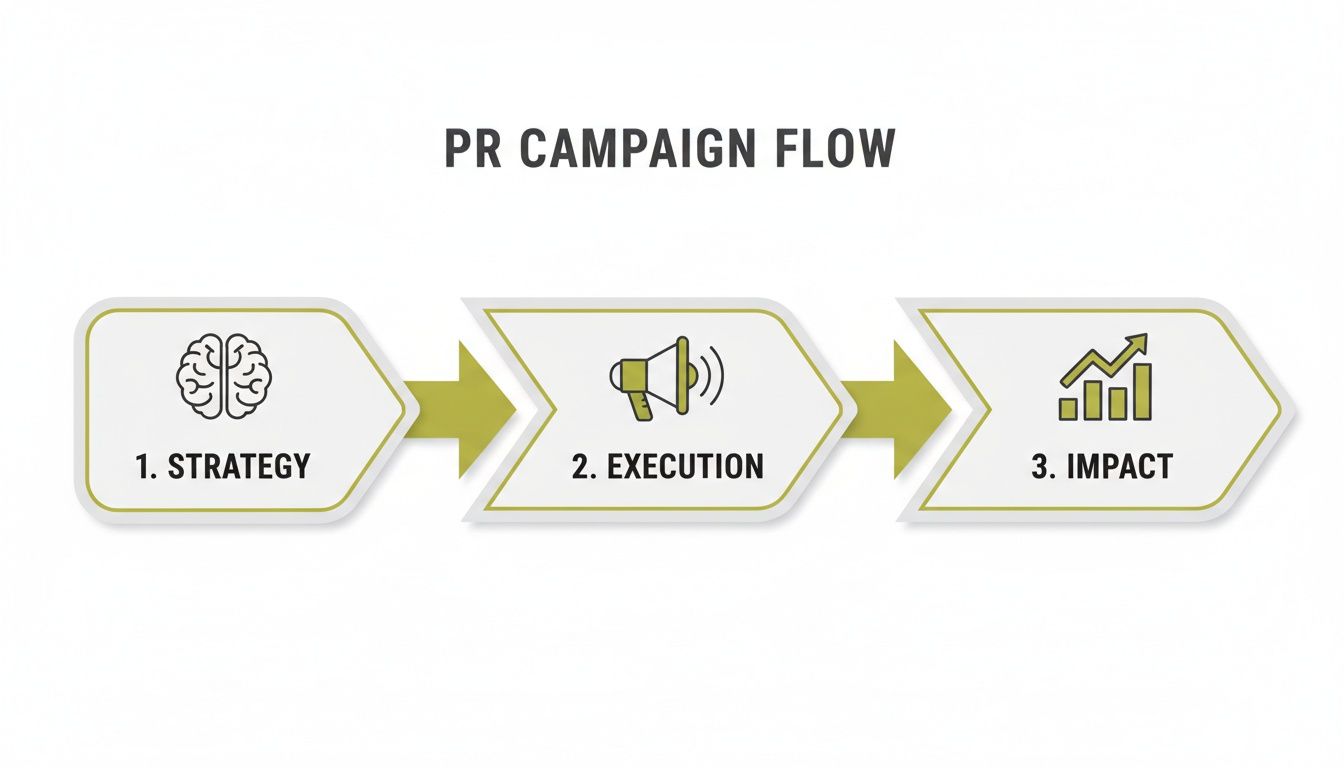
As you can see, a thoughtful strategy always comes first. It guides the execution and, ultimately, delivers a real, measurable impact. This methodical approach ensures every single action you take is purposeful and contributes directly to your main objectives.
H3: Setting Objectives That Actually Drive Action
First things first: what are you trying to achieve? Vague goals like "get more press" are practically useless. You need crystal-clear, measurable objectives that tie directly back to your business goals.
The SMART framework is an oldie but a goodie for a reason. It works.
- Specific: Nail down exactly what you want. Instead of "increase brand awareness," try "secure feature articles in three national business publications."
- Measurable: Define how you'll track your progress. For example, "increase website traffic from earned media by 20%."
- Achievable: Be ambitious, but stay grounded in the reality of your resources and timeline.
- Relevant: Make sure your PR goal directly supports a bigger business objective, like generating leads or breaking into a new market.
- Time-bound: Give yourself a deadline. For instance, "achieve this within the next fiscal quarter."
Setting SMART objectives is the difference between a wishful thinking exercise and a strategic initiative with clear benchmarks for success.
H3: Knowing Your Audience: Who Are You Really Talking To?
Once your goal is set, you have to figure out precisely who you need to reach. A message aimed at everyone ends up resonating with no one. This is where you need to get serious about creating detailed audience personas.
A persona is a semi-fictional profile of your ideal customer or key stakeholder. It goes far beyond basic demographics to uncover their motivations, their pain points, and, crucially, their media habits. What do they read? Which podcasts are they subscribed to? Whose opinions do they trust?
Building detailed personas is like creating a GPS for your campaign. Every decision you make—from the messages you craft to the channels you choose—should be guided by a deep understanding of the people you’re trying to reach.
H3: Crafting Your Message: What’s Your Story?
Your core message is the heart of your story, boiled down to its most compelling form. It has to be consistent, memorable, and flexible enough to work across different channels and for different audiences. The best tool for this job is the message house.
A message house is a simple but powerful framework that gets everyone on the same page. It usually contains:
- The Core Message: The one big idea you want people to remember.
- Supporting Pillars: Three or four key points that explain and prove your core message.
- Proof Points: The facts, stats, testimonials, or real-world examples that give your claims credibility.
This structure keeps your story sharp and potent, whether it’s in a 280-character tweet, a CEO interview, or a detailed white paper.
H3: Choosing Your Channels: Where Will You Tell It?
With your objectives, audience, and message sorted, it's time to choose the right channels to tell your story. The PESO model—Paid, Earned, Shared, and Owned—is a brilliant framework for building a truly integrated plan.
- Paid: This includes advertising, sponsored articles, and paid influencer work.
- Earned: This is classic PR—getting coverage from journalists, bloggers, and other trusted third parties.
- Shared: This is all about amplifying your story through social media.
- Owned: This is your home turf—your website, blog, and email newsletters.
The most effective PR campaigns rarely lean on just one channel. The real magic happens when you integrate these elements so they work in concert, creating a surround-sound effect that amplifies your message for maximum reach. To see how these components work together, you can explore a real-world example of a public relations campaign we’ve delivered.
H3: Measurement: How Do You Prove It Worked?
Finally, measurement isn't something you tack on at the end. It has to be baked in from the very beginning. You must decide on the Key Performance Indicators (KPIs) you’ll use to track progress against your SMART objectives before the campaign even starts.
This is where specialist expertise becomes a game-changer. At Carlos Alba Media, our team is made up entirely of former national news journalists and senior agency experts. We don’t just know how to land a story; we know how to build a campaign that connects directly to business outcomes. Our background working with international brands means we're experts at defining and tracking the KPIs that really matter to your bottom line.
How to Set Objectives and Measure True Success
A public relations campaign without clear measurement is just wishful thinking. So often, success is judged by the amount of noise made, not the actual business results delivered. It’s time to move past the old-school “vanity metrics” and start connecting your PR efforts to things that really matter: lead generation, sales, and investor confidence.
This is exactly where many businesses stumble. They get caught up tracking activity—the doing—but they completely miss the impact. The real skill is learning to distinguish between what you did and what you achieved. When you get this right, PR transforms from a simple cost centre into a data-backed engine for growth.

Beyond Vanity Metrics: The Three Levels of PR Measurement
To measure what truly matters, you need a simple but effective framework. I find it helps to categorise your Key Performance Indicators (KPIs) into a clear hierarchy. This approach helps you see the complete story, from the work you put in to the long-term business impact.
Outputs: This is the most basic level. It’s a log of what you produced and where it went. Think of it as your activity list. Examples include the number of press releases you sent, media pitches you made, or articles you secured.
Outtakes: This level goes a step deeper. It measures how your target audience actually received and understood your message. It’s about comprehension, not just exposure. Key metrics here are message pull-through in media coverage, social media engagement, and shifts in audience sentiment.
Outcomes: Now we’re talking. This is the holy grail of PR measurement because it connects your campaign directly to business goals. This is where you track website traffic from earned media, the number of qualified leads generated, or a measurable increase in sales attributed to your campaign.
Focusing only on outputs is like celebrating sending 100 job applications without getting a single interview. The activity is there, but the result isn't. It’s the outtakes and, most importantly, the outcomes that prove the real value of your public relations campaign.
True ROI in public relations isn't found in counting clippings. It's found in demonstrating a clear line from a piece of earned media to a new customer, a signed contract, or a spike in share price.
Connecting PR Goals to Business KPIs
The critical step that proves your worth is mapping specific campaign goals to tangible KPIs. This isn't just about showing you were busy; it’s about proving you were effective. For any campaign, you have to define what success looks like before you even start.
At Carlos Alba Media, this philosophy is at the core of everything we do. Our team of specialists are all former national news journalists or have agency experience working with international brands. This unique background means we don't just chase headlines—we build strategies that are hardwired to your commercial objectives. We know what it takes to create stories that not only get published but also drive audiences to act.
This insider knowledge allows us to define and measure the KPIs that executives and investors genuinely care about. We understand that a front-page story is only valuable if it translates into measurable business growth.
To make this practical, let's look at how to map common PR goals to the KPIs that demonstrate their impact.
Mapping PR Goals to Business KPIs
The table below provides a simple guide for connecting your efforts to metrics that matter.
| Campaign Goal | Primary KPI | Secondary KPI | Example Tool |
|---|---|---|---|
| Increase Brand Awareness | Increase in direct and organic website traffic. | Share of Voice (SOV) vs. competitors. | Google Analytics |
| Generate Sales Leads | Number of new marketing qualified leads (MQLs) from referral traffic. | Website goal completions (e.g., demo requests). | HubSpot / Salesforce |
| Build Thought Leadership | Number of inbound speaking or expert commentary requests. | Key message pull-through in top-tier media. | Media Monitoring Service |
| Support Product Launch | Sales figures or pre-orders attributed to the campaign period. | Volume and sentiment of online reviews and social mentions. | E-commerce Platform |
| Attract Investors | Increase in inbound enquiries from VCs or potential investors. | Positive coverage in key financial publications. | CRM System |
By using a framework like this, you create a direct link between your PR activity and the company's bottom line, making the value of your work undeniable.
Bringing Your PR Campaign Strategy to Life
It's one thing to talk about strategy in theory, but seeing it in action is where it all clicks. A great public relations campaign isn't just a to-do list; it’s a living, breathing story that unfolds to connect a brand with the right people in a way that feels completely natural.
Let's break down how this works in the real world. We'll look at a couple of scenarios using the five core components we've discussed: objective, audience, message, channels, and measurement. These examples show what happens when a sharp strategy meets expert execution—something our team at Carlos Alba Media has delivered for everyone from ambitious start-ups to established names like The Johnnie Walker Experience.
Case Study One: The Tech Start-up Launch
First up, imagine a new fintech app called "FinFlow." It's built specifically to help UK freelancers sort out their taxes. The main goal here is simple: get people to download and use the app.
- Objective: To hit 10,000 app downloads within the first three months of launching.
- Audience: We’re talking to UK-based freelancers and sole traders, typically aged 25-45. They’re comfortable with tech but completely strapped for time. You'll find them reading online publications, listening to business podcasts, and scrolling through LinkedIn and X (formerly Twitter).
- Message: The core message is direct: "FinFlow: The UK's smartest tax app for freelancers. Save time, reduce stress, and maximise your earnings effortlessly." This is backed up with tangible features like "AI-powered expense tracking" and "real-time tax liability estimates."
- Channels (PESO Model):
- Earned: We’d pitch exclusive launch stories to tech journalists at influential sites like TechCrunch UK and Wired UK. The founder could also offer expert commentary on freelance finance trends to the business desks of national newspapers.
- Shared: We'd team up with respected freelance finance influencers on X and Instagram. They could create authentic "day in the life" content showing how FinFlow actually solves their problems.
- Owned: The FinFlow website would feature a blog series on common tax mistakes freelancers make, all properly optimised to show up in search results.
- Measurement: Success is tracked by watching app downloads through unique links shared with the media. We'd also keep a close eye on referral traffic in Google Analytics and monitor brand mentions and sentiment across social media to see how the message is landing.
Case Study Two: The Hospitality Brand Driving Bookings
Now, let's switch gears. Picture a chain of beautiful boutique hotels in Scotland that needs to fill rooms during the quiet off-season. This campaign is all about generating direct revenue.
- Objective: To boost direct website bookings by 25% during Q1 (January to March) compared to the same period last year.
- Audience: Our target is couples and small groups from England, aged 30-60, on the hunt for a luxurious weekend escape. They get their travel inspiration from magazines like Condé Nast Traveller and follow high-end travel influencers on Instagram.
- Message: We’re selling an experience: "Discover the magic of a Scottish winter. Cosy fires, stunning landscapes, and unforgettable luxury await."
- Channels:
- Earned: Nothing beats first-hand experience, so we'd host an exclusive press trip. A small, curated group of travel writers and influencers would be invited to experience the hotels and the stunning winter scenery for themselves.
- Paid: We'd run highly targeted social media ads featuring breathtaking winter photography and promoting a special "Winter Warmer" package to catch their eye.
- Owned: A visually rich "Winter in Scotland" guide would be created for the hotel's website. Packed with itineraries and professional photos, it would be promoted through their email newsletter to past and potential guests.
- Measurement: The main KPI is crystal clear: that 25% increase in direct bookings, tracked right through their booking engine. We'd also track the use of a campaign-specific promo code and measure the engagement and reach of our influencer content.
A successful public relations campaign hinges on a deep understanding of what makes news. At Carlos Alba Media, our entire team consists of former national news journalists and senior agency experts. We don't just pitch stories; we build narratives that we know will land because we used to be the ones making those decisions in the newsroom.
When to Partner With a Specialist PR Agency
For many businesses, handling PR in-house makes perfect sense at the start. But there comes a point in every company’s growth where ambition outgrows capacity. That's the moment the DIY approach starts to hold you back.
Knowing when you’ve hit that ceiling is crucial. It’s not just about running out of time; it’s about recognising that your next big goals demand a different level of expertise. Moving to a specialist agency at the right time isn't just a good idea—it can be the single most important decision you make for your brand's future.
When Your Story Needs a Bigger Stage
One of the clearest signs is when you need to make a much bigger splash. Maybe you’re launching a game-changing product, expanding across the UK, or you’ve just landed a funding round that puts you in a new league. Local press and trade magazines are fantastic, but they can't give you that nationwide impact.
This is where you need more than a simple media list you've scraped together. You need a proper "black book" of contacts at the nationals, the major online news sites, and the broadcast networks. More than that, you need a team that already has a relationship with those journalists and knows exactly what makes them tick.
Without those established connections, even the most powerful brand story can get lost in the noise. A good agency acts as your bridge, getting your message directly in front of the people who can amplify it to a national audience.
When Strategy Becomes Critical
Another trigger is when the stakes get higher. Perhaps you're up against fierce competitors, dealing with tricky industry regulations, or heading towards a major event like a merger. In these scenarios, just 'getting some press' won't cut it. You need senior-level strategic advice.
The whole PR profession has moved in this direction. Recent data shows that strategy and planning have seen a 43% growth in importance for PR pros, overtaking even traditional media relations. This lines up with growing public trust in our industry—with 66% of people now seeing PR as a trustworthy source. As you can see by exploring the latest UK public relations market insights, a thoughtful, strategic approach is no longer a 'nice-to-have'.
Hiring an agency isn't an admission of failure; it's a declaration of ambition. It means your goals have outgrown your resources, and you're ready to invest in the expertise needed to reach that next level.
This is especially true when things get tough. Managing a crisis requires a cool head and an objective viewpoint that’s almost impossible to maintain from inside the business. A specialist team provides the calm, strategic hand you need to steer your reputation through choppy waters. If that's a concern, our guide to crisis communication management is a great place to start.
The Specialist Advantage: The Newsroom Insider
When you do decide to partner with an agency, the background of its people is everything. This is where a consultancy like Carlos Alba Media brings something truly different to the table. Every single person on our team is either a former national news journalist or has agency experience working with international brands.
This isn’t just a bullet point on a slide; it’s the very core of why we get results.
- Newsroom Instinct: We don’t have to guess what a journalist wants. We know. We’ve been that journalist, sitting in that newsroom, fighting for a story to get past the editor’s desk. We understand the deadlines, the pressures, and the angles that get a story noticed.
- Senior-Level Counsel: When you work with us, you’re not passed down to a junior account exec. You get direct access to experienced experts who provide the commercial awareness and strategic thinking you'd expect from a big London agency, but without the eye-watering overheads.
- Authentic Storytelling: Our journalism background means we are hard-wired to find the human story and the compelling narrative at the heart of your business. We craft pitches that land because they’re built on real journalistic principles.
Working with an agency like ours means you aren’t just hiring PR people. You’re hiring a team that has sat on the other side of the desk, giving you an unbeatable insider’s advantage to make your public relations campaign a genuine success.
Your Public Relations Campaign Questions Answered
When you're thinking about launching a public relations campaign, it's natural for the practical questions to start bubbling up. Planning everything out can feel like a huge task, and most of the worries we hear boil down to a few key things: the budget, the timeline, the people needed, and how PR even fits in with marketing.
So, let's get straight to it. Here are the honest answers to the questions every founder and marketing manager asks, based on years of experience in the trenches.
How Much Does a Public Relations Campaign Cost?
This is always the first question, and the frank answer is there’s no single price tag. A campaign is tailored to your goals. Getting the word out about a new local shop might only require a few thousand pounds, whereas a nationwide launch for a new piece of software is a much bigger undertaking.
Generally, you'll see costs broken down in two ways. There's the monthly retainer fee for ongoing support from an agency, or a one-off project fee for a campaign with a clear beginning and end. The final figure is shaped by the campaign's length, the experience of the team working on it, and the specific activities involved, like organising media events or working with influencers.
It’s helpful to think of it not as a cost, but as an investment. The right campaign delivers a tangible return. At Carlos Alba Media, our entire model is built to give you the best possible value. Our specialist nature means everyone who works for us is a former national news journalist or has agency experience working with international brands. This ensures you get top-tier strategy and execution without paying for the giant overheads of a traditional agency, and your budget is spent on getting results.
How Long Until I See Results From My PR Campaign?
Patience is a virtue in PR. While some digital tactics can give you a quick boost, building a solid, lasting reputation doesn't happen overnight. It’s a common myth that one press release will suddenly make you famous. Real impact is the result of consistent, strategic work.
Here’s a realistic timeline of what you can expect:
- Weeks 1-4: The first signs of life should appear. This often looks like a jump in social media engagement, new followers, and maybe some mentions in smaller, industry-specific publications.
- Months 2-3: This is when the bigger fish start to bite. Landing features in national papers or influential online magazines is a process. It takes time to build relationships with the right journalists and follow up persistently.
- Months 6-12: Now, the real, lasting impact becomes obvious. After months of consistent, positive stories, your brand starts to be seen as an authority in its field. This is when you’ll notice a real difference, like a steady stream of inbound leads or a clear positive shift in how people see your brand.
Can I Run a PR Campaign Myself?
Of course. Many brilliant businesses start with a DIY approach to PR, and it can work wonders, especially for things like managing your social media or connecting with your local community. It’s a fantastic way to learn the fundamentals.
However, there comes a point where bringing in an agency stops being a luxury and becomes a necessity. Ask yourself these questions:
- Do I need to get in touch with national journalists, but I don't have the contacts?
- Am I planning a high-stakes launch or facing a potential crisis where I need expert guidance?
- Do I genuinely have enough hours in the day to dedicate to proactive media outreach, every single day?
If you answered 'yes' to any of these, it’s probably time to call in the specialists. An agency provides the expertise, connections, and sheer manpower to get you to the next level. This is where having a team of former journalists is a game-changer—they know exactly what makes a story stand out because they used to be the ones deciding what got published.
What Is the Difference Between PR and Marketing?
There's an old saying in the industry: "Marketing is what you pay for; PR is what you pray for." It’s a bit tongue-in-cheek, but it gets to the heart of the matter. Marketing is mostly about directly promoting and selling something, often through paid ads. Public relations, on the other hand, is about earning trust and building a great reputation through credible, third-party stories.
Marketing tells people to buy your product. Public relations gives them a reason to believe in your brand. One drives sales today; the other builds the loyalty that secures your sales tomorrow.
These days, the lines are definitely blurring, and the best strategies use both. A great public relations campaign builds the trust that makes all your marketing spend work that much harder. The UK industry is a testament to this, with a workforce of 73,800 PR professionals as of Q3 2024. It shows just how much businesses value this function. You can dive deeper into the UK's professional landscape and media trends to get a sense of the industry's scale. A modern team understands how to weave PR and marketing together for a powerful, unified brand story.
A well-planned public relations campaign can be the most powerful engine for your brand's growth. If you’re ready to move from planning to action and build a campaign that delivers real, measurable results, Carlos Alba Media is here to help. Our team of former national journalists and senior agency experts has the insider knowledge to get you seen, trusted, and chosen.
Discover how we can make your story heard by visiting carlosalbamedia.co.uk