

Before you even think about writing a press release, you need a map of the territory. The UK media is a fast-paced, highly concentrated world, and only certain kinds of stories will ever get traction. If you want to learn how to get press coverage, mastering this landscape isn't just a good idea—it's the only place to start.
Understanding the Modern UK Media Landscape
Let's be clear: the UK media isn't some vast, open field where any good idea can flourish. It's a tight-knit ecosystem dominated by a few massive players. For a startup or SME, this isn't a problem. In fact, it's a huge strategic advantage, but only if you know who holds the influence and what they’re actually looking for.
This is where having a newsroom perspective becomes your secret weapon. At Carlos Alba Media, our entire team is made up of former national news journalists or PR pros with deep agency experience working with international brands. We don’t have to guess what journalists want; we know, because we’ve sat in their chairs, staring down impossible deadlines and sifting through hundreds of pitches a day.
Why Media Concentration Matters to Your Startup
The way the UK media is structured has a direct impact on your PR strategy. A handful of corporations own the vast majority of national newspapers and their incredibly powerful online platforms. Knowing this lets you focus your energy where it will make the biggest splash.
The numbers don't lie. In 2025, DMG Media (think the Daily Mail and Metro) now controls an enormous 43.4% of national newspaper weekly circulation. That's up from 41.6% in 2023, making them prime targets.
This grip extends online, too. DMG, Reach, and News UK command over 40% of the combined reach of the UK's top 50 newsbrands. Mail Online alone reaches 21.2 million people (that’s 41% of UK adults), with The Guardian right there at 21.1 million (40%). You can dig into the full report on UK media ownership to see the trends for yourself.
This infographic paints a pretty clear picture of who holds the cards.
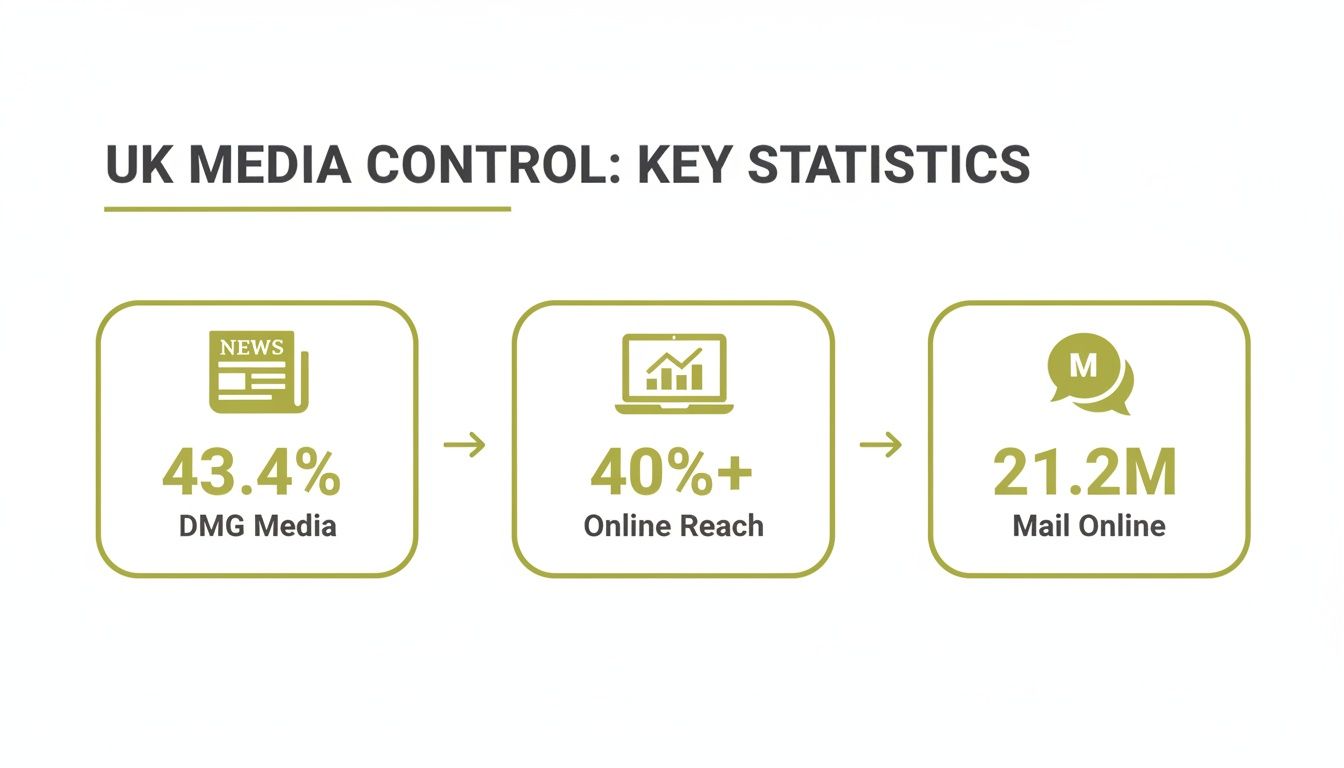
The takeaway? A targeted approach aimed at outlets owned by these media giants can give your story incredible exposure.
Thinking Like a Journalist
Knowing who owns what is step one. Step two is learning to think like the people you’re pitching. Every journalist and editor I know operates under intense pressure. They’re juggling multiple stories, facing relentless deadlines, and their inboxes are a war zone.
Your pitch isn’t just up against other companies. It’s competing with breaking news, political scandals, and whatever’s trending on social media. To stand a chance, it has to be exceptionally relevant and incredibly easy for them to say "yes" to.
Here are the pressures that decide whether your story lives or dies in an inbox:
- No Time: Journalists are chronically short on time. If your pitch is confusing, waffly, or looks like hard work, it’s getting deleted. Simple as that.
- Audience is Everything: An editor's main job is to publish things their specific audience wants to read. A story for the Financial Times needs a completely different hook to one for The Sun.
- The "Why Now?" Test: News is, by definition, new. Your story must have a reason for existing today. Is it tied to a recent event? A new trend? A specific date?
This is the insight we bake into every single campaign at Carlos Alba Media. Because our team is composed entirely of former national news journalists and PR experts with agency experience on international brands, we instinctively see stories from a journalist’s point of view. We know how to take a standard business announcement and frame it so it slots perfectly into the current news cycle, or find the hook that connects a product launch to a wider social trend.
That’s what turns a bland press release into a compelling story a journalist is genuinely excited to cover. It’s the difference between the delete key and the front page.
Finding the Newsworthy Story Within Your Business

Here’s a hard truth: your new funding round isn’t a story. Neither is your fancy new product feature. It might be a huge achievement for your business, and rightly so, but it’s not news. This is the single biggest hurdle that trips up startups and SMEs trying to figure out how to get press coverage.
Journalists aren't in the business of writing adverts for you. Their job is to tell stories that grab their audience and won't let go. Your job is to find the genuine, compelling narrative hidden inside your business update and serve it to them on a plate. This is the art of story mining, and it’s a skill you absolutely can learn.
At Carlos Alba Media, this is our bread and butter. Every member of our team is a former national news journalist or has agency experience working with international brands. We’ve spent our careers sifting through announcements to find the narratives that editors can't ignore, and we know exactly how to turn a dry company update into a story with tension, relevance, and a powerful hook.
Moving Beyond the Obvious Announcement
The first step is to stop thinking about what you want to announce and start thinking about why anyone outside your company should give a damn. A funding round isn't just a number; it’s a story about creating 20 new jobs in a town hit hard by unemployment. A new software feature isn't just a line of code; it's the solution to a widespread industry problem that's costing businesses millions.
To unearth your real story, you need to start asking the right questions:
- Who is the hero? Is it your founder who overcame incredible odds to get here? A customer whose life was fundamentally changed by your product? An employee driving genuine innovation from within?
- What is the conflict? What massive problem are you solving? Which industry giant are you bravely challenging? What outdated way of thinking are you trying to upend?
- What is the 'why now'? Why is this story relevant today? Does it hook into a seasonal trend, a new government report, or a major cultural conversation everyone is already having?
This "story mining" process is all about digging for the human element, the surprising data point, or the timely trend that elevates your announcement into a newsworthy event. To see how we've put these principles into practice, take a look at some of our client success stories.
Identifying Your Strongest Story Hooks
Once you start digging, you'll probably uncover several potential angles. Not all are created equal. As former journalists, we instinctively filter every idea through a newsroom lens, looking for the one with the most punch.
Here are the most powerful types of story hooks you should be looking for inside your own business:
1. The Surprising Data Angle
Do you have internal data that reveals an unexpected trend? A fintech startup, for example, might have data showing a 40% jump in Gen Z users investing in sustainable funds since the last election. That’s not a product update; it’s a story about the shifting economic priorities of a generation.
2. The Human Interest Angle
People connect with people, not with faceless corporations. Think about a health tech company. Instead of just announcing a new device, tell the story of the very first patient whose life it saved. This puts a real human face on your innovation and makes its impact tangible and emotional.
3. The Counter-Intuitive Angle
This is all about challenging a widely held belief in your industry. Maybe your logistics company found that a four-day work week actually boosted productivity by 15%. This flies in the face of convention and provides a strong, opinionated hook that journalists love because it sparks debate.
The strongest stories often connect a small business update to a much bigger national or global conversation. A journalist can use your company’s story as a specific, timely example to illustrate a broader trend their readers already care about.
Ultimately, your goal is to make a journalist's ridiculously busy job as easy as possible. When you provide them with a fully-formed story—complete with a hero, a conflict, and a clear reason for its timeliness—you're no longer just another company begging for a mention. You’re a valuable source giving them exactly what they need: a great story. Getting that mindset shift right is the key to winning consistent press coverage.
Crafting a Pitch That Cuts Through the Noise

You’ve nailed down the perfect story angle. Fantastic. But now comes the real test: the pitch. That email is your single shot at convincing a journalist, who is drowning in hundreds of other messages, that your story is the one they need to cover. Getting this right is a massive part of figuring out how to get press coverage.
This is more than just writing a polite email; it's about crafting a professional, concise, and frankly irresistible proposition. Our team at Carlos Alba Media is built on real newsroom experience. Every one of us is a former national news journalist or has agency experience working with international brands. This means we don’t have to guess what reporters want—we know, from experience, what makes a pitch compelling and what gets it sent straight to the trash.
The Anatomy of a Perfect Pitch Email
A great pitch is an exercise in economy. Journalists are scanners, not readers, and your email has to respect their time by getting straight to the point. Every single element, from the subject line to your sign-off, has a job to do.
- The Subject Line is Your Gatekeeper: This is your first impression and, often, your only one. It must be sharp, clear, and intriguing without ever feeling like clickbait. Ditch generic labels like "Story Idea" and lead with your strongest hook. Think: "SCOOP: Glasgow tech firm data reveals 40% shift in Gen Z investing".
- The Opening Line Must Deliver the Goods: Forget the fluff. Your very first sentence needs to lay out the core of your story. Jump right in: "Hi [Journalist's Name], I'm getting in touch because our new report shows Gen Z investors in Scotland are moving away from traditional stocks towards ethical funds at a record pace."
- The Body Adds Colour (Quickly): In just a few lines, explain why this story matters now. This is your chance to drop a powerful statistic or a short, punchy quote. Keep your paragraphs tight—one or two sentences, max.
- The Call to Action Makes It Easy: Finish by telling them the next step. Offer an interview with an expert, provide a link to the full dataset, or mention that high-res images are ready to go.
This approach shows you understand their world and value their time, which instantly positions you as a professional source worth listening to.
Pitch vs. Press Release: When to Use Each
A common rookie error is treating pitches and press releases as the same thing. They’re not. They are different tools for different jobs, and knowing when to use each is crucial.
A personal pitch is a short, direct email sent to a specific journalist, offering them an exclusive or an angle tailored just for them. It’s a conversation starter, perfect for when you have a unique story that feels like a perfect fit for that reporter's beat.
A press release is a formal, standardised document announcing company news (think a product launch, a new executive hire, or a funding round). It follows a strict format and is often sent out broadly to a newsdesk or distributed via a newswire service like PR Newswire.
As a rule of thumb, always try to lead with a personalised pitch to a handful of your top-tier journalists. The press release can be there to support the broader announcement, but it's the targeted pitch that builds relationships and lands you the really great features.
To help you get it right every time, here’s a quick-reference guide on what to do—and what to avoid—when you hit ‘send’.
| Pitch Email Do's and Don'ts |
| :— | :— |
| Do | Don't |
| ✅ Keep your subject line under 10 words. | ❌ Use vague or clickbait-style subject lines. |
| ✅ Personalise the greeting with their first name. | ❌ Use "Dear Sir/Madam" or a generic greeting. |
| ✅ State the story hook in the very first sentence. | ❌ Bury the lede under long introductions. |
| ✅ Reference a recent, relevant article they wrote. | ❌ Send a pitch that has nothing to do with their beat. |
| ✅ Keep the entire email under 150 words. | ❌ Send a wall of text that requires scrolling. |
| ✅ Provide links to assets (images, data) in the cloud. | ❌ Attach large files directly to the email. |
| ✅ Offer a clear call to action (e.g., an interview). | ❌ Be demanding or send multiple follow-ups in one day. |
Sticking to these principles shows you’re a professional who understands how a newsroom operates, making you a source journalists will be happy to work with again.
Common Pitching Mistakes That Guarantee Deletion
With decades of collective experience inside newsrooms, we've seen every mistake imaginable. Getting your pitch opened is one thing; avoiding the red flags that get it immediately deleted is another.
Here are the most common own goals we see:
- Bulky Attachments: Never, ever attach large files like PDFs or high-res photos to an initial pitch. It clogs inboxes, looks amateurish, and is a huge security red flag for most media companies. Instead, just pop a link to a Dropbox or Google Drive folder in your email.
- Overly Promotional Language: Your pitch needs to sound like a news tip, not a sales brochure. Cut the jargon and buzzwords. Avoid over-the-top claims like "game-changing" or "revolutionary." Let the facts of your story do the talking.
- Not Knowing Their Work: This is the fastest way to get blacklisted. Firing off an irrelevant pitch screams "spam." A simple line mentioning a specific article they wrote shows you’ve done your homework and actually understand their audience.
- Burying the Lede: Journalists are impatient. Don’t make them hunt for the story. If your most interesting point is hiding in the fourth paragraph, they will simply never see it. State your hook right at the top.
A successful pitch is part art, part science. It requires a genuinely newsworthy angle, smart targeting, and an email written with the journalist’s needs front and centre. Follow these guidelines, and you’ll stop being just another bit of noise in their inbox and start becoming a trusted source they actually want to hear from.
Building Your Media List and Mastering Outreach
Even the most perfectly crafted pitch in the world is useless if you send it to the wrong person. It's like shouting into the void – a complete waste of time and effort. This is why building a targeted, relevant media list isn't just a preliminary task; it's the absolute foundation of any successful PR strategy.
Forget the temptation to buy a huge, outdated list of contacts. That’s just a shortcut to landing your emails in the spam folder. A truly effective media list is built, not bought. It takes surgical precision and a genuine understanding of who you’re trying to reach.
At Carlos Alba Media, we treat this process with the respect it deserves. Our team is made up entirely of former national news journalists and senior agency pros, so we know that a strong list is about quality, not quantity. We’ve been on the receiving end of thousands of pitches and can tell you firsthand that a personalised message to the right journalist is 100 times more effective than a generic blast to a hundred wrong ones.
Finding the Right Journalists for Your Story
First things first, you need to pinpoint the specific writers, editors, and producers who actually cover your industry and are interested in the kind of stories you’re telling. This isn’t about guesswork; it's proper detective work.
Start by thinking about where your ideal customer gets their news. Is it a niche trade publication? The business section of a national paper? Maybe a popular industry podcast? Once you have a list of target publications, it’s time to drill down to the individuals.
Here’s how to find the right people:
- Use Social Media Strategically: Platforms like X (formerly Twitter) and LinkedIn are goldmines for this. Journalists often share their latest articles, discuss their areas of focus (their "beat"), and even put out calls for sources. Search for keywords related to your industry (e.g., "fintech reporter," "sustainable fashion," "SME funding") to find the journalists active in your space.
- Analyse Publication Bylines: This is the most direct approach. Actually read the articles in your target outlets. Who is consistently writing about topics relevant to your business? Make a note of their names and the specific angles they tend to cover.
- Leverage Media Databases (Wisely): Services like Gorkana or Roxhill can be powerful, but they are just a starting point. Use them to find names and contact details, but always, always follow up with your own research to confirm their current role and what they're writing about now.
The Crucial Step Most Start-ups Skip: Research and Personalisation
Finding a journalist’s name is the easy part. Understanding their work is what truly sets you apart. Before you even think about writing your pitch, you have to do your homework. This is the single most important step in outreach, and it’s the one most people ignore.
Read their last three or four articles. What themes keep cropping up? What kind of sources do they quote? What’s the tone of their writing? This insight is invaluable. It allows you to tailor your pitch so it feels less like a cold outreach and more like a helpful suggestion from someone who gets what they do.
A simple, genuine reference to a recent article they wrote—"I really enjoyed your piece on supply chain challenges last week, which is why I thought this might be of interest"—instantly shows you’re not just spamming them. It proves you’ve done the work, you respect their journalism, and you have something relevant to offer.
This level of personalisation transforms your outreach from an interruption into a valuable contribution. To get more insight into this relationship-focused approach, check out our guide on what is media relations and why it matters.
Mastering the Art of the Follow-Up
So, you’ve sent your brilliant, personalised pitch. Now what? Hitting ‘send’ is only half the battle. A professional and persistent follow-up is often what turns a good pitch into actual press coverage. This isn’t about being annoying; it’s about being professionally persistent.
Our experience shows a simple follow-up can dramatically increase your chances of getting a response. But there’s definitely a right way and a wrong way to do it.
Your Professional Follow-Up Cadence:
- Initial Pitch: Send your personalised email. We find early in the week works well, like a Tuesday or Wednesday morning.
- The First Follow-Up (3-4 Days Later): If you haven’t heard back, send a brief, polite reply to your original email. Keep it short and to the point. "Hi [Name], just wanted to gently bump this in your inbox in case it’s of interest."
- The Second Follow-Up (A Week After the First): Still silent? You can try one last time. This is a good opportunity to add new value if you can. For example: "Hi [Name], just a final follow-up. We also have new data showing X, which adds another layer to this story. Happy to share if you’re interested."
- Know When to Move On: If you don’t get a response after two follow-ups, let it go. Bombarding a journalist will only damage your reputation. It's time to move on to the next contact on your list.
This strategic approach to building lists and conducting outreach is what consistently secures top-tier coverage. It’s methodical, respectful, and rooted in the reality of how modern newsrooms actually work.
Getting Your Story on TV and Radio

Getting press coverage isn't just about what people can read online or in a newspaper. Broadcast media—television and radio—gives you an incredibly powerful way to build authority, reach a massive audience, and literally give your brand a voice. For a lot of founders, figuring out how to get on air feels like a mystery, but it's a field packed with opportunity if you know how to approach it.
The world of broadcast PR is huge. It could be anything from a quick expert comment on a national news segment to a longer, more personal interview on a local radio show. Or perhaps it's a deep-dive discussion on an influential industry podcast. Each format needs a slightly different angle, but the endgame is always the same: deliver your message in a clear, compelling, and memorable way.
Understanding What Producers Look For
Broadcast producers are always up against the clock, even more so than journalists in print. They need experts who can jump in with concise, insightful commentary that adds immediate value to their programme. A story that works for a magazine feature might fall flat in the faster, more conversational world of TV or radio.
So, what are producers constantly hunting for?
- Timely Expertise: Can you offer an expert take on a breaking news story? For example, if a major cyber-attack hits the headlines, they need a cybersecurity expert right now to explain the implications to their audience.
- Strong Visuals or Audio: For TV, a visually engaging story is gold. Think about a product demonstration or a tour of an innovative workspace. For radio and podcasts, it’s all about great storytelling and a confident, articulate speaker.
- A Clear, Concise Message: You have no time to waffle. Producers are looking for guests who can break down complex ideas into simple terms and stick to a few key points.
The potential reach is massive. Broadcast is a powerhouse for UK press coverage, with radio alone hitting a record 50.9 million adult listeners every week in 2025. When you consider that nine in ten people tune in and trust in outlets like BBC News is at 62%, getting your story on-air gives it enormous credibility. You can find more on the impact of broadcast PR stats and its growing audience.
The Critical Role of Media Training
Here's a hard-learned lesson for many: being a brilliant founder or a leading expert in your field doesn't automatically make you a great interviewee. A live interview is a high-pressure situation. Without a bit of prep, it’s all too easy to get flustered, drift off-message, or completely miss your chance to land your key points.
Being invited for an interview is only half the battle. Delivering a performance that is confident, credible, and on-message is what turns that opportunity into a tangible win for your business.
This is exactly why media training isn't a luxury—it’s an essential part of any serious broadcast PR strategy. At Carlos Alba Media, our team is made up of former national news journalists and has agency experience working with international brands, meaning we’ve spent our careers on both sides of the camera. We offer specialist on-camera delivery training because we’ve seen firsthand how a little preparation can make a world of difference.
Our training is all about giving you the practical skills you need to nail it:
- Staying on Message: We’ll teach you how to define your three core messages and use simple techniques to circle back to them, no matter what question you're asked.
- Handling Tough Questions: Learn how to pivot from a difficult question to a topic you do want to discuss, without sounding like you're dodging the issue.
- Mastering Body Language: For TV appearances, your non-verbal cues are just as important as your words. We help you project confidence and authority.
- Soundbite Savvy: We train you to deliver your key points in short, memorable soundbites that are perfect for news clips and social media.
Ultimately, cracking broadcast media comes down to preparation. By tailoring your pitch for the specific needs of TV and radio and investing in some solid media training, you can position yourself as the credible, engaging expert that producers are desperate to find.
Common Questions About Getting Press Coverage
Diving into public relations can feel like navigating a minefield, especially when you're just starting out. It's completely normal to have questions. So, let's tackle some of the most common ones we hear from UK startups and SMEs trying to get their heads around press coverage.
The answers you'll find here aren't just theory pulled from a textbook. They come from decades of real-world experience. Our team at Carlos Alba Media is made up entirely of former national news journalists and senior agency pros who've worked with international brands. We offer straight-talking, practical advice that cuts through the noise because we know what actually works inside a modern newsroom.
How Much Does PR Cost?
This is always the first question, and the honest answer is: it really depends. The cost of PR is tied directly to what you need and who you decide to work with.
You’ll typically come across a few different pricing models:
- Monthly Retainer: This is the standard approach. You pay a set fee each month for continuous support. For a decent UK agency, expect this to be anywhere from £2,000 to over £10,000 a month, based on the scope of work.
- Project-Based Fees: If you have a one-off campaign, like a product launch or a big funding announcement, you can agree on a fixed project fee. It gives you cost certainty for a specific outcome.
- Pay-on-Results: Some freelancers and smaller outfits might offer a model where you only pay when you get coverage. It sounds tempting, but be careful—it can sometimes push the focus towards getting lots of low-quality mentions rather than coverage that actually makes an impact.
At Carlos Alba Media, we give you senior-level expertise without the bloated overheads of a massive agency. That means you work directly with seasoned ex-journalists and PR strategists, so your budget goes towards getting results, not funding layers of account managers.
What Is the Difference Between PR and Marketing?
It's a classic point of confusion, but getting the distinction right is crucial. While both are about building your brand's reputation, they go about it in fundamentally different ways.
Marketing is, quite simply, what you say about yourself. It's paid media—think adverts, sponsored posts, and any promotional activity where you have complete control over the message because you're paying for the space.
Public Relations (PR), on the other hand, is all about earning media. It’s the craft of persuading a trusted third party—a journalist, an editor, a broadcast producer—to tell your story for you. This is where real credibility comes from. An article in a respected newspaper or a feature on the evening news carries an implicit endorsement that money just can't buy.
Ultimately, the two should work together. A brilliant piece of PR coverage can be supercharged through your marketing channels, and solid marketing data can be the very thing that gives you a newsworthy story to pitch.
How Do I Measure the Success of a PR Campaign?
Thankfully, the days of just counting a stack of press clippings are long gone. Today, a successful PR campaign has to deliver tangible results for the business.
Here are a few of the key metrics we always track to show a real return on investment:
- Media Mentions: The basic building block. We look at the number of articles, but more importantly, the quality and relevance of the publications.
- Share of Voice: How much of the conversation in your sector do you own compared to your competitors?
- Website Referral Traffic: A big one. Using analytics, you can see exactly how many people an online article sent directly to your website.
- Domain Authority Uplift: High-quality backlinks from major news sites are gold dust for SEO. They significantly boost your search rankings over time.
- Lead Generation and Sales: Did that feature in The Times lead to a spike in enquiries or sales? This is the ultimate proof that your PR is working.
For any business focused on its digital footprint, good PR is a non-negotiable part of the strategy. You can read more about how this all connects in our guide on online reputation management tips.
Winning press coverage is a skill that combines sharp journalistic instincts with smart, strategic thinking. Once you grasp these fundamentals, you're on your way to building a PR function that doesn't just get you headlines, but genuinely drives business growth.
Ready to secure the high-impact press coverage your business deserves? The team at Carlos Alba Media combines newsroom expertise with modern brand-building to get you seen, trusted, and chosen. Get in touch today to find out how we can tell your story.