

Reputation management is all about actively shaping how people see your small business online. It’s a mix of good old-fashioned customer service, smart PR, and creating great content to build a brand that people trust and want to stand behind.
Think of it less as a task and more as a continuous conversation with your audience.
Why Your Reputation Is Your Most Valuable Asset
In a world where everyone’s first move is to Google your business, what they find is your reality. It's the digital handshake, the first impression, and often the deciding factor in whether someone chooses you over a competitor. All the hard work you’ve poured into your business can be put at risk by one bad review that goes viral or a customer complaint that’s handled clumsily.
This is precisely why what is reputation management has become absolutely essential for any small business. It’s not just about putting out fires; it’s about proactively building a positive story around your brand.
A solid reputation has a real, measurable impact on your business:
- It Builds Trust and Loyalty: People do business with companies they trust. A positive and consistent online presence makes that an easy decision.
- It Drives Sales: With nearly 9 out of 10 consumers checking reviews before buying, positive feedback is one of your most powerful sales tools.
- It Attracts Top Talent: The best people want to work for well-respected companies. Your reputation is a magnet for attracting and keeping great employees.
The Financial Impact of a Strong Reputation
The connection between a great reputation and a healthy bank balance is crystal clear. For UK small businesses, the numbers speak for themselves. Companies with excellent reputations have seen stock growth 2.7 times higher than the Dow Jones Industrial Average, according to research from The Harris Poll UK.
The study found a direct correlation of 0.79 between the quality of customer experience and a company's reputation, showing just how closely the two are linked. When customers feel valued, they become your best advocates.
At Carlos Alba Media, we treat reputation as a tangible, hard-working asset. Everyone who works for us is a former national news journalist or has agency experience working with international brands. We bring that senior-level thinking to small businesses, helping you build and protect your brand story without the eye-watering agency fees.
By getting a handle on how people perceive your brand, you’re not just managing feedback; you're building a foundation for a more secure and profitable future.
Your First Step: A Practical Reputation Audit
Before you can start shaping your online story, you first need to get a clear picture of what people are already saying about you. This is where a reputation audit comes in. It's the essential first step for any sensible reputation management for small business plan. Think of it as taking an honest, clear-eyed look at your digital footprint to see where you stand right now.
This audit gives you a baseline. It shows you what you're doing well and, just as importantly, flags any potential vulnerabilities before they have a chance to blow up into major problems. You wouldn't set off on a journey without a map, and the same logic applies here. You don’t need fancy, expensive software for this—just a bit of time and a methodical approach.
The whole point of managing your reputation is to build trust, which in turn fuels growth and creates lasting customer loyalty. It's a continuous cycle.
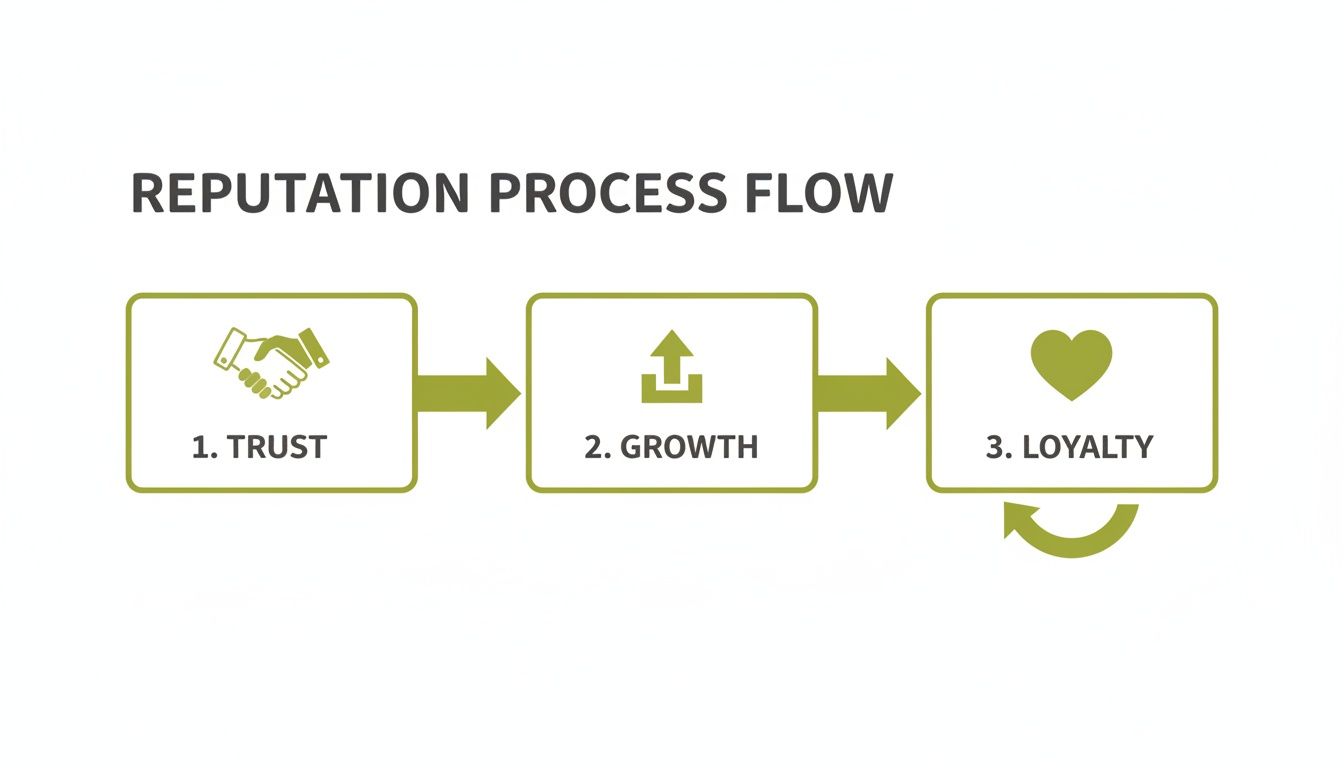
As you can see, it all starts with trust. Get that right, and you're on the path to growing your business and keeping your customers coming back.
How To Conduct Your Own Reputation Audit
Your goal here is simple: see your business through the eyes of a potential customer. This means going beyond a quick search of your company name. You need to dig into the specific places and search terms where people are actually talking about you.
I'd recommend setting up a simple spreadsheet to keep everything organised. Create columns for the source (like Google or Trustpilot), a link to the mention, the sentiment (positive, negative, or neutral), and a final column for notes on what action, if any, needs to be taken.
Here’s a practical checklist to get you started:
- Your Business Name: Search for your full name, but also any common abbreviations or even old names you might have operated under.
- Key People: Look up your CEO, founder, or any other public-facing team members. Their personal reputation is often linked directly to the business.
- Products and Services: Search for your main offerings by name to see what customers are saying about them specifically.
- Branded Search Queries: Get creative. Combine your brand name with terms like "reviews," "complaints," "scam," or even "vs [your main competitor]."
At Carlos Alba Media, we approach an audit with a newsroom mentality. Every member of our team is either a former national news journalist or has significant agency experience with global brands. We treat an audit like an investigation—we're thorough, objective, and focused on uncovering the whole story. This specialist expertise gives us a unique perspective to spot the reputational risks and opportunities that others might miss.
Analysing What You Find
Once you've gathered all this information, it's time to make sense of it. This is where you turn raw data into something you can actually use. Don't just glance at star ratings; dive into the actual comments to understand the story behind them.
Start looking for patterns. Are several customers mentioning the same issue, like slow delivery? Is your customer service getting consistent praise? These recurring themes are absolute gold. They give you priceless feedback that can help improve everything from your operations to your marketing.
Another key thing to look for is who owns the conversation about your brand. When you search your name, are your own website and social media profiles at the top? Or are third-party review sites and old news articles dominating the results? A major long-term goal is to control what people see on that first page of Google.
The insights you pull from this audit are the foundation for your entire strategy. To see how we use this information to build powerful brand stories, you can explore the services offered by Carlos Alba Media.
Think of this initial audit as your "before" photo. It’s the benchmark you'll use to measure the success of all your future efforts, making sure your strategy is focused, effective, and delivering real, positive change for your business.
Building a Resilient Brand Narrative
Waiting for a negative comment to pop up before you do anything is like trying to build a dam after the flood has already started. The best kind of reputation management for small business isn’t about frantically putting out fires; it's about proactively building a brand story so strong and positive that it can easily weather the occasional storm. This is your chance to go on the offensive, shaping the narrative before someone else does it for you.
Think of this strong narrative as your buffer of goodwill. It’s the collection of positive, authoritative content that dominates the first page of search results when someone looks up your business name. When a potential customer Googles you, this is what they find, cementing your credibility long before a stray negative review ever crosses their screen. It’s all about owning your digital footprint with purpose.

Getting this right takes a smart mix of content marketing and strategic PR. It means creating assets that not only show off what you know but also actively push any potential negative results further down in the search rankings. You're essentially building a fortress of positivity around your brand, one piece of high-quality content at a time.
Master Your Message with Content Marketing
Content marketing is your number one tool for telling your brand's story. It’s how you prove your expertise, share your company values, and build a real connection with your audience. For a small business, this doesn't require a Hollywood-sized production budget. It just means creating focused, genuinely helpful content on a consistent basis.
Start by thinking about the questions your customers are always asking you. What problems are they trying to solve day in and day out? Answering these through your content positions you as a helpful expert, not just someone trying to make a sale.
Here are a few high-impact content types that work wonders for small businesses:
- Insightful Blog Posts: Forget simple company updates. Write detailed "how-to" guides, share your unique take on industry trends, or offer practical solutions to common customer headaches. When optimised for search, these posts become long-term assets that keep bringing in new people.
- Compelling Case Studies: Honestly, nothing tells your story better than a happy customer. A well-crafted case study offers undeniable social proof, showing exactly how your product or service gets real results for real people.
- Authoritative Thought Leadership: Pen articles or whitepapers that offer a fresh perspective on your industry. This cements your status as an expert and is a fantastic way to earn backlinks and catch the eye of the media.
By consistently putting out this kind of content, you're not just selling; you're educating, helping, and building trust. Every single piece you create is another positive result that can rank for your brand name, reinforcing your online reputation.
Earn Credibility Through Strategic PR
While content marketing covers what you say about your business, public relations is all about getting other credible sources to talk about you. Earned media coverage—getting featured in respected publications or on broadcasts—is a powerful third-party endorsement. For a small business, a single well-placed article can be a game-changer, driving huge brand awareness and building incredible trust.
"Securing positive media coverage is an art and a science. It requires understanding what makes a story newsworthy and having the connections to get it in front of the right journalists. At Carlos Alba Media, our specialist nature comes from our team's background: everyone is either a former national news journalist or has PR agency experience working with international brands. We know how newsrooms think because we've been there. This unique insight allows us to find the stories within a business and pitch them in a way that editors and producers find irresistible, securing impactful press for clients like VisitScotland and The Johnnie Walker Experience."
This kind of specialist expertise is what makes the difference. It’s about so much more than just firing off a press release; it's about crafting a story that journalists actually want to cover.
As we've seen, some tactics are about building for the future, while others are about managing the present. The table below breaks down this difference between proactive and reactive approaches.
Proactive vs Reactive Reputation Management Tactics
| Tactic | Proactive Approach (Building Equity) | Reactive Approach (Damage Control) |
|---|---|---|
| Content Creation | Publishing expert blog posts, case studies, and thought leadership to build authority and positive search results. | Creating content specifically to address a negative story or push down a bad review in search rankings. |
| Public Relations | Securing positive press in industry publications to build third-party credibility and brand awareness over time. | Issuing press releases or statements to manage a crisis, correct misinformation, or respond to negative publicity. |
| Review Management | Systematically encouraging happy customers to leave reviews, creating a buffer of positive feedback. | Responding to negative reviews to mitigate damage and show that you are listening to customer feedback. |
| Social Media | Engaging with the community, sharing valuable content, and building a loyal following. | Monitoring for negative mentions and responding quickly to customer complaints or viral issues. |
Ultimately, a balanced strategy that incorporates both proactive and reactive tactics will provide the most resilient defence for your brand's reputation.
Create a System for Generating Positive Reviews
Your happy customers are your most powerful, and often most underused, marketing asset. Actively encouraging them to share their great experiences is one of the fastest and most effective ways to build a stellar reputation. The trick is to make it incredibly easy for them and to ask at just the right moment.
Don’t just hope for the best. A simple, automated system can bring in a steady stream of fresh, positive reviews that act as a powerful counterbalance to any negative feedback you might get.
A Simple Review Generation Workflow:
- Identify the 'Happy Moment': Pinpoint the exact point where a customer is most satisfied. This could be right after a project is successfully completed, a few days after their product arrives, or following a great customer service call.
- Automate the Ask: Use your email marketing software or CRM to automatically send a polite request for a review at that peak 'happy moment'. Keep the message short, personal, and to the point.
- Make It Effortless: Provide direct links to the review platforms that matter most to you, whether that's Google, Trustpilot, or an industry-specific site. The fewer clicks it takes, the higher the chance they'll complete it.
This proactive approach to gathering reviews creates what I like to call a 'reputational shield'. When your profiles are filled with genuine praise from real customers, the impact of a single negative comment is dramatically reduced. It’s an essential part of building a narrative that truly reflects the quality of your business.
Turning Feedback into a Growth Opportunity
Every single piece of feedback, whether it's a glowing five-star review or a frustrated one-star complaint, is a performance. It’s happening live, on a public stage, and how you react is a real-time demonstration of your brand's values for every potential customer to see.
This is where reputation management stops being a chore and becomes a chance to prove you listen, you care, and you’re committed to getting it right. A negative comment can feel like a punch to the gut, I know. But a calm, strategic response can often win over not just the unhappy customer, but also the dozens of silent observers reading the exchange. It’s a make-or-break moment for building trust.

Deconstructing the Perfect Response to Negative Reviews
Responding to a bad review is a delicate art. The goal isn't to win an argument—it's to resolve the issue and show everyone else that you're accountable. Getting defensive is the fastest way to lose all credibility. Instead, you need an empathetic, structured approach.
From my experience, the very best responses always have three core elements:
- Acknowledge and Empathise: Always start by thanking them for their feedback and acknowledging their frustration. A simple, "I'm so sorry to hear about your experience," shows you're actually listening and validates how they feel.
- Take Accountability (Without Throwing Yourself Under the Bus): You don't have to agree with every single point they've made. What you do need to do is take responsibility for their dissatisfaction. Use phrases like, "This isn't the standard we aim for," or "We're disappointed we didn't meet your expectations this time."
- Offer a Clear Path to Resolution: This is the most critical step. Take the conversation offline. This stops a public back-and-forth and proves you’re serious about fixing things. Provide a direct contact, like an email address or a phone number for a specific person.
Following this framework shows other potential customers that you take feedback seriously, even when things go wrong.
Real-World Response Examples You Can Adapt
Let's walk through a real-world scenario. Imagine a customer leaves a one-star review for your café, complaining about slow, disorganised service.
A poor, defensive response might be:
- "We were extremely busy on Saturday, and our staff were doing their best. Most of our customers understand that."
This just dismisses the customer's feelings and makes excuses. It offers no solution and makes the business look petty.
Now, let's try an effective, empathetic response:
- "Hi Jane, thank you for taking the time to share this. I'm very sorry to hear that your visit didn't meet expectations and that our service felt disorganised. That's certainly not the standard we strive for. I'd appreciate the chance to learn more and make things right. Could you please email me directly at manager@ourcafe.co.uk? I'd like to personally look into this for you. —Sarah, Manager"
See the difference? It’s personal, apologetic, and provides a clear, offline way to sort it out. It turns a public complaint into a public display of professionalism.
Don't Neglect Your Positive Feedback
It’s tempting to pour all your energy into putting out fires, but engaging with positive reviews is just as important. When someone takes the time to praise your business, they are being a brand advocate for free. Acknowledging their comment amplifies its impact and strengthens their loyalty.
At Carlos Alba Media, we see every piece of feedback as a story waiting to be shaped. Our team's specialist nature—comprised entirely of former national news journalists and agency experts who have worked with international brands—means we understand narrative control. We bring a seasoned, expert perspective to help small businesses manage these public conversations with the same care and strategy that global companies do.
Replying to positive feedback doesn't have to be a huge task. A simple, personalised thank you often does the trick.
Here are a few quick tips to make your positive responses more impactful:
- Be Specific: Mention something they brought up in their review. For example, "We're so glad you enjoyed the steak pie—it's a team favourite!"
- Reinforce Your Values: Casually drop in a brand value. For instance, "We're thrilled you found our team so helpful; we pride ourselves on friendly service."
- Encourage a Return Visit: End with a warm invitation to come back. "We can't wait to see you again soon!"
By actively managing both sides of the coin—positive and negative—you build a vibrant, engaged community around your brand. These interactions tell a powerful story of a business that is not only confident but also humble enough to listen and improve. If you’re interested in seeing how we craft these narratives, feel free to explore some of our client success stories here.
Getting Your Business Ready for a Crisis
Even the most robust proactive strategies can't make your business completely bulletproof. When it comes to a potential crisis, it’s never a matter of if, but when. The trigger could be anything from a faulty product or a major service outage to an employee’s mistake going viral or a coordinated attack on your reviews.
Trying to find an umbrella in the middle of a downpour is a terrible strategy. A business that has prepared for the worst can move through a crisis with a steady hand, minimising the fallout and often coming out the other side with its reputation intact—sometimes even stronger than before. This kind of prep is a non-negotiable part of any serious reputation management for small business.
First things first, you need to be able to tell the difference between a problem and a full-blown crisis. A single negative review is a customer service issue you can handle. A sudden flood of one-star reviews all claiming food poisoning? That's a crisis brewing. Knowing which is which dictates how you respond.
Spotting Your Biggest Reputational Threats
Every industry has its own Achilles' heel. If you run a restaurant, your biggest worries are likely health and safety scares. For a tech start-up, a data breach or server failure could be catastrophic. It's time to sit down and brainstorm all the "what if" scenarios that could genuinely hit your business.
What could realistically go wrong here? Thinking through these tough questions now, while you’re calm and clear-headed, means you can map out a considered response instead of making panicked decisions under pressure.
This foresight is more important than ever. With UK small business confidence looking shaky and owners feeling increasingly uncertain—surging from 22% to 40% recently—stability is the name of the game. A strong reputation, built on a foundation of positive exposure, is like having credit in the bank. It helps you weather these storms and maintain the customer trust you'll desperately need. You can dig deeper into this in SumUp's latest business confidence report.
Putting Together Your Crisis Comms Plan
A crisis plan doesn't have to be a dusty, hundred-page binder on a shelf. For a small business, a simple, clear guide that outlines who does what in the first few hours is far more practical. Think of it as your playbook for when things go south.
Your plan needs to nail down three core elements:
- The Internal Comms Chain: Who needs to know, and in what order? Map out a clear communication flow so key people are brought into the loop immediately. This stops internal chaos before it starts and gets everyone on the same page.
- The Designated Spokesperson: Decide now who speaks for the company. It should be one person—usually the owner or a senior leader—to keep the message consistent and controlled. They need to be cool under fire and ready to be the public face of the company.
- Drafted Holding Statements: You won't have all the answers right away, but silence is not an option. Prepare a few pre-approved "holding statements" that buy you time while you get to the bottom of things.
A good holding statement is short, empathetic, and reassuring. For example: "We are aware of the situation and are taking it very seriously. We are currently investigating the details and will share more information as soon as we have it. Our immediate priority is [e.g., the safety of our customers]."
This kind of initial response shows you're taking control without admitting fault before you have all the facts.
The Value of Having an Expert in Your Corner
When a crisis hits, speed and expertise are everything. The online world moves at lightning speed, and a fumbled response can turn a manageable problem into a brand-defining disaster. This is where getting specialist help can be a game-changer.
At Carlos Alba Media, our expertise comes from years of being on the front lines. Every single person on our team is either a former national news journalist or has agency experience working on major international brands. We don't just understand the 24/7 news cycle—we've lived it.
That background means we provide swift, senior-level advice when the pressure is on. Just as importantly, we partner with leading UK media lawyers, ensuring that our crisis management strategy is not just smart, but legally sound. In a world where institutional trust is low, having seasoned experts to guide you through a tough spot is vital for protecting the long-term health of your brand.
Your Reputation Management Questions Answered
Even with the best strategy in place, you’re bound to hit a few roadblocks. Maybe it’s a particularly nasty review that’s clearly fake, or you’re just not sure which tools are worth your time. These are the kinds of specific challenges that can throw you off course.
Let's tackle some of the most common questions I hear from business owners, with clear, practical answers to help you handle these situations like a pro.
How Can I Remove a Fake or Malicious Review?
Getting a fake review removed starts with reporting it to the platform it’s on, whether that’s Google, Trustpilot, or another site. But don't just click "report" and hope for the best.
When you submit your report, you need to point to a specific policy violation. Is it spam? Does it come from a clear conflict of interest (like a disgruntled ex-employee)? Does it contain hate speech? Be factual, stay calm, and provide any evidence you have.
While the platform investigates, you absolutely must post a professional public reply. Something simple and measured works best: "We have no record of this customer or transaction and have reported this review to the platform. We invite the poster to contact us directly to resolve this." This does two crucial things: it shows potential customers you're on top of your feedback, and it subtly flags the review as illegitimate.
For persistent or highly damaging defamatory attacks, the situation can become more complex. This is where working with a specialist team is essential. At Carlos Alba Media, every consultant is a former national news journalist or has agency experience working with international brands. This specialist expertise is why we partner with top media lawyers to explore more formal options for our clients, ensuring you have senior-level counsel when the stakes are high.
What Are Some Free Tools for Reputation Monitoring?
You don't need a huge budget to keep an eye on your online reputation. In fact, you can get a surprisingly clear picture of what’s being said about you without spending a penny.
A few free tools will give you a solid foundation:
- Google Alerts: This one’s non-negotiable. Set up alerts for your business name, your own name, and maybe your top products. You’ll get an email whenever new mentions pop up online. It’s your digital smoke detector.
- Social Mention: This is a handy tool for a quick pulse check across social media. It scours blogs, microblogs, and social sites to see who's talking about you. It even gives a rough sentiment analysis—positive, negative, or neutral—which is great for a snapshot view.
- Manual Checks: Honestly, don't underestimate this. Just get into the habit of manually checking your key profiles once a week. Take five minutes to look over your Google Business Profile, your Trustpilot page, or any industry-specific review sites.
Paid tools definitely offer more detailed analytics, but these free options are more than enough to build an effective monitoring habit for any small business just starting out.
How Often Should I Ask Customers for Reviews?
The secret to a steady stream of positive reviews isn't about how often you ask, but when you ask. Timing is everything.
You want to make the request a natural part of your customer's journey. The perfect moment is shortly after they’ve had a win – a few days after their product arrives and they love it, or right after you’ve successfully completed a service for them. The positive experience is still fresh in their mind.
Think consistency over intensity. A single, polite, and personalised email or a simple prompt on a post-purchase "thank you" page is far more effective than hounding people. Your best bet is to automate this. Use your CRM or email platform to trigger a review request after a positive milestone. This ensures a consistent flow of fresh reviews, which is vital for reputation management for small business, and it saves you from a ton of manual work.
Ready to take control of your brand's narrative with the help of seasoned media experts? Carlos Alba Media provides senior-level PR and digital marketing counsel without the big agency overheads. Get in touch today to see how we can help your business be seen, trusted, and chosen.
Published via the Outrank app