

Let's be honest, reputation management isn't just about PR spin or burying bad news. It's the ongoing, hands-on process of shaping how the world sees your brand, whether you're a person, a start-up, or a global corporation. It’s a mix of public relations, savvy marketing, and smart SEO all working together to control the story told about you online.
What Is Reputation Management Really About?

Think of your business's reputation as your digital shop window. Every single review, news article, social media comment, and Google search result is part of that display. What people see when they glance in determines whether they step inside or keep on walking.
So, reputation management is simply the art of curating that window display. It’s a deliberate, continuous strategy for influencing what people see, think, and feel about you. It's a common mistake to see it as just a fire-fighting exercise—something you only do when a negative story pops up. While crisis management is definitely part of the toolkit, real reputation work is about being proactive, not just reactive.
Beyond Damage Control
At its heart, this is all about building and protecting trust over the long haul. It's the difference between letting random online chatter define your brand and actively telling your own story, on your own terms.
To get this right, you need to bring together several core components. Modern reputation management is a multi-faceted discipline, far more than just responding to reviews. It's a strategic blend of monitoring, creating, engaging, and optimising.
Here’s a quick breakdown of what a complete strategy looks like:
The Four Pillars of Modern Reputation Management
| Pillar | Core Function | Key Activities |
|---|---|---|
| Monitoring & Listening | Keeping an ear to the ground | Tracking brand mentions, keyword alerts, social media conversations, and competitor activity. |
| Content & PR | Building a positive narrative | Creating expert articles, case studies, press releases, and securing positive media coverage. |
| Review & Social Management | Engaging with your audience | Responding to all reviews (good and bad), managing social media comments, and fostering community. |
| Search Engine Optimisation (SEO) | Controlling your digital footprint | Pushing positive, brand-owned content to the top of Google search results. |
Each pillar supports the others, creating a strong, resilient brand presence that can weather the inevitable bumps in the road.
"Your brand isn’t what you say it is. It’s what Google says it is." This popular saying nails it. In a world where 95% of people read reviews before buying anything, your online presence is your reality.
The Value of Expert Insight
Managing all this effectively requires a deep understanding of the media, public perception, and how digital channels actually work. This is precisely where specialist expertise makes all the difference.
At Carlos Alba Media, our team is made up entirely of former national news journalists and senior professionals with agency experience working with international brands. This background gives us a unique edge. We don't just know marketing theory; we know how stories are built, how journalists tick, and what actually shapes public opinion. This insider's perspective lets us craft strategies that build genuine, lasting credibility for your business, both in the UK and internationally.
Why Your Reputation Is a Quantifiable Asset
For a long time, reputation was seen as a vague, 'soft' business metric. It felt important, sure, but you couldn't really pin it down on a balance sheet. That way of thinking is completely out of date. Today, your brand’s reputation is a hard, quantifiable asset with a direct and measurable impact on your company's financial health, influencing everything from investor confidence to customer loyalty.
Think of it this way: a business with a stellar reputation for quality and ethics can command higher prices and attract top talent far more easily. On the flip side, a company hit by negative reviews or a public crisis will watch its value plummet as customers and investors lose faith. This isn't just theory; it’s a financial reality that plays out in boardrooms and on stock exchanges every single day.
For UK businesses, especially start-ups hunting for funding or SMEs in regulated sectors, this is the most critical asset you have. Investors don't just back a business plan; they back the people and the public perception behind it. A solid reputation is your best insurance policy, safeguarding your market position and your potential for future growth.
The Financial Link Between Perception and Profit
The connection between what people think of you and what your business is worth has never been clearer. In the UK, corporate reputation is a massive driver of financial performance. In fact, recent analysis shows a company's reputation now accounts for 29% of the total market value of the FTSE 350. That’s a figure equivalent to a staggering £730 billion.
This isn't a static number, either. It grew by £11 billion in just one year, which shows just how much financial weight stakeholders now place on a company's image. You can explore the detailed UK reputation valuation report to see the full financial breakdown for yourself.
But the rewards aren't shared equally. While the vast majority—95% of UK-listed companies—are gaining value from a positive reputation, a small but significant 5% are actively losing money because of it. These firms have seen around £9 billion in value simply vanish, eroded by negative perceptions around their management, governance, and how they treat people.
Building Trust with Expertise
Grasping this financial reality is the first step. Actively managing it, however, takes specialist knowledge. It’s about so much more than marketing; it’s about understanding narratives, media cycles, and the subtle shifts in public sentiment.
This is exactly where the team at Carlos Alba Media comes in. Our background gives us a unique edge.
Everyone who works for Carlos Alba Media is a former national news journalist or has agency experience of working with international brands. This isn't just a talking point; it's our core strength.
We’ve sat on the other side of the desk. We know what makes a story stick, what turns a minor issue into a major headline, and how to communicate with authority and transparency when the pressure is on. This insider knowledge allows us to build and protect your most valuable asset—your reputation—with an insight that generic marketing agencies just can't offer. We don't just manage perceptions; we understand how they’re formed and know how to shape them for long-term financial gain.
The Four Core Components of Reputation Management
Good reputation management isn’t a single action, but a system of four connected parts working together. It’s a bit like looking after a classic car. You've got to listen to the engine, keep the paintwork flawless, pay attention to how it handles, and make sure people see it shine on the road. If you neglect one part, the whole experience suffers.
To really get what reputation management is, you need to break it down into these four areas. Each one needs its own expertise, but they all have to work in sync to build and protect your brand's good name. This is where a team with a mix of skills, like ours at Carlos Alba Media, really comes into its own. Our specialists – a blend of former national news journalists and seasoned agency pros with experience of working with international brands – bring deep experience to each of these crucial pillars, creating a strategy that’s both cohesive and incredibly effective.
1. Monitoring and Listening
You can't steer a conversation if you don't even know it's happening. Monitoring is the bedrock of everything else; it’s your early warning system. It means using specialist tools to keep an ear to the ground, tracking every mention of your brand, your key people, your products, and even your competitors across the entire web.
But this isn't just about spotting bad comments. It's about gathering intelligence. Who’s talking about you? What are they really saying? And where are these conversations taking place? Is it on social media, in the news, buried in a forum, or popping up in Google reviews? Proper monitoring gives you a live feed of public opinion.
For instance, a FinTech start-up we work with might set up alerts for their brand name paired with terms like "security flaw" or "complaint". This allows them to jump on a potential problem long before it spirals into a crisis, protecting both their customers' trust and their all-important regulatory standing.
2. Proactive Public Relations
While monitoring is often about reacting, proactive PR is about writing the story yourself. It’s the art of shaping your brand’s narrative through powerful storytelling and getting it into the right hands in the media. This is where you switch from defence to attack, actively building the positive reputation you want people to see.
This goes way beyond just firing out a press release and hoping for the best. At Carlos Alba Media, our background as former national news journalists gives us a real edge. We know what makes a story stick because we used to be the gatekeepers deciding what got published.
We know how to find the right angle for a story, pitch it to our contacts, and land the kind of media coverage that builds genuine authority and trust—not just a quick flash of attention.
Take a renewable energy firm that wants to be seen as a true innovator. Instead of just announcing a new product, a smart PR strategy would look something like this:
- Pitch an exclusive story to a major business publication, focusing on the technology's real-world impact.
- Position the CEO as a thought leader by writing opinion pieces for key industry journals.
- Line up broadcast interviews to explain the benefits to a much wider audience in simple, compelling terms.
This kind of coordinated push builds a rich, positive story that sticks in people’s minds and defines the brand on its own terms.
3. Engagement and Review Management
In a world where 95% of consumers read reviews before they buy anything, talking directly with your customers simply isn’t optional. This part of the job is all about managing your presence on review sites like Trustpilot or Google Reviews, as well as your social media channels.
Real engagement means responding to all feedback—quickly, professionally, and with a human touch. A glowing review deserves a genuine thank you, which encourages more of the same. A negative review, on the other hand, is a golden opportunity. A considered response that acknowledges the problem and offers a fix can turn an unhappy customer into a fierce supporter. More importantly, it shows everyone else watching that you actually care.
This is a specialist skill. It takes a cool head and a strategic mindset, especially when you’re facing criticism in a public forum. The aim isn’t to win an argument; it’s to show you’re accountable and committed to getting it right.
4. Reputation SEO
The final piece of the puzzle is Search Engine Optimisation (SEO). It doesn't matter how many positive articles you get published if the first thing people see when they Google your business is a negative story or an old forum thread from five years ago. Reputation SEO is the technical work of controlling what appears on your search engine results page (SERP).
The whole game here is to create and promote high-quality, positive content that you own, pushing it up the rankings so it shoves any negative results off the first page. This can involve:
- Writing optimised blog posts that showcase your expertise.
- Building out comprehensive, detailed profiles on professional networks.
- Securing positive mentions and links from high-authority websites.
- Publishing compelling case studies that prove your value.
Think of it as buying up digital real estate. The more positive assets you own on page one of Google, the less space there is for anything that could damage your reputation. It's a long-term play, but it’s what locks in all the hard work from your PR and engagement, ensuring your digital shop window is always looking its best.
How Customer Reviews Shape Your Brand Story
In a world buzzing with ads, your most convincing marketers are your own customers. Gone are the days when a slick advertising campaign was all it took to shape public opinion. The conversation has moved online, and the genuine voices of real people—shared through reviews—now carry far more weight than any brand's carefully crafted message.
This isn't just a trend; it's a fundamental shift in how trust is built. We're hardwired to trust our peers. When we're deciding where to eat or what to buy, we instinctively look for guidance from people who've been there before. The internet has simply amplified this, putting millions of opinions right at our fingertips. Suddenly, a great customer experience isn't just a bonus—it's the very foundation of a brilliant online reputation.
The Power of Peer-Generated Content
The sheer volume of online feedback can make or break a business. In the UK, online reviews have completely changed the game for consumers, with peer-to-peer content now easily trumping traditional marketing. As trust in big corporations has dipped, people have turned to user-generated content for the real story.
Just to give you an idea of the scale we're talking about, one benchmark report analysed a staggering 31 million reviews from over 226,500 business locations. That’s a colossal amount of public feedback shaping how brands are perceived every single day. You can find more insights into UK consumer behaviour and the impact of reviews here.
This visual breaks down the different threads that have to be woven together to manage this complex environment.
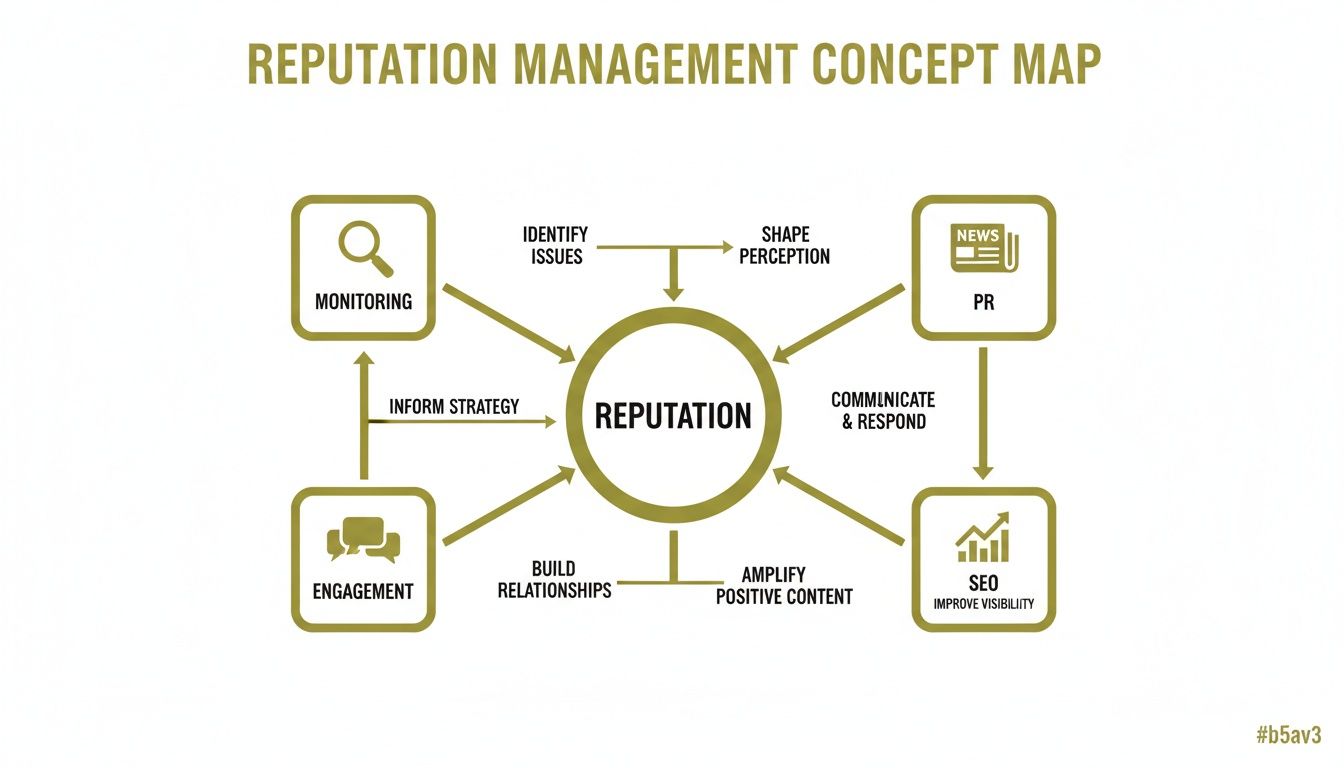
As the map shows, true reputation management is a blend of monitoring, PR, SEO, and direct engagement—all working together to steer your brand's narrative.
Transforming Feedback into Opportunity
Actively managing your reviews isn't about trying to censor criticism. It's about joining the conversation that's already happening about you. Every single piece of feedback, good or bad, is a gift—an insight into your business and an opportunity to show what your brand really stands for.
A thoughtful response to a negative review can often be more powerful than another five-star rating. It shows potential customers that you listen, you care, and you’re committed to putting things right. That sort of transparency builds a level of trust that no advert can buy.
Handling this properly takes a specific skillset, blending smart marketing with a deep understanding of public communication. At Carlos Alba Media, our team's background is our biggest asset. Everyone who works for us is a former national news journalist or has agency experience of working with international brands. This gives us a unique perspective on managing public dialogue.
We know how to turn a customer complaint into a public win and how to amplify glowing testimonials to build an authentic story around your brand. Take a look at some of the successful client campaigns we have managed to see this in action. By strategically encouraging and responding to reviews, you’re not just passively collecting feedback—you’re actively shaping your brand's reputation alongside the people who matter most: your customers.
Navigating a Crisis Before It Escalates

A full-blown reputation crisis rarely just happens. It usually starts life as a small, manageable problem that, when ignored or fumbled, spirals out of control. The secret to professional reputation management isn't just about damage control; it's about having a plan long before you need one.
It’s a bit like fire safety. Proactive planning means installing smoke alarms, checking the batteries, and making sure everyone knows the escape route. Reactive management is desperately looking for the fire extinguisher while the room fills with smoke. One is a calm, strategic process. The other is a high-stakes panic.
With the right preparation, a crisis doesn't have to turn into a catastrophe. Handled correctly, it can even become a moment to prove your company’s character and earn a deeper level of trust.
The Foundations of a Solid Crisis Plan
A robust crisis communications plan is the single most important shield your business can have. It’s your playbook, pre-agreed and ready to go, allowing your team to respond with speed, clarity, and confidence instead of trying to make things up under immense pressure.
An effective plan always covers these core elements:
- The Crisis Team: Who has the authority to speak for the company? This should be a small, senior group, including leadership, legal, and your comms lead or agency.
- Monitoring Protocols: How will you spot trouble early? This means having a system of alerts for keywords and mentions that could signal a gathering storm.
- Prepared Holding Statements: You won't know all the facts instantly, but saying nothing is often the worst move. Pre-drafted statements let you acknowledge an issue quickly, confirm you're on the case, and promise to be transparent.
- Communication Channels: How will you get your message out to customers, staff, and investors? Define the primary channels you'll use, from social media updates to direct emails.
Getting this groundwork done is what separates a contained incident from a public relations disaster. It ensures your first move is a measured and authoritative one.
Why Speed and Transparency Are Non-Negotiable
When a crisis breaks, the first few hours are everything. A quick response shows you're taking the situation seriously, while being transparent builds the credibility you'll desperately need. Trying to hide or downplay a problem almost never works; the truth eventually gets out, and the cover-up often causes more damage than the original issue.
A swift, honest, and accountable response can turn detractors into advocates. It demonstrates that your organisation values integrity over image, which is a powerful message that resonates deeply with modern consumers.
Accountability is the third essential piece. This means owning any mistakes, clearly outlining the steps you're taking to fix the problem, and explaining how you’ll stop it from happening again. This approach defuses anger and helps shift the conversation from blame to resolution. You can see how expert guidance makes this possible in some of our client success stories.
The Value of Newsroom Experience Under Pressure
This is where specialist expertise really shows its worth. Handling a media storm requires more than just good communication skills—it demands a deep, instinctual understanding of the news cycle, what journalists need, and how a story can twist and turn.
At Carlos Alba Media, our unique strength is our team. Everyone who works for us is a former national news journalist or has agency experience of working with international brands. We haven't just read about media crises in a textbook; we've lived them from the inside.
We know exactly what it feels like to be on the other end of that phone call, chasing a story against a tight deadline. This background gives us a priceless advantage. We can anticipate a reporter’s next question, frame a response that the press will actually use, and prepare your spokespeople to face the toughest interviews with confidence. When the stakes are at their highest, that newsroom insight is what protects your brand.
Choosing the Right Reputation Management Partner
Picking an agency to handle your brand’s reputation is one of the biggest calls a business can make. The right partner does far more than just track brand mentions online; they become a strategic part of your team, offering seasoned advice when the pressure is on. This means you have to look past the usual marketing fluff to find genuine, specialist expertise.
Plenty of agencies can talk the talk, but real reputation management requires a pretty unique mix of skills. You need a partner who can fuse the art of public relations with the science of digital marketing. They need to be just as skilled at pitching a story to a journalist as they are at digging into search engine data, because these days, the two are completely connected.
The Specialist Advantage
This is where the actual background of the team you hire really comes into play. At Carlos Alba Media, we bring something different to the table because our team is built differently. Every single person who works for us is a former national news journalist or has agency experience of working with international brands.
That’s not just a nice-to-have, it’s our core strength. We haven’t just studied how the media works; we’ve lived it. We know what it's like inside a newsroom, how a journalist thinks, and what it takes for a small issue to blow up into a front-page story. That insider perspective gives us a massive head start when it comes to shaping a story, spotting media risks, and managing a crisis with a cool head.
When your reputation is on the line, you need a team that has been in the hot seat before. Newsroom experience provides an instinct for communication that simply can't be taught—it has to be lived.
Key Questions to Ask a Potential Partner
When you're checking out a potential agency, you need to ask the right questions to get past the sales pitch and understand what they can really do.
Here are a few things you should always ask:
- What's your team's direct experience with crisis communications? Get them to share specific, real-world examples of how they’ve helped a client navigate a tough spot.
- How do you connect PR work to actual business goals? A good partner won't just talk about "getting coverage." They'll explain how their efforts will positively affect your bottom line.
- Who, specifically, will be working on our account? Make sure you'll have a direct line to the senior experts, not just a junior account manager.
- How will you measure success? Look for clear, well-defined KPIs that go beyond vanity metrics. They should be focused on things like search engine rankings, sentiment analysis, and even lead generation.
A strong partnership is all about trust, expertise, and working towards the same goals. To see how we put this into action, you can learn more about what we do and our specialist services. Choosing the right partner is an investment in experience you can count on.
Frequently Asked Questions About Reputation Management
Even when the concept is clear, the practical side of reputation management can feel a bit fuzzy. It’s completely normal for business owners to have questions about how it all works in the real world.
Let's clear up some of the most common questions we get asked by clients.
How Long Does It Take to Fix a Bad Reputation?
Honestly, there's no magic wand. The timeline really depends on the scale of the problem you're facing.
If it's a relatively minor issue – say, a small cluster of bad reviews – you could start seeing a real difference in three to six months with a consistent effort. But for bigger headaches, like recovering from a major PR crisis or dislodging stubborn negative search results, you need to be in it for the long haul. We're often talking about a sustained campaign over 12 months or more. True, lasting change comes from a steady, multi-pronged strategy that blends SEO, positive content creation, and smart PR.
Can We Just Do This In-House?
For the day-to-day stuff, absolutely. Keeping an eye on brand mentions or responding to happy customers on review sites is something your team can, and should, handle. It's a fantastic way to keep your finger on the pulse of customer sentiment.
But when you're facing a serious strategic challenge—like navigating a media crisis, launching a proactive PR campaign, or tackling a complex SEO reputation issue—that's when a specialist agency is worth its weight in gold. A dedicated partner brings a depth of strategic insight that’s incredibly difficult to build from scratch.
This is where deep experience truly makes a difference. At Carlos Alba Media, for example, our team is our unique advantage. Every single one of us is a former national news journalist or has agency experience of working with international brands. That kind of battle-tested, newsroom perspective is invaluable when the pressure is on.
What's the Actual Difference Between PR and Reputation Management?
It helps to think of it like this: Public Relations (PR) is one of the most important tools in your workshop, but reputation management is the entire workshop.
PR is mostly about offence. It's the proactive work of building a positive image through great storytelling, positioning your leaders as experts, and securing positive media coverage. It’s your megaphone for shouting about the good stuff.
Reputation management is the bigger picture. It’s the full 360-degree strategy that includes PR but also weaves in brand monitoring, review management, crisis planning, and technical SEO. It’s about controlling the entire conversation around your brand, good and bad. It's both your offence and your defence, all working together to protect your good name.
Ready to protect and grow your most valuable asset? The team at Carlos Alba Media brings together newsroom instinct and digital know-how to build reputations that stand the test of time. Get in touch today to discuss your strategy.
Produced via Outrank tool