

Reputation management is all about actively shaping how the public sees your brand, a person, or your entire organisation. It’s a strategic blend of public relations, search engine optimisation (SEO), and top-notch customer service, all working together to build a strong, trustworthy online presence.
The Digital Handshake Your Business Must Master
Think of your online reputation as a digital handshake. It’s often the very first impression a potential customer has of you, and it’s fundamental to building the lasting trust you need with clients, partners, and investors. In an age where one bad review can seriously stunt your growth, managing your reputation isn’t just a task for the PR team anymore—it's a core business function that directly hits your bottom line.
At its heart, this is the art and science of listening to what people are saying about you, joining those conversations where it makes sense, and proactively guiding the narrative everywhere it appears. That includes Google search results, online review sites, social media chatter, and, of course, news articles.
More Than Just Good PR
It’s a common mistake to think reputation management is just another name for public relations. While PR is a crucial piece of the puzzle—focused on creating positive stories—reputation management is a much broader and more defensive discipline. It’s about protecting the brand value you’ve poured so much effort into building.
Getting this right demands a specific kind of expertise. Here at Carlos Alba Media, our specialist nature comes from our team's unique background: everyone who works for us is a former national news journalist or has agency experience working with international brands. This background gives us a unique edge. We know exactly how stories are constructed and taken apart in the public sphere, allowing us to build compelling, credible narratives that both protect and enhance a brand’s reputation.
Why It’s a Financial Imperative
A solid reputation isn't just a nice-to-have; it's a powerful financial asset. The 2025 UK Reputation Valuation Report drove this point home, revealing that corporate reputation now accounts for a massive 29% of the FTSE 350's total market value—a figure worth an eye-watering £730 billion.
This isn't just about good feelings; it proves that a well-managed reputation is a financial engine, not a marketing expense. The same report found that 5% of UK-listed firms lost a combined £9 billion in value due to perceptions of mismanagement, while the other 95% saw gains from strong stakeholder confidence.
A strong reputation is built on consistency and authenticity. It’s the cumulative result of every action your company takes, every product it sells, and every interaction it has. It’s the ultimate currency of trust.
For any UK business, whether you're a scrappy start-up or a well-established SME, getting a handle on this is essential. The right strategy, carried out by experienced professionals, can turn your reputation from a point of weakness into your most durable asset. It ensures that when people look you up, they find a story worth believing in, as many of our clients can confirm. Ultimately, it’s how you are seen, trusted, and chosen over the competition.
Building Your Reputation Management Strategy
A great reputation doesn't just appear out of thin air. It’s built, piece by piece, with a deliberate strategy behind it. Think of it like constructing a sturdy building – you need a solid foundation, strong support beams, and a well-thought-out plan for weathering any storm. In the world of brand perception, those elements are the core components of your reputation management plan.
Every piece works together. Good monitoring tells you what stories your PR team needs to tackle. Strong Reputation SEO makes sure those positive stories are the first thing people see when they look you up. It’s all part of an interconnected system designed to protect and grow your brand’s most valuable asset.
This visual captures the essence of it all: a continuous cycle of monitoring, engaging with, and influencing public perception.
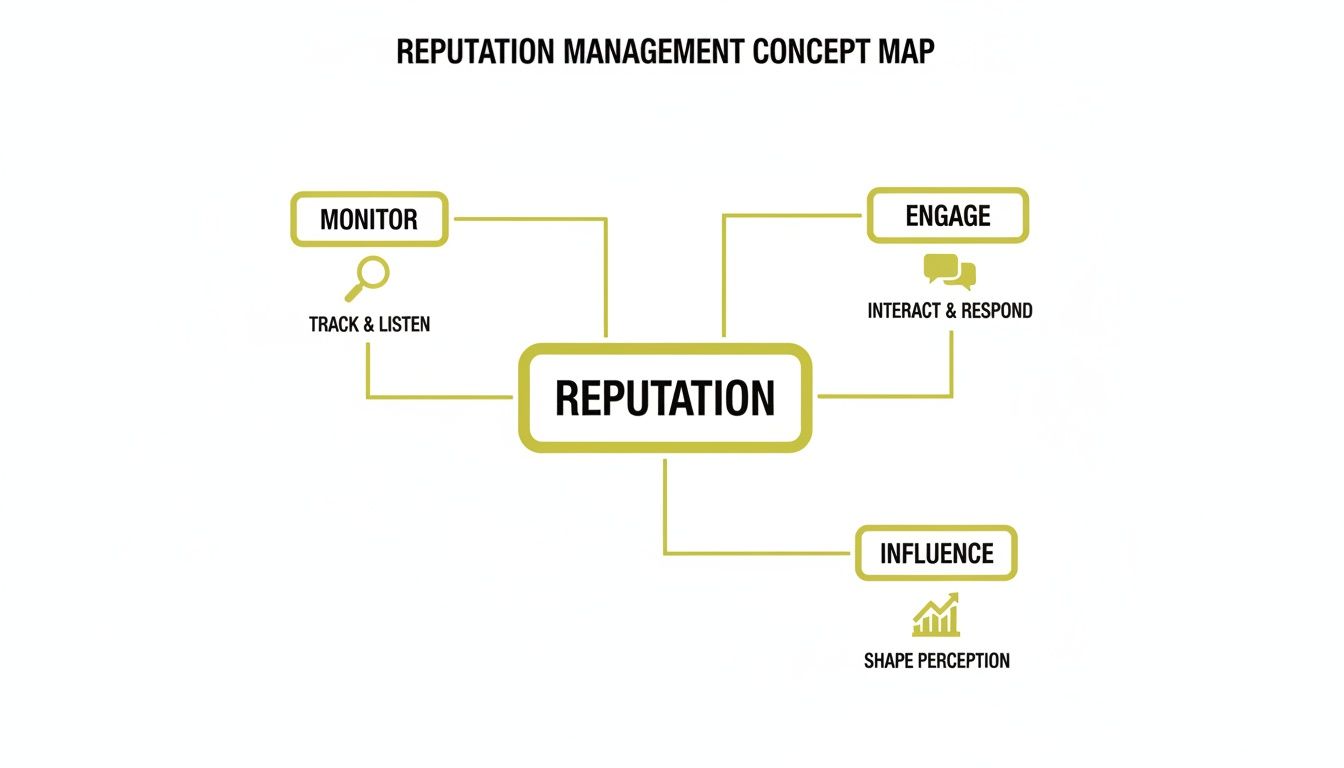
Ultimately, a winning strategy isn't about one-off actions. It’s a unified effort to control your brand’s narrative.
Proactive Monitoring: Listening to the Digital Chatter
The first step in any good strategy is simply to listen. You can't possibly manage conversations if you don't even know they're happening. Proactive monitoring means using specialised tools to keep track of every mention of your brand, your key people, and your products across the entire web—from social media and review sites to news articles and obscure forums.
But this isn't just about playing defence and spotting negativity. It's about gathering intelligence. What are customers consistently praising? What are their common frustrations? Catching these trends early means you can fix problems before they blow up and lean into what people already love.
There's a reason monitoring is so critical. The UK's enterprise internet reputation management market is projected to be worth USD 60.8 million in 2025, and the monitoring segment alone makes up a massive 43.2% of that. This just shows how seriously businesses are taking real-time oversight to defend against the kind of digital threats that can shatter trust in an instant. You can dig deeper into these market trends in the full market analysis from Future Market Insights.
Strategic Public Relations: Actively Telling Your Story
If monitoring is your defence, then strategic PR is your offence. It’s about proactively shaping your own narrative by creating and sharing positive, compelling stories that define your brand on your terms. This goes way beyond just firing out the odd press release. It's about building real relationships with the media and crafting stories that are genuinely newsworthy.
This is where specialist expertise becomes a real game-changer. At Carlos Alba Media, our expertise is rooted in our team's unique composition: every single member is a former national news journalist or has deep agency experience working with international brands. We don't just understand the media; we come from it. That insider's perspective lets us shape stories that journalists actually want to cover, building a powerful 'reputational shield' of positive coverage that makes your brand far more resilient.
A well-executed PR campaign doesn't just get you a headline. It builds a reservoir of goodwill and credibility that you can draw upon when things get tough. It’s a proactive investment in your brand’s future.
Review and Social Engagement: Managing Direct Feedback
Your customers are talking to you – and about you – all the time on platforms like Google Reviews, Trustpilot, and across social media. Engaging in those conversations isn't optional anymore. This part of your strategy is all about:
- Responding Promptly: Acknowledging all feedback, good or bad, shows you’re listening and that you care about the customer experience.
- Resolving Issues Publicly: When you turn a negative review into a positive outcome by offering a public solution, you demonstrate outstanding customer service for everyone to see.
- Encouraging Positive Reviews: You need a system for asking your happy customers to share their experiences. This helps build a strong foundation of positive social proof that speaks for itself.
Reputation SEO: Controlling Your Search Results
For most people, what appears on the first page of Google is your reputation. Full stop. Reputation SEO, sometimes called Search Engine Reputation Management (SERM), is the technical work of influencing those search results. The goal is simple: make sure that when someone searches for your brand, the first things they find are positive, accurate, and controlled by you.
We do this by creating a wealth of high-quality content—optimised blog posts, official company profiles, positive news articles, case studies—and then using SEO techniques to push them to the top of the rankings. This strategy effectively shoves any negative or irrelevant content down to page two or three, where very few people will ever see it.
Crisis Readiness: Preparing for Turbulence
No matter how solid your reputation is, a crisis can always hit. The final, crucial component of any strategy is having a plan in place before you need it. A crisis readiness plan is a detailed playbook for how your organisation will respond if a significant negative event occurs.
It defines clear roles and responsibilities, establishes a chain of command, and contains pre-approved messaging and communication protocols. Having this framework ready means you can respond swiftly, transparently, and effectively, which minimises the damage and helps you rebuild trust faster. It’s the fire escape you build long before you ever smell smoke.
How Online Reviews Define Your Brand Story
Think of online reviews as the modern-day word-of-mouth, but on a massive scale. They’ve become the single most powerful trust signal for anyone considering your business. This isn't a passive part of your online presence anymore; reviews are active, living chapters of your brand's story, written by the people who matter most: your customers.
Every single piece of feedback, whether it’s a glowing five-star rating or a critical one-star complaint, adds to the public narrative that shapes what people think of you. It’s what drives their decision to either click ‘buy’ or go to a competitor.
In short, platforms like Google, Trustpilot, and other industry-specific sites are the new front lines where reputations are either built or broken. A steady stream of positive reviews can be your best marketing tool, hands down. On the flip side, just a few unanswered negative comments can plant seeds of doubt that are incredibly hard to root out. Managing this ongoing conversation is a huge part of what is reputation management.

This is particularly true for businesses in hospitality, e-commerce, and professional services. For them, a proactive review management strategy isn’t just a nice-to-have—it’s absolutely essential for survival and growth.
The Psychology Behind Customer Reviews
So, why do reviews carry so much weight? It all comes down to a simple human truth: we trust other people far more than we trust slick advertisements. When a potential customer is on the fence, an authentic story from a real person gives them the social proof they need to feel confident in their choice. The shift away from traditional marketing has been nothing short of dramatic.
The numbers don't lie. Trustpilot recently flew past 300 million reviews, and a staggering 89% of UK consumers now check online ratings before making a purchase. Reviews have well and truly overtaken old-school media and brand ads as the ultimate signal of trust. As faith in big institutions wanes, peer opinions on everything from product quality to customer service have become the real drivers of buying decisions.
This is exactly why every single review demands your attention. It's a direct line to your market, offering priceless feedback on what you’re doing right and, just as importantly, where you need to step up your game.
Turning Feedback into a Strategic Asset
A smart review management strategy is about so much more than just chasing a five-star average. It’s about engagement, recovery, and gathering intelligence. At Carlos Alba Media, our specialist approach is shaped by our team's unique background. As former national news journalists and agency professionals with experience working with international brands, we know how to manage a public narrative with precision and authenticity.
A negative review isn’t a threat; it’s a public opportunity to demonstrate outstanding customer service, transparency, and a genuine commitment to getting things right.
Think about it. A thoughtful, professional response to a complaint can often build more trust than a dozen generic positive reviews. It shows potential customers that if something does go wrong, you’ll be there to sort it out. You’re turning a moment of potential conflict into a powerful demonstration of your company's values.
An Actionable Strategy for Review Management
Building a solid system for managing reviews doesn't have to be complicated. It boils down to a few key actions:
- Actively Encourage Feedback: Don't just sit back and wait. Put a simple, non-intrusive process in place to ask your happy customers to share their experiences. This helps build a strong foundation of positive sentiment that can weather the occasional bad day.
- Respond to Everything: Make a point to acknowledge both positive and negative comments quickly. Thank customers for their praise and address any criticism with empathy and a clear plan to make things right.
- Take Conversations Offline: For tricky or sensitive issues, offer to resolve the problem directly through a phone call or email. This shows you’re taking it seriously while keeping the messy details out of the public eye.
- Analyse the Data: Treat your reviews like a goldmine of business intelligence. Look for patterns. Are customers constantly praising a specific team member? Is there a recurring complaint about your delivery process? Use these insights to make real, meaningful improvements to your operations.
By treating every review as a vital conversation, you can take control of your brand’s story. This proactive approach ensures your online reputation genuinely reflects the quality of your business and builds the trust you need to thrive. You can see how we've helped brands build their narratives in some of our favourite success stories.
Winning the Battle for Page One with Reputation SEO
Think of Google's first page as your digital shop window. When a potential customer, a new investor, or a future business partner looks you up, what do they see? Are they greeted by glowing reviews and professional, well-crafted stories? Or is their first impression soured by a misleading news article, a few angry comments, or just plain old outdated information?
This is where reputation SEO comes into its own. It’s a deliberate strategy for curating that digital shop window, making sure the story people find online is the one you want them to read. It's one of the most powerful tools in the modern business toolkit.

The idea behind it is simple but incredibly effective. You create and promote a flood of positive, high-quality content that you own, alongside positive stories from third parties. This new material effectively swamps the search results, pushing anything negative or irrelevant further down the rankings where it’s unlikely to be seen. Given that the first result on Google gets a whopping 27.6% of all clicks, and page two gets next to none, winning that top spot is everything.
Building Your Digital Fortress
Reputation SEO isn't about trying to delete negative content—in most cases, that’s simply not possible. Instead, it’s a strategy of suppression through promotion. You’re building a fortress of positive assets so strong that it completely dominates the search results for your brand name.
What do these assets look like?
- Your Corporate Website: This must always be the number one result for your name. No exceptions.
- Official Social Media Profiles: Your company’s LinkedIn, X (formerly Twitter), and Instagram pages are powerful properties you directly control.
- High-Quality Blog Content: Writing insightful articles that help your audience positions you as a genuine expert in your field.
- Positive Media Coverage: Landing articles in respected publications is third-party validation at its finest.
- Official Press Releases: These often rank for brand searches and give you a direct line to controlling key announcements.
Every piece of positive content you publish acts like a digital shield, making your brand’s online reputation tougher and more resilient to attack.
The Journalist’s Edge in Reputation SEO
This is where working with a specialist agency like Carlos Alba Media gives you a serious advantage. Our specialist expertise comes from the fact that every member of our team is either a former national news journalist or has deep agency experience working with international brands. We don't just know SEO; we understand what makes a story believable and engaging to both Google’s algorithms and, more importantly, to real people.
Our newsroom background means we excel at creating content that is genuinely authoritative and newsworthy. That’s vital because Google is built to reward high-quality, trustworthy information above all else.
Content created with a journalist's mindset isn't just optimised for keywords; it's engineered for credibility. That's the secret to creating assets that don't just rank well but also build real trust with your audience.
We know how to build narratives that editors and reporters will actually want to publish. This generates the kind of powerful, positive backlinks and brand mentions that form the bedrock of any successful reputation SEO campaign.
Your First Steps to a Stronger Search Footprint
So, where do you begin? Start with a simple audit. Google your brand name, your CEO’s name, and your main products or services. Take a hard look at that first page. Is what you see positive, accurate, and on-message?
If the answer is no, it’s time to act. A good first step is to make sure all your company-owned profiles are fully filled out, optimised, and active. From there, you need a content plan that consistently produces the positive material needed to define your brand’s story online. By taking control of your search results, you take control of that all-important first impression.
Navigating Turbulence with a Crisis Communications Plan
In business, a crisis doesn't knock politely; it kicks the door down. A single ill-judged tweet, a product fault, or an internal mistake can erupt into a full-blown reputational firestorm in a matter of hours. The secret to getting through it isn't trying to outrun the flames—it's having your fire escape planned long before you even smell smoke. That’s the whole point of a crisis communications plan.
Think of it as your company's playbook for handling a disruptive event that threatens your brand. It’s what shifts your team from panic mode to prepared, decisive action. The aim is always to control the story, hold onto the trust you've built with stakeholders, and limit the damage by responding quickly, openly, and with empathy. Without a plan, you're just making it up as you go along in the middle of a hurricane.
The Anatomy of a Modern Crisis
Crises today are a different beast. They move at the speed of social media, amplified by a news cycle that never sleeps. The definition of a "crisis" has also expanded massively. It could be anything from:
- Social Media Backlash: A marketing campaign that misses the mark or an off-hand comment that goes viral for all the wrong reasons.
- Operational Failures: Serious supply chain problems, product recalls, or major service outages that leave customers stranded.
- Data Breaches: The theft or loss of sensitive customer data, which can shatter trust in an instant.
- Employee Misconduct: When the actions of a staff member—whether senior or junior—clash with your company’s values and become public knowledge.
Building Your Crisis Response Framework
A solid crisis plan is more than just a document; it's a complete framework. It needs to lay out clear roles, responsibilities, and the exact steps to take the moment a threat emerges. At a minimum, every effective plan needs a dedicated crisis response team, a clear chain of command for making tough decisions, and pre-drafted messages that can be quickly adapted and rolled out.
This is where having specialist support really pays off. The team here at Carlos Alba Media is made up of former national news journalists and experienced agency pros who have managed high-stakes media crises for international brands. Our background, which includes a deep understanding of media law, gives us the senior-level perspective needed to turn a potential disaster into a contained situation. We know how to write statements that calm the waters without admitting liability too soon.
In a crisis, silence is often read as guilt. Having clear, empathetic, and legally sound holding statements ready to go in the first hour can be the single most important step in keeping control of the narrative.
Ultimately, the goal isn't to dodge blame but to lead with honesty and protect the trust you’ve worked so hard to earn. Having experts on retainer means that when a crisis hits, you aren't desperately searching for help. Instead, you're rolling out a plan with a team that already knows your business inside out. It's the difference between navigating the storm and being sunk by it.
Choosing the Right Reputation Management Partner
Picking an agency to handle your reputation is a huge decision. You’re not just hiring another supplier; you’re handing over the keys to your most important asset. Get it right, and you’ll build a brand that people trust and want to work for. Get it wrong, and the mistakes can be incredibly costly.
This isn’t about finding a marketing agency that just ‘dabbles’ in PR. Proper reputation management is a unique beast. It demands the storytelling flair of public relations, the technical know-how of SEO, and the steady hand of a crisis communications expert, all working together. Your partner needs to be a master of all three.
As you look at different agencies, focus on their process. Is it transparent? Can they show you real results from businesses like yours? Is their senior team genuinely experienced? Be wary of anyone promising a quick fix or guaranteed removal of bad reviews – those are major red flags. What you’re looking for is a firm focused on building a strong, positive presence for the long haul.
The Journalist’s Advantage
Here’s a simple truth: not all agencies are created equal. A standard marketing firm knows how to buy ads and push a message out. What they often don't have is a deep, intuitive understanding of how the media actually works. This is where the specialist nature of Carlos Alba Media comes in.
Every single person on our team is either a former national news journalist or has spent years in agencies working with international brands. That’s not just a nice-to-have; it’s our entire strategic foundation. We’ve been on the other side of the fence, living the daily grind of the newsroom. We know what makes a story stick, what an editor is looking for, and how to shape a narrative that earns respect and holds up under pressure.
A marketing agency knows how to pitch a story. A team of former journalists knows how to build a story the media actually wants to cover. It’s a fundamental difference that dictates the result.
This background gives us a massive head start, whether we're building you up or defending you from attack. We create PR campaigns that land with impact because we think like the journalists we’re talking to. And when a crisis inevitably hits, we know exactly how to handle the fallout because we’ve reported on it, written the headlines, and seen it play out a thousand times before.
What to Expect from a True Partnership
Working with a specialist reputation agency should feel like a true partnership. It’s a collaborative, transparent process—never a black box where you’re left wondering what you’re paying for.
It all starts with a deep dive into your current online footprint, pinpointing your strengths and, more importantly, your vulnerabilities. From there, you should get a clear, written strategy with goals you can actually measure.
A healthy partnership always includes:
- A Clear Strategy: A detailed plan that covers both proactive and defensive moves, from content and SEO to media relations.
- Regular Reporting: Consistent updates with meaningful KPIs that show real progress, like better search rankings, positive media mentions, and improved sentiment scores.
- Senior Counsel: Direct access to seasoned experts who can offer sharp advice when the stakes are high.
- An Integrated Approach: One cohesive strategy where PR, SEO, and social media are all pulling in the same direction.
Choosing a partner with the right mix of real-world experience and a clear, honest process is the key to protecting and growing your brand’s reputation. To get a better sense of how we combine these elements, you can explore what we do at Carlos Alba Media and see how we build reputations that last.
Your Reputation Management Questions Answered
We get asked a lot of questions about reputation management. Here are the most common ones we hear from business leaders, with straightforward answers to help you see things clearly and decide on your next steps.
How Long Does It Take to Repair a Damaged Reputation?
This is the big question, and the honest answer is: it depends. If you're dealing with a few isolated negative reviews, a focused effort to generate more positive feedback can start turning the tide in just a few months. The goal is to create a new, more accurate picture by consistently adding good experiences to the mix.
However, more serious damage takes serious time. If you're trying to push a damaging news story or a critical blog post off the first page of Google, you're looking at a sustained campaign of PR and reputation SEO. This isn't a quick fix; it's a marathon, not a sprint, and can easily take from six months to over a year. The strategy is to build such a strong, positive online presence that it eventually and decisively overshadows the negative.
Can I Manage My Reputation Myself?
Absolutely. You can, and should, handle the basics in-house. Things like keeping an eye on your social media mentions, replying to customer comments, and asking happy customers for reviews are all fantastic starting points. These are the foundational activities that form the core of good reputation management.
But when things get complicated, it’s time to call in the experts. A coordinated smear campaign, a crisis that’s snowballing online, or the technical work involved in reputation SEO demand a specialist's touch. An agency like Carlos Alba Media brings the senior-level strategic expertise needed to handle these high-stakes situations. Our specialist nature means our team of former national news journalists and agency pros with experience working with international brands knows how to navigate sensitive issues without making them worse.
What’s the Difference Between PR and Reputation Management?
This is a great question, as the two are often confused. Think of Public Relations (PR) as one of the most important tools in the reputation management toolbox, but not the whole box. PR is all about proactively building a positive image – it’s the art of telling your story through the media, establishing your leaders as experts, and communicating your brand's value.
Reputation management is the bigger picture. It uses PR, but it also includes:
- Listening: Actively monitoring what’s being said about you everywhere online.
- Engaging: Managing and responding to online reviews and social media conversations.
- Controlling: Using search engine optimisation (SEO) to shape what people find when they Google you.
- Defending: Having a solid crisis plan ready to go when things go wrong.
Put simply, PR builds your good name. Reputation management builds it, protects it, and defends it across every single digital channel.
Your reputation is your most valuable asset. The team at Carlos Alba Media has the senior-level experience to protect and enhance it. Get in touch to learn how we can help.
Drafted with Outrank