
In the UK, reputation management services are a fusion of PR, search engine optimisation (SEO), and review management, all working together to safeguard how your business is seen online. For any company, this isn't just a 'nice-to-have'. A single negative article or a run of bad reviews can derail everything from sales to your ability to hire good people, which makes protecting your brand a top priority.
What Are Reputation Management Services
Think of your brand’s online presence as its digital front door. It’s the very first impression you make on customers, investors, and potential new hires. So, what happens when that doorway is blocked by false claims, angry reviews, or a misleading news story? This is exactly where professional reputation management services prove their worth.
It’s about so much more than just trying to delete a few bad comments. Real reputation management is an ongoing, strategic effort to monitor, shape, and ultimately control the public conversation around your brand. The goal is simple: when someone Googles your business, they should find a story that reflects your credibility, quality, and trustworthiness.
Moving From Defence to Offence
Too many businesses only think about their reputation when a crisis is already unfolding. A complaint goes viral, a damaging story gets published, or a review site gets flooded with negative feedback, and suddenly they're stuck playing defence. The best strategies, however, are always proactive.
Picture your brand’s reputation as having a 'health score'. Every positive review, glowing news feature, and great piece of content you publish boosts that score. On the flip side, every negative mention chips away at it. The aim is to build such a high score that your brand can easily absorb the odd negative hit without its reputation collapsing. This comes down to three core activities:
- Monitoring: Keeping a close watch on what’s being said about your brand across the entire internet—from Google reviews and social media to forums and news sites.
- Repairing: Taking precise, strategic action to tackle, lessen the impact of, or remove damaging content that’s hurting how people see you online.
- Building: Proactively creating and promoting positive content that cements your brand’s authority and pushes any negative results further down the search rankings.
Why Journalistic and Brand Expertise Is Crucial
Successfully managing a reputation requires a very specific set of skills. It’s not just a technical SEO job; it’s a communications challenge that needs a deep understanding of how information travels and how public opinion is formed. For a UK business owner, one bad article can poison customer trust and make it impossible to attract top talent. You can explore a complete guide to online reputation management to get a fuller picture of what's involved.
This is where the specialist background of an agency like Carlos Alba Media really makes a difference. Every single consultant on our team is either a former national news journalist or has significant agency experience working with international brands. This gives us an insider’s view of the media and a strategist’s eye for building a brand.
Our team doesn't just get algorithms; we get the news cycle, we know how to frame a story, and we know how to communicate with authority when the stakes are high. It's this unique combination of journalistic insight and brand strategy that is vital for protecting and growing your most valuable asset: your reputation. To learn more, have a look at our detailed breakdown of what is reputation management and how it works for businesses today.
The Core Pillars of Online Reputation Management
A strong online reputation doesn't just appear out of thin air. It's built, brick by brick, through a smart, ongoing strategy that blends defensive awareness with proactive brand building. When you understand the core components of professional reputation management services, you start to see how it’s less about just fighting fires and more about actively shaping how the world sees you online.
Think of it as having several key specialists on your team, each with a distinct but connected job. They all work together to build a robust, resilient presence that not only weathers criticism but also actively attracts positive attention. If one of these pillars is weak, the whole structure can become unstable.
This diagram neatly shows how the constant cycle of monitoring, repairing, and building is what keeps your brand healthy and strong.
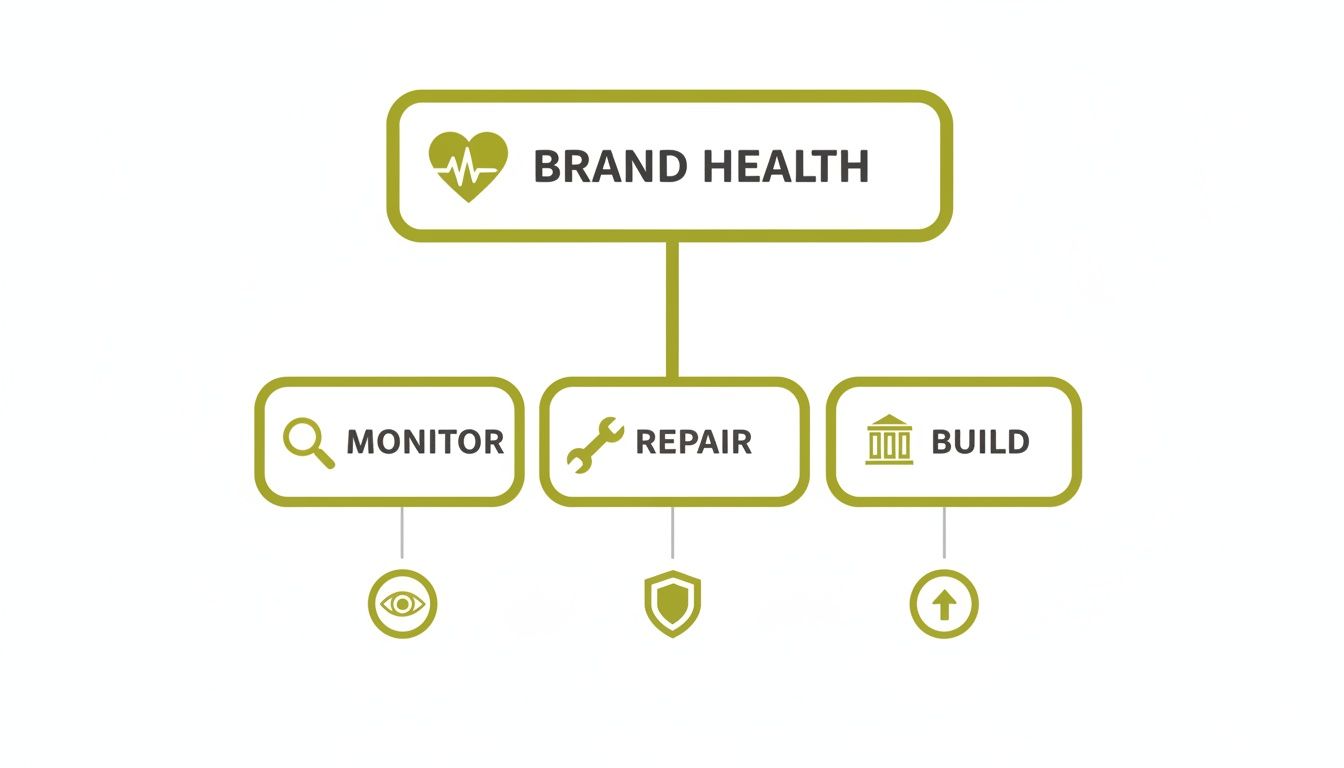
It’s this continuous loop of activity—listening, fixing, and creating—that gives your reputation its strength and positive momentum. Let's break down what these services actually involve.
To give you a clearer picture, here’s a breakdown of the typical services you’ll find and what they aim to achieve for your business.
Core Reputation Management Services Explained
| Service Component | Primary Goal | Common Activities |
|---|---|---|
| Reputation Monitoring | To detect and analyse brand mentions across the web in real-time. | Using specialist tools to track social media, news sites, forums, and review platforms for keywords related to your brand. |
| Search Engine Reputation Management (SERM) | To control the first page of search results for your brand name. | Promoting positive, owned content (website, blog posts) and pushing negative or irrelevant results further down. |
| Digital PR & Content Creation | To proactively build a positive online footprint and authority. | Securing positive media coverage, publishing expert articles, creating case studies, and optimising your company's own digital assets. |
| Review Management | To generate positive reviews and manage negative feedback constructively. | Implementing strategies to encourage happy customers to leave reviews; responding professionally to all feedback. |
| Negative Content Suppression & Removal | To minimise the visibility of or remove damaging, false, or defamatory content. | Using advanced SEO tactics to suppress harmful links; pursuing legal options for removal where applicable (e.g., GDPR). |
| Crisis Communications | To protect the brand's reputation during a significant negative event. | Developing a response strategy, managing media inquiries, and controlling the public narrative during a crisis. |
Each of these components plays a crucial role. A comprehensive strategy will almost always involve a blend of these services, tailored to your specific situation.
Reputation Monitoring: Your Digital Early Warning System
You can't fix a problem you don’t know exists. Reputation monitoring is the foundational pillar, acting as your eyes and ears across the digital world. It’s all about using sophisticated tools to continuously scan the internet for any mention of your business, your products, or even your key people.
This is far more advanced than just setting up a few Google Alerts. Professional monitoring casts a much wider net, covering:
- Review Platforms: Heavyweights like Google and Trustpilot, plus any niche portals specific to your industry.
- Social Media: Public posts, comments, and tags across every relevant platform, from professional networks like LinkedIn to fast-moving spaces like TikTok.
- News Media & Blogs: Mentions in major news outlets, trade press, and influential industry blogs.
- Forums & Communities: Unfiltered conversations happening on Reddit, Mumsnet, and specialist forums where customers give their most honest opinions.
Good monitoring is what feeds the rest of your strategy. It’s how you spot a brewing crisis before it explodes, see patterns in customer feedback, and find golden opportunities to engage positively. This proactive approach is quickly becoming the norm for UK businesses that want to stay ahead.
The numbers back this up. The UK's enterprise internet reputation management market is set to grow from over £48 million (£ equivalent of USD 60.8 million) in 2025 to a massive £190 million (£ equivalent of USD 240.3 million) by 2035. The fact that monitoring solutions are expected to grab 43.2% of the market share in 2025 shows just how critical this proactive intelligence has become.
Search Engine Reputation Management (SERM): Controlling Your Digital Front Door
When a potential client, partner, or customer wants to check you out, their first move is almost always a Google search. What they discover on that first page instantly becomes their perception of your business. Search Engine Reputation Management (SERM) is the art and science of controlling what they see.
The entire goal is to make sure that when someone searches for your brand, the results are dominated by positive, accurate, and brand-controlled websites and articles. This is done through a highly specialised type of SEO that works to push negative or irrelevant results down while elevating positive content to the top spots.
Think of the first page of Google as your shop window. SERM is the process of carefully arranging your best products in the display while moving any clutter or unwanted items into the stockroom, out of sight.
This isn't a one-off task. It’s a constant effort to own your narrative where it matters most, ensuring search engines are telling the story you want told.
Digital PR and Content Strategy: Building Your Positive Firewall
While SERM has a defensive element, a powerful content and digital PR strategy is your best offence. This pillar is all about proactively building a "firewall" of positive, authoritative content that you own and control. By creating high-quality assets, you establish credibility and create content that naturally ranks well, insulating your brand from potential harm.
This typically involves:
- Securing Positive Media Coverage: Landing features, interviews, and positive mentions in respected online publications.
- Creating High-Value Content: Publishing insightful articles, detailed case studies, and expert reports that showcase your knowledge.
- Optimising Your Owned Assets: Turning your website, blog, and social media profiles into powerful, positive resources that people want to find.
This is where having the right kind of experience makes all the difference. For instance, everyone who works for Carlos Alba Media is a former national news journalist or has agency experience working with international brands. That insider knowledge of what makes a story newsworthy is priceless. It means knowing how to craft compelling narratives that journalists actually want to cover, which builds a far more authentic and powerful positive presence.
Review Management and Negative Content Suppression
In today's market, reviews are the ultimate form of social proof. Good review management goes beyond just replying to comments. It’s a systematic process of encouraging your happy customers to share their positive experiences while handling criticism with professionalism and accountability.
Sometimes, however, you'll face something more serious—defamatory, false, or outdated negative content that can do real damage. This is where negative content suppression comes in. It's a specialist discipline that uses a blend of technical SEO and, when necessary, UK legal channels to get harmful content removed or de-indexed from search results.
Navigating this requires a deep understanding of both digital strategy and media law. A team of ex-journalists and seasoned strategists knows exactly how to handle these delicate situations, whether it's through careful negotiation, targeted suppression campaigns, or using legal frameworks like the "right to be forgotten." You can learn more by checking out our essential online reputation management tips for businesses.
How a Strong Reputation Impacts Your Bottom Line
Let's be clear: a positive reputation isn't just a fluffy PR goal. It’s a hard-hitting asset that directly fuels your financial performance. For any UK business, whether you're a two-person startup or a household name, treating your reputation as a strategic investment is the bedrock of sustainable growth.
This isn't about vague goodwill. It's about building tangible value that shows up on your balance sheet.
Think of it as ‘reputational capital’. Just like financial capital, you build it up over time through consistent, positive actions. Every glowing customer review, every transparent communication, and every time you go the extra mile adds to your reserves. When a crisis eventually comes knocking—and it often does—this is the capital you draw on to weather the storm.

The Direct Link Between Trust and Revenue
In the UK market, trust is everything. When customers believe in your business, they’re not just more likely to choose you; they stay with you and become your best advocates. This trust feeds your bottom line in a few critical ways.
- Drives Customer Loyalty: Trusted brands keep their customers. When people feel you have their back, they're more forgiving of the occasional slip-up and far less likely to be tempted by a competitor's flashy discount.
- Justifies Premium Pricing: A brilliant reputation often gives you the power to command higher prices. Customers will happily pay more for the peace of mind that comes with quality and reliability.
- Lowers Customer Acquisition Costs: A great name does your marketing for you. Positive word-of-mouth and five-star reviews mean you spend less time and money convincing new customers, because they already arrive wanting to believe in you.
The financial link is undeniable. Research from The Harris Poll UK found that companies with strong reputations achieved 2.7x higher stock growth than their lower-rated peers. The data also showed a 0.79 straight-line correlation between customer experience and reputation, proving that excellent service directly builds the trust that drives profit.
Attracting Top Talent and Securing Partnerships
But the impact doesn't stop with customers. In a fierce job market, the best people want to work for companies they genuinely admire. A positive public image makes you a magnet for top talent, cutting recruitment costs and improving staff retention.
The same goes for partnerships, investments, and your supply chain. Other organisations want to do business with companies that are seen as stable, ethical, and reliable. A poor reputation can shut down crucial growth opportunities before you even get in the room.
A strong reputation is a currency that opens doors. It reassures investors, attracts the best employees, and builds resilient partnerships. In this sense, investing in reputation management services isn't a cost centre; it's an investment in every future opportunity your business will have.
This is precisely why having a specialist team is so crucial. At Carlos Alba Media, our expertise is built on real-world experience. Every member of our team is either a former national news journalist or has agency experience working with international brands. We know what it takes to build and protect the reputational capital that fuels growth, translating positive perception into measurable financial results for your business.
How to Choose the Right UK Reputation Management Agency
Picking a partner to safeguard your company’s reputation is a huge decision. This isn’t just another line item in your marketing budget; it's a direct investment in your brand’s resilience and future. But with so many firms offering reputation management services UK, how do you spot a true specialist amongst the generalists?
It all comes down to asking the right questions and looking for a very specific set of skills.
The reality is, you need more than just technical SEO know-how. You need strategists, storytellers, and crisis-hardened communicators who genuinely understand the subtle art of shaping public opinion. The agency's background is your best clue here.
Look Beyond the Sales Pitch to the Team’s DNA
A digital marketing agency might be great at running PPC campaigns, but can they field a difficult call from a national newspaper journalist? An SEO firm can build links, but can they weave a compelling narrative that rebuilds public trust after things have gone wrong?
This is where the real experts stand out. The best agencies are built with teams whose careers directly reflect the challenges of reputation management. It's why our own background at Carlos Alba Media is so specific: everyone on our team is either a former national news journalist or has managed communications for major international brands. This isn't just a talking point; it's the foundation of our entire approach.
Think about what that kind of background brings to the table:
- Newsroom Instinct: We know what gives a story legs and, crucially, what makes it fizzle out. We understand the news cycle because we used to drive it.
- Strategic Messaging: We’ve spent years framing messages for global companies, delivering them with clarity and authority, especially when the pressure is on.
- Crisis-Ready Mindset: Having worked on the front lines of breaking news, our team is wired for fast, precise action when a reputation is hanging in the balance.
When you’re vetting an agency, dig deep into the actual experience of the people who would be handling your account. Are they genuine communications experts, or are they just running a standard SEO playbook?
When you hire a reputation management agency, you're not just buying a service; you're gaining a partner. Your goal should be to find a team whose expertise gives you an unfair advantage in controlling your own story.
Your Agency Evaluation Checklist
To help you cut through the noise and make a solid choice, we've put together a checklist of questions to ask. The answers you get will quickly separate the real experts from the pretenders.
| Area of Enquiry | Key Question to Ask | What a Good Answer Looks Like |
|---|---|---|
| Proven Results & Case Studies | "Can you show me a specific example of a UK business similar to mine where you successfully managed their reputation?" | They provide a detailed case study (respecting client confidentiality) that clearly outlines the initial problem, their strategy, the actions taken, and the measurable results. Vague promises are a red flag. |
| Methods & Transparency | "What specific methods do you use for negative content suppression, and do you guarantee removals?" | An honest answer will focus on ethical 'white-hat' SEO and PR strategies. They’ll be upfront that removals are never guaranteed and depend heavily on legal grounds and platform policies. |
| Team Expertise & Background | "Who exactly will be handling my account, and what is their direct experience in crisis communications and PR?" | They should introduce you to senior-level people with proven, relevant track records in journalism, public relations, or corporate strategy—not just a junior account manager. |
| UK Legal & Regulatory Knowledge | "How do you handle issues related to GDPR, the 'right to be forgotten', and UK-specific media law?" | They’ll show a confident grasp of the UK's legal landscape and might mention having specialist media lawyers on call for complex situations. This proves they’re prepared for serious challenges. |
| Reporting & KPIs | "How will you measure success, and what will your reports look like?" | They’ll propose clear Key Performance Indicators (KPIs) like improved search rankings for positive assets, sentiment analysis, and share of voice—not just fuzzy vanity metrics. |
Using these questions gives you the power to see past the sales pitch. It helps you find a partner who not only understands the mechanics of reputation management services UK but also has the strategic insight to protect your most valuable asset. The right agency will feel like a true extension of your own leadership team.
Turning a Crisis into a Defining Moment
A reputation crisis often feels like a house fire. It starts with a single spark – maybe a disgruntled customer's post, a misleading comment, or a fake review. Before you know it, that spark can erupt into a full-blown blaze, threatening to burn down everything you’ve worked so hard to build.
The real test of a brand isn’t whether you can avoid the fire altogether, but whether you have a specialist crew on standby, ready to bring it under control with skill and precision. Panic is a reaction; strategy is a choice.
Let’s play out a scenario. Imagine a mid-sized UK tech firm has just launched its flagship product. A minor bug in the first release affects a handful of users, but one of them happens to be an influential industry blogger. They publish a scathing, highly technical takedown that gets picked up by news sites and explodes on X (formerly Twitter). Within hours, the narrative is set: "New product is a total disaster."

The First Hour: The Containment Phase
A generalist marketing team might hit the panic button. They could draft a defensive corporate statement or, even worse, start arguing in the social media comments. A specialist team does the exact opposite. Their first move isn't to talk, but to listen and contain.
- Immediate Triage: First, they get a clear picture of the damage. Where is the story spreading? Who are the key voices making it louder? What’s the general feeling out there?
- Pause All Promotions: Next, all scheduled marketing posts, ads, and email campaigns are put on hold. Trying to push a "buy now" message while your brand is on fire just adds fuel to the flames.
- Internal Alignment: The crisis team gets the leadership team in a room (virtual or real). No one from the company says a word to the media or posts anything online until a unified plan is locked in. This single step prevents conflicting messages and unforced errors.
This initial containment stops the bleeding. It buys you breathing room, creating the critical space you need to shift from defence to offence.
Reshaping the Narrative with Journalistic Insight
This is where having a team of former journalists and senior brand strategists completely changes the game. They don't just see a PR problem; they see a news story, and they know exactly how to write the next chapter. At Carlos Alba Media, this is our DNA – everyone who works for Carlos Alba Media is a former national news journalist or has agency experience of working with international brands.
We’ve seen it from the inside: you can’t fight a negative story with corporate jargon or silence. You fight it with a better, more honest story.
Here's how that strategy would unfold:
- Acknowledge and Own It: The company would publish a clear, human statement directly from the CEO. It would thank the blogger for flagging the issue, offer a sincere apology to those affected, and outline the exact steps being taken to fix it. This immediately shows transparency and control.
- Engage the Messenger: Instead of picking a fight with the influential blogger, the team would reach out to them directly. Treat them like an unpaid consultant who just helped you find a problem. This simple act can disarm a critic and bring them onside.
- Deploy Positive Content: The team would then quickly create and push out new, helpful content. This isn't marketing fluff; it's genuinely useful information, like a detailed blog post from the lead developer explaining the bug and the fix, or a quick video message from the CEO.
A crisis is a moment of truth. When you handle it right, it doesn't destroy your reputation; it reveals your company's character. It can be the very moment you prove your commitment to customers, turning angry critics into your most loyal advocates.
Of course, a crisis isn’t the only threat. Sometimes it's a slow burn of negative comments. Knowing how to deal with damaging individual items, like learning how to remove a false Google review, is a vital part of any defensive strategy.
Ultimately, this entire approach flips the narrative on its head. The story stops being "Tech Firm Fails" and becomes "Tech Firm Shows Everyone How to Handle a Crisis with Integrity." By understanding the news cycle, a specialist team can turn a potential disaster into a defining moment of trust. If your business is navigating a reputational storm, a dedicated crisis management agency can give you the tools and expertise to take back control.
Your Reputation Management Questions, Answered
When it comes to your online reputation, it's natural to have a few questions. Let's cut through the jargon and get straight to what UK business owners really want to know.
How Quickly Can I Actually See Results?
This is the big one, and the honest answer is: it really depends on the challenge. If you’re proactively looking to build up a bank of positive reviews, you could start seeing a noticeable uptick within a few weeks.
However, if you're trying to fix a more serious problem, like a damaging news article or a flood of negative feedback, patience is key. Pushing a negative result down Google's rankings is a marathon, not a sprint. It can easily take several months of consistent, focused work. A good agency is always upfront about this; be very wary of anyone promising an overnight fix.
What’s the Difference Between Reputation Management and PR?
It's a common point of confusion, but the distinction is crucial. While they're close cousins, they play different roles.
Think of it this way:
- Public Relations (PR) is about getting out there and telling your story. It’s the proactive work of building relationships with journalists and creating a positive narrative around your brand.
- Reputation Management is the 360-degree defence. It includes the positive storytelling of PR, but it also involves listening for threats, managing customer reviews, and actively repairing damage when things go wrong online.
A solid strategy needs both. In fact, we often use PR as a core tool within our reputation management services UK, building a firewall of positive content that makes your brand far more resilient if a crisis ever hits.
Can You Really Get a Negative Review or Article Removed for Good?
Sometimes, yes, but it's not the go-to solution for every problem. Permanent removal is most likely when the content clearly breaks the rules of a platform (like a fake review) or UK law (for example, if it's defamatory or breaches GDPR).
More often than not, a better and more reliable strategy is suppression. This means creating a wealth of high-quality, positive content—from articles to profiles—and promoting it so effectively that it pushes the negative item off the first page of Google. Since over 90% of users never click to page two, it becomes virtually invisible.
An expert team knows which path to pursue. This is where having the right background is essential. At Carlos Alba Media, our team is comprised of former national news journalists and strategists with experience managing international brands. We understand the legal and ethical lines and know how to use both suppression and removal tactics effectively.
How Much Do Reputation Management Services Cost in the UK?
Costs vary hugely because every situation is unique. For a small local business that just needs a hand managing its Google reviews, a plan might start from a few hundred pounds a month.
On the other hand, a larger company dealing with a full-blown crisis or trying to suppress multiple negative articles will require a much more intensive campaign, which could cost several thousand pounds per month. Be cautious of any agency offering a one-size-fits-all price. The best ones will always want to audit your online footprint and understand your goals before giving you a bespoke quote. See it not as a cost, but as an investment in the long-term health and value of your brand.
Ready to take control of your online story? The team at Carlos Alba Media combines newsroom insight with digital strategy to protect and build your brand's most valuable asset. Our senior-level experts deliver results without the big agency overheads. Learn more and book a consultation at https://carlosalbamedia.co.uk.